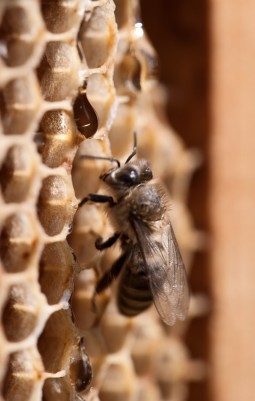
It’s all about the honey

I went to the London Honey Festival on Sunday hoping to eat more honey than Pooh. The seasonal festival celebrated the capital’s honey crop and offered honey tasting, honey massages, bee-themed music and movies, and a chance to meet your local beekeeper.

The London Honey Festival at Royal Festival Hall, Southbank, London on Sunday 21 August 2011. The five-hour festival was sponsored by Capital Bees and free for beekeepers and the public, and for bees.

With over 2,500 hives in the city, you are never far from a bee, and at a bee event you are never far from a beekeeper. So I was surprised to see so many non-beekeepers. People are more curious than bears about bees.

Who will bring the best honey in all the land?

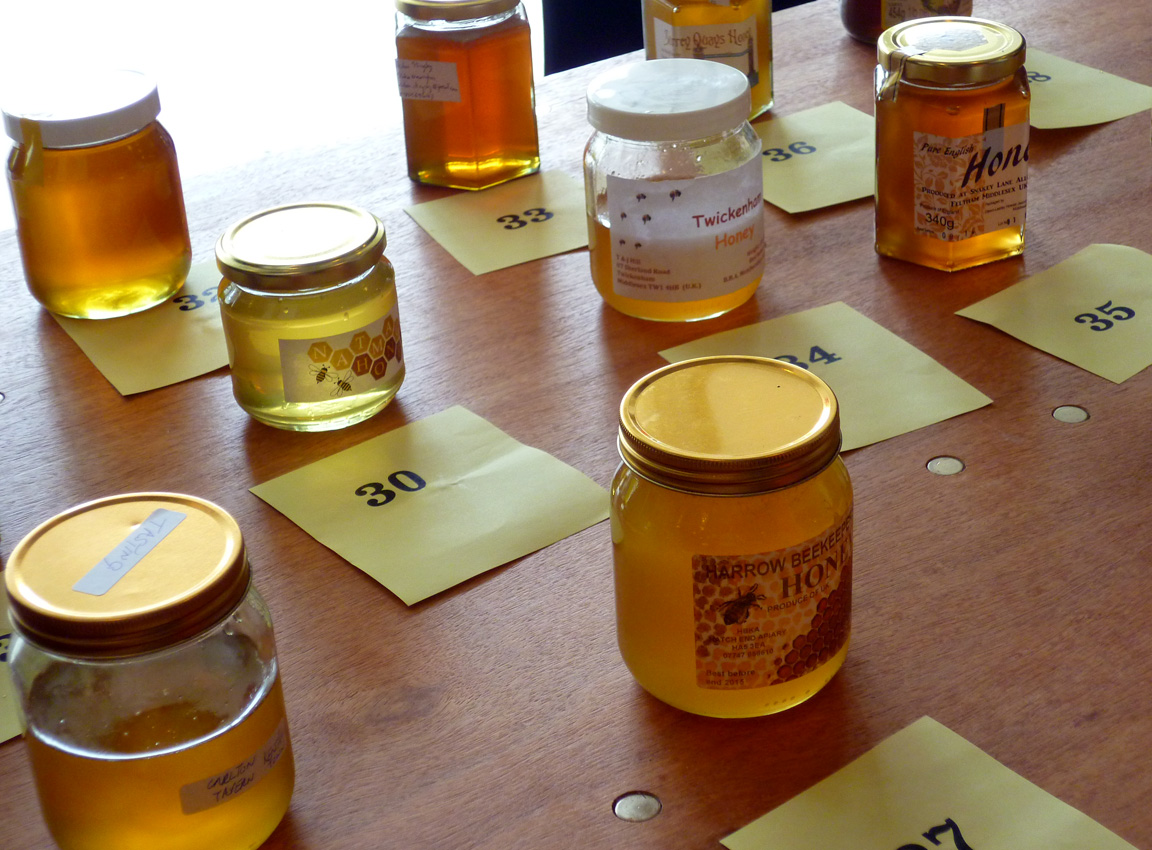
The honey tasting was easy to find with people lining up like drones. Little pots of sugary goodness in more varieties of gold than an alchemist’s workshop. Heavy-scented floral flavours, mellow fruity fragrances, and subtle citrus aromas reflected the wide range of London forage. Town bees have more choice than their country cousins thanks to imaginative urban gardening, city parks and allotments.

My favourite honey made me think of my old bees, who made a beautiful, delicate honey that tasted of lime blossoms and was the colour of sunshine.

A honey map of London showing where urban bees like to forage.

Emily and I have been guessing all year where our bees fly off to collect their pollen and what their favourite flowers might be. Many of our ladies have been returning with white stripes on their backs from Himalayan balsam and I spotted a forager return with more blue pollen in her basket last Saturday, which might be from poppy. Our honey crop this August was thick like treacle, amber-gold and mildly floral. Any ideas where our bees like to hang out?

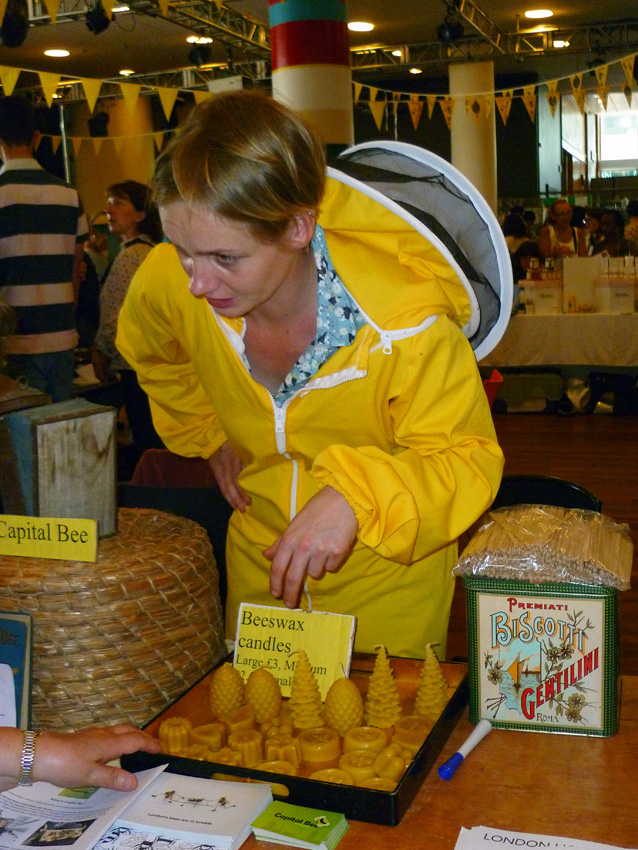
I love that beekeeper's suit!

Every stall at the festival had a crowd of people fascinated by the magic of keeping bees. There was also a lot of information on how to help London’s bee population by growing bee-friendly plants or your own fruit and vegetables. People really wanted to know how they could help even if they couldn’t keep a hive.

From far right: Ron (beekeeper), Doreen (beekeeper by proxy), me (beekeeper) and Andy (the man who set us on this dodgy path)

It wasn’t long before I bumped into Andy, who introduced me to some Federation beekeepers, and a bit later we were spotted by more familiar faces congregating around the Middlesex stall.

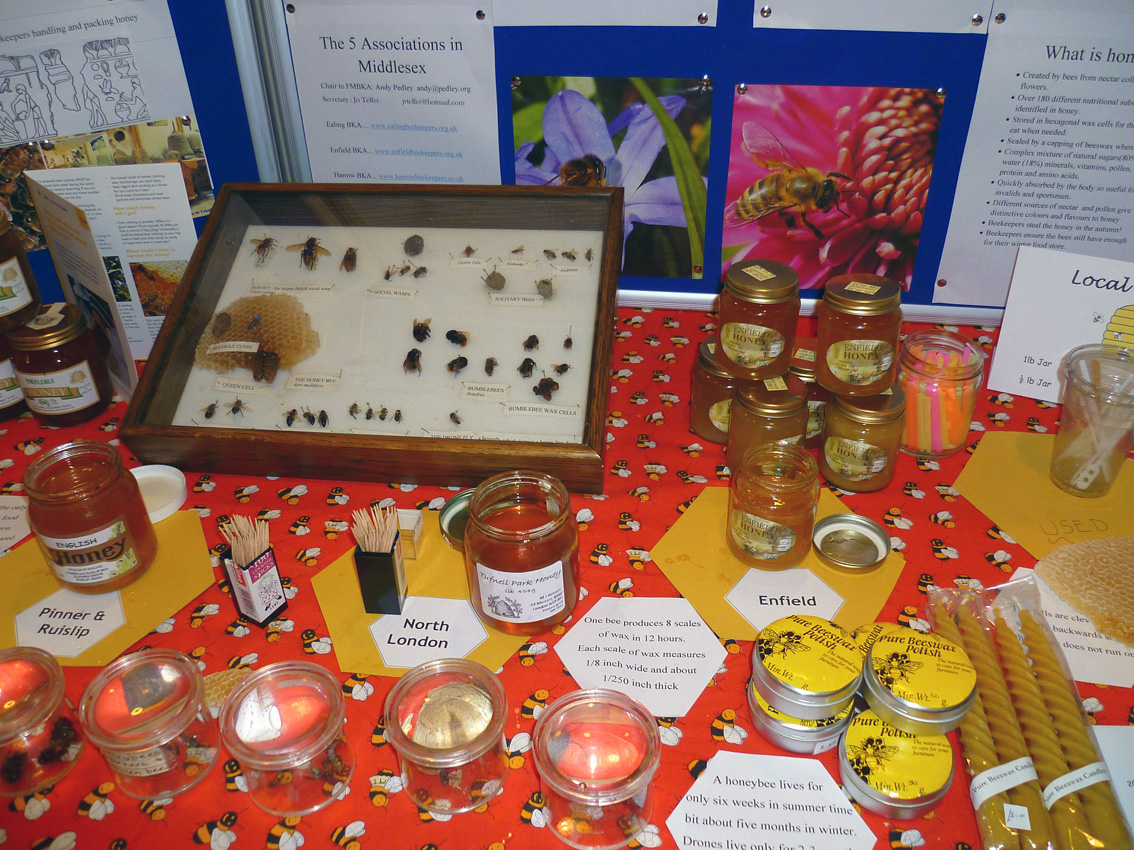
The Middlesex Federation Beekeepers stall neatly displays bees who died in suspicious circumstances.

Fortunately, no one noticed that I was wearing a Capital Bee badge. I’m not a splitter, but I got pinned by a man wearing wings while signing up my pledge to help London bees.

He's got wings.

There were no tea stalls, but there was an observation hive…

Who's watching who?

And bumble-bee making…

Bumble-bee making ages 4–99 years. Mmm.

And honey jam…

London honey jam is jammin'

Sadly, I don’t have a honey stomach like bees. After finding out that there is actually a limit to the amount of honey I can eat in a few hours, I went for chowpatty on Southbank beach and a stroll in the sunshine along the river.

It did the trick and when I got home I was happy to discover a piece of chocolate-honey fudge in my pocket to enjoy with a cup of tea.

Bee celebrity.

The London Honey Festival was sponsored by Capital Bee, which is a Capital Growth campaign for community beekeeping in London. Capital Growth aims to support 2,012 new community food-growing spaces for London by the end of 2012.

Capital Bee is asking Londoners to support their local beekeepers and bees by growing bee-friendly plants and buying bee-friendly food. To pledge your support click here.

How to extract honey

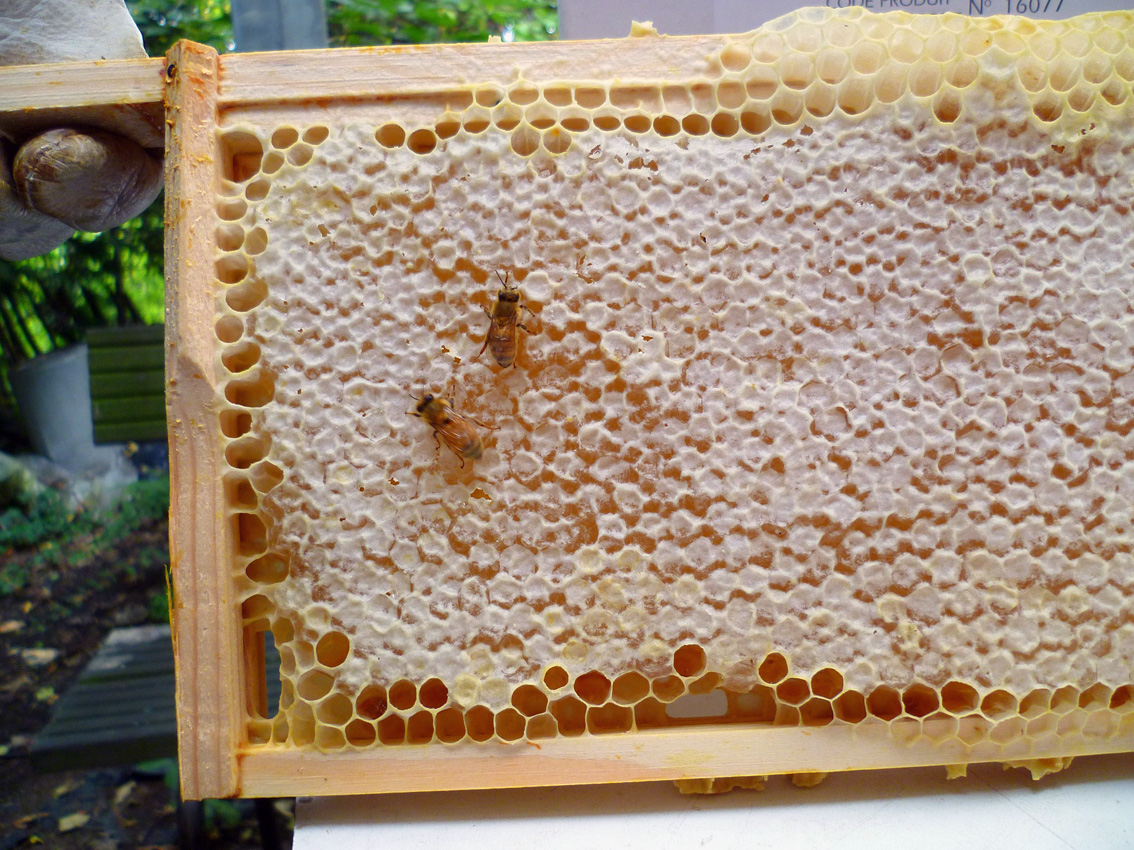
In the UK the honey harvest usually starts around July until August. When all the honey on a frame is capped it is ready to harvest.

I wrote this post one year ago on my old blog and, with the exception of a few edits, the process of clearing bees and extracting honey are the same. Our adventures took a few different twists and turns this summer, but here is how it’s supposed to be done.

I am aware that this is a slightly long post, so I have divided it into two parts and an addendum:

Part one: How to clear bees
Part two: How to extract honey
Addendum for treacle honey

It has been a good beekeeping year and you have a super or two of frames filled with capped honey. Great, but how do you get hold of it?

Part one: How to clear bees

Step 1: Clear bees from the supers

First, you need to remove the honey from the hive. Guarded by about 50,000 bees this could be Mission Impossible, but is in fact only Mission Slightly Difficult. There are these handy little inventions called ‘bee escapes’ that allow bees to leave supers, but which do not let them back in. You can get various bee escapes from beekeeping suppliers with instructions for use. I am reliably informed that rhombus escapes are very good, but we used Porter bee escapes and they worked quite well.
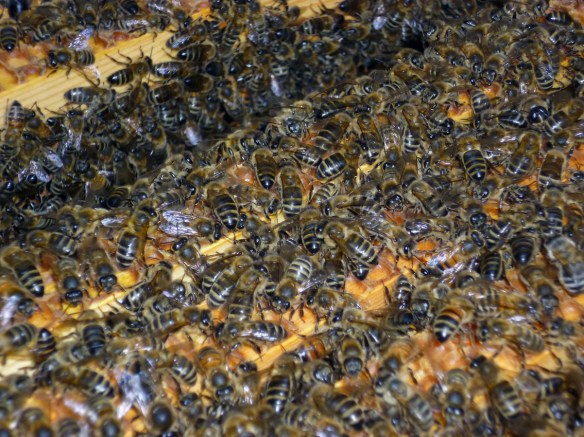
Bees don't give up their honey easily. Clearer boards trick them into leaving the supers overnight, so you can harvest a bee-free honey crop the next day.

Ideally, you need two crown boards to carry out the process of clearing bees from the supers. Place a crown board between the brood box and supers with the Porter bee escapes in the two holes.

The second crown board (with something covering the two holes like a tile or brick on top) should go on top of the supers before you put back the roof. This is because you are now going to leave the hive for 24 hours or overnight, during which time supers will be cleared of bees and left vulnerable to robbers. 24 hours is more than enough time for wasps to invade and clear out your honey. Check your hive, particularly around the roof and supers, for any holes or gaps, and seal with tape. Wasps are crafty.

Step 2: Remove the supers from the hive

Return to your hive 24 hours later and find the supers almost empty of bees. A bee brush or shaking can help to remove any remaining stragglers from the frames, before you take the supers back to your kitchen to start extracting honey.

If, like me, you have a kitchen in a studio flat not big enough to swing a cat, you will want to make sure you don’t bring any bees. Trust me, it’s not fun sharing your flat for a night with about 50 lost bees. You won’t sleep.

Your bees will try to help extract your honey unless you shake or brush off stragglers and quickly cover the frames.

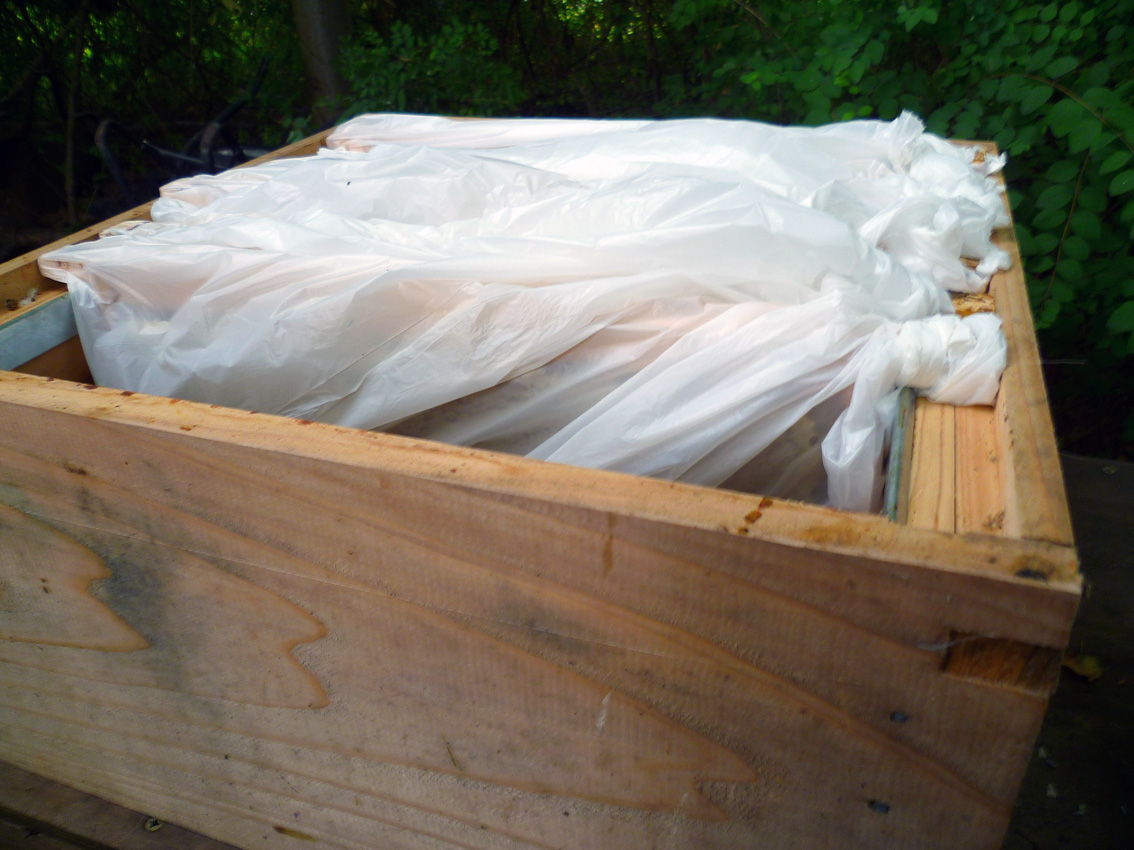
So if you are super-organised (sorry for the pun), go to the hive with a partner in crime. Shake and brush bees off the frames, then quickly wrap each frame inside a plastic bin liner and hang on an empty super. This method makes sure that no bees hitch a ride back home.

This is a more laborious method of taking honey off the hive, but well worth it to take home bee-free frames. Emily and I did this, and enjoyed a bee-free extraction process.
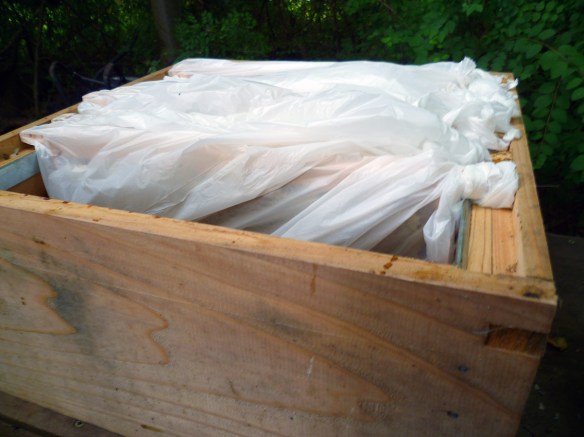
My dad, who is highly suspicious of bees, was secretly relieved we brought home bee-free frames.

Back to top

Part two: How to extract honey

Step 1: De-cap the honey

Ok, so that was actually the ‘slightly difficult’ bit. You have your supers, or box with honey frames, standing on your kitchen work surface. Now you need:

  • A de-capping fork
  • A centrifugal extractor
  • Buckets to collect your honey
  • A kitchen wire mesh strainer
  • Storage jars and labels

All of the above can be purchased at Thornes.

Be careful to keep your work area dry and free from water. Water is the enemy of honey.

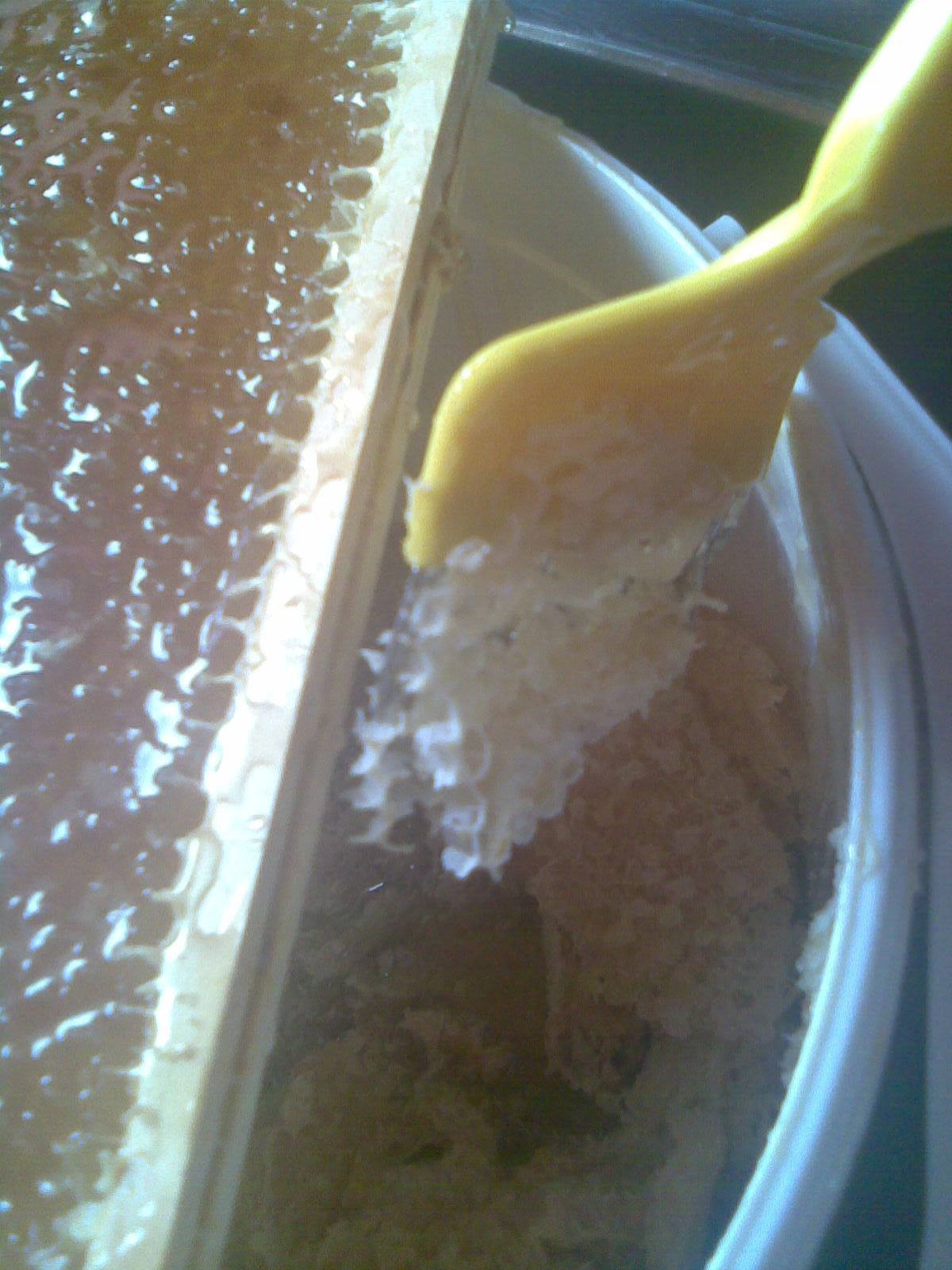
Take a frame and place it over a bucket. Use the de-capping fork to run along the surface of the honeycomb and remove the wax caps. Super easy!
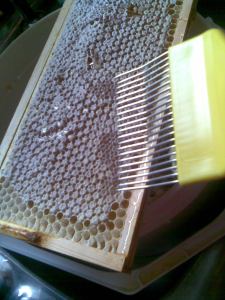
Hold a frame of honey over a bucket, and get a de-capping fork to take off the wax caps of the honeycomb
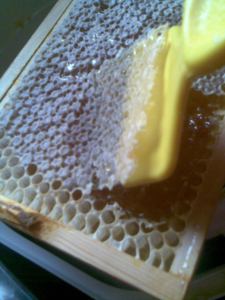
Run the fork lightly up the frame to remove the wax caps. Turn over the frame and repeat on the other side. Some honey will drip into the bucket but can be drained off from the wax later on
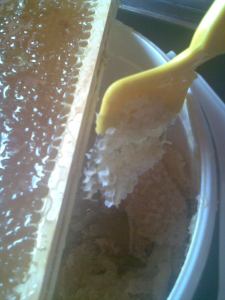
Place the wax from the honeycomb into the bucket. It can be separated from the honey dripping into the bucket at a later stage, cleaned up and used to make beeswax pellets for cosmetic recipes (face and hand creams) or to make candles

Step 2: Spin off the honey

Now place two frames of de-capped honey into a centrifugal extractor. Most are manual and are really hard work, so if you are going to do beekeeping seriously invest in a mechanical one.
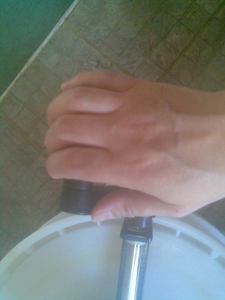
A centrifugal extractor has a metal basket in which to place frames of honey. Put on the lid and spin the frames round as fast as possible for about a minute. Then turn the frames around inside the extractor basket (so that the opposite side of honeycomb is facing out) and spin again
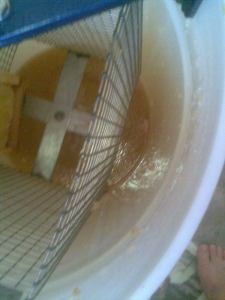
Honey spun off from the frame at the bottom of the extractor
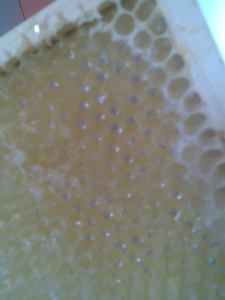
A frame of honeycomb with the honey spun out. You'll notice how much lighter the frames are when you remove them from the extractor

Step 3: Drain off the honey

Spin off as many frames of honey as you can in the extractor until the level of honey at the bottom starts to reach the metal basket. It is harder to spin round the extractor with honey restricting the motion.

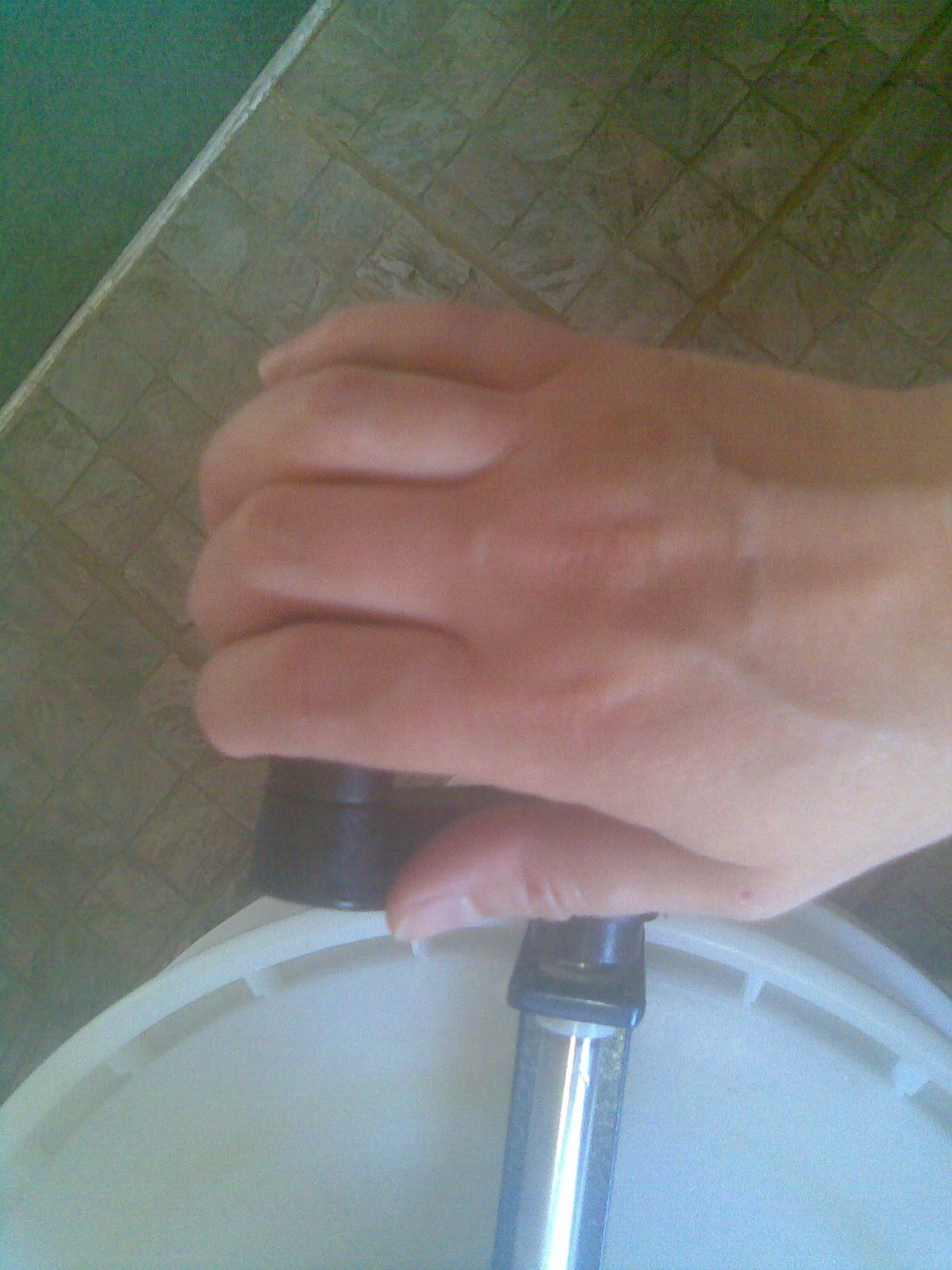
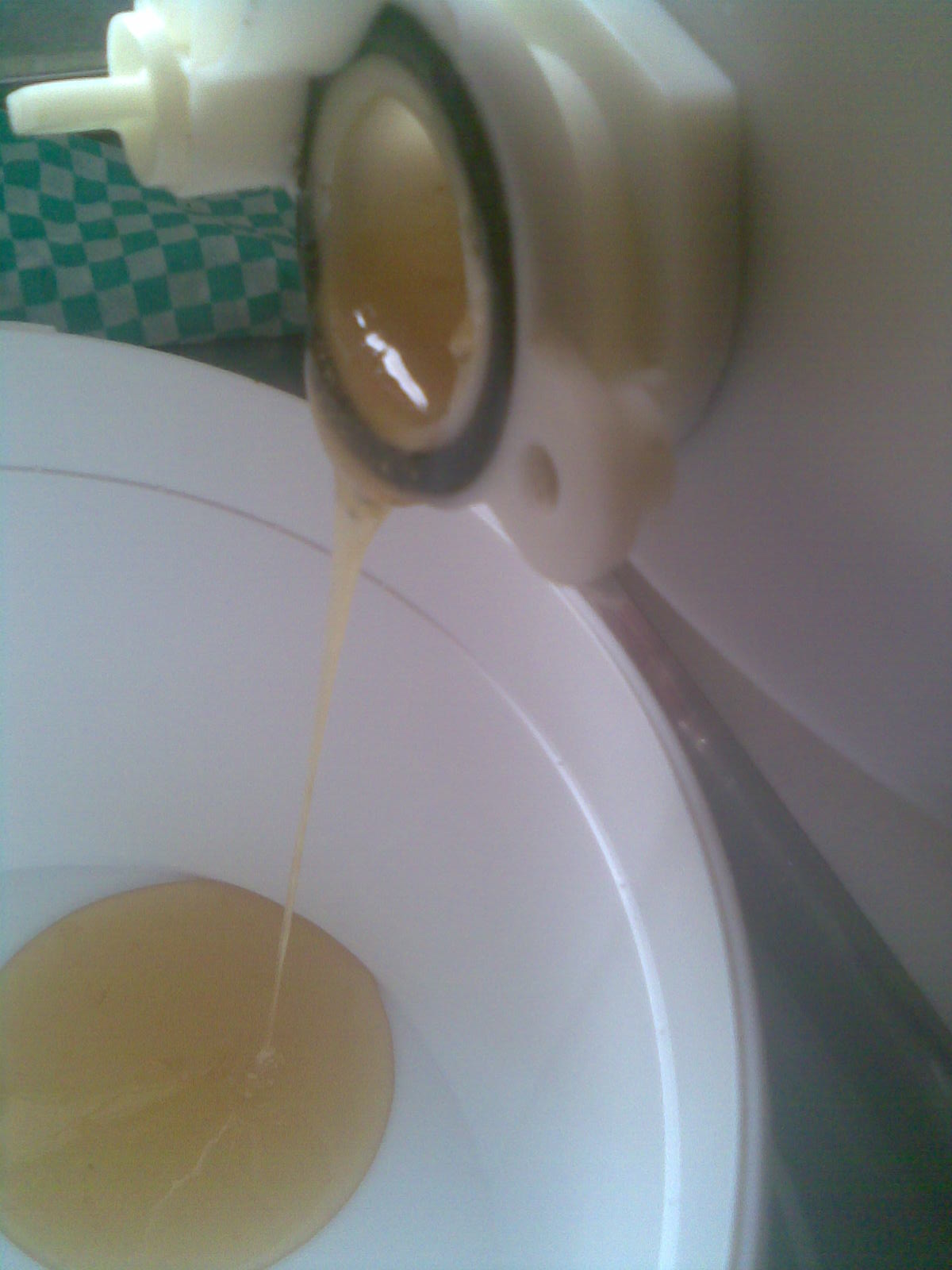
Lift up the centrifugal extractor to the kitchen work surface (if it is full with a couple of litres of honey, you may need someone to help you do this) and put another bucket in the sink. Open the tap of the extractor and let the honey pour out. Some manipulation of the extractor is needed to get the last dregs of the honey out.

It takes one bee a lifetime to collect one teaspoon of honey, so try and get every last drop.

Open the tap of the extractor and let the honey pour out into a clean honey bucket
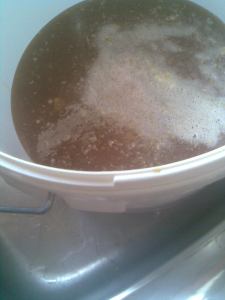
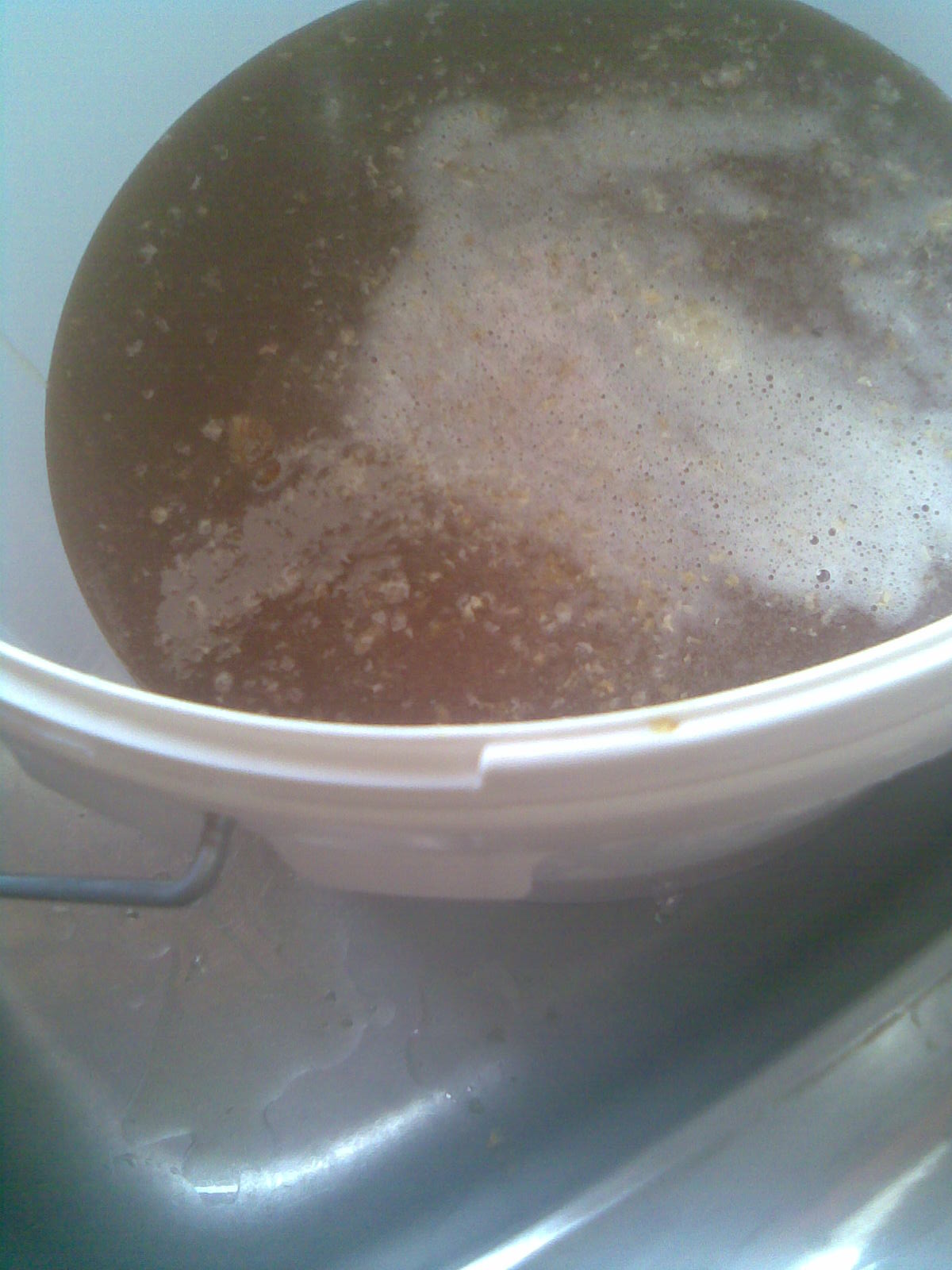
A bucket filled with freshly extracted honey ready to be filtered and strained off into glass jars

Step 4: Products of the hive

Remove the froth from the top of your extracted honey into separate containers. This can be used as a ‘marmalade’ on your toast or fermented for mead. As enjoyed by Vikings – ARG!

Filter honey from the buckets through a kitchen strainer into jars and label for family and friends.

Filter the honey in the bucket of wax to ensure you get as much honey harvested into jars as possible. Clean the wax in warm water and leave to dry. You can mould beeswax into pellets for beauty products or use to make candles.

Clean the extraction equipment, including centrifugal extractor, with washing soda and scrubbing brushes to get rid of stubborn sticky bits.

Simples.

Back to top

Addendum for treacle honey

My old boss, Bob Allan, kindly gave me his electric honey extractor this year. Bob used to keep bees but he gave up the craft, because his mother-in-law was allergic.  ‘One
winter the hive died out,’ said Bob. ‘It seemed only polite not to re-stock the bees.’ Most beekeepers at my apiary have balked at this. However Bob says, ‘I am rather fond of my mother-in-law’.

After last year’s hard graft of extracting two supers of honey manually, I was excited to try the mechanical extractor. Disaster! The first three frames almost spun apart on the highest setting. So we cleared up and started again, this time using a lower setting. Nothing. Our honey was like treacle! It didn’t even drip out of the comb when we de-capped it.

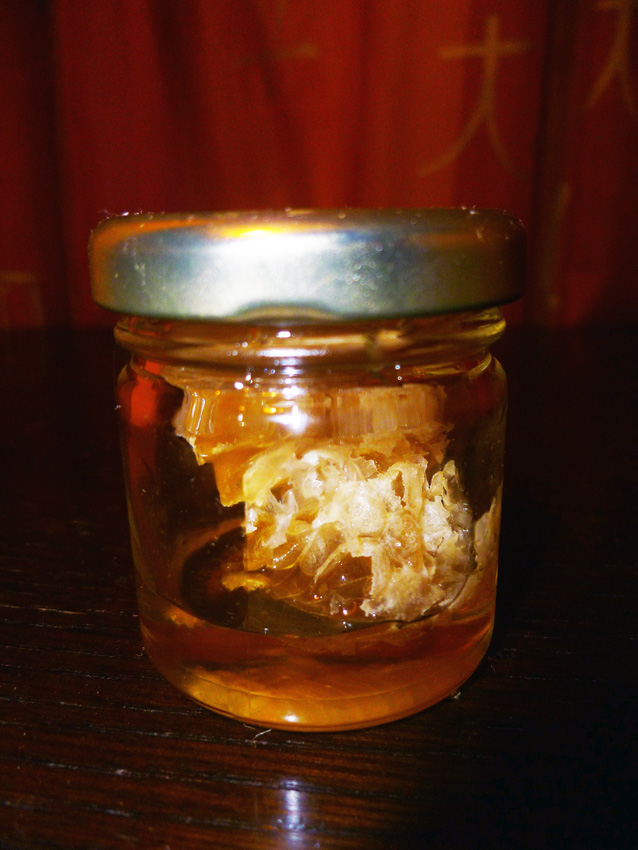
Plan B. So we decided to make cut-comb honey instead. An evening of delicate operations began and the result was rather spectacular.
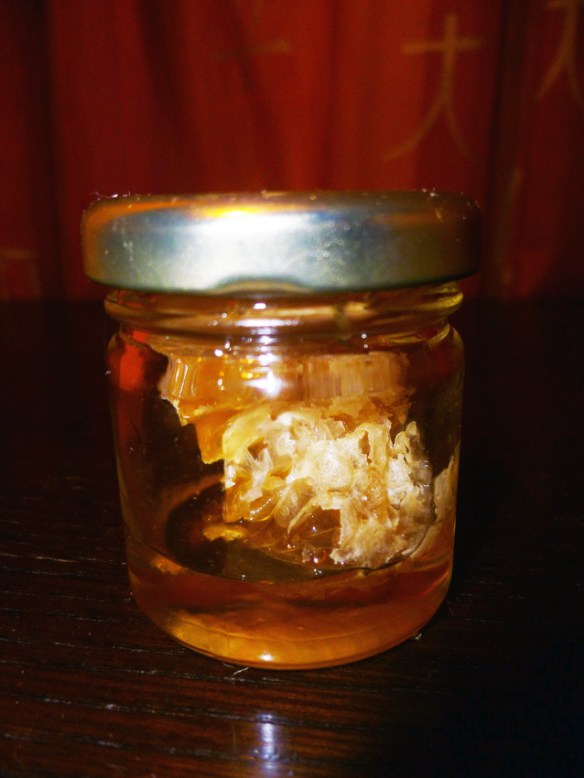
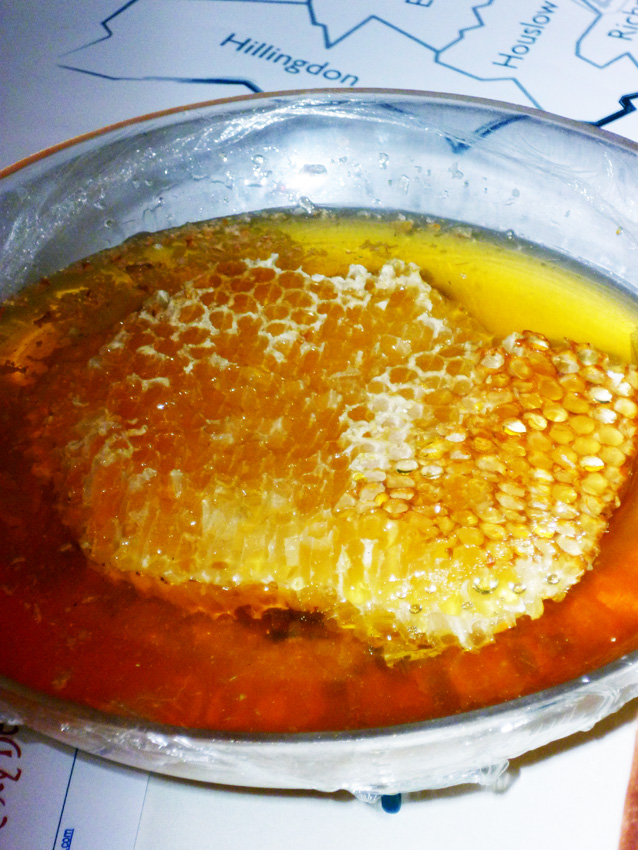
Taster pots of cut-comb honey for all our family and friends.

You can read all about it on Emily’s blog: Hunny time and Bringing home the hunny!

This post is dedicated to Bob Allen, who retired as medical director of publications at the Royal College of Physicians this year and to who we said a fond farewell, and to my dad who let us take over his house to extract our treacle honey.

Back to top

How do you get bee honey without bee babies?

'We're like Marmite, man. Love us or hate us' / image © Andrey Davidenko / 123RF

I was recently asked this question by friends: ‘How do you keep baby bees out of bee honey?’ At this time of year, when the honey crop is due, FAQs about beekeeping are popular. ‘I watched a nature program that showed bee larvae in honeycomb,’ said Damien, quite concerned. ‘Is it the same honeycomb that you use for honey?’

It is a good question: bees do make honeycomb both for raising brood and to store food. However, wily beekeepers manipulate bees to make sure only honey is harvested from the hive. Don’t worry, you are not spreading baby bees on your toast!

The hexagonal array of honeycomb is all the bees handiwork. / image © Andrey Davidenko / 123RF

People sometimes think that the honeycomb in hives is man-made. How could this geometrically-perfect hexagonal array be made by stripy little insects? But the bees do make it, because they are clever. They make the comb for bee babies and the comb for our honey.

Here are some secrets of the comb and how beekeepers get the honey bit.

#FAQ1: Why do bees make honeycomb?

Bees use honeycomb as a nursery, honey factory and food store. The queen lays eggs inside the cells, which hatch into white grub-like larvae. The larvae pupate and emerge as bees. Collectively, rows of larvae in honeycomb are called brood. Worker bees also use the cells in honeycomb to store nectar, which they convert to honey, and to store pollen, which they pack inside a cell by head-butting. Nectar, or honey, is a carbohydrate food source and pollen is a source of protein.

Honeybees head-butting pollen into cells. Pollen is a source of protein for bees. / image © Andrey Davidenko / 123RF

#FAQ2: How do bees make honeycomb?

Bees build honeycomb from wax secreted by their abdominal glands, which is passed along the legs to the mouth and moulded into hexagonal cells. The honeybee builds row upon row of geometric six-sided cells, each exactly the same size, in a precise interlocking hexagonal array.

#FAQ3: Why is honeycomb made of hexagons?

Marcus du Sautoy, on BBC’s The Code, explained why bees choose a hexagon rather than any other shape to build honeycomb. ‘The bees’ primary need is to store as much honey as they can, while using as little precious wax as possible,’ says Marcus. He describes honeycomb as an amazing piece of engineering, but asks why bees have evolved to produce this hexagonal pattern? ‘Actually they don’t have too many choices,’ explains Marcus.

The light shining through this honeycomb reveals the precise geometric sides of each hexagonal cell. / image © Olena Kornyeyeva / 123RF

To produce a regular-shaped interlocking network, bees can only choose three shapes: triangles, squares or hexagons. A hexagon requires the least amount of wax to build, which makes it the most economically efficient shape. ‘It is a solution that was only mathematically proven a few years ago. The hexagonal array is the most efficient storage solution the bees could have chosen,’ says Marcus. ‘Yet with a little help from evolution they worked it out for themselves millions of years ago.’

You can watch Marcus explore the mathematics of honeycomb in Behind the beehive on the BBC’s The Code.

#FAQ4: How do you keep baby bees out of the honey?

So how do beekeepers extract honeycomb that has only honey and not larvae or pollen? The answer is simple: by confining the queen to one area of the hive.

The queen is the egg-layer. She spends most of her life laying eggs inside the cells of honeycomb, which become female workers or male drones, or potentially a new queen. A beekeeper uses a ‘queen excluder’ to trap the queen inside the brood chamber of a hive.

A handy harmless queen excluder. The slots are big enough for workers to pass between but the queen is too large to get past.

This is a sheet of slotted plastic or a metal grid with holes large enough for worker bees to crawl through, but too small for the larger queen to pass. Unable to climb above the brood chamber, the queen cannot enter the main honey stores of the hive and lay eggs.

There are different types of hives, but most have a brood chamber (the nest containing the queen and larvae) and supers (boxes that store honey). The most common hive used in the UK is the National hive. Here’s one I built earlier.

This is the hive I built at New Year. You can see it is made of different-sized boxes. The deep bottom box is the brood chamber and the two shallow boxes above are the supers.

The queen excluder is placed over the brood box to keep the queen in the nest and prevent her from laying eggs in the honey stores. You don't want to eat honey with bits of baby bees, yuk!

With a queen excluder fitted between the brood chamber and supers, the queen can only lay eggs that hatch into larvae in the brood chamber. This leaves the supers baby-bee free and full of honey!

#FAQ5: Why do bees make bee-free honey?

So why do worker bees leave the cosy brood nest and the court of the queen to climb past the queen excluder into the supers and make us lovely bee-free honey? I want to believe it is out of the goodness of their tiny bee-sized hearts. Not true. It is all about instinct.

Honeybees have an instinctive drive to climb upwards and to fill whatever space they find with comb. If you place a super with empty frames on top of the brood, worker bees will instinctively climb up and start to build comb. The comb in the super is usually pollen-free too. Workers store this source of protein where it is most needed in the brood chamber.

Honeycomb showing capped and uncapped honey. Uncapped cells glisten with ripening nectar. Capped cells contain honey covered by white wax. Beekeepers harvest honey when all cells are capped. / image © Laurent Dambies / 123RF

So there you have it. That’s how beekeepers extract only honey-filled honeycomb and no mystery bits.

#FAQ6: How do you get the bees to leave the honey?

One final question remains. How do you get the worker bees out of supers so that you can nick their honey? In the height of summer, one hive is home to around 50–60,000 honeybees with many of these individuals busily working inside supers or guarding them. Beekeepers use a process called ‘clearing bees’ to make the bees leave the supers before the honey is taken off the hive.

I’ll cover clearing bees in my next post, which is all about the hunny! My hive partner, Emily, and I extracted the honey from our hive last weekend. You can read about our exploits in her Adventuresinbeeland’s blogHunny time and Bringing home the hunny.

This post is dedicated to Helen and Damien, who both enjoy ‘bee honey’.

All images on this post, with the exception of the hive, were taken from 123RF. Until I get a macro lens, you won’t see honeycomb as sharp with my pink camera!

Find out: How to extract honey