10 years of pretending to be a beekeeper

The bees at our apiary playing, 'pretend the beeks keep us'.

While I have only pretended to be a beekeeper for two years, some people have been pretending for much longer than that. A group of beekeepers from Ealing and District Beekeepers Association met last Thursday evening to celebrate Pat’s 10-year anniversary of being a beekeeper.

The average life span of a beekeeper is said to be the same as the queen, which is about three years. One year to find out what you have to do, another year to understand why you have to do it, and a third year for things to go wrong. This is why Pat’s 10 years of beekeeping is a real achievement and worth celebrating! This will be my third year.

With the bees on their winter break, beekeepers congregate like drones at the local pub.

We met at the Duke of Kent pub in Ealing and it wasn’t long before talk turned to our favourite topic – bees. Alan was telling us how he marks his queens with a ring, while John, who is an expert queen catcher, preferred the queen marking pen. Don commented ‘I would like to put a bell on mine so that I can find her’ and I joined in with ‘maybe a crown and a little dress’.

Knowing our bees I suspect orders would swiftly come from the top to remove any paraphernalia used to dress the queen. They quickly dispatched Emily’s queen cage last year.

Towards the end of the evening, after a pint or three, resolutions were made, ‘I am going to be ready for the shook swarm this year’ and promises given, ‘I am going to bring sausage rolls to the apiary on Saturday afternoons’. Beekeepers are, by nature, quite cautious so this was followed by, ‘Let’s not let the sausage rolls get out of hand’.

Emily wearing a very stylish bee hat for winter hive inspections. It saves time putting on a full suit, but protects from the odd bee flying and getting caught in long hair!

The following Sunday morning Emily and me checked our hives. February is a perilous month for bees, because it is the time of year when colonies are most likely to perish. The bees will have almost depleted their winter stores, the queen will begin to lay again, and they await good fortune in both weather and plants to forage. They are at their most vulnerable and more susceptible to pests and disease.

Sunday morning at the apiary, Emily comes across a purple crocus that is waiting for a bee to find it. If you look closely at the middle flower with petals starting to part, you can see a glimpse of the luminous orange pollen inside.

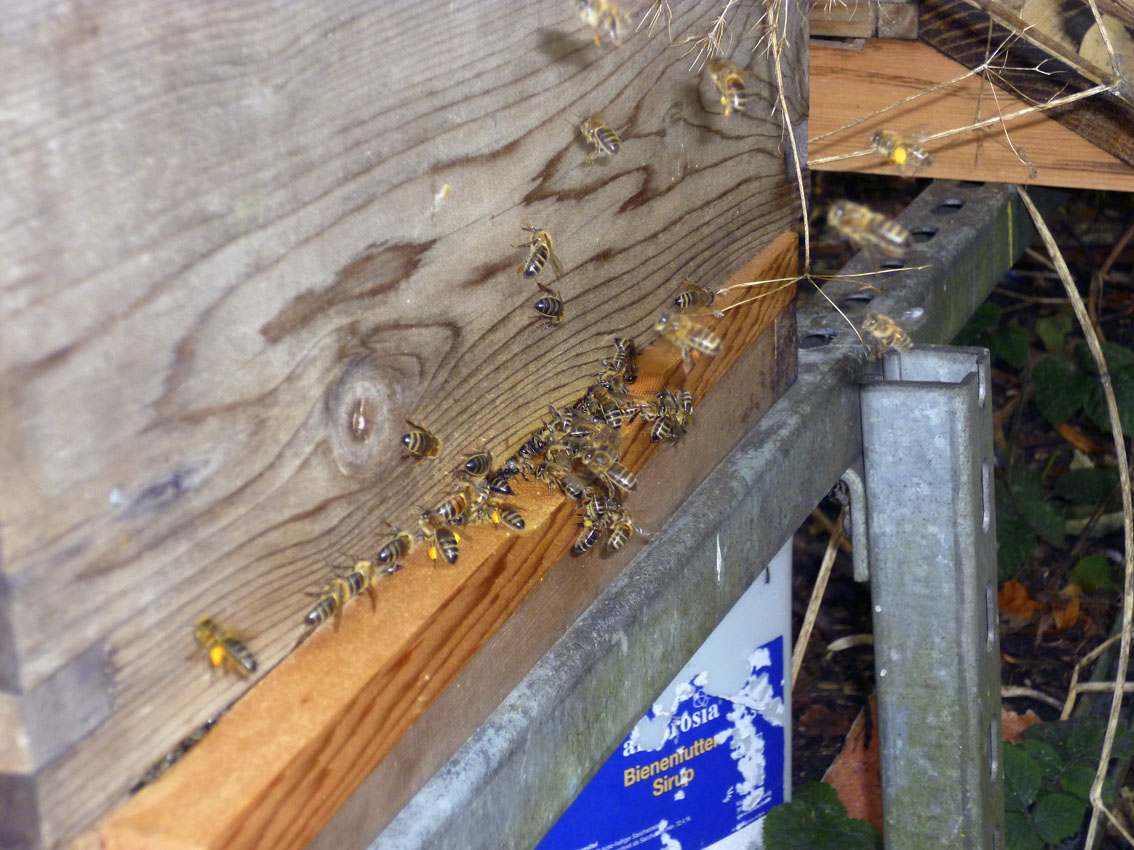
Emily found our bees flying into the hive dusted with yellow pollen. We hefted both hives to check the weight of honey stores and opened the roof to see how much fondant had been eaten. All was well and there was no sign of dead bees or disease at the entrances, so we took a stroll around the apiary to check the other hives.

Spring is coming. Snowdrops budding at the apiary.

Having not done a bad job of pretending to be beekeepers, there was little to do but go home for a cup of tea and cupcake, and dream of months of bees and honey to come.

A cake fit for a fairly good beekeeper, sugar sprinkled by the bees.

Emily took a great video of our bees returning home with pollen on her post ‘More signs of spring‘.

Giving the bees oxalic acid

Oxalic acid is an effective treatment against varroa. It burns the feet and tongues of the varroa mites so that they fall off the bees! The treatment is only given in winter when the mites are living on adult bees and there is no brood for the acid to damage.

This weekend the apiary gave the hives oxalic acid as a way of saying ‘Happy New Year’ to our bees. The bees were not pleased, as they do not like their cosy cluster being disturbed in winter, and flew up as soon as the crown board was lifted. John Chapple, who is rarely seen behind a veil, observed that even he wears a bee suit when giving oxalic acid to the bees. Although the bees were not pleased, Emily and I enjoyed saying hello to our ladies again, and both hives looked healthy and strong.

The treatment is given as a pre-mixed solution of 3% oxalic acid in sugar syrup and warmed slightly so that it won’t chill the bees. About 5ml of solution is dribbled in-between each gap in the frames where the bees are clustered, called seams of bees. The British Beekeepers Association (BBKA) have a good advisory leaflet on oxalic acid cleansing. It is a simple treatment to do, but it is critical to get the dosage right as over-dosing will harm the bees.

Lavender’s ladies were quiet and well behaved for their treatment, while Rosemary’s ladies were livelier. Believe it or not, our bees are much calmer than this in the summer! My first video, I hope to do more this year, shows Emily treating Rosemary’s hive:

Look how disgusted our bees are that we tore apart the sticky propolis insulating the hive! Sadly one bee was squashed as we closed the hive, but we rescued stragglers who had got cold and slow in the roof and carried them around to the entrance of the hives. It was fun to watch them climb in and re-join their sisters.

The BBKA say that oxalic acid is an important part of varroa management alongside other treatments and methods to keep varroa ‘below a level that damages the colony’. As varroa levels at the apiary increased in late autumn, it is hoped that the oxalic acid will help all the hives to stay healthy until spring. There is some talk among beekeepers about replacing treatments like oxalic acid and fumidil with ‘natural’ treatments, but I will write about this in another post in 2012 alongside a re-launch of my blog coming soon.

Happy New Year to bees, beekeepers, everyone and world!

Note: If you have not given oxalic acid to bees before, Glyn Davies of the Devon Beekeepers Association demonstrates the method very well. Emily has more videos of our apiary receiving oxalic acid treatment that are less shaky than my shots!

Not much beekeeping doing

There is not much beekeeping to be done in mid-winter. The bees stay in and surround the queen in a cosy cluster. There are no brood, or drones, to care for. Workers may leave the hive on a warm day for a cleansing flight or to drop-off dead bodies.

The more hardier beekeepers – and Emily and me – continue to visit the apiary in winter, but this weekend had a definite bite in the air and I wondered who would turn up to drink tea. A generous-sized tupperware cake box sitting on the apiary long table was a clue that my hive partner had arrived. I found Emily and Albert wandering around the hives, and hefting a few to check the weight of food stores. It was too cold even for Albert’s or John’s bees to fly out.

I had brought a bag of bubble-wrap to insulate our hive roofs, but first we needed a cup of tea and a slice of coffee-and-walnut cake. Chat around the long table ranged from monkey-fish (inspired by the random exhibit of a Japanese merman at my work) to the question: can crocodiles climb trees? The deductive reasoning of beekeepers settled this debate, ‘Crocodiles are very good jumpers and they have long bodies,’ said Andy. ‘A croc could jump quite high and grip the trunk, and with its long mouth could reach up the tree.’ So if you get chased by a crocodile and climb up a tree, keep climbing.

After drinking tea and munching cake, we decided it was time to bubble-wrap our bees. First, we visited Rosemary’s hive to put a layer of bubble-wrap inside the roof. We startled, and were startled by, a bee who flew up from the entrance. She may have been a vigilant guard bee disturbed by the movements in the roof, but she looked equally surprised to see us mid-flight and flew past so quickly that I think the little lady was desperate for a cleansing flight.

Emily thought our bees might want to send some Christmas post

Next we visited Lavender’s hive and a heft test reassured us that our baby hive has enough food stores. We insulated this hive with bubble wrap too. Emily had already padded the roofs of both hives with jiffy bags, and this, with a layer of bubble-wrap, should keep our ladies nice and toasty.

Bees bubble-wrapped for Christmas!

Bees can heat the hive extremely well themselves and you can feel the heat that they generate if you hold your hand over a hole in the crownboard. But as Thomas reminded us, ‘Insulating the hive is the least that you can do for your bees in winter.’ Condensation and damp is more a problem for bees than cold, but the open mesh floor of modern hives provides enough ventilation.

Winter is a great time for beekeepers to catch-up on their reading, attend meetings, clean and mend equipment, and to keep up with tea drinking. In about three months, there will be plenty of beekeeping to do.

The day my mum met the bees

My mum who is highly suspicious of bees, wasps, gnats and ‘flying things’ finally met my bees this Saturday.

She visited the apiary on the promise of no bees, ‘The bees will be sleeping because it is almost winter’, I said. This isn’t entirely true. Bees don’t sleep. But the apiary is generally quieter in late autumn and winter, except for a few bees taking a chance flight in a pocket of warm air and a few crazy beeks huddled around the apiary long table in the hope of tea and cake.

A small crowd greeted my mum, step dad and me on Saturday afternoon and enjoyed watching my mother nervously approach the hive area. We visited Rosemary’s hive first and no one was flying so mum was very happy. ‘That’s very nice,’ she said of the hive. Opposite, Albert’s and John’s bees were active, but we walked past unnoticed.

Next we visited Lavender’s hive and I attempted to show my mum the mouse guard. She raised her head from where she stood at the back of the hive and pretended to see it: ‘Yes, that’s very nice’.

My step dad, Bryan, then became fascinated with inspecting the canal that runs behind the apiary. Meantime, I carefully lifted the roof off Lavender’s hive to see if they had drunk their syrup. About half an inch of syrup was left in the feeder and three bees were drinking. I beckoned my mum over so that she could see a real live bee, promising that it couldn’t fly out of the feeder. She quite liked watching it drink and said, ‘Ooh, look at that’.

I quickly put the roof back to keep our bees warm. Emily and I probably won’t open our hives until the apiary does the oxalic acid treatment in December. We do this to keep down the levels of varroa inside the hive until spring. I pulled out the varroa board underneath Lavender’s hive and showed mum and Bryan a few varroa. Most of the debris on the board was clumped together in one area, which suggests that our bees are clustered on brood frames towards the entrance of the hive.

So we left the bees in peace and went to enjoy a cup of tea. There was no milk and as my mum is not a hardened beek accustomed to drinking black tea I found her some coffee instead.

Don arrived with his dog Annie, a gorgeous, friendly alsatian. Mum and Bryan love dogs (and so do I) so this delayed our goodbyes. As we left, my mum and step dad were invited by the beeks to come back for summer inspections on the promise of ‘much more bees and also cake’.

Feeding our autumn bees

Last Saturday was a balmy 16 degrees in London, which is warm enough for bees to fly out. What will they find to eat? At this time of year the forage is scarce for bees and they may have little choice than to collect nectar from ivy. Honey from ivy nectar crystallises very quickly inside the hive and sets like hard candy, which is almost impossible for bees to eat. This can cause starvation if all, or most, of the colony’s winter food reserves are ivy honey.

Emily and I have been continuing to feed both our hives syrup and the bees have been taking this quite happily. Usually, we stop feeding syrup between the middle and end of October, but an unusually mild autumn has tricked our bees into eating their precious honey reserves so they can fly out and forage for more nectar and pollen. We want to make sure that our ladies are re-stocking their larder with honey made from sugar syrup and not from ivy nectar.

I played hookie this weekend and skipped the Saturday afternoon apiary session for an art class at the studio of artist Nick Malone. Painting bees instead of keeping them. Meantime, Emily reported that Lavender’s hive has drunk all their syrup and that a heft test showed the hive has built-up its winter reserves. Rosemary’s hive has not drunk all their syrup but this is not surprising. Rosemary’s hive had good honey reserves even after we extracted the honey crop and has continually eaten syrup throughout late August and September. The colony probably has little room spare to store more sugary goodness.

We have bought two bags of fondant – one for each hive – from our apiary, which I am impatient to put in the roof. It is fun to see bees climbing through the holes in the crownboard to tuck into a mountain of sugar. However, Pat advised that we wait until December to give them fondant, because it is better for them to stay warm inside the brood nest eating up their honey reserves first.

A second spring for bees?

I have been reading the BBC’s Autumnwatch blog and found a great guest post called Mild autumn, second spring by Matthew Oates, the National Trust’s naturalist-in-residence, who reports on the repercussions for our wildlife of November’s record-breaking mild weather.

Matthew says that flowers are enjoying a second spring: ‘dandelions and white dead-nettle prominent along verges, and Aubretia, Kerria, Magnolias, Skimmias and Viburnums blossoming in gardens’. He also comments that this has been a fascinating autumn for insects: ‘Butterflies, moths and dragonflies just won’t stop’. Our bees won’t stop this autumn, it seems! I just hope that they have been finding their flower friends waiting to greet them in gardens and not their nemesis ivy!

10 reasons to have a hive partner

Following on from my post Reflections on a year in beekeeping, I have been lucky to share my bee adventures this year. Here are 10 reasons why every beek should have a hive partner.

#1 Beekeeping is a two-man woman job. An extra pair of hands (and eyes) is handy for hive inspections. You can both lift parts of the hive when they are sticky (particularly propolised queen excluders) and work with levers and smoke to close the hive without squishing bees.

#2 You have to make a lot of frames. 11 frames per brood box and 10 frames per super (National hive). With a hive partner you can knock these up in half the time when you need to put another brood box or super on the hive. At least, that’s the theory.

#3 A super of honey weighs around 60 pounds. If like Queen Elizabeth I you have the heart and stomach of a beekeeper but the body of a weak and feeble woman, you will need a hive partner to help lift a full super of honey. This is true.

#4 There are about 50,000 bees and only one of you. A hive partner helps even the odds.

#5 Queens can be tricksy. Even experienced beeks can sometimes have trouble spotting and caging queens – she is good at running and hiding. Try holding up a frame covered by about 2,000 bees, spotting the queen, caging her and marking her as the workers try to free her – with only two hands. Good luck! Three beeks couldn’t cage and mark our flighty queen.

#6 Two beeks are better than one. Staying one step ahead of the bees and predicting what they will do next is not easy. When you find a queen cell, or perhaps five, it helps to discuss a plan of action with a hive partner preferably over tea and cake.

#7 Extracting honey is a lot of work. Clearing bees from supers is the easy bit, but it helps to have a hive partner to shake off stragglers and take home bee-free frames. Then there’s decapping frames, spinning off the honey, filtering, jarring and labelling. It’s more than an evening’s work for just six frames one hive, so it helps to share honey extraction with a hive partner.

#8 Beekeeping is an expensive hobby. Bees are high-maintenance. Assume one extra hive for every colony for a shook swarm or bailey comb change, nucs and spare hives for artificial swarms, spare frames, jars and labels, mouse guards, sugar and fondant, medicines… It’s easier to spread the cost of a year in beekeeping between two beekeepers!

#9 You will have more than one hive. Once you are started on this dodgy path there is no stopping. By the end of your second year beekeeping, it’s likely you will have at least two hives to keep.

#10 Beekeepers don’t have holidays. We don’t joke about this. You don’t know what naughtiness your bees will get up to while you are away. A hive partner can cover your holidays between March and September.

And finally..

#11 Beekeepers need tea and cake after hive inspections. I forgot to add this, but it is essential. Make sure you get a hive partner who bakes.

Happy October bees!

Hand-feeding our gentle bees.

Our ladies enjoyed a second summer this weekend thanks to a heatwave in October. The entrance to Rosemary’s hive was busier than Heathrow with foraging bees flying in and out, and Lavender’s hive was almost as busy as Gatwick. Our bees were loving that sunshine!

Betty, an experienced and super-successful beekeeper at our apiary who gets gallons of honey every year, warned that the unseasonal warm weather might not necessarily be good for British bees. The heat stimulates bees to fly out and forage for nectar to make honey, but one of their few sources of nectar at this time of year is ivy. Ivy honey hardens and granulates inside the comb so bees can’t eat it over winter and starve.

Emily and I are still feeding our bees sugar syrup and both feeders were drained dry when we opened our hives, so hopefully they are using this to make their winter stores. A good tip to stimulate bees to climb inside the feeder and take down syrup is to soak a twig in syrup and place it inside the feeder hole. The bees will lick the twig and climb up to find more sugar.

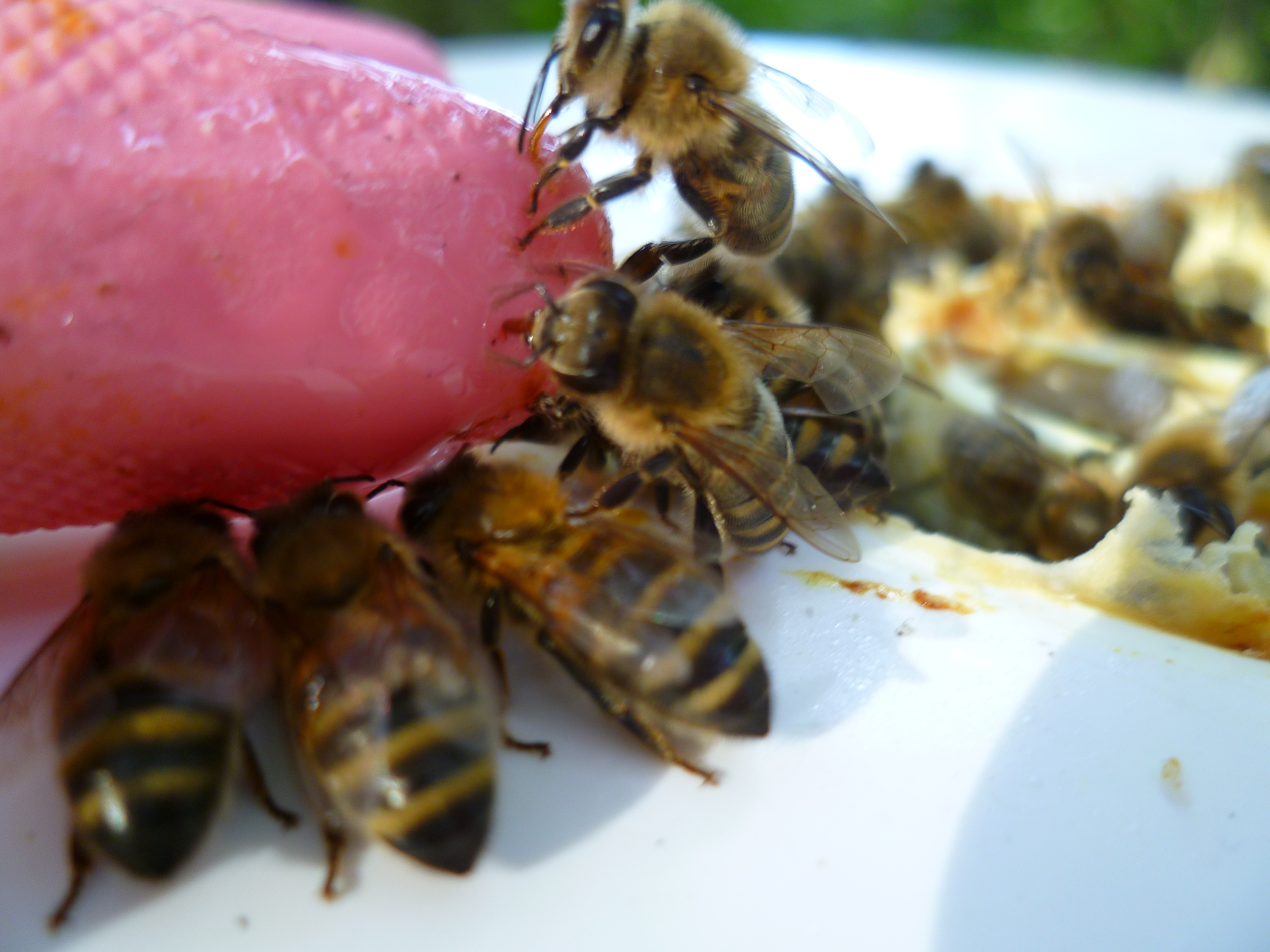
Slurp! Slurp!

Emily opened Rosemary’s hive to find bees crammed inside an empty feeder waiting for their weekly feed, and naughty bees who had found a way get in the roof and investigate. While Emily inspected the second half of the hive, I tried a little experiment by dipping my finger in some syrup and hand-feeding our bees.

Hmmn, what's this pink thing?

Yum! It tastes sweet!

It's finger-lickin' good!

They seemed to like it and gently licked my finger clean of syrup then climbed off to see if they could find a few more drops on the feeder.

An idyllic day at the apiary with beekeepers sharing stories and tips. I got a great piece of advice on how to smoke bees without distressing the hive too much. Don’t point the nozzle of the smoker downwards because this blows heat and dust (as well as smoke) inside the hive. Instead, point the nozzle across the hive and puff smoke over the top of the frames.

The peaceful afternoon was momentarily disturbed by a slight calamity when a tree fell on a hive belonging to another beekeeper, David. Fortunately two hero beekeepers were ready to rescue upturned bees, and then to enjoy a well-earned cup of afternoon tea.

Bees do read books

Last week we left a small gap between the brood box and crown board to let our bees munch on a bit of honeycomb. When we opened the hive today we found out that our bees do read the books after all…

Golden rolling waves of rogue honeycomb

‘Give bees a space and they will fill it.’

Our ladies built these beautiful honeycomb structures in less than a week and were already filling them with honey.

Sadly we had to take away their handiwork as we needed to remove the gap and close the brood box. A few puffs of smoke persuaded our bees to leave their newly made larder, which we scraped off with our hive tools…

Our bees enjoy making their own honeycomb creations free from the foundation of the frames

I enjoy seeing our bees build rogue comb because it gives a clue about what it might be like inside a wild honeybee colony.

It won’t be long before we close our hives for winter. I will miss seeing our bees’ cute faces peering up at us, but we’ll catch glimpses of them nibbling fondant under the roof.

Between now and then, we’ll need to keep feeding them lots of syrup to make sure that they have enough stores inside the brood box for overwintering. We found five frames of honey in Rosemary’s hive today. Each colony needs about 35lb of honey and I read that one frame weighs about 6.5lb, so we are nearly there.

It started to spit with rain before we could open Lavender’s hive so we topped up the feeder with ambrosia syrup and left our ladies to enjoy a sugary slurp.

The secret beekeepers

Secret goings on inside the hive by our September bees

Every second Saturday of the month, Ealing’s beekeepers have a workshop at the scout hut. While the apiary is free of visitors, Emily and I can do some secret beekeeping.

At this time of year we need to check that our hives have enough stores. One hive needs about 35lb of honey for winter. When I hefted our hives a few weeks ago they felt a little light, so I have been feeding both colonies syrup twice a week and it has made a real difference. Emily has written a great post about feeding bees for winter: Some good advice.
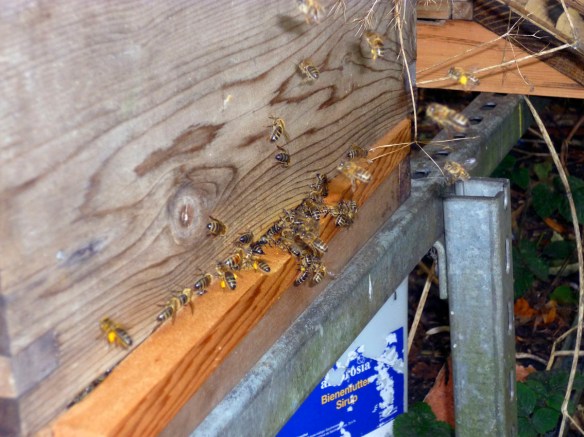
Our bees squirrel away stores for winter

We got our lavender-scented smoker roaring with flames, although we only need a few puffs for our ladies. Rosemary’s hive was very busy as usual. Bees were frantically flying in and out overloaded with bright golden and orange pollen, trying to make the most of the last days of sunshine.

It took both our hive tools to get the crown board off Rosemary’s hive. This is why…

Our ladies were too busy sticking propolis on frames to notice that we had opened the hive

Our ladies were so busy chewing and sticking propolis to the top bars of the frames that they barely glanced up to say hello. Propolis is a resin that bees collect from trees to seal up the hive for winter. You can buy it in health-food stores as a supplement to boost the immune system because of its anti-microbial properties. We don’t harvest the propolis from our hives as London bees have a tendency to collect resin from road tar and roofs. Not very healthy!

I lifted out the dummy board to find that a foil lid from an Apiguard tray had been stuck down with propolis. Our bees are like Wombles, they investigate everything that they find inside the hive!
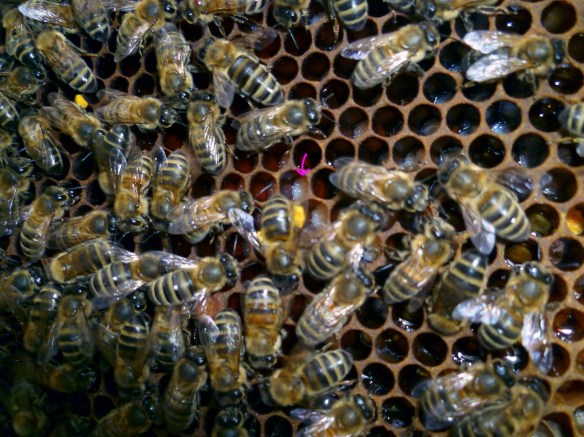
Foragers push their sisters out of the way looking for a place to unload. You can see some larvae cosily curled up here too (pink arrow)

Rosemary’s hive has about five frames of honey and six frames of worker brood (they have stopped making drone). I think this colony will be strong and healthy going into winter. We say plenty of forager bees waddling on the frames. They look funny trying to walk with heavy baskets of pollen, and I noticed that they elbow other bees out of the way looking for a cell to unload their shopping.

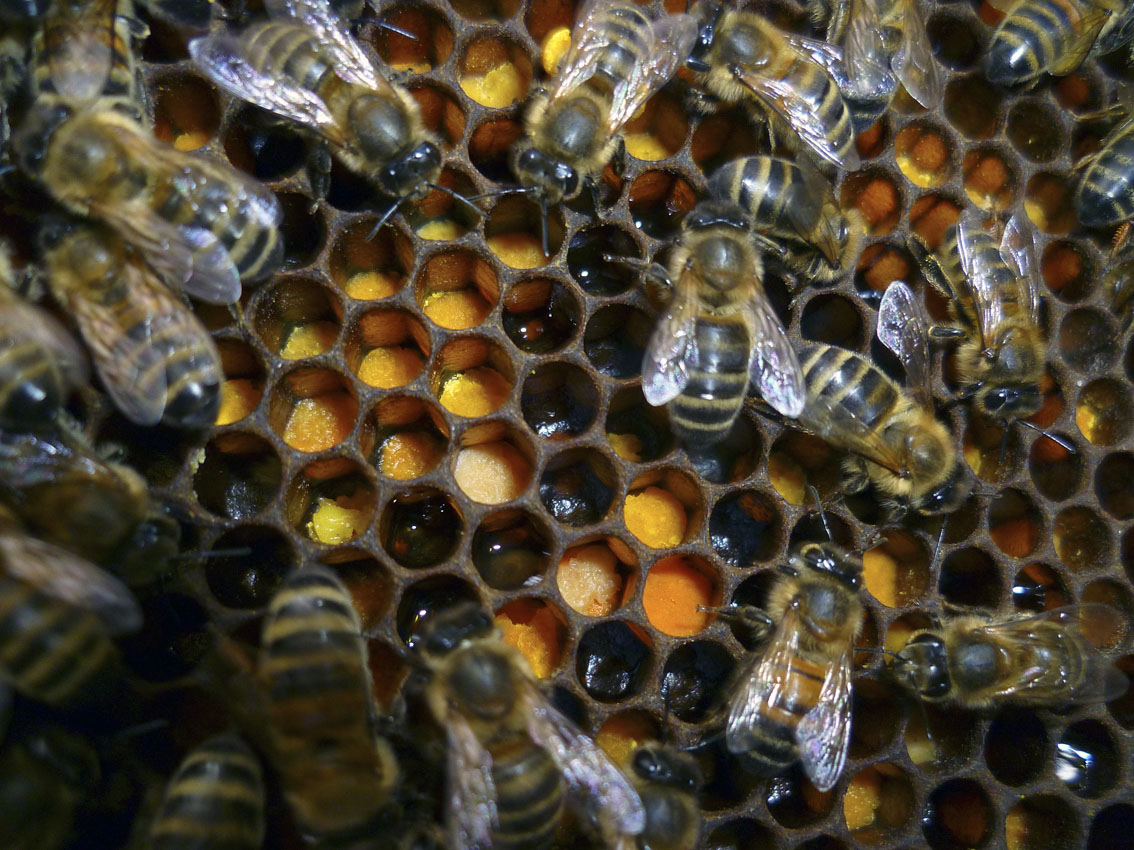
Bees use pollen as a source of protein and not just for making beautiful patterns for us to admire…

Autumnal varieties of pollen tightly packed into cells

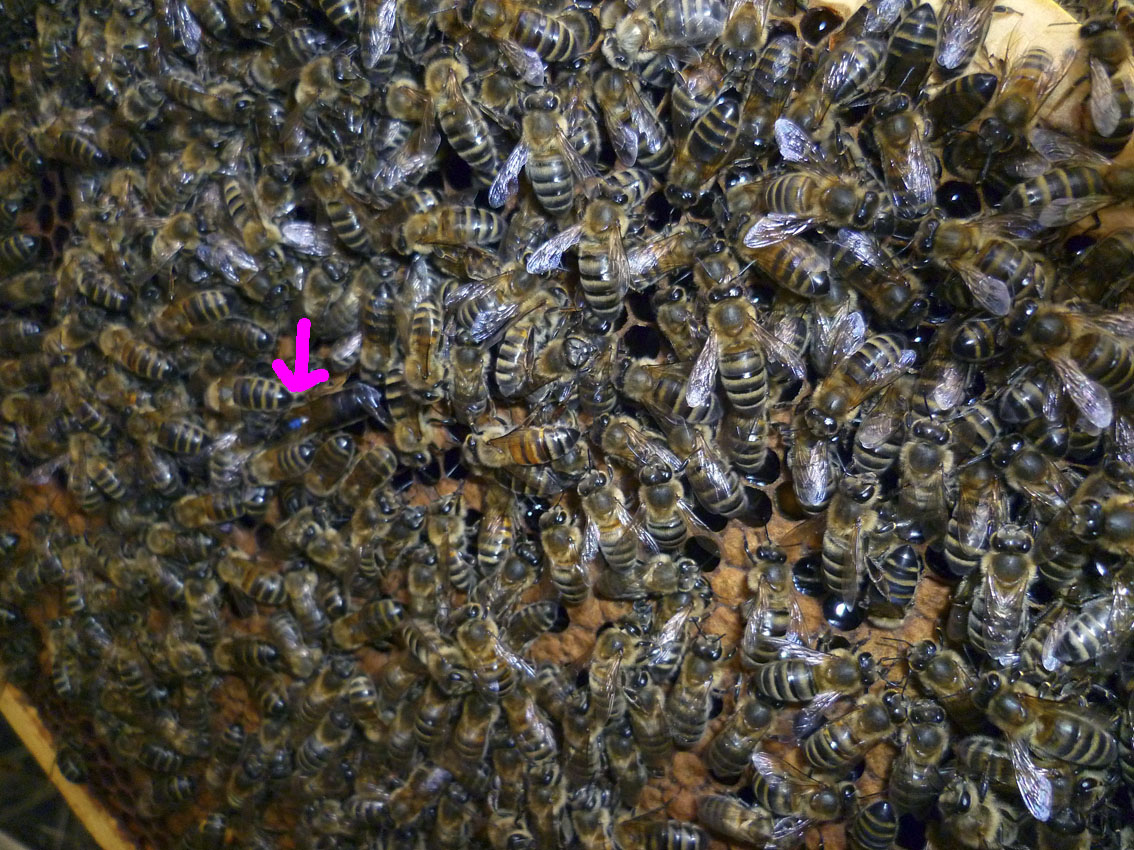
Emily spotted Rosemary running across a frame, alive and well, but her blue dot is hard to spot. Here she is…
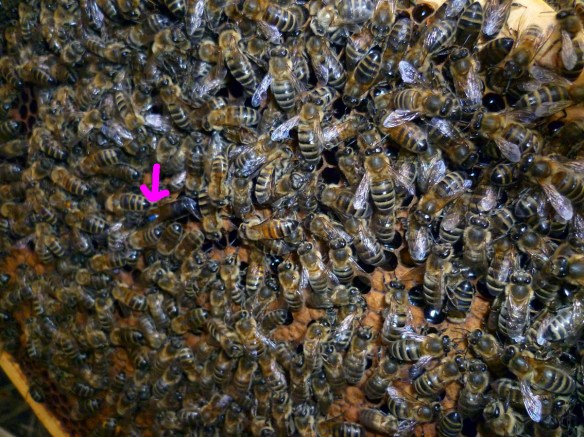
The camera spotted Rosemary even if I didn't! Our queen is marked with a blue dot on her back that is quite difficult to spot

We took the honey off this hive at the beginning of August, but left a space between the brood and the super to encourage our bees to take the remaining honey into the brood. They mostly cooperated, but there was one frame that still had a patch of precious honey.
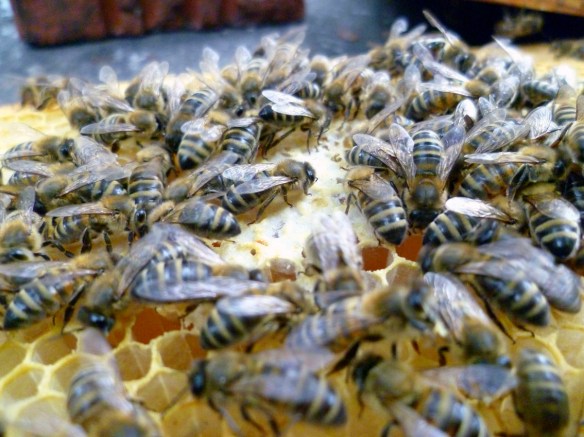
Mmm, it's all about the honey!

I used my hive tool to scoop out the honeycomb and placed it on the top bars of the brood. It didn’t take long for our ladies to start chowing down. We left Rosemary’s hive happily munching on fresh comb oozing with golden-amber honey. Mmmm.

'Gosh! Where did all this honey come from? Rub it all over yer face!'

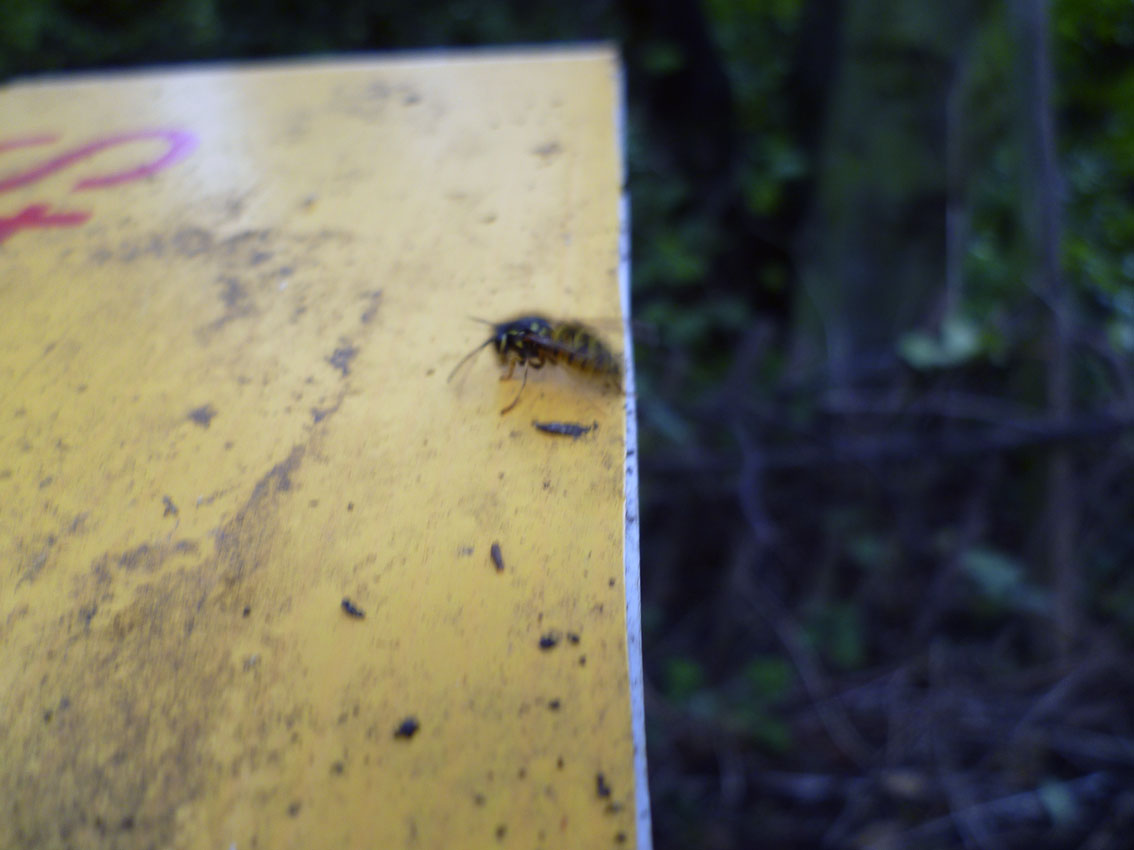
A little wasp was spotted loitering, so we were careful that she didn’t sneak inside as we closed the hive.

Wasps are starving at this time of year and desperately scavenging for food. This little wasp sat so quietly and innocently as we inspected our hive – she almost looked cute. Almost

We opened Lavender’s hive to find the bees had taken all the syrup that I gave them on Thursday (only two days ago) and were desperately poking their tongues through the feeder trying to get the last sugary drops.

'I can just reach it'

Last week Emily and I wondered if Lavender had mated with Albert’s New Zealand drones, because our ladies looked lighter and more golden in colour. Here is the proof…

Evidence! Our golden ladies have built a Kiwi-bee style conservatory in the roof

We opened the hive to find that our bees have built a conservatory in the roof – identical to the little hang-out that Albert’s bees have built in their hive! Sadly we had to remove their play area as we don’t want them to store honeycomb in the roof for winter. Emily observed that our bees seem to enjoy making their own comb. I suggested that we experiment next year by alternating frames with and without foundation – we’ll have a 50:50 chance of either practice working.

Lavender seems to have taken after her mother and sister. She is a hard-working queen who has produced quite a lot of brood in the past few weeks and who continues to give us gentle-natured bees.

Lavender has been hard at work creating lots of winter bees

The honeycomb in the last frame was flat and hard on one side. ‘This is the dance floor,’ said Emily. ‘The bees sometimes store propolis in the last comb to make a flat, hard surface for the waggle dances to be heard throughout the hive.’ Bees are so clever!

A propolis 'dance floor' for bees to communicate by vibrating messages to the rest of the hive. Genius

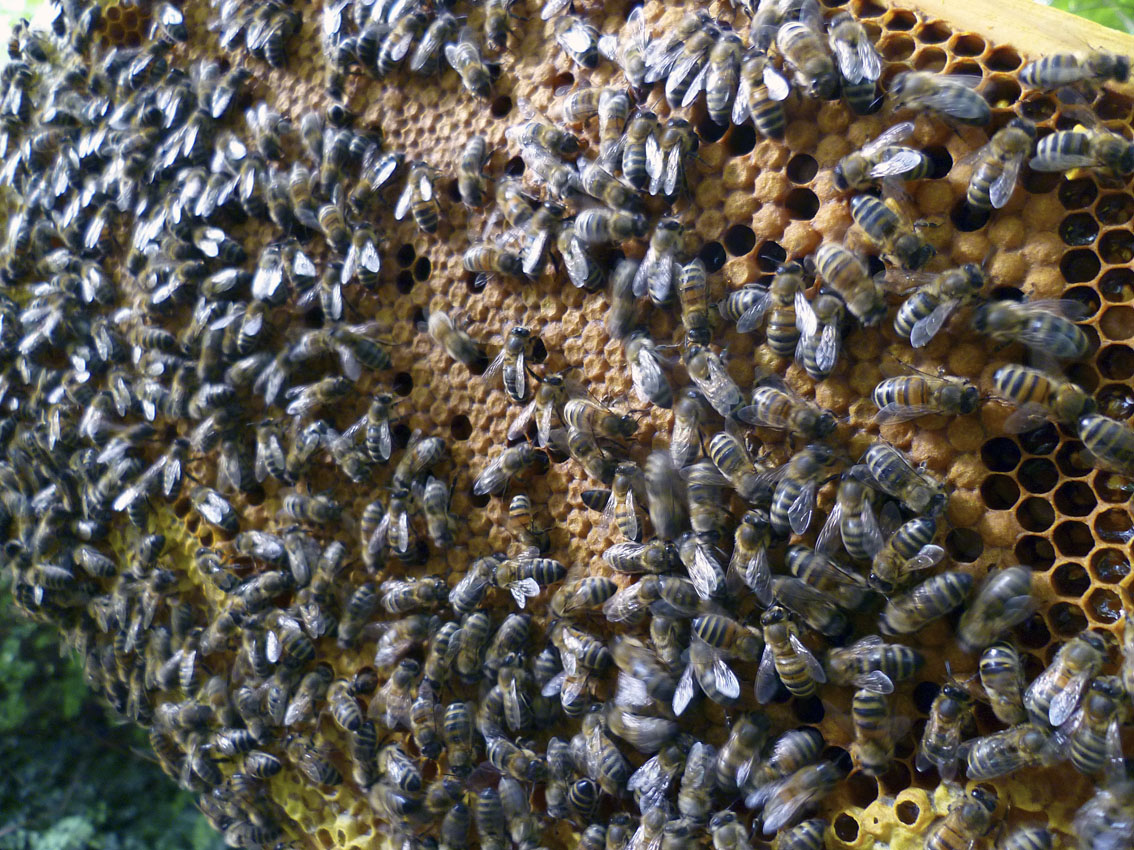
On the other side of the frame we saw foragers head-butting pollen of many varieties tightly into cells.

Lavender's ladies are still finding sources of blue and grey pollen. I wonder what is flowering nearby?

We put a mouse guard on this hive last week to help our smaller colony defend itself against would-be intruders, such as wasps, robber bees and mice. There was quite a lot of activity around the entrance showing that this hive is growing from strength to strength.
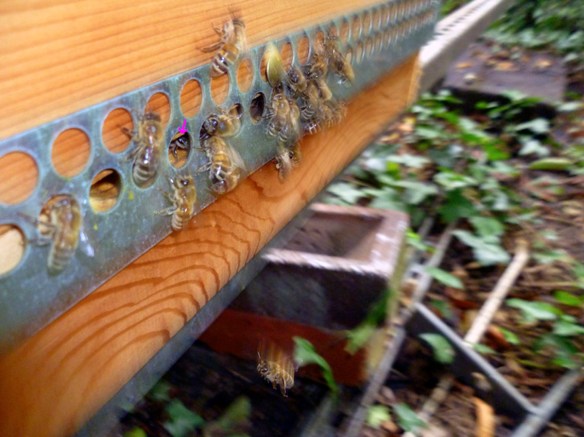
A mouse guard helps protect our bees in autumn and winter from would-be robbers and pests. You can see a little guard bee vigilantly peering out (pink arrow)

We closed the hive and topped up the feeder to keep our ladies happy and busy till next week.

Finally, I apologise in advance to my hive partner for the next photo…

These curious autumn spiders intrigue me. What are they?

Every autumn I am intrigued by these pretty-patterned spiders with enormous webs. What are they? I much prefer this spider to the big hairy sort that rampage like a lunatic around your house in September. This fellow wasn’t at all bothered when I poked a bright pink camera in his face.

This weekend we will be feeding our bees fumidil with their syrup – if I can just do the maths! I hope our ladies will still be hungry!

Reflections on a year in beekeeping

This year has been all about the queen. Queen Rose split from her court in early spring and was succeeded by her daughter, Queen Rosemary. Taking objection to her coronation, Rosemary briefly abdicated in a royal huff before returning to her throne. Rose, in her newly founded kingdom, made fewer public appearances before eventually going MIA. We then discovered five queens-in-waiting in July. Our royal saga concluded with the coronation of Queen Lavender.

Lavender made her debut at the end of a busy afternoon’s beekeeping: bees had been cleared, our honey crop removed and Apiguard given to treat varroa. The beekeeping year starts and ends in August. The honey crop summons the end of our annual activities as preparations for overwintering begin the new year. Bees are a bit pagan.

Emily brought dried lavender for the smoker to calm our late summer bees, while we nicked their honey and gave them medicine. So it seemed appropriate when Sarah spotted our new queen running across a frame in our baby hive that she was christened Lavender.

Remembering the drama of our runaway queen earlier this year, Lavender was swiftly caged without hesitation and marked white – on her head, wings and thorax! Future inspections will tell if she survived my clumsy coronation attempt intact.

I think I may have squashed two workers while securing the queen in her cage. Ugh, more guilt! Catching and marking a queen is tricky business. Try to catch one bee from thousands on a frame inside a cage, then mark her as the workers try to set her free. That’s when you need a hive partner! It is a good idea to practise caging and marking with drones early in the year. They are bigger and fairly amiable about it, and it doesn’t matter quite as much if you damage a drone.

So our beekeeping year ends with Queen Rosemary reigning over our fully grown hive, which is bursting at the seams with bees, and with Queen Lavender inheriting our baby hive, which is slowly filling the brood box. Emily and I wondered how well our July queen mated late in the season and with August rains. So we were happy to find new brood and larvae during our last inspection.

I thought that the bees in our baby hive looked lighter and more golden, unlike Lavender who inherited her mother’s dark looks. Emily suggested that Lavender may have mated with Albert’s drones. We might have Kiwi bees!

As an aromatherapist, I named my first queen after an essential oil and this tradition has continued with the hives I share with Emily. So far the queens have taken after their namesakes of Jasmine, a beautiful relaxing oil, Rose, a warm mothering fragrance, and Rosemary, an energetic invigorating aroma. Lavender is renowned for its gentleness and effectiveness, I hope our new queen has these qualities.

Our adventures in beekeeping have kept us busy this year – building hives and shook swarms, frame-making workshops and beards of bees, runaway queens, a new nuc, rainbows of pollen and honey, a quintet of queen cells, weird bees, a honey crop, and a honey festival! I haven’t even taken my basic beekeeping assessment yet!

With a new year around the corner, I wonder what our bees will do next!