10 reasons to have a hive partner

Following on from my post Reflections on a year in beekeeping, I have been lucky to share my bee adventures this year. Here are 10 reasons why every beek should have a hive partner.

#1 Beekeeping is a two-man woman job. An extra pair of hands (and eyes) is handy for hive inspections. You can both lift parts of the hive when they are sticky (particularly propolised queen excluders) and work with levers and smoke to close the hive without squishing bees.

#2 You have to make a lot of frames. 11 frames per brood box and 10 frames per super (National hive). With a hive partner you can knock these up in half the time when you need to put another brood box or super on the hive. At least, that’s the theory.

#3 A super of honey weighs around 60 pounds. If like Queen Elizabeth I you have the heart and stomach of a beekeeper but the body of a weak and feeble woman, you will need a hive partner to help lift a full super of honey. This is true.

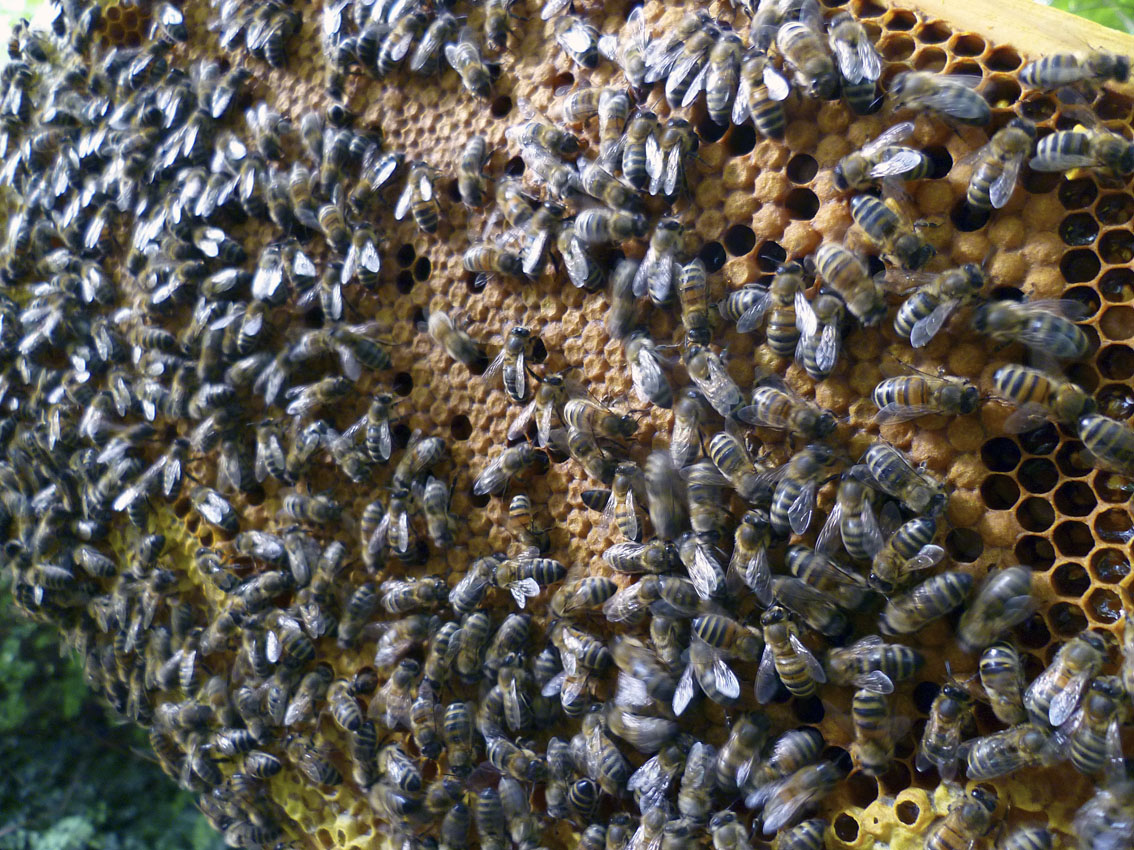
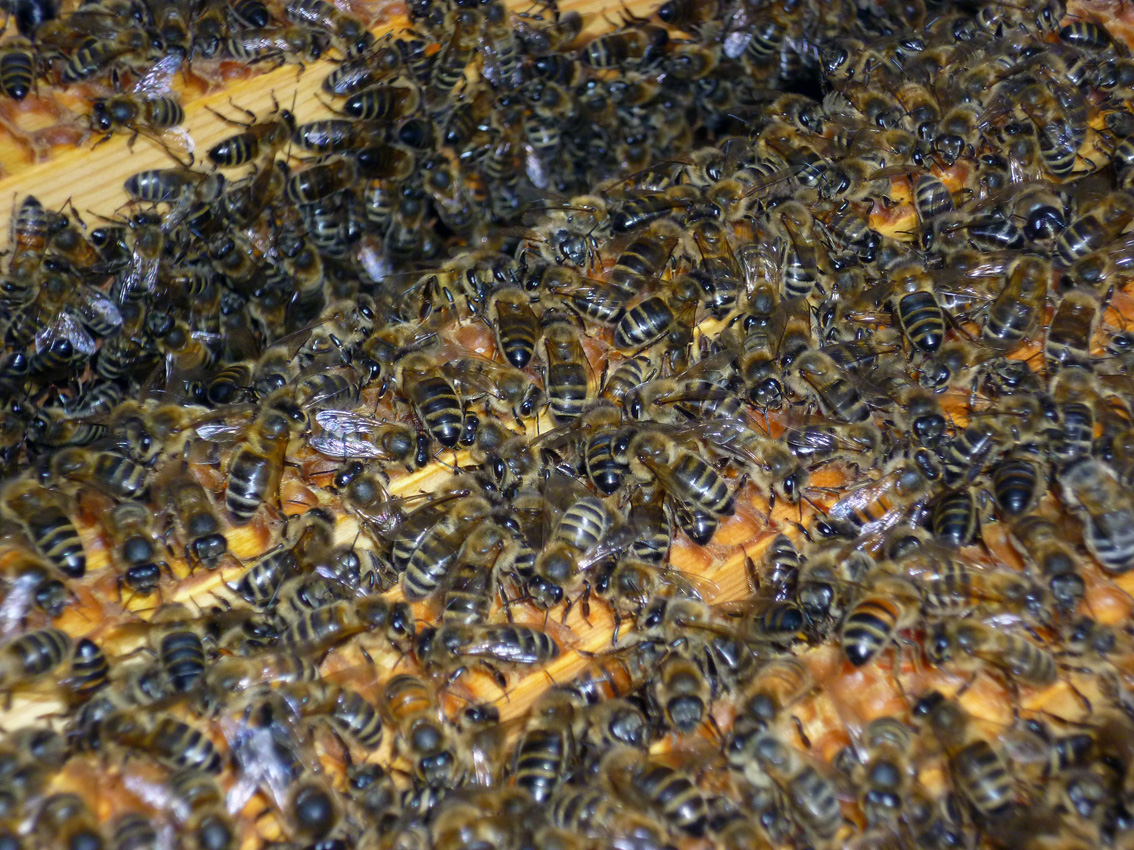
#4 There are about 50,000 bees and only one of you. A hive partner helps even the odds.

#5 Queens can be tricksy. Even experienced beeks can sometimes have trouble spotting and caging queens – she is good at running and hiding. Try holding up a frame covered by about 2,000 bees, spotting the queen, caging her and marking her as the workers try to free her – with only two hands. Good luck! Three beeks couldn’t cage and mark our flighty queen.

#6 Two beeks are better than one. Staying one step ahead of the bees and predicting what they will do next is not easy. When you find a queen cell, or perhaps five, it helps to discuss a plan of action with a hive partner preferably over tea and cake.

#7 Extracting honey is a lot of work. Clearing bees from supers is the easy bit, but it helps to have a hive partner to shake off stragglers and take home bee-free frames. Then there’s decapping frames, spinning off the honey, filtering, jarring and labelling. It’s more than an evening’s work for just six frames one hive, so it helps to share honey extraction with a hive partner.

#8 Beekeeping is an expensive hobby. Bees are high-maintenance. Assume one extra hive for every colony for a shook swarm or bailey comb change, nucs and spare hives for artificial swarms, spare frames, jars and labels, mouse guards, sugar and fondant, medicines… It’s easier to spread the cost of a year in beekeeping between two beekeepers!

#9 You will have more than one hive. Once you are started on this dodgy path there is no stopping. By the end of your second year beekeeping, it’s likely you will have at least two hives to keep.

#10 Beekeepers don’t have holidays. We don’t joke about this. You don’t know what naughtiness your bees will get up to while you are away. A hive partner can cover your holidays between March and September.

And finally..

#11 Beekeepers need tea and cake after hive inspections. I forgot to add this, but it is essential. Make sure you get a hive partner who bakes.

Happy October bees!

Hand-feeding our gentle bees.

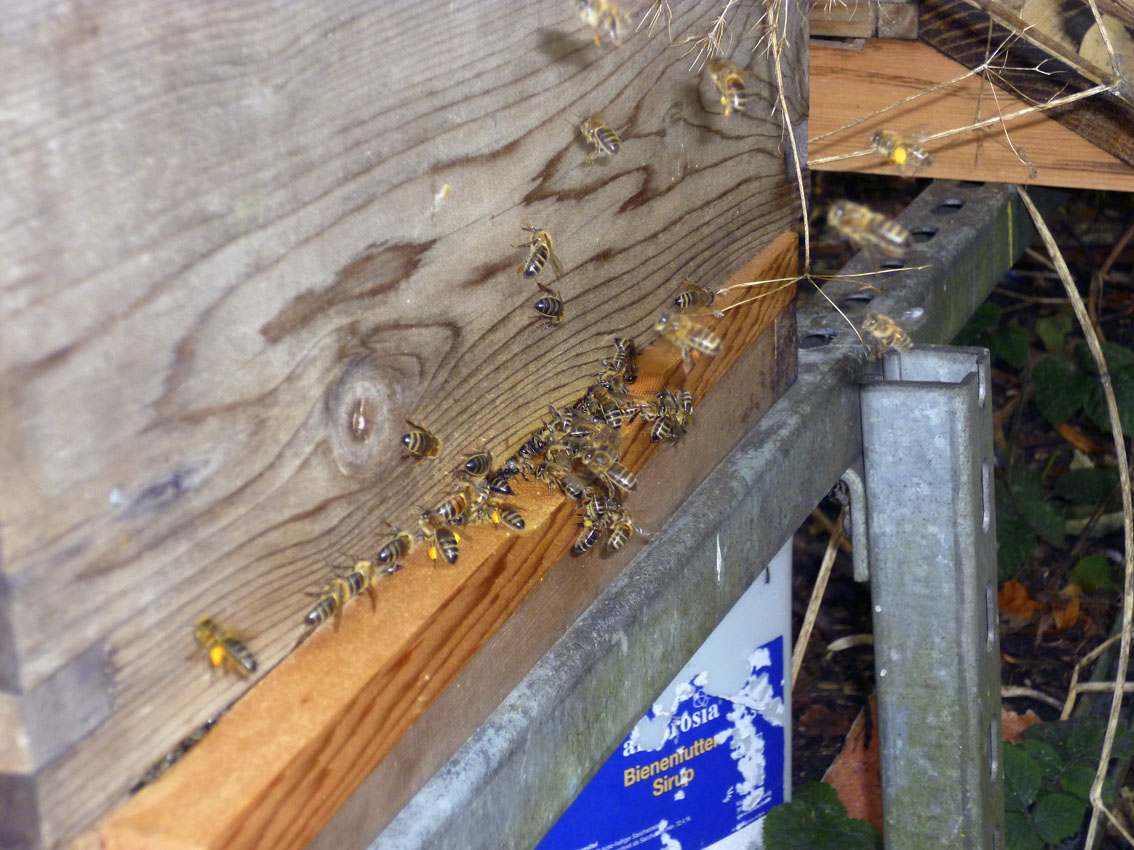
Our ladies enjoyed a second summer this weekend thanks to a heatwave in October. The entrance to Rosemary’s hive was busier than Heathrow with foraging bees flying in and out, and Lavender’s hive was almost as busy as Gatwick. Our bees were loving that sunshine!

Betty, an experienced and super-successful beekeeper at our apiary who gets gallons of honey every year, warned that the unseasonal warm weather might not necessarily be good for British bees. The heat stimulates bees to fly out and forage for nectar to make honey, but one of their few sources of nectar at this time of year is ivy. Ivy honey hardens and granulates inside the comb so bees can’t eat it over winter and starve.

Emily and I are still feeding our bees sugar syrup and both feeders were drained dry when we opened our hives, so hopefully they are using this to make their winter stores. A good tip to stimulate bees to climb inside the feeder and take down syrup is to soak a twig in syrup and place it inside the feeder hole. The bees will lick the twig and climb up to find more sugar.

Slurp! Slurp!

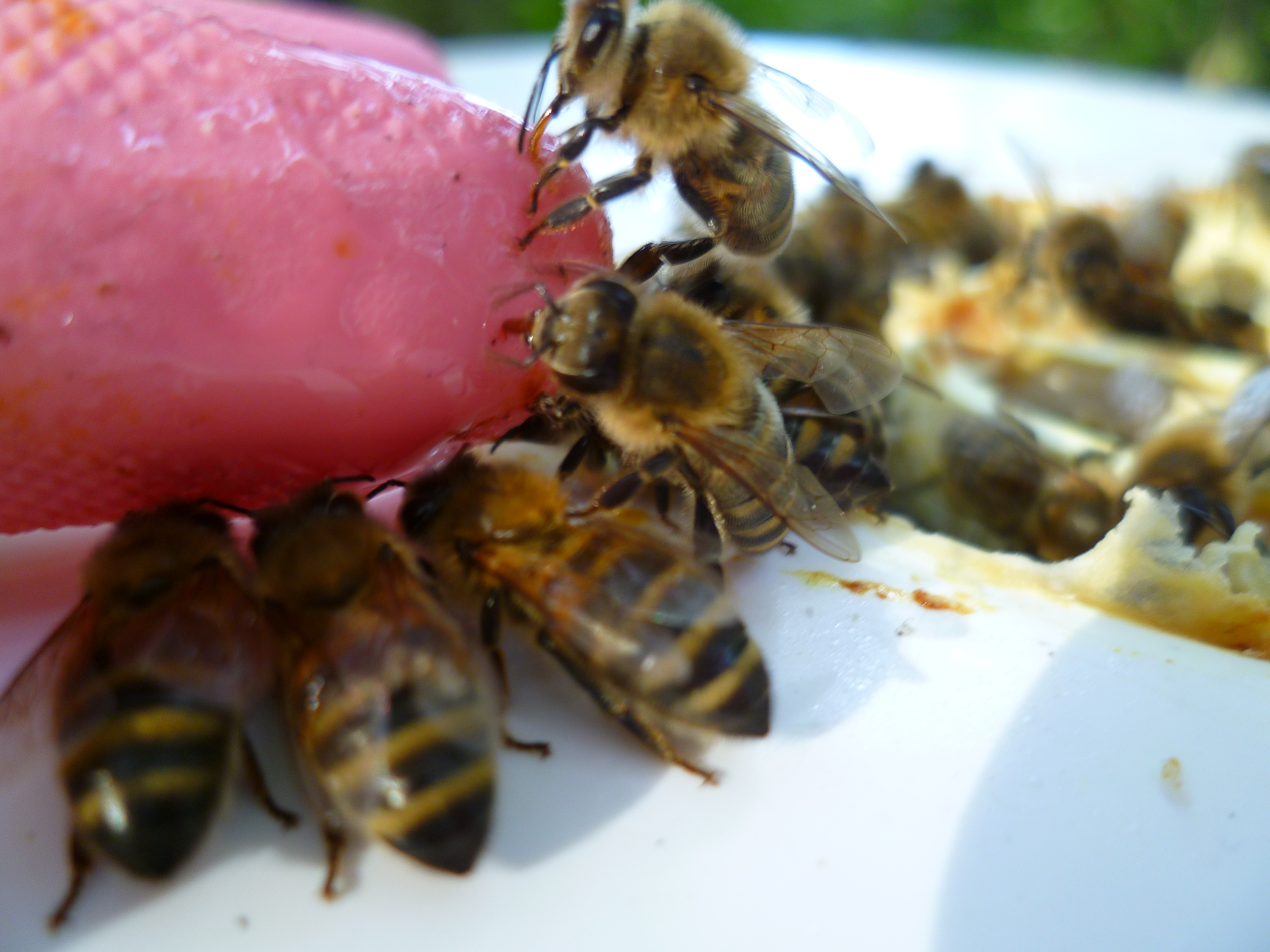
Emily opened Rosemary’s hive to find bees crammed inside an empty feeder waiting for their weekly feed, and naughty bees who had found a way get in the roof and investigate. While Emily inspected the second half of the hive, I tried a little experiment by dipping my finger in some syrup and hand-feeding our bees.

Hmmn, what's this pink thing?

Yum! It tastes sweet!

It's finger-lickin' good!

They seemed to like it and gently licked my finger clean of syrup then climbed off to see if they could find a few more drops on the feeder.

An idyllic day at the apiary with beekeepers sharing stories and tips. I got a great piece of advice on how to smoke bees without distressing the hive too much. Don’t point the nozzle of the smoker downwards because this blows heat and dust (as well as smoke) inside the hive. Instead, point the nozzle across the hive and puff smoke over the top of the frames.

The peaceful afternoon was momentarily disturbed by a slight calamity when a tree fell on a hive belonging to another beekeeper, David. Fortunately two hero beekeepers were ready to rescue upturned bees, and then to enjoy a well-earned cup of afternoon tea.

Bees do read books

Last week we left a small gap between the brood box and crown board to let our bees munch on a bit of honeycomb. When we opened the hive today we found out that our bees do read the books after all…

Golden rolling waves of rogue honeycomb

‘Give bees a space and they will fill it.’

Our ladies built these beautiful honeycomb structures in less than a week and were already filling them with honey.

Sadly we had to take away their handiwork as we needed to remove the gap and close the brood box. A few puffs of smoke persuaded our bees to leave their newly made larder, which we scraped off with our hive tools…

Our bees enjoy making their own honeycomb creations free from the foundation of the frames

I enjoy seeing our bees build rogue comb because it gives a clue about what it might be like inside a wild honeybee colony.

It won’t be long before we close our hives for winter. I will miss seeing our bees’ cute faces peering up at us, but we’ll catch glimpses of them nibbling fondant under the roof.

Between now and then, we’ll need to keep feeding them lots of syrup to make sure that they have enough stores inside the brood box for overwintering. We found five frames of honey in Rosemary’s hive today. Each colony needs about 35lb of honey and I read that one frame weighs about 6.5lb, so we are nearly there.

It started to spit with rain before we could open Lavender’s hive so we topped up the feeder with ambrosia syrup and left our ladies to enjoy a sugary slurp.

The secret beekeepers

Secret goings on inside the hive by our September bees

Every second Saturday of the month, Ealing’s beekeepers have a workshop at the scout hut. While the apiary is free of visitors, Emily and I can do some secret beekeeping.

At this time of year we need to check that our hives have enough stores. One hive needs about 35lb of honey for winter. When I hefted our hives a few weeks ago they felt a little light, so I have been feeding both colonies syrup twice a week and it has made a real difference. Emily has written a great post about feeding bees for winter: Some good advice.

Our bees squirrel away stores for winter

We got our lavender-scented smoker roaring with flames, although we only need a few puffs for our ladies. Rosemary’s hive was very busy as usual. Bees were frantically flying in and out overloaded with bright golden and orange pollen, trying to make the most of the last days of sunshine.

It took both our hive tools to get the crown board off Rosemary’s hive. This is why…

Our ladies were too busy sticking propolis on frames to notice that we had opened the hive

Our ladies were so busy chewing and sticking propolis to the top bars of the frames that they barely glanced up to say hello. Propolis is a resin that bees collect from trees to seal up the hive for winter. You can buy it in health-food stores as a supplement to boost the immune system because of its anti-microbial properties. We don’t harvest the propolis from our hives as London bees have a tendency to collect resin from road tar and roofs. Not very healthy!

I lifted out the dummy board to find that a foil lid from an Apiguard tray had been stuck down with propolis. Our bees are like Wombles, they investigate everything that they find inside the hive!

Foragers push their sisters out of the way looking for a place to unload. You can see some larvae cosily curled up here too (pink arrow)

Rosemary’s hive has about five frames of honey and six frames of worker brood (they have stopped making drone). I think this colony will be strong and healthy going into winter. We say plenty of forager bees waddling on the frames. They look funny trying to walk with heavy baskets of pollen, and I noticed that they elbow other bees out of the way looking for a cell to unload their shopping.

Bees use pollen as a source of protein and not just for making beautiful patterns for us to admire…

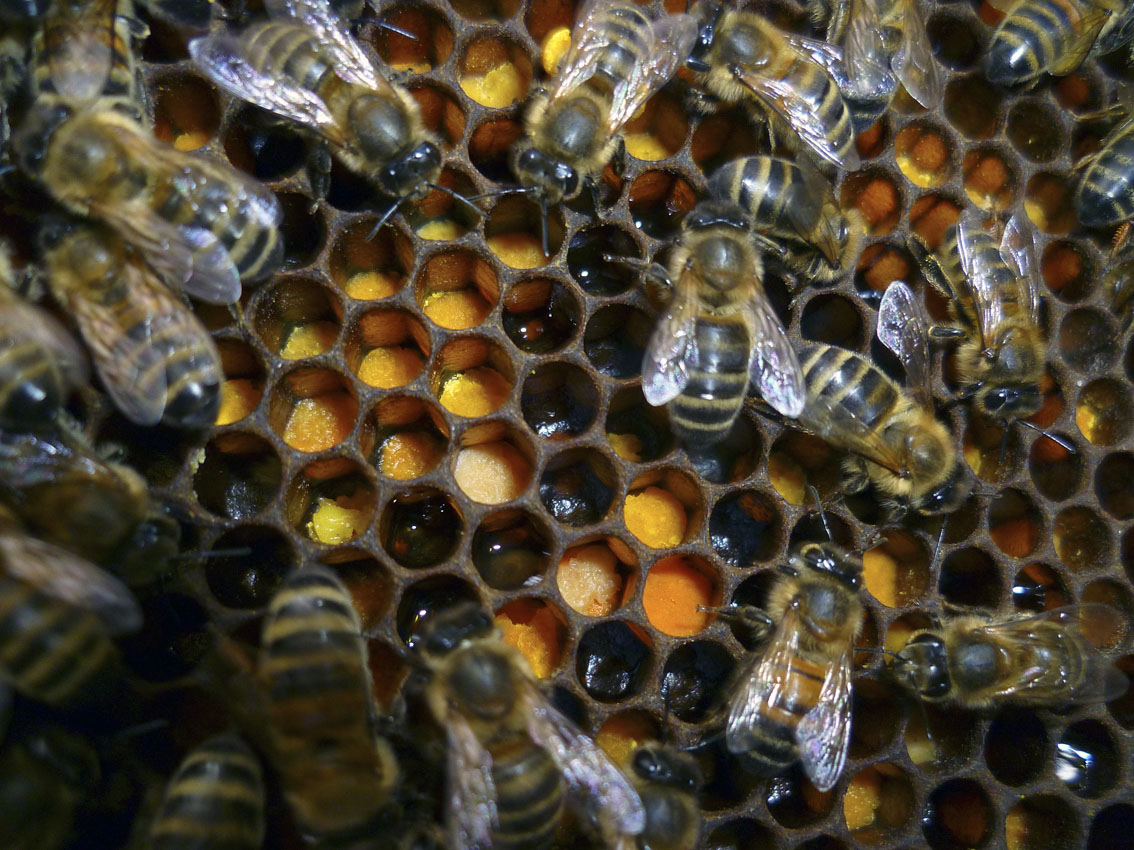
Autumnal varieties of pollen tightly packed into cells

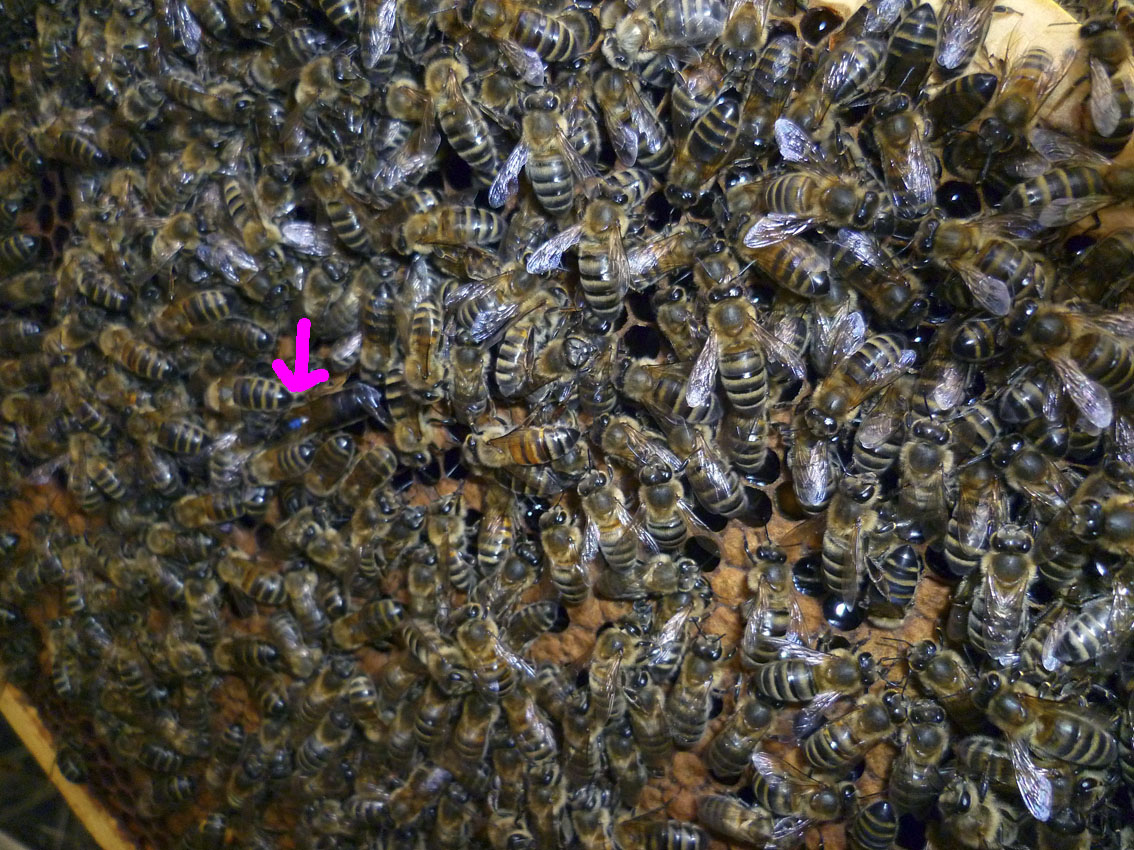
Emily spotted Rosemary running across a frame, alive and well, but her blue dot is hard to spot. Here she is…

The camera spotted Rosemary even if I didn't! Our queen is marked with a blue dot on her back that is quite difficult to spot

We took the honey off this hive at the beginning of August, but left a space between the brood and the super to encourage our bees to take the remaining honey into the brood. They mostly cooperated, but there was one frame that still had a patch of precious honey.

Mmm, it's all about the honey!

I used my hive tool to scoop out the honeycomb and placed it on the top bars of the brood. It didn’t take long for our ladies to start chowing down. We left Rosemary’s hive happily munching on fresh comb oozing with golden-amber honey. Mmmm.

'Gosh! Where did all this honey come from? Rub it all over yer face!'

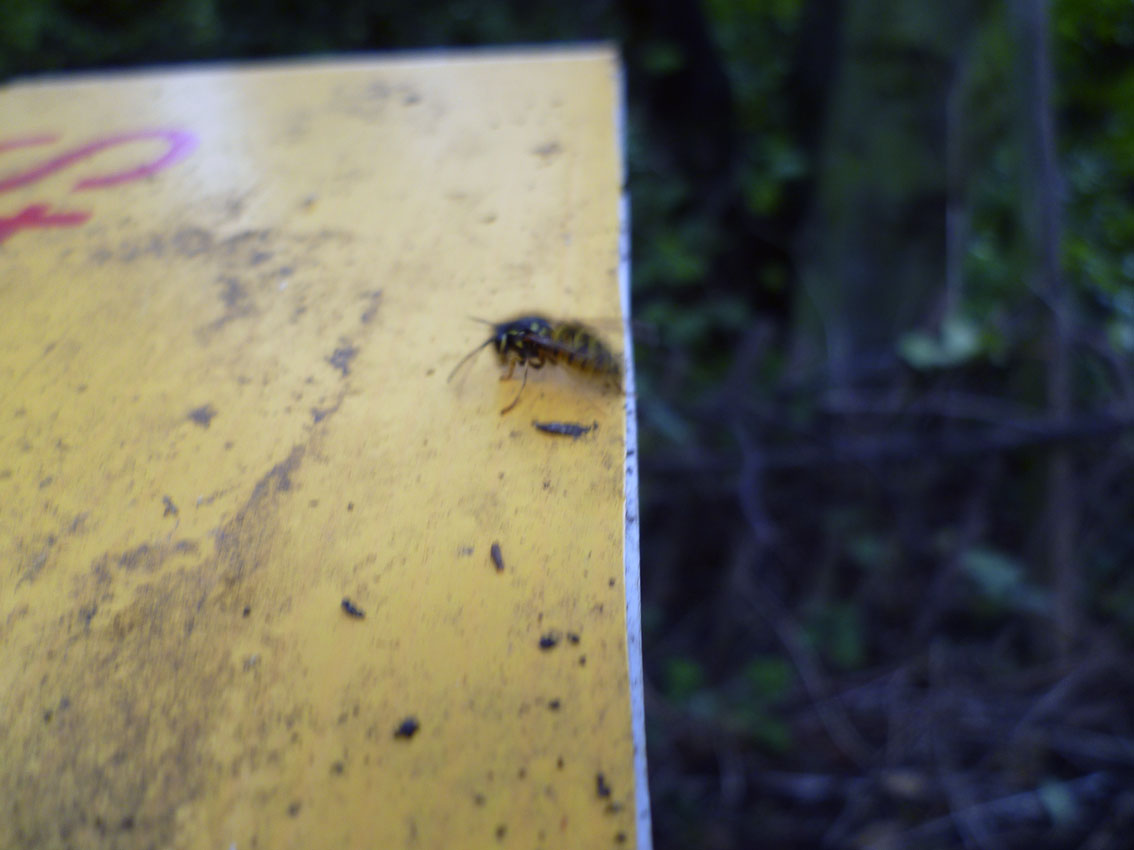
A little wasp was spotted loitering, so we were careful that she didn’t sneak inside as we closed the hive.

Wasps are starving at this time of year and desperately scavenging for food. This little wasp sat so quietly and innocently as we inspected our hive – she almost looked cute. Almost

We opened Lavender’s hive to find the bees had taken all the syrup that I gave them on Thursday (only two days ago) and were desperately poking their tongues through the feeder trying to get the last sugary drops.

'I can just reach it'

Last week Emily and I wondered if Lavender had mated with Albert’s New Zealand drones, because our ladies looked lighter and more golden in colour. Here is the proof…

Evidence! Our golden ladies have built a Kiwi-bee style conservatory in the roof

We opened the hive to find that our bees have built a conservatory in the roof – identical to the little hang-out that Albert’s bees have built in their hive! Sadly we had to remove their play area as we don’t want them to store honeycomb in the roof for winter. Emily observed that our bees seem to enjoy making their own comb. I suggested that we experiment next year by alternating frames with and without foundation – we’ll have a 50:50 chance of either practice working.

Lavender seems to have taken after her mother and sister. She is a hard-working queen who has produced quite a lot of brood in the past few weeks and who continues to give us gentle-natured bees.

Lavender has been hard at work creating lots of winter bees

The honeycomb in the last frame was flat and hard on one side. ‘This is the dance floor,’ said Emily. ‘The bees sometimes store propolis in the last comb to make a flat, hard surface for the waggle dances to be heard throughout the hive.’ Bees are so clever!

A propolis 'dance floor' for bees to communicate by vibrating messages to the rest of the hive. Genius

On the other side of the frame we saw foragers head-butting pollen of many varieties tightly into cells.

Lavender's ladies are still finding sources of blue and grey pollen. I wonder what is flowering nearby?

We put a mouse guard on this hive last week to help our smaller colony defend itself against would-be intruders, such as wasps, robber bees and mice. There was quite a lot of activity around the entrance showing that this hive is growing from strength to strength.

A mouse guard helps protect our bees in autumn and winter from would-be robbers and pests. You can see a little guard bee vigilantly peering out (pink arrow)

We closed the hive and topped up the feeder to keep our ladies happy and busy till next week.

Finally, I apologise in advance to my hive partner for the next photo…

These curious autumn spiders intrigue me. What are they?

Every autumn I am intrigued by these pretty-patterned spiders with enormous webs. What are they? I much prefer this spider to the big hairy sort that rampage like a lunatic around your house in September. This fellow wasn’t at all bothered when I poked a bright pink camera in his face.

This weekend we will be feeding our bees fumidil with their syrup – if I can just do the maths! I hope our ladies will still be hungry!

Reflections on a year in beekeeping

This year has been all about the queen. Queen Rose split from her court in early spring and was succeeded by her daughter, Queen Rosemary. Taking objection to her coronation, Rosemary briefly abdicated in a royal huff before returning to her throne. Rose, in her newly founded kingdom, made fewer public appearances before eventually going MIA. We then discovered five queens-in-waiting in July. Our royal saga concluded with the coronation of Queen Lavender.

Lavender made her debut at the end of a busy afternoon’s beekeeping: bees had been cleared, our honey crop removed and Apiguard given to treat varroa. The beekeeping year starts and ends in August. The honey crop summons the end of our annual activities as preparations for overwintering begin the new year. Bees are a bit pagan.

Emily brought dried lavender for the smoker to calm our late summer bees, while we nicked their honey and gave them medicine. So it seemed appropriate when Sarah spotted our new queen running across a frame in our baby hive that she was christened Lavender.

Remembering the drama of our runaway queen earlier this year, Lavender was swiftly caged without hesitation and marked white – on her head, wings and thorax! Future inspections will tell if she survived my clumsy coronation attempt intact.

I think I may have squashed two workers while securing the queen in her cage. Ugh, more guilt! Catching and marking a queen is tricky business. Try to catch one bee from thousands on a frame inside a cage, then mark her as the workers try to set her free. That’s when you need a hive partner! It is a good idea to practise caging and marking with drones early in the year. They are bigger and fairly amiable about it, and it doesn’t matter quite as much if you damage a drone.

So our beekeeping year ends with Queen Rosemary reigning over our fully grown hive, which is bursting at the seams with bees, and with Queen Lavender inheriting our baby hive, which is slowly filling the brood box. Emily and I wondered how well our July queen mated late in the season and with August rains. So we were happy to find new brood and larvae during our last inspection.

I thought that the bees in our baby hive looked lighter and more golden, unlike Lavender who inherited her mother’s dark looks. Emily suggested that Lavender may have mated with Albert’s drones. We might have Kiwi bees!

As an aromatherapist, I named my first queen after an essential oil and this tradition has continued with the hives I share with Emily. So far the queens have taken after their namesakes of Jasmine, a beautiful relaxing oil, Rose, a warm mothering fragrance, and Rosemary, an energetic invigorating aroma. Lavender is renowned for its gentleness and effectiveness, I hope our new queen has these qualities.

Our adventures in beekeeping have kept us busy this year – building hives and shook swarms, frame-making workshops and beards of bees, runaway queens, a new nuc, rainbows of pollen and honey, a quintet of queen cells, weird bees, a honey crop, and a honey festival! I haven’t even taken my basic beekeeping assessment yet!

With a new year around the corner, I wonder what our bees will do next!

It’s all about the honey

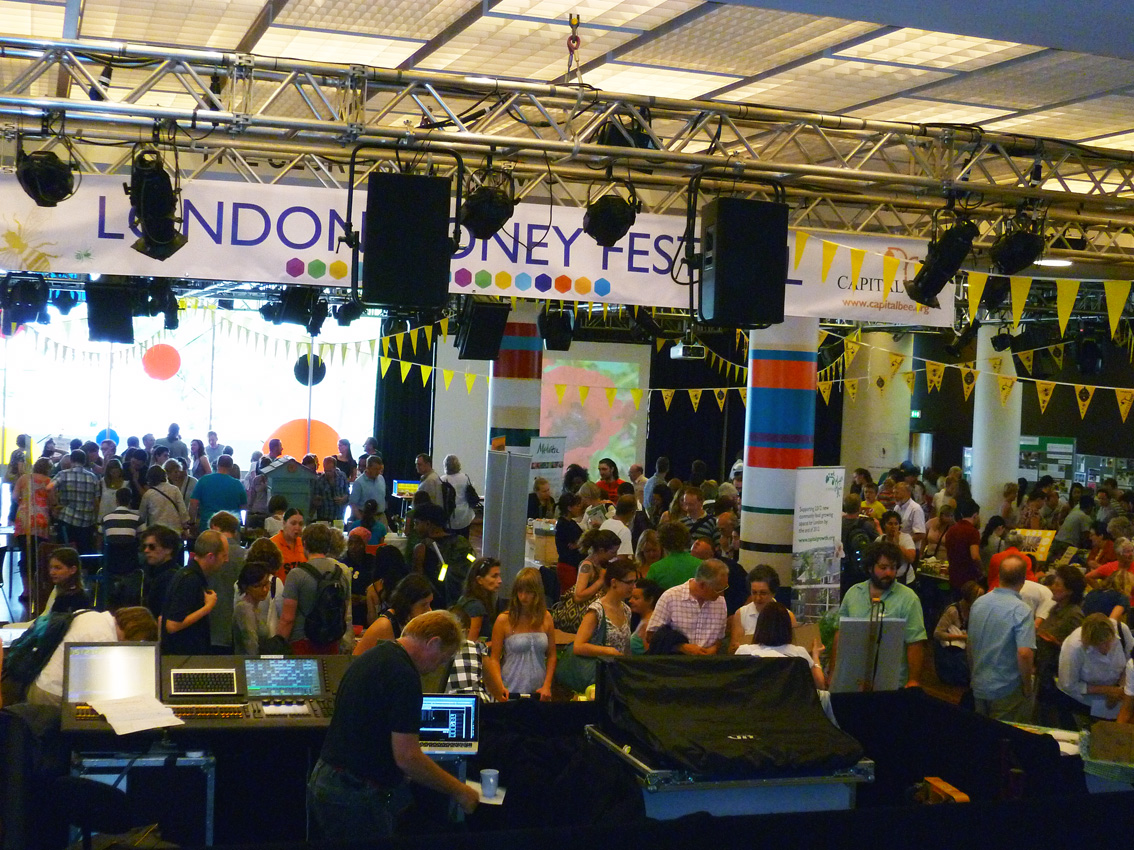
I went to the London Honey Festival on Sunday hoping to eat more honey than Pooh. The seasonal festival celebrated the capital’s honey crop and offered honey tasting, honey massages, bee-themed music and movies, and a chance to meet your local beekeeper.

The London Honey Festival at Royal Festival Hall, Southbank, London on Sunday 21 August 2011. The five-hour festival was sponsored by Capital Bees and free for beekeepers and the public, and for bees.

With over 2,500 hives in the city, you are never far from a bee, and at a bee event you are never far from a beekeeper. So I was surprised to see so many non-beekeepers. People are more curious than bears about bees.

Who will bring the best honey in all the land?

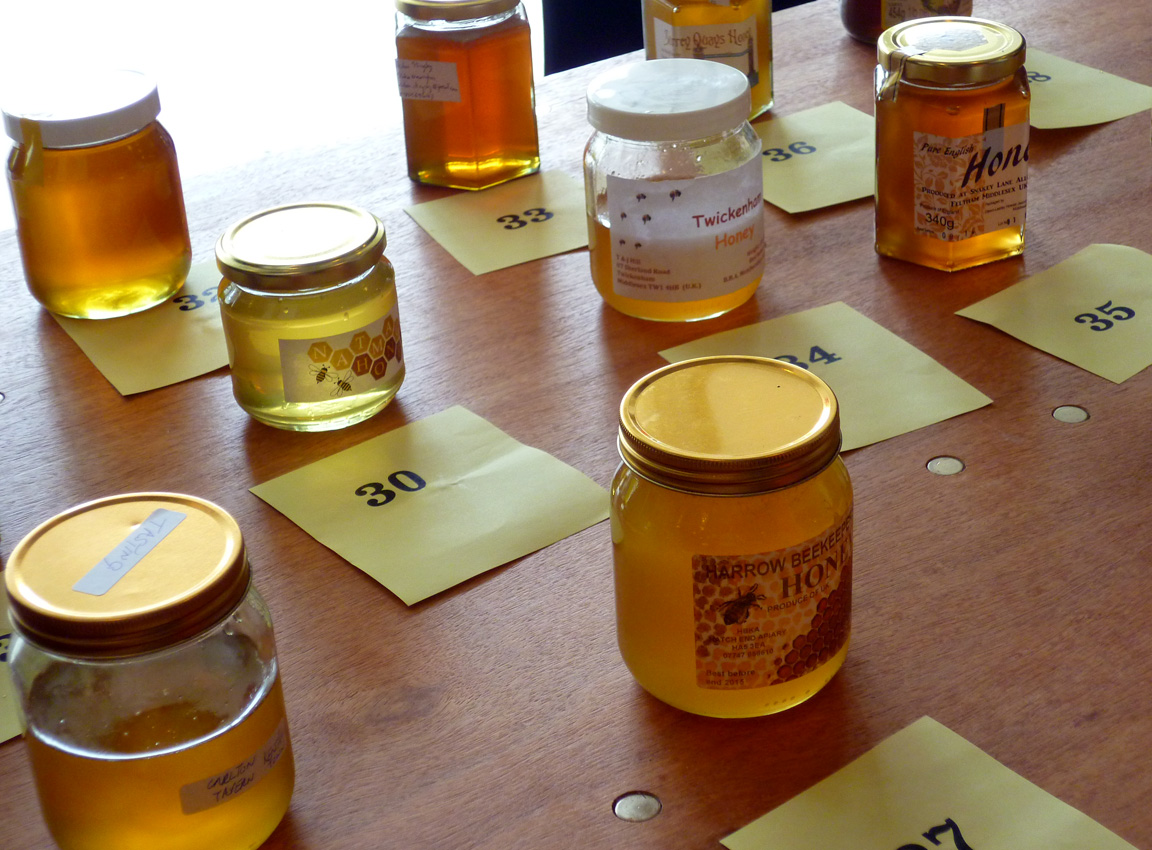
The honey tasting was easy to find with people lining up like drones. Little pots of sugary goodness in more varieties of gold than an alchemist’s workshop. Heavy-scented floral flavours, mellow fruity fragrances, and subtle citrus aromas reflected the wide range of London forage. Town bees have more choice than their country cousins thanks to imaginative urban gardening, city parks and allotments.

My favourite honey made me think of my old bees, who made a beautiful, delicate honey that tasted of lime blossoms and was the colour of sunshine.

A honey map of London showing where urban bees like to forage.

Emily and I have been guessing all year where our bees fly off to collect their pollen and what their favourite flowers might be. Many of our ladies have been returning with white stripes on their backs from Himalayan balsam and I spotted a forager return with more blue pollen in her basket last Saturday, which might be from poppy. Our honey crop this August was thick like treacle, amber-gold and mildly floral. Any ideas where our bees like to hang out?

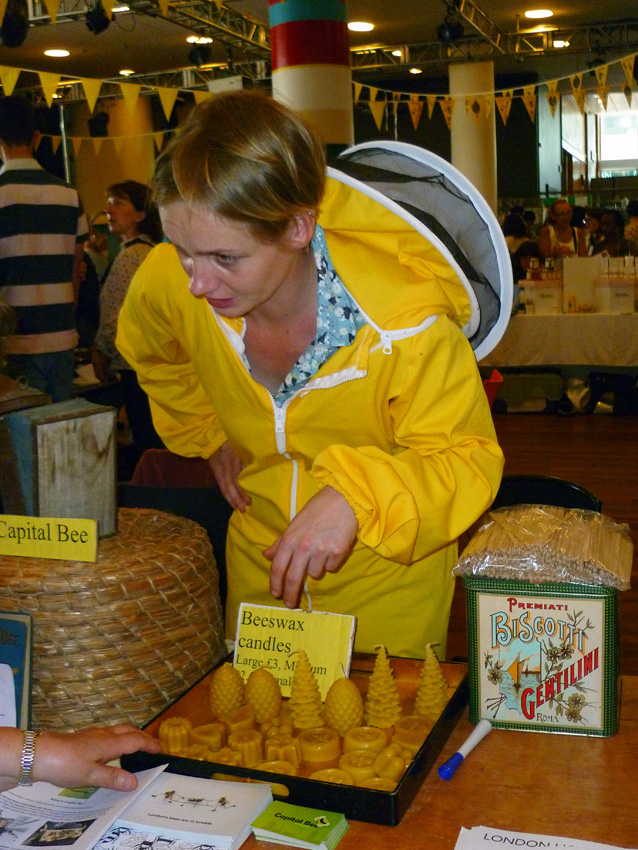
I love that beekeeper's suit!

Every stall at the festival had a crowd of people fascinated by the magic of keeping bees. There was also a lot of information on how to help London’s bee population by growing bee-friendly plants or your own fruit and vegetables. People really wanted to know how they could help even if they couldn’t keep a hive.

From far right: Ron (beekeeper), Doreen (beekeeper by proxy), me (beekeeper) and Andy (the man who set us on this dodgy path)

It wasn’t long before I bumped into Andy, who introduced me to some Federation beekeepers, and a bit later we were spotted by more familiar faces congregating around the Middlesex stall.

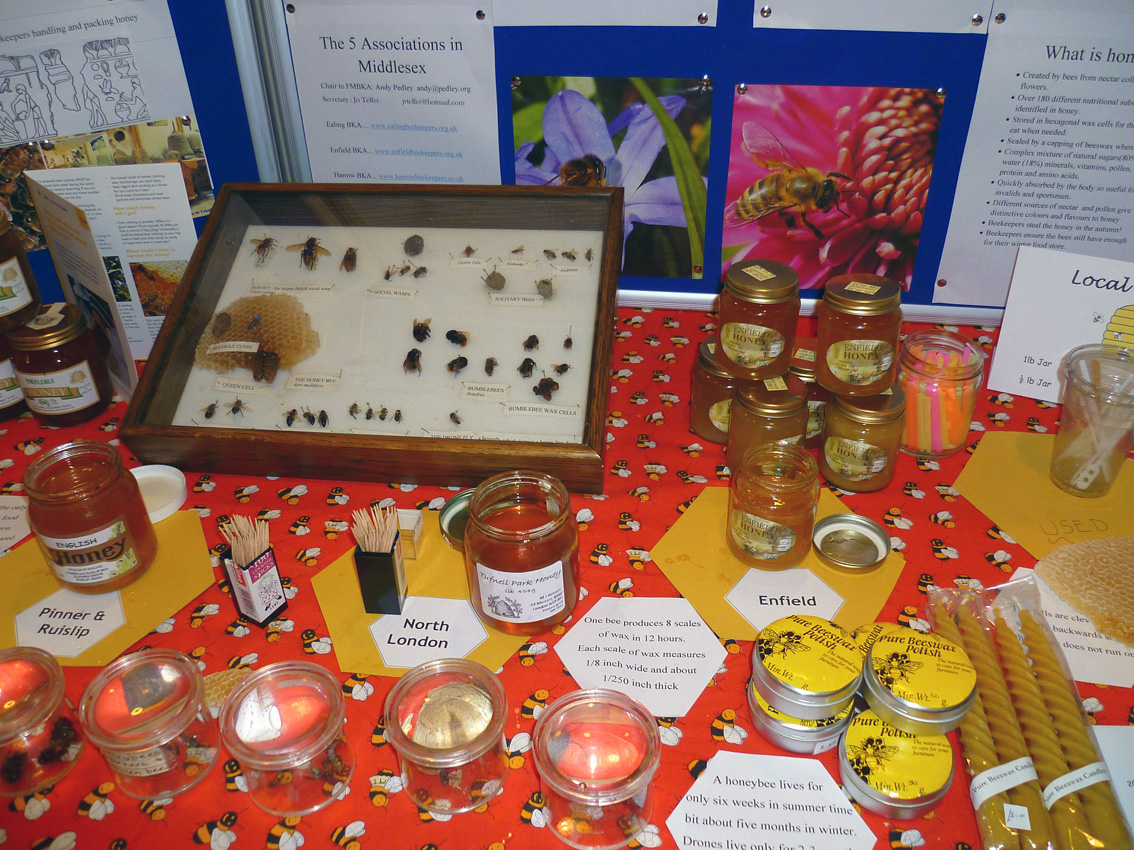
The Middlesex Federation Beekeepers stall neatly displays bees who died in suspicious circumstances.

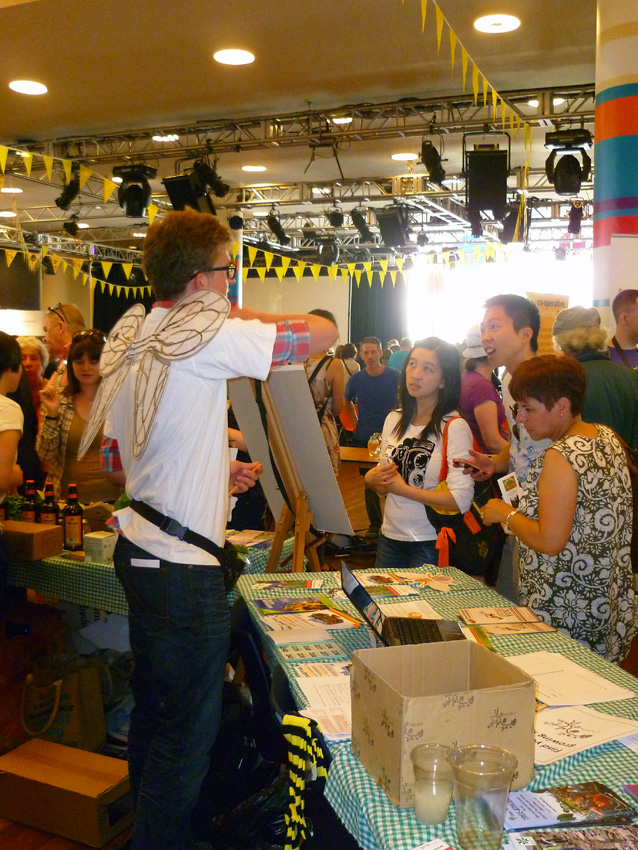
Fortunately, no one noticed that I was wearing a Capital Bee badge. I’m not a splitter, but I got pinned by a man wearing wings while signing up my pledge to help London bees.

He's got wings.

There were no tea stalls, but there was an observation hive…

Who's watching who?

And bumble-bee making…

Bumble-bee making ages 4–99 years. Mmm.

And honey jam…

London honey jam is jammin'

Sadly, I don’t have a honey stomach like bees. After finding out that there is actually a limit to the amount of honey I can eat in a few hours, I went for chowpatty on Southbank beach and a stroll in the sunshine along the river.

It did the trick and when I got home I was happy to discover a piece of chocolate-honey fudge in my pocket to enjoy with a cup of tea.

Bee celebrity.

The London Honey Festival was sponsored by Capital Bee, which is a Capital Growth campaign for community beekeeping in London. Capital Growth aims to support 2,012 new community food-growing spaces for London by the end of 2012.

Capital Bee is asking Londoners to support their local beekeepers and bees by growing bee-friendly plants and buying bee-friendly food. To pledge your support click here.

How to extract honey

In the UK the honey harvest usually starts around July until August. When all the honey on a frame is capped it is ready to harvest.

I wrote this post one year ago on my old blog and, with the exception of a few edits, the process of clearing bees and extracting honey are the same. Our adventures took a few different twists and turns this summer, but here is how it’s supposed to be done.

I am aware that this is a slightly long post, so I have divided it into two parts and an addendum:

Part one: How to clear bees
Part two: How to extract honey
Addendum for treacle honey

It has been a good beekeeping year and you have a super or two of frames filled with capped honey. Great, but how do you get hold of it?

Part one: How to clear bees

Step 1: Clear bees from the supers

First, you need to remove the honey from the hive. Guarded by about 50,000 bees this could be Mission Impossible, but is in fact only Mission Slightly Difficult. There are these handy little inventions called ‘bee escapes’ that allow bees to leave supers, but which do not let them back in. You can get various bee escapes from beekeeping suppliers with instructions for use. I am reliably informed that rhombus escapes are very good, but we used Porter bee escapes and they worked quite well.
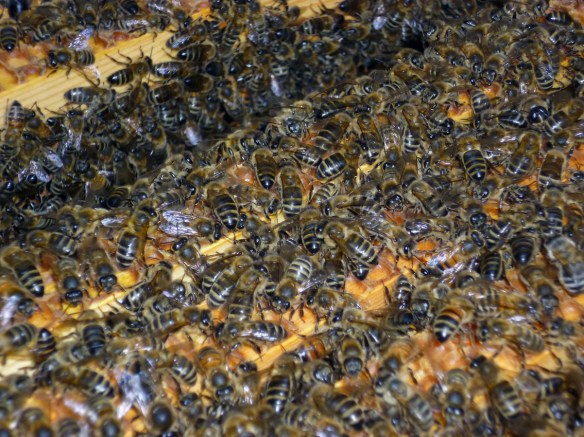
Bees don't give up their honey easily. Clearer boards trick them into leaving the supers overnight, so you can harvest a bee-free honey crop the next day.

Ideally, you need two crown boards to carry out the process of clearing bees from the supers. Place a crown board between the brood box and supers with the Porter bee escapes in the two holes.

The second crown board (with something covering the two holes like a tile or brick on top) should go on top of the supers before you put back the roof. This is because you are now going to leave the hive for 24 hours or overnight, during which time supers will be cleared of bees and left vulnerable to robbers. 24 hours is more than enough time for wasps to invade and clear out your honey. Check your hive, particularly around the roof and supers, for any holes or gaps, and seal with tape. Wasps are crafty.

Step 2: Remove the supers from the hive

Return to your hive 24 hours later and find the supers almost empty of bees. A bee brush or shaking can help to remove any remaining stragglers from the frames, before you take the supers back to your kitchen to start extracting honey.

If, like me, you have a kitchen in a studio flat not big enough to swing a cat, you will want to make sure you don’t bring any bees. Trust me, it’s not fun sharing your flat for a night with about 50 lost bees. You won’t sleep.

Your bees will try to help extract your honey unless you shake or brush off stragglers and quickly cover the frames.

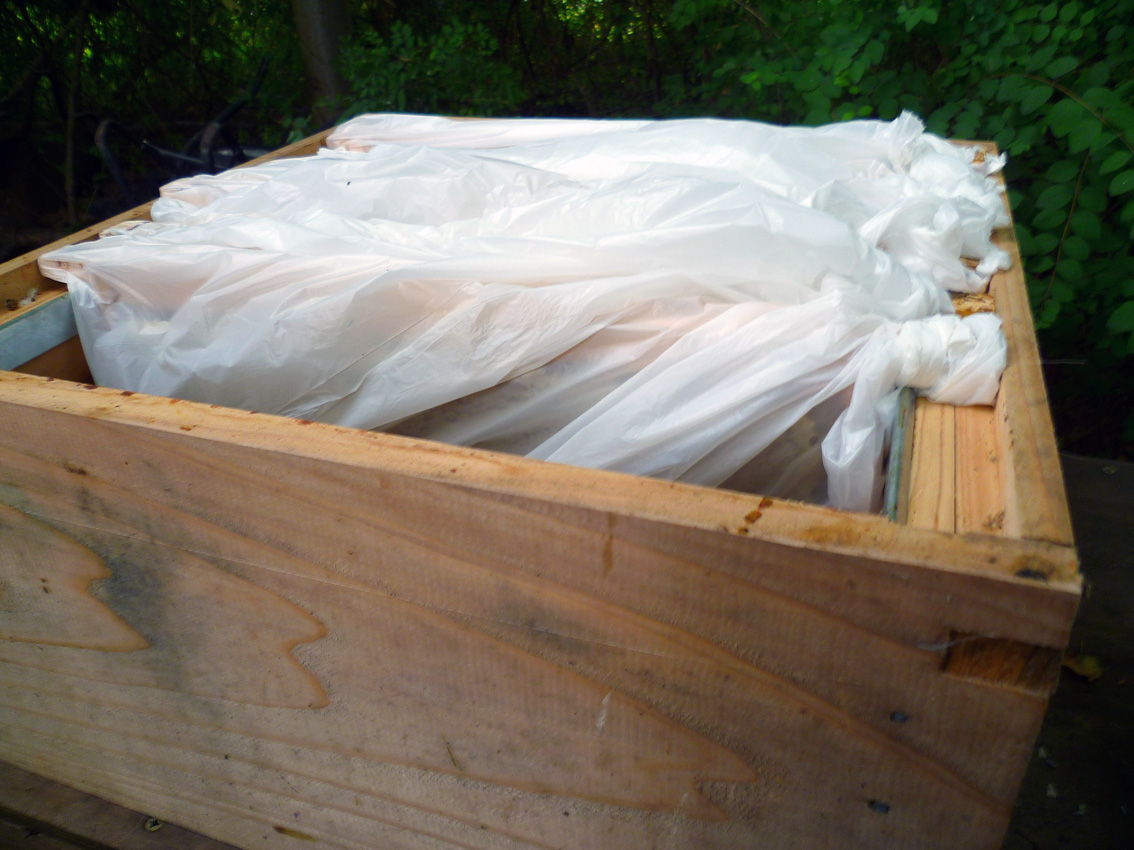
So if you are super-organised (sorry for the pun), go to the hive with a partner in crime. Shake and brush bees off the frames, then quickly wrap each frame inside a plastic bin liner and hang on an empty super. This method makes sure that no bees hitch a ride back home.

This is a more laborious method of taking honey off the hive, but well worth it to take home bee-free frames. Emily and I did this, and enjoyed a bee-free extraction process.
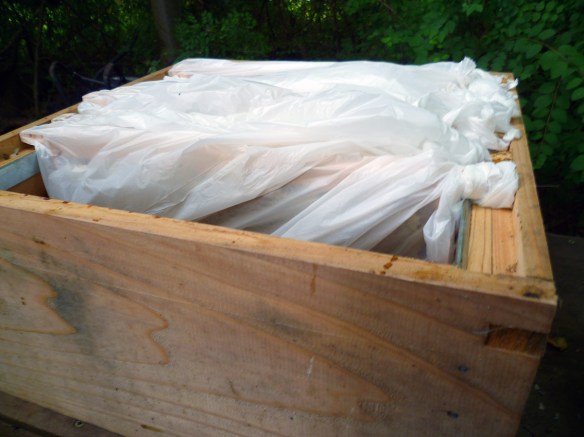
My dad, who is highly suspicious of bees, was secretly relieved we brought home bee-free frames.

Back to top

Part two: How to extract honey

Step 1: De-cap the honey

Ok, so that was actually the ‘slightly difficult’ bit. You have your supers, or box with honey frames, standing on your kitchen work surface. Now you need:

  • A de-capping fork
  • A centrifugal extractor
  • Buckets to collect your honey
  • A kitchen wire mesh strainer
  • Storage jars and labels

All of the above can be purchased at Thornes.

Be careful to keep your work area dry and free from water. Water is the enemy of honey.

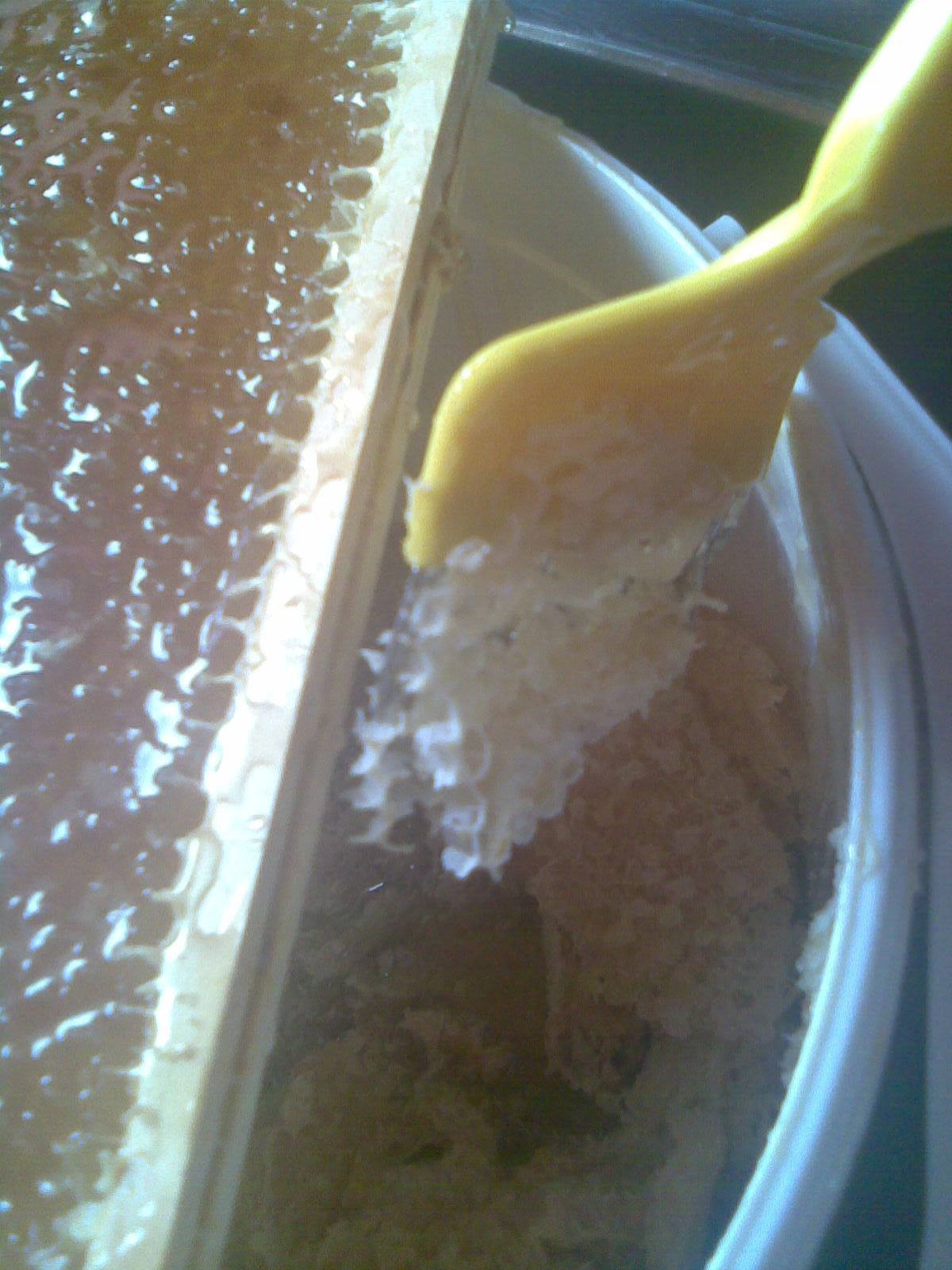
Take a frame and place it over a bucket. Use the de-capping fork to run along the surface of the honeycomb and remove the wax caps. Super easy!
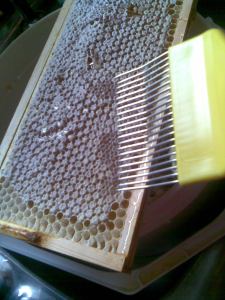
Hold a frame of honey over a bucket, and get a de-capping fork to take off the wax caps of the honeycomb
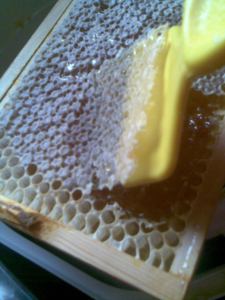
Run the fork lightly up the frame to remove the wax caps. Turn over the frame and repeat on the other side. Some honey will drip into the bucket but can be drained off from the wax later on
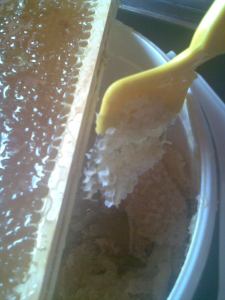
Place the wax from the honeycomb into the bucket. It can be separated from the honey dripping into the bucket at a later stage, cleaned up and used to make beeswax pellets for cosmetic recipes (face and hand creams) or to make candles

Step 2: Spin off the honey

Now place two frames of de-capped honey into a centrifugal extractor. Most are manual and are really hard work, so if you are going to do beekeeping seriously invest in a mechanical one.
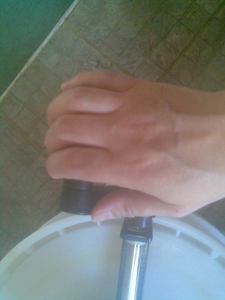
A centrifugal extractor has a metal basket in which to place frames of honey. Put on the lid and spin the frames round as fast as possible for about a minute. Then turn the frames around inside the extractor basket (so that the opposite side of honeycomb is facing out) and spin again
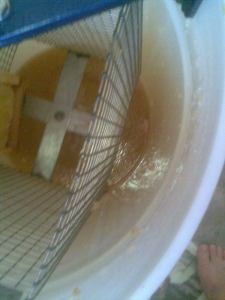
Honey spun off from the frame at the bottom of the extractor
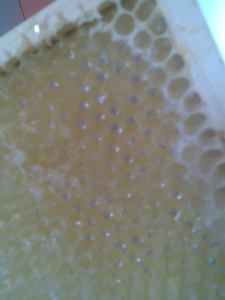
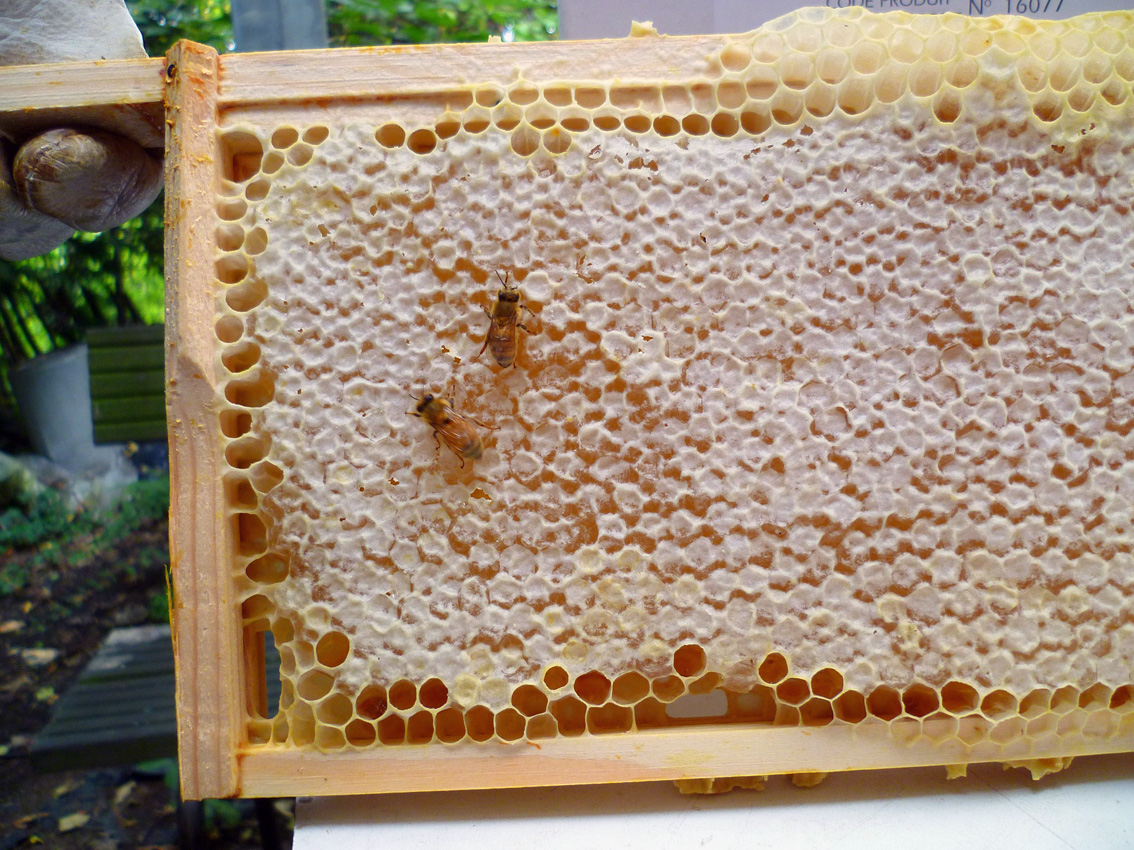
A frame of honeycomb with the honey spun out. You'll notice how much lighter the frames are when you remove them from the extractor

Step 3: Drain off the honey

Spin off as many frames of honey as you can in the extractor until the level of honey at the bottom starts to reach the metal basket. It is harder to spin round the extractor with honey restricting the motion.

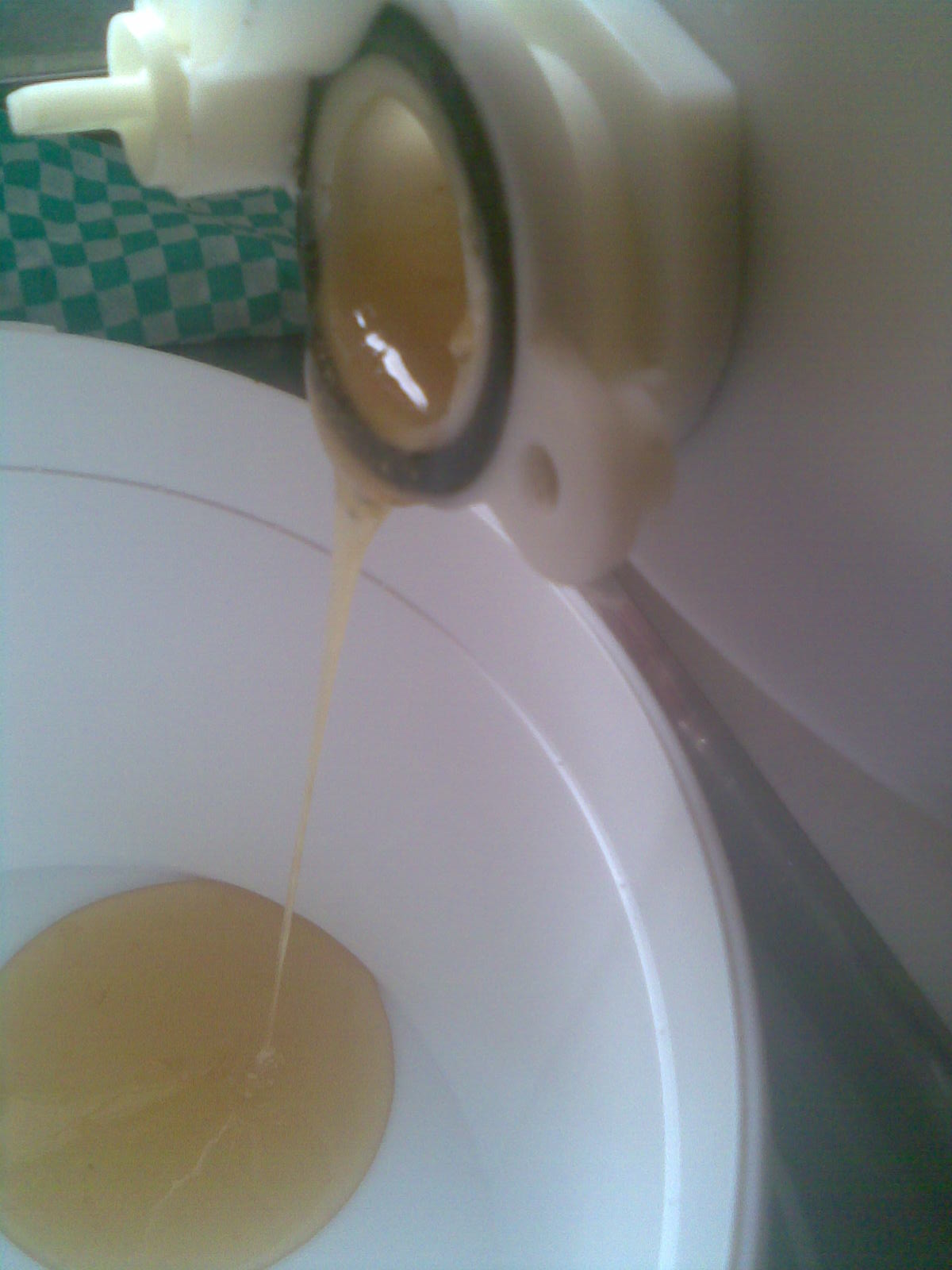
Lift up the centrifugal extractor to the kitchen work surface (if it is full with a couple of litres of honey, you may need someone to help you do this) and put another bucket in the sink. Open the tap of the extractor and let the honey pour out. Some manipulation of the extractor is needed to get the last dregs of the honey out.

It takes one bee a lifetime to collect one teaspoon of honey, so try and get every last drop.

Open the tap of the extractor and let the honey pour out into a clean honey bucket
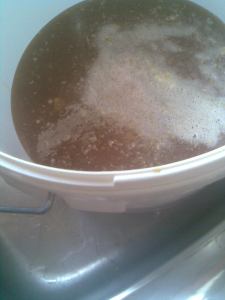
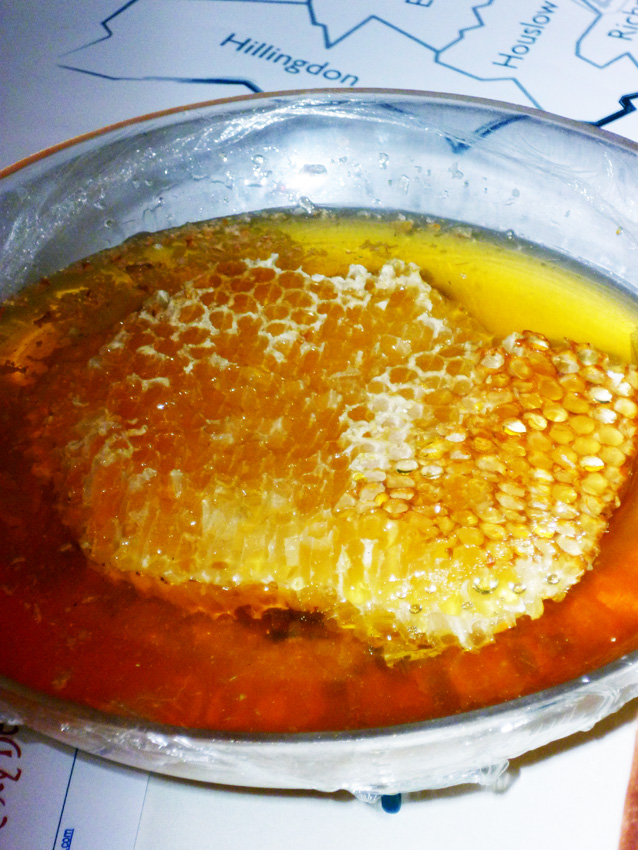
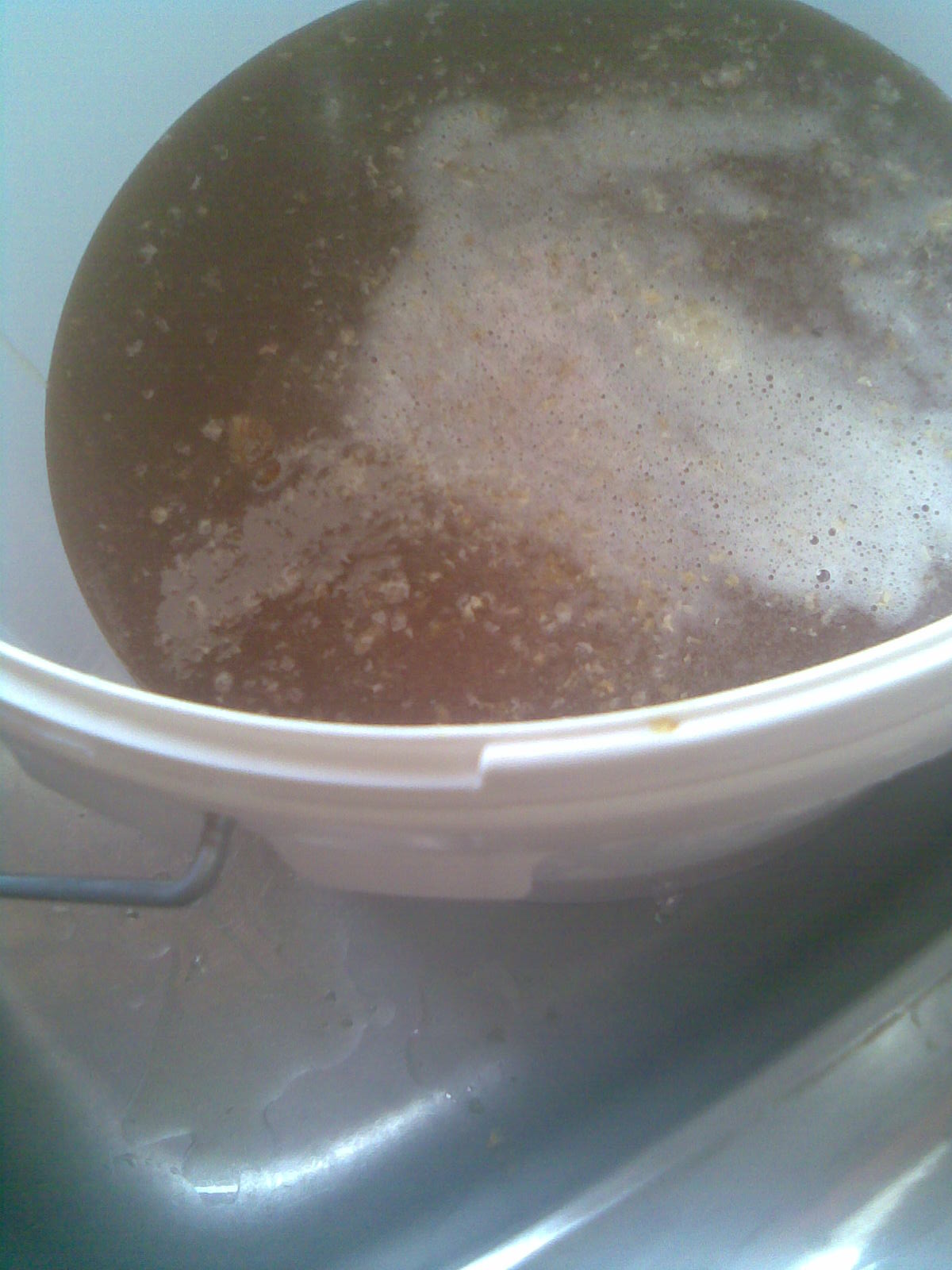
A bucket filled with freshly extracted honey ready to be filtered and strained off into glass jars

Step 4: Products of the hive

Remove the froth from the top of your extracted honey into separate containers. This can be used as a ‘marmalade’ on your toast or fermented for mead. As enjoyed by Vikings – ARG!

Filter honey from the buckets through a kitchen strainer into jars and label for family and friends.

Filter the honey in the bucket of wax to ensure you get as much honey harvested into jars as possible. Clean the wax in warm water and leave to dry. You can mould beeswax into pellets for beauty products or use to make candles.

Clean the extraction equipment, including centrifugal extractor, with washing soda and scrubbing brushes to get rid of stubborn sticky bits.

Simples.

Back to top

Addendum for treacle honey

My old boss, Bob Allan, kindly gave me his electric honey extractor this year. Bob used to keep bees but he gave up the craft, because his mother-in-law was allergic.  ‘One
winter the hive died out,’ said Bob. ‘It seemed only polite not to re-stock the bees.’ Most beekeepers at my apiary have balked at this. However Bob says, ‘I am rather fond of my mother-in-law’.

After last year’s hard graft of extracting two supers of honey manually, I was excited to try the mechanical extractor. Disaster! The first three frames almost spun apart on the highest setting. So we cleared up and started again, this time using a lower setting. Nothing. Our honey was like treacle! It didn’t even drip out of the comb when we de-capped it.

Plan B. So we decided to make cut-comb honey instead. An evening of delicate operations began and the result was rather spectacular.
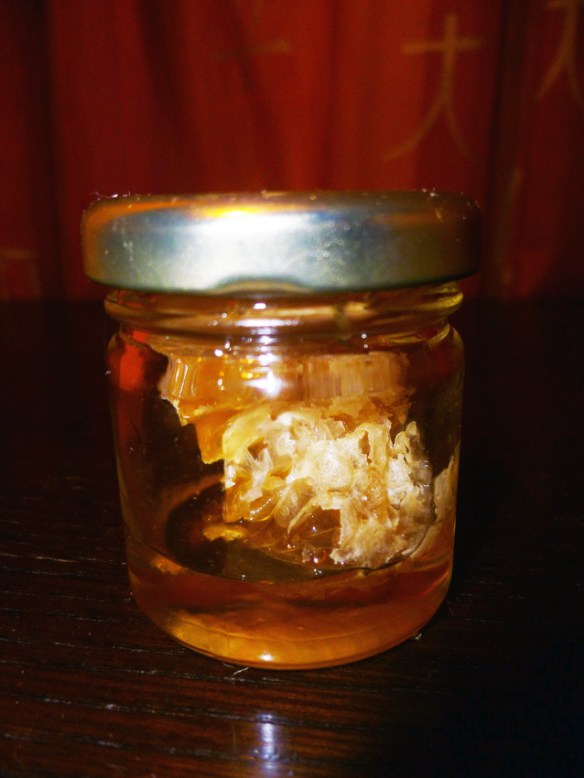
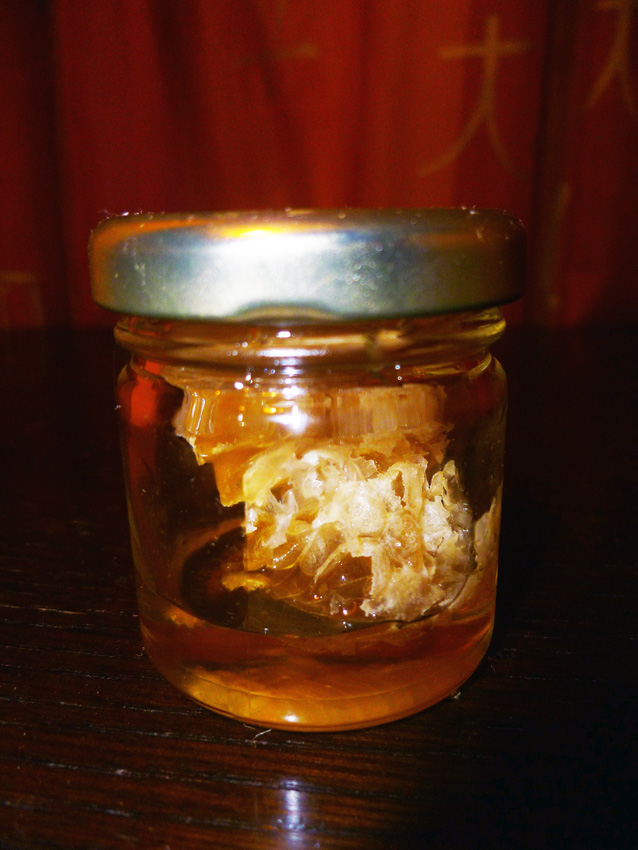
Taster pots of cut-comb honey for all our family and friends.

You can read all about it on Emily’s blog: Hunny time and Bringing home the hunny!

This post is dedicated to Bob Allen, who retired as medical director of publications at the Royal College of Physicians this year and to who we said a fond farewell, and to my dad who let us take over his house to extract our treacle honey.

Back to top