

Emily and me did less tea drinking and more proper beekeeping last weekend, captured beautifully on camera by Emily's 'entourage' Drew Scott!
Things can happen fast in bee-land. Barely a month has passed since the Bailey comb change, but there has been a drone-laying queen, a suspected case of foul brood and the unexpected appearance of a virgin queen. That’s just one hive. I sat on this post for a while thinking back on the lessons learned in the past few weeks.
Rain had prevented our hive inspections for two weekends following the Bailey comb change, but when the sun came out after Easter bank holiday Emily went to check on our bees. What she found inside Queen Rosemary’s hive would worry most beekeepers, so she raised the alarm by emailing the secretary of our association, Andy Pedley.
‘I am worried our hive has some kind of brood disease,’ wrote Emily. ‘There is virtually no healthy worker brood, lots of drone brood, and some dried up larvae, some that look a bit scaly, and some that look a bit bloated.’

Emily thought our bees were grumpy and a bit aggressive, which can be a sign of a failing queen or being queenless. She spotted cells filled with pollen with a film of honey on the top, which can also indicate being queenless.
Andy is a very experienced beekeeper, a sentinel apiarist for the Middlesex area, and apprentice to the queen’s beekeeper, John Chapple. So he really is the bees knees! Andy offered to meet at the apiary on Saturday to test our hive for bacterial disease.
What followed was a week of worry as I wondered how our bees could have declined so quickly. At the last inspection every cell in every brood frame had been scrutinised while we tried to find the queen and eggs, and there was no sign of disease. But now we had a suspected brood disease like European foul brood (EFB), which is not good but can be treated, or American foul brood (AFB), which is untreatable – destroy the hive, burn the remains and salt the earth!
I downloaded these educational images of EFB and AFB from the National Bee Unit.

Healthy bee larvae are curled in half-moon shapes inside cells and are pearly white with yellow tummies from the pollen that they eat. © Crown copyright 2010

Unhealthy brood with EFB look misshapen, dark and slimy. © Crown copyright 2010
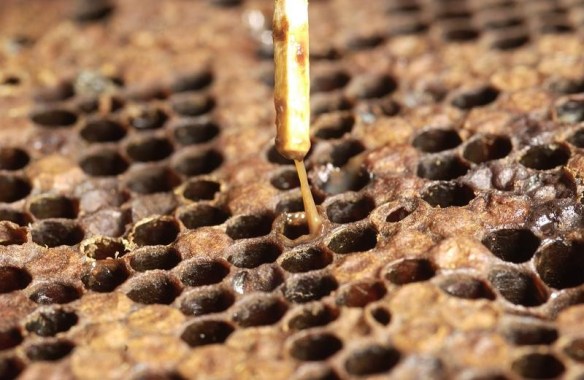
The classic 'snot test' for AFB, a matchstick is dipped into a cell – if a stringy mess of slime is pulled out there may be bacterial disease. © Crown copyright 2010
On Saturday we arrived at the apiary to find Andy was already there. When I told how beekeepers from New York had kindly tried to help identify the brood disease on Emily’s blog, Andy shook his head in amazement and marvelled at the inter-web, then he said cheerfully, ‘Right, let’s go have a look’.
Andy used tweezers to pull out and examine a few larvae, then disposed of them in the smoker for hygiene. The first few were healthy white grubs with yellow tummies from the pollen they had eaten. So far so good. He then found a couple of larvae that were discoloured and slimy, and used the EFB and AFB kits to test for disease. The kits are similar to pregnancy tests: a sample is dropped onto an indicator, then you wait three minutes and…

One larvae is popped into a vial of spirit and shaken. It is important to use only one larvae for the test or this can affect the results, Andy explained, because EFB is always present in bee colonies at low levels.

Andy used a pipette to drop a sample on the indicator. Then we waited three minutes. Breathe.

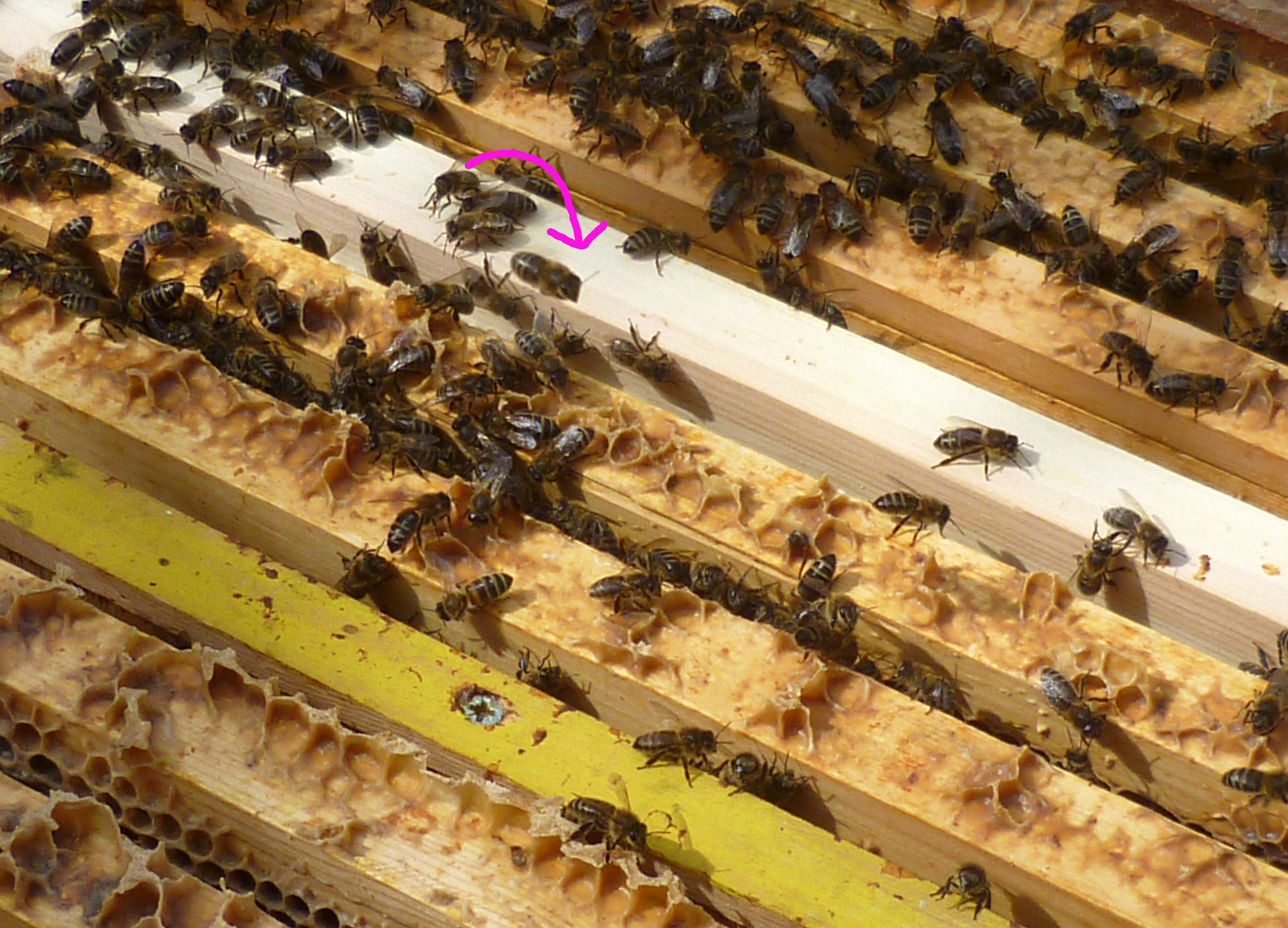
One line under 'C' for 'control' is a negative result, two lines under 'C' and 'T' for 'test' is positive. Both our tests for EFB and AFB only had one line under 'C', phew! You can't see it clearly on this photo so I have drawn a pink line.
All clear! Both tests for bacterial disease were negative, phew! But it was not over…
This was not a case of EFB or AFB but a lack of TLC. The larvae had become cold and hungry because Rosemary was a drone-layer, explained Andy, so there were not enough workers inside the hive to nurse the baby bees. Unless the queen was replaced the whole colony would die out.
This is the moment I had been dreading as a beekeeper – disposing the queen for the good of the hive. In the past, our bees have been very good at superceding their own queens, and Emily and me have preferred to let them do this. However, they may have been unable to supercede Rosemary without enough viable fertile larvae. I felt I should step up to the plate and get the job done, but Andy kindly and quickly did the deed. It seemed fitting because he has a history with our flighty queen.

Andy mashed the honeycomb around the young larvae to encourage the bees to find it and build a queen cell.
Blissfully unaware of the untimely death of her sister, we took a frame from Queen Lavender’s hive that had young worker larvae and placed this inside Rosemary’s hive hoping that our bees would now raise a new queen. Andy mashed the honeycomb around the larvae to encourage the bees to find them and build queen cells.
A frame of young larvae placed in Rosemary's hive so her daughters can raise a new queen to ensure the colony survives. They will have to work fast as there are not many workers left, I caught one on camera immediately flying over the frame to where we had put the new larvae.
Lavender’s hive was thriving with healthy-looking bees, lots of workers and brood. I found Lavender happily climbing on a frame so we caged her to complete the Bailey comb change. With Lavender now in the top brood box and queen excluder beneath, all the bees can move up into their new home.

Emily releases Queen Lavender from her cage and into the top brood box. (She is the largest bee in the colony, I have put a pink circle around her.)
Emily’s boyfriend, Drew, took these lovely shots of us doing some proper beekeeping.

Looking for the queen. © Drew Scott
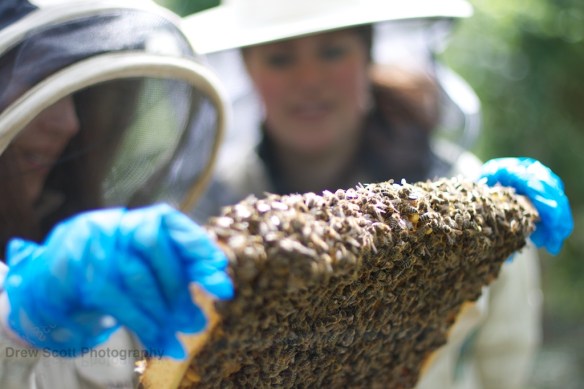
Still looking. It's difficult to spot one bee among hundreds of fast-moving insects on a frame! © Drew Scott
It was a busy day at the apiary, Andy and Pat were also shook swarming a couple of hives.

Andy shook swarming the hive belonging to David. This is a prolific colony of very fierce bees. Ghetto bees.

Drew took a shot of me shooting Pat! I gave David's bees oxalic acid treatment in December which they didn't enjoy, so I kept my distance in case they remembered. © Drew Scott
The business of beekeeping done for the day, there was still the afternoon meeting at the scout hut for the second Saturday of the month. Elsa had brought a chocolate celebration cake and I got the tea on.
On Monday the bee inspector visited the apiary and there was a surprise email from Andy titled ‘Rosemary’s baby’:
‘When Caroline checked the hive, we found an emerged queen cell in the bottom corner of one frame. Caroline then spotted a queen – very dark coloured. The frame that we put in had not got queen cells pulled out and indeed the section that was prepared for queen cells was being repaired!’

I thought we were one step ahead of our bees. Silly beekeeper. The workers were already preparing a new queen. © Drew Scott
So it seems our bees were one step ahead of us as usual, and were already raising a new queen to replace Rosemary. While we are hoping that Rosemary’s baby is not diabolical, it has inspired a name for our new queen thanks to Deborah Delong of Romancing the Bee who gave me this verse about myrrh:
‘Its bitter perfume
Breathes of life of gathering gloom.’
Queen Myrrh has emerged in a storm of rain and wind this week – not good for a virgin queen who must fly out and mate. Fingers crossed that our diabolical queen will have fair weather soon!


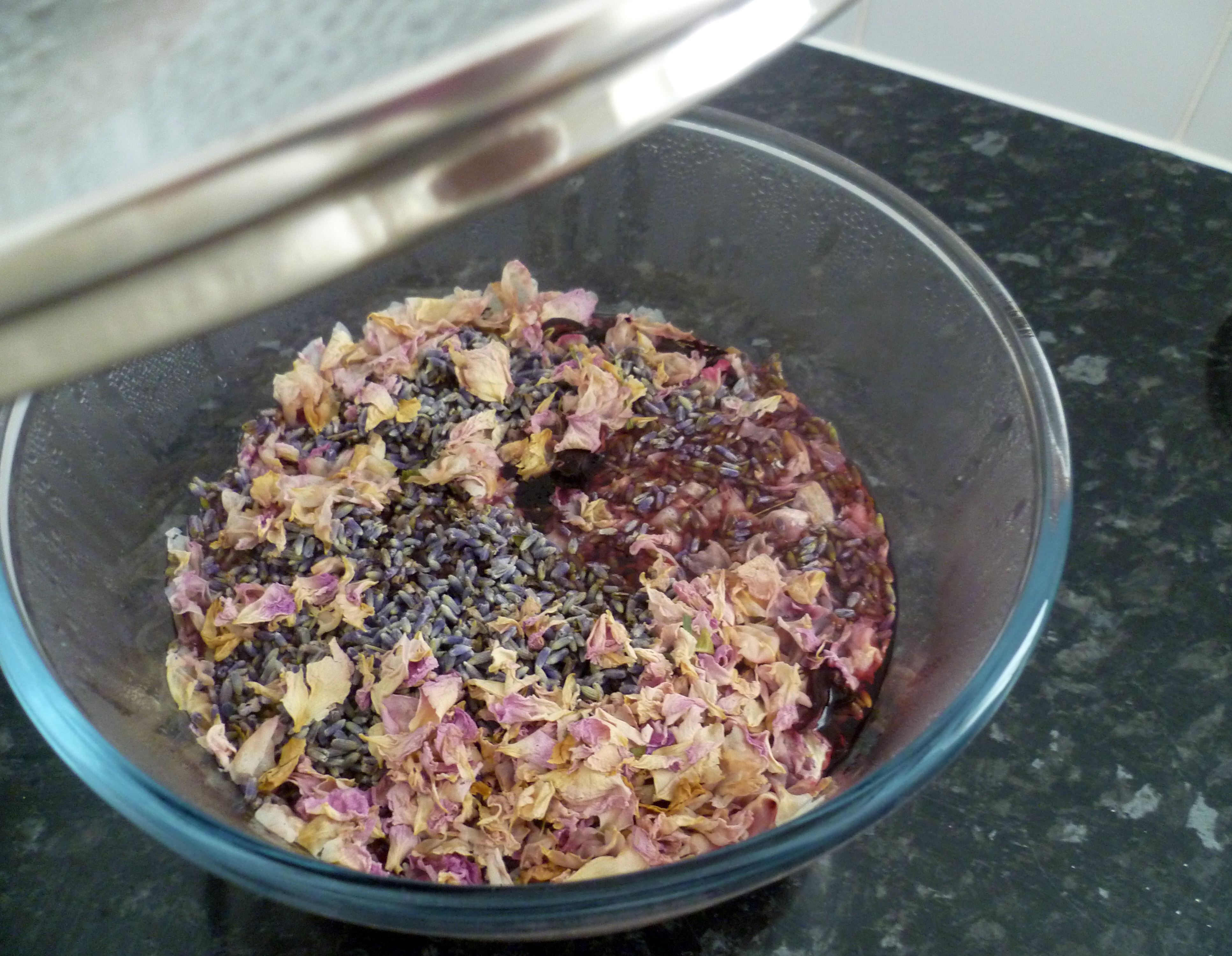


 Mrs Apis Mellifera