Too cold for a bee’s nose

001

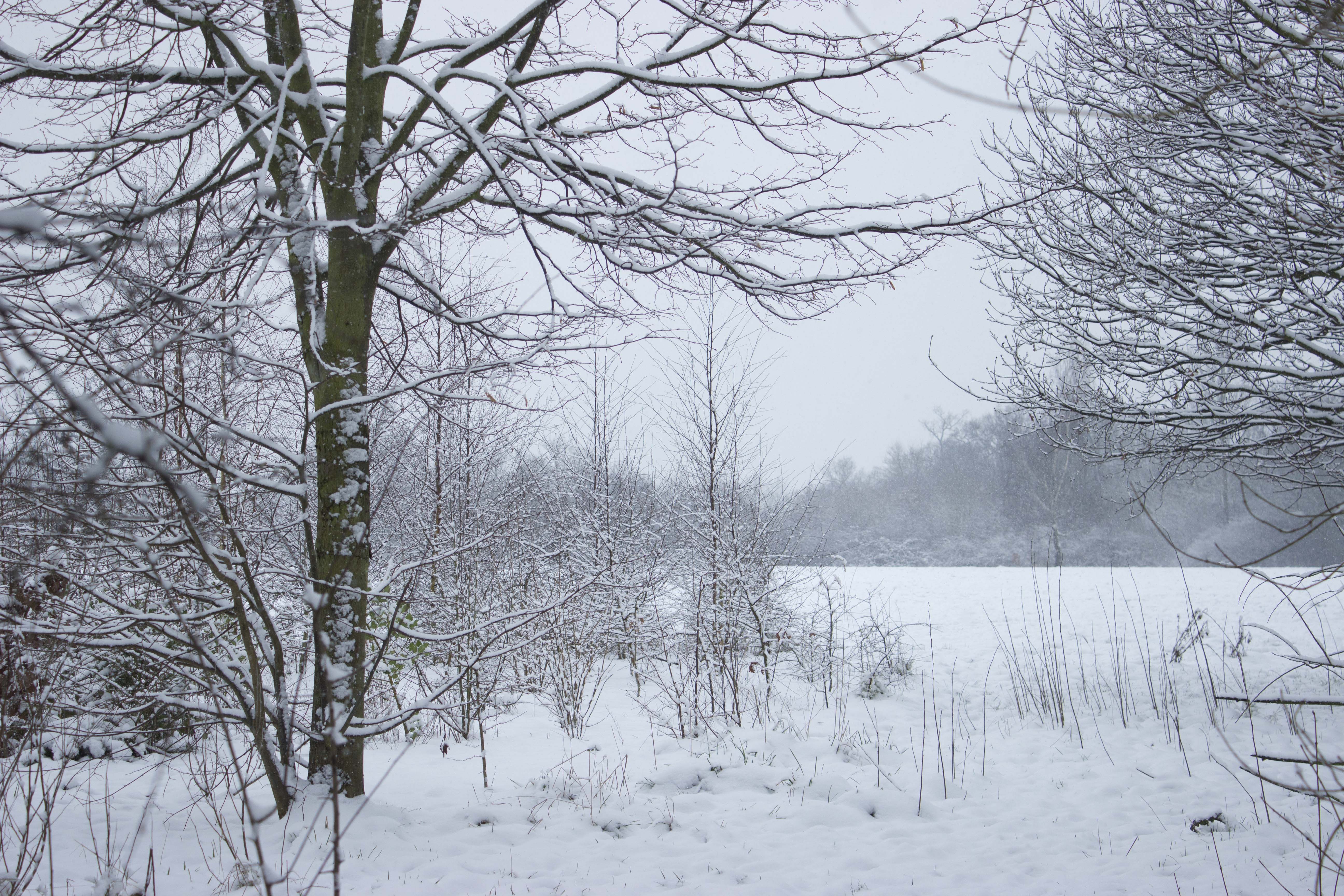
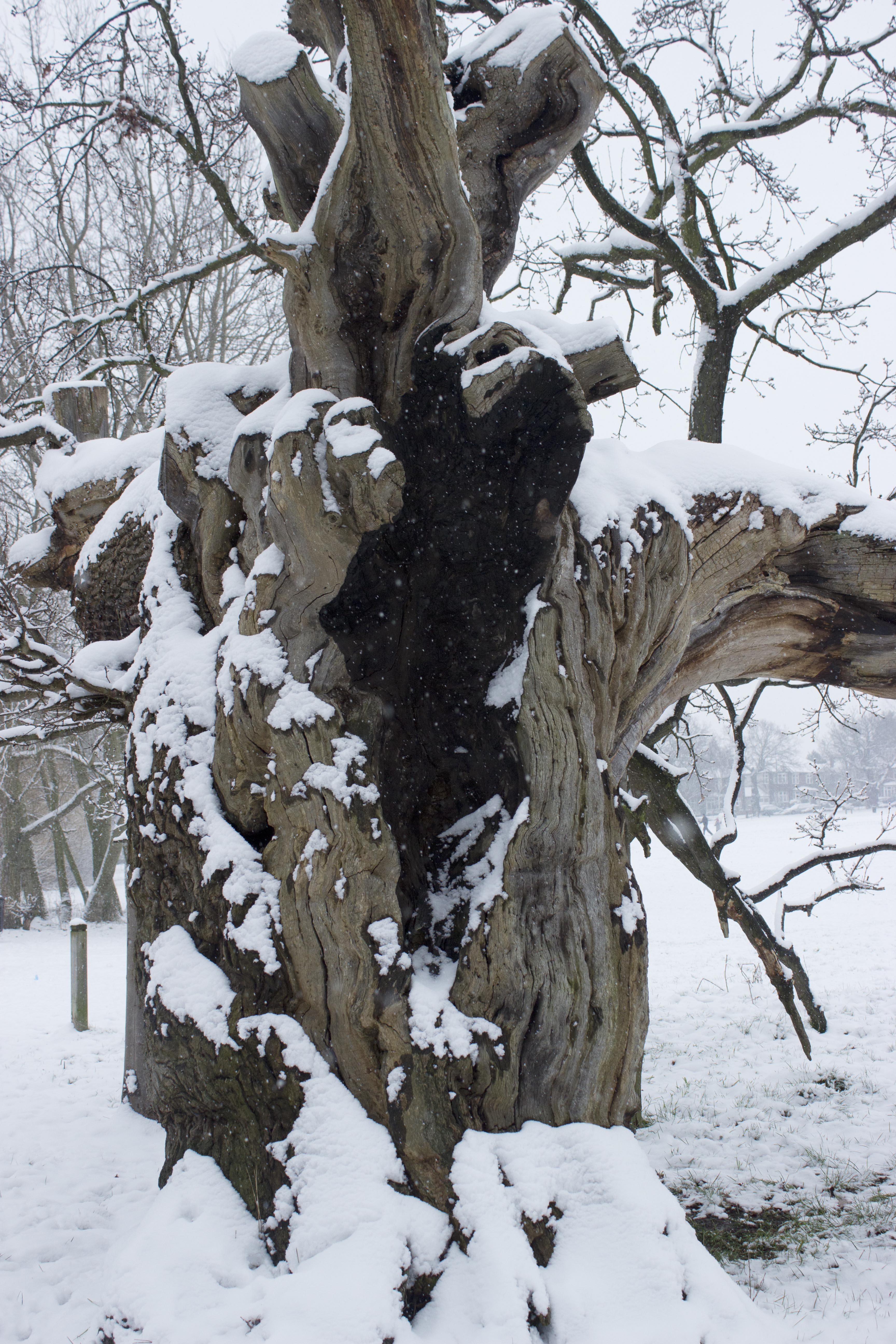
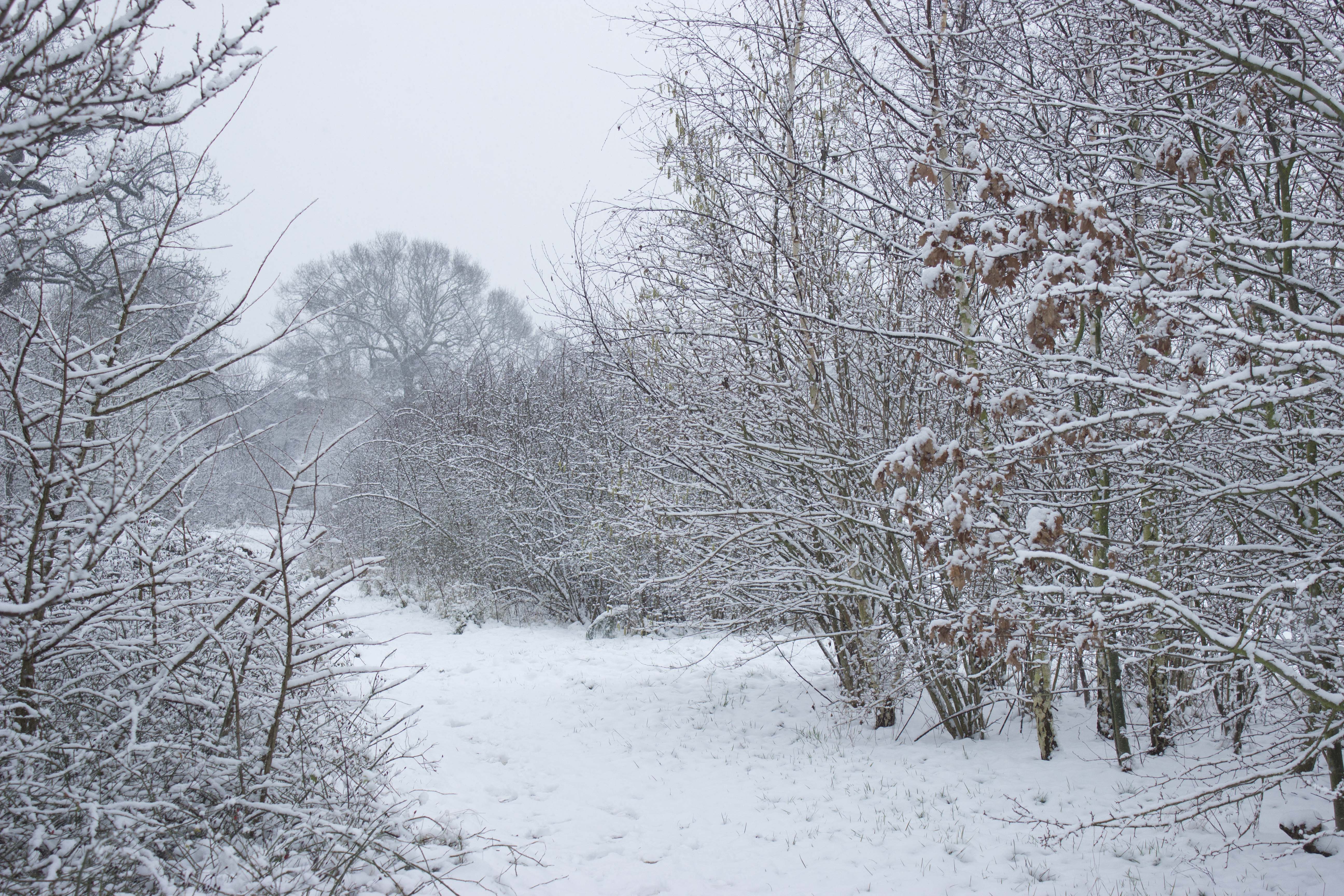
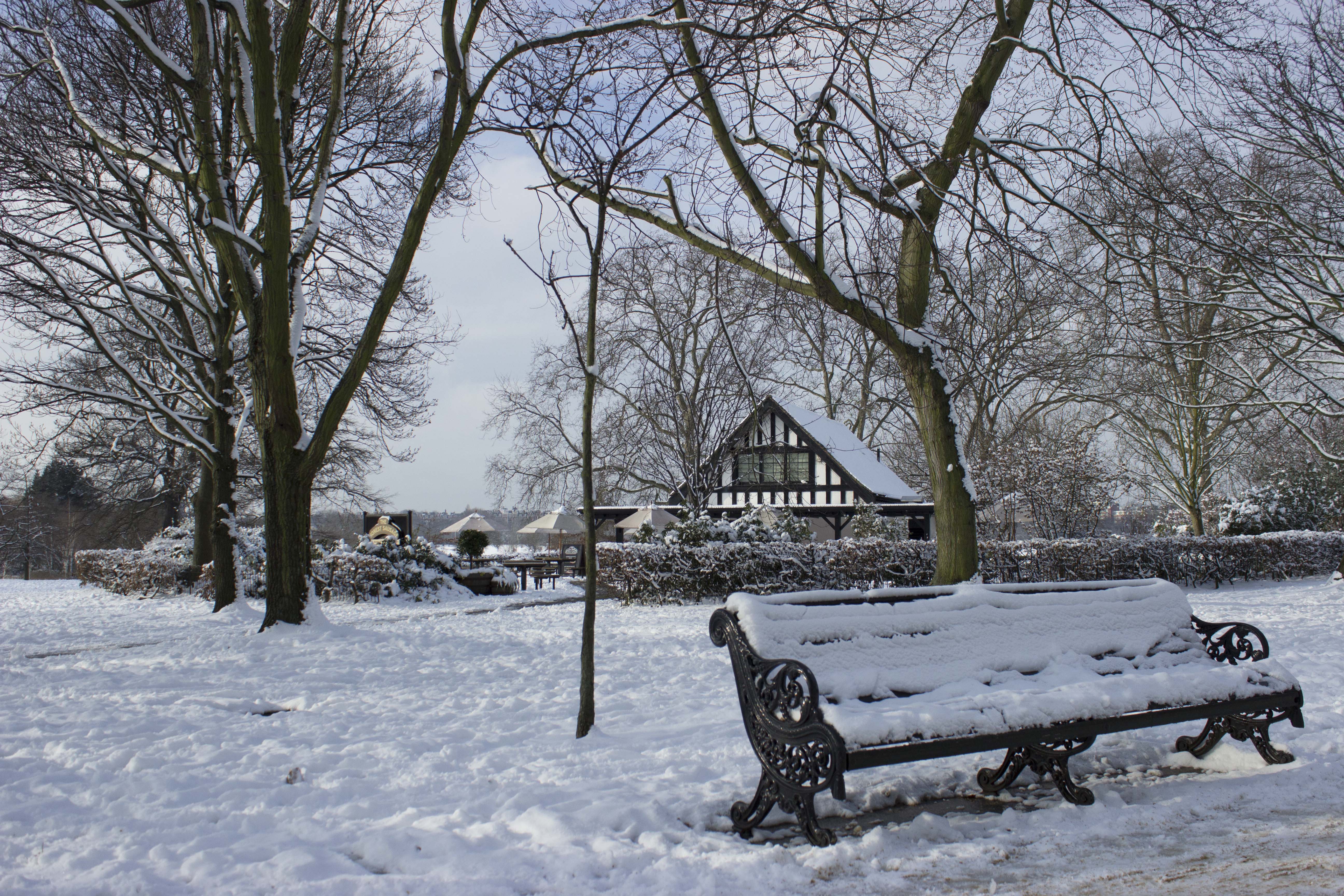
Another fine day of sunshine and showers in London and it is hard to remember that just over a week ago a blanket of snow had fallen and transformed the city into a winter wonderland. The weekend that it snowed I had been caught in a wintry blizzard when walking in Wimbledon woods and froze these scenes on camera.

002 003 004 005 006 011 012 013

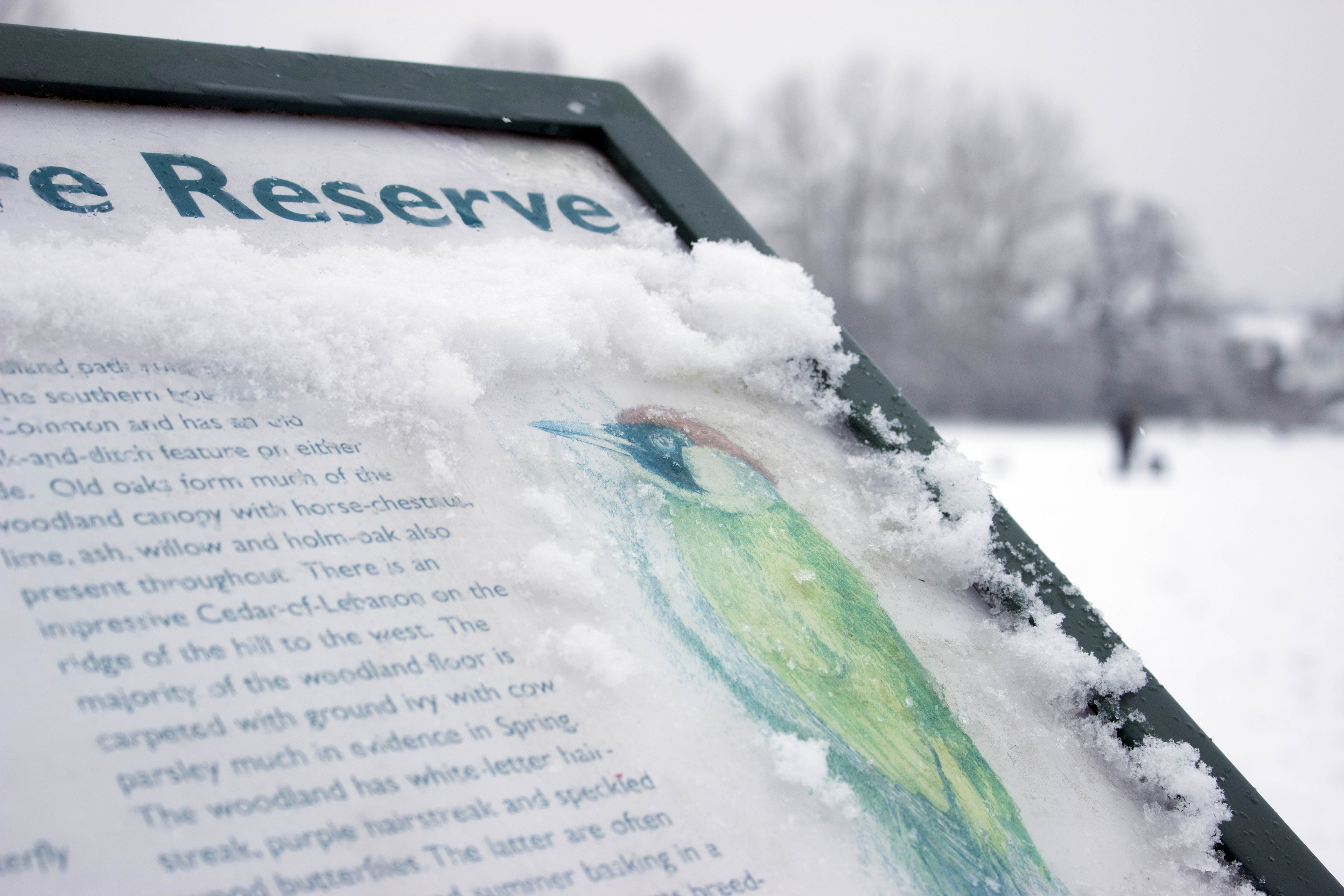
The woodlands were part of a nature reserve with signs to indicate local species, including the green woodpecker. This inquisitive bird can live in an apiary for years before, one day, it learns that tasty treats of bee larvae and honeycomb may be found inside the hives.

001 002

More on woodpeckers later…

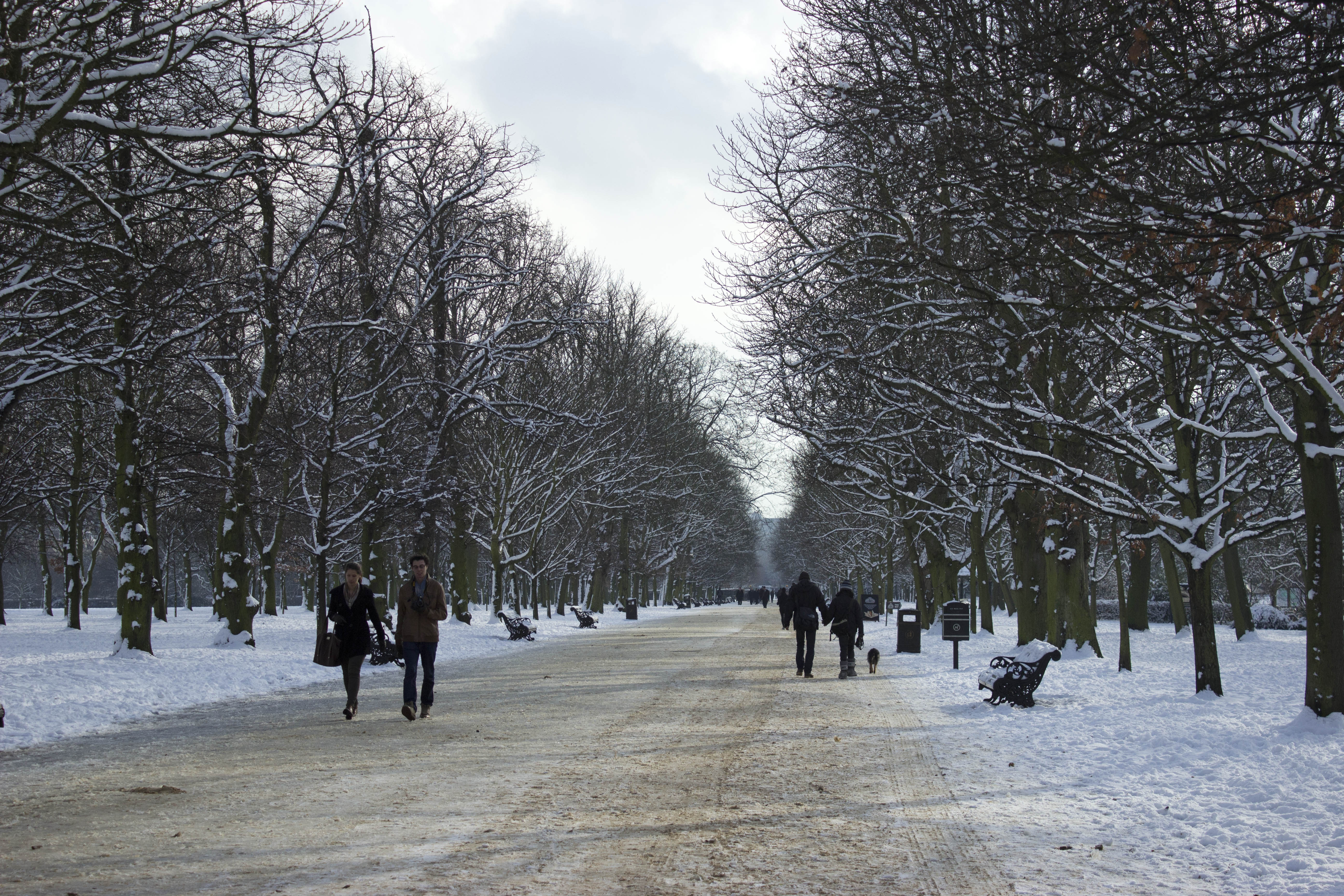
The snow had lasted after the weekend until Monday. Those who made it into work enjoyed a lunchtime walk around Regent’s Park as the afternoon sunshine took a sideways slant through the trees.

000 005 006 007 008 009 012 013 014

There was more to see than just snow – this tree has eyes!

003

And these pigeons huddled on top branches to keep warm.

004

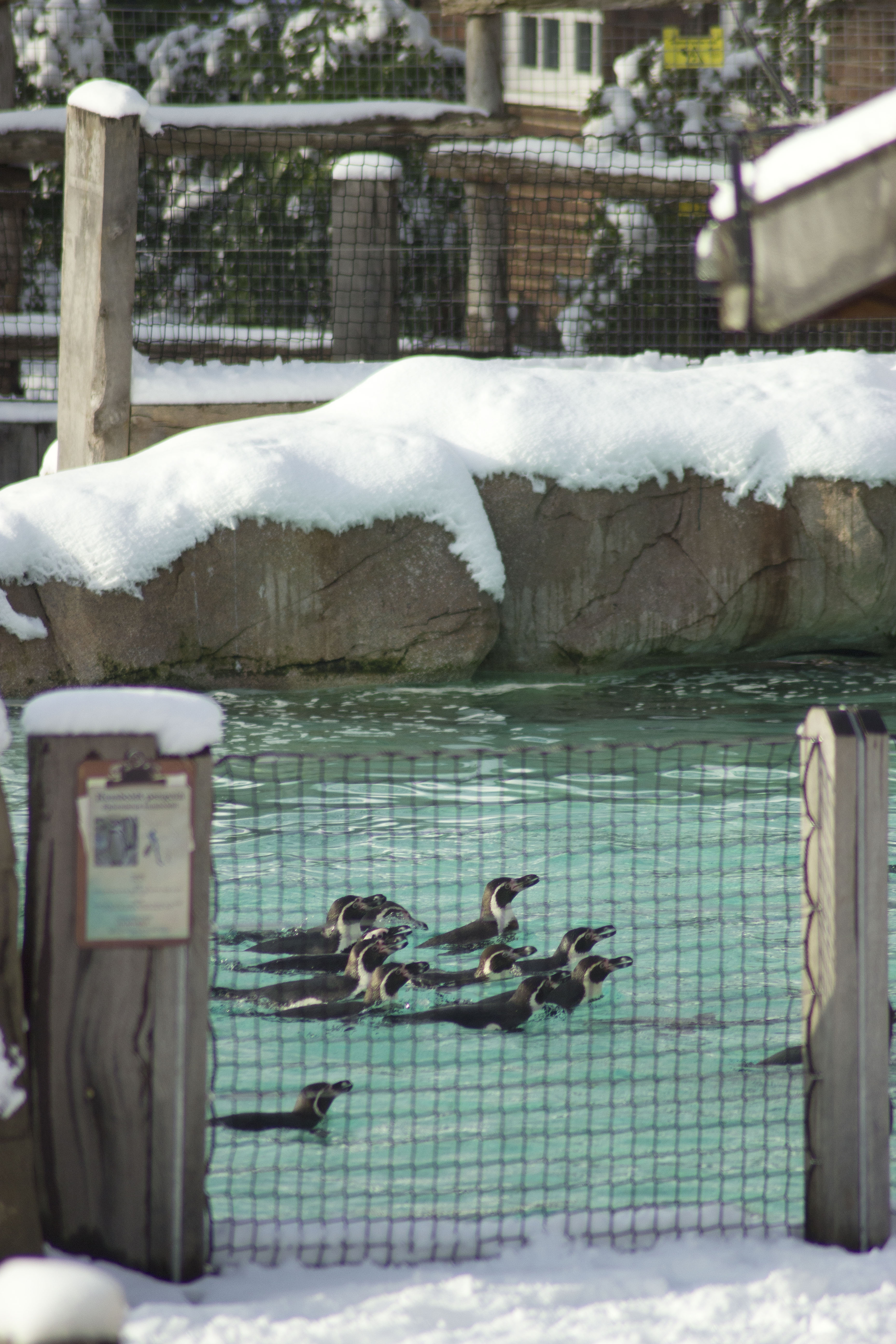
And spying through the bushes on the penguins at London Zoo!

011

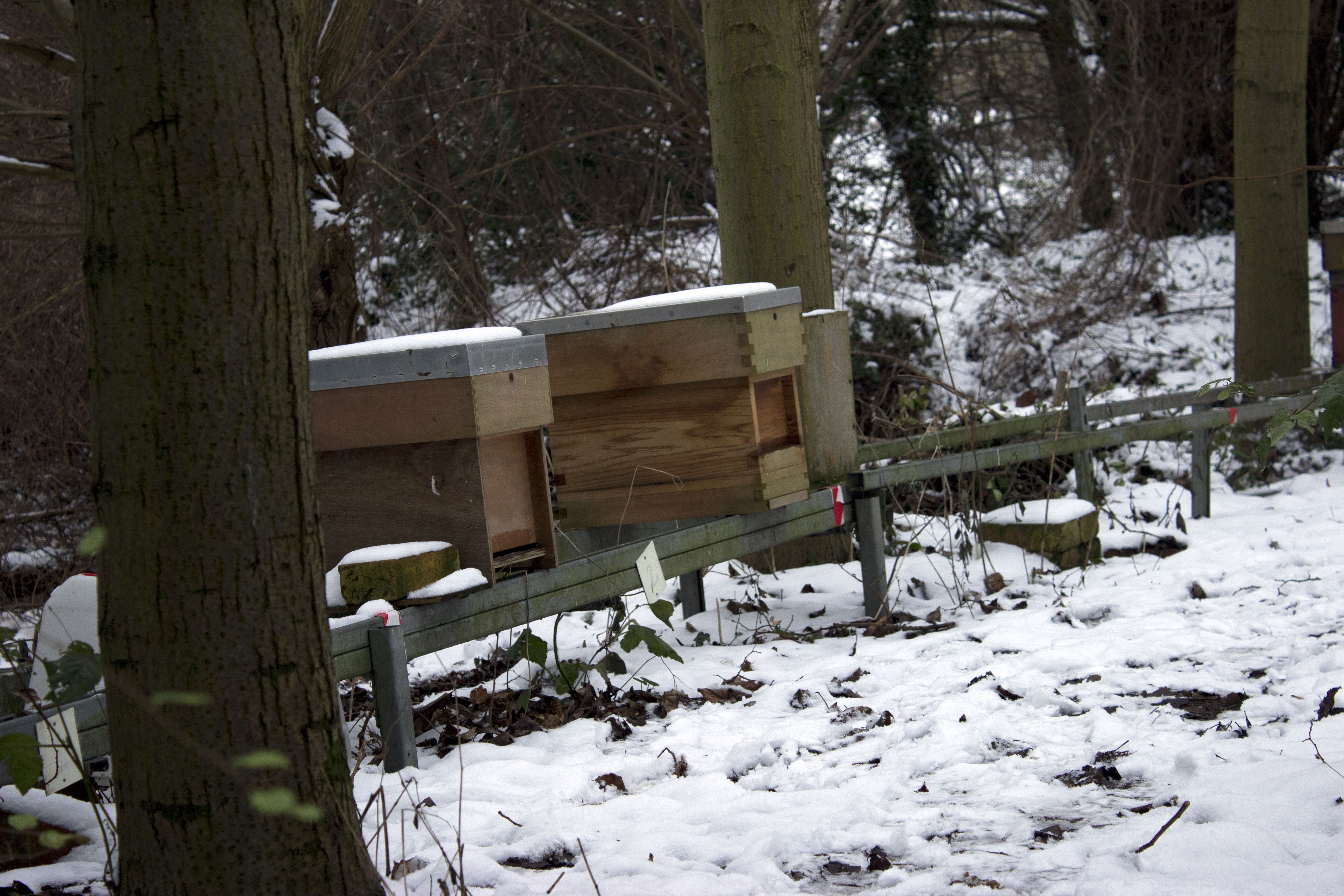
London has its own microclimate and by Tuesday the snow had left the inner city completely. In the meantime, a little visitor had landed at the apiary in search of food – woodpecker-bored holes were found on the side of one of the hives. Pat had found similar holes in his hives at Osterley a few weeks ago, so it appears that the woodpeckers are spreading the word.

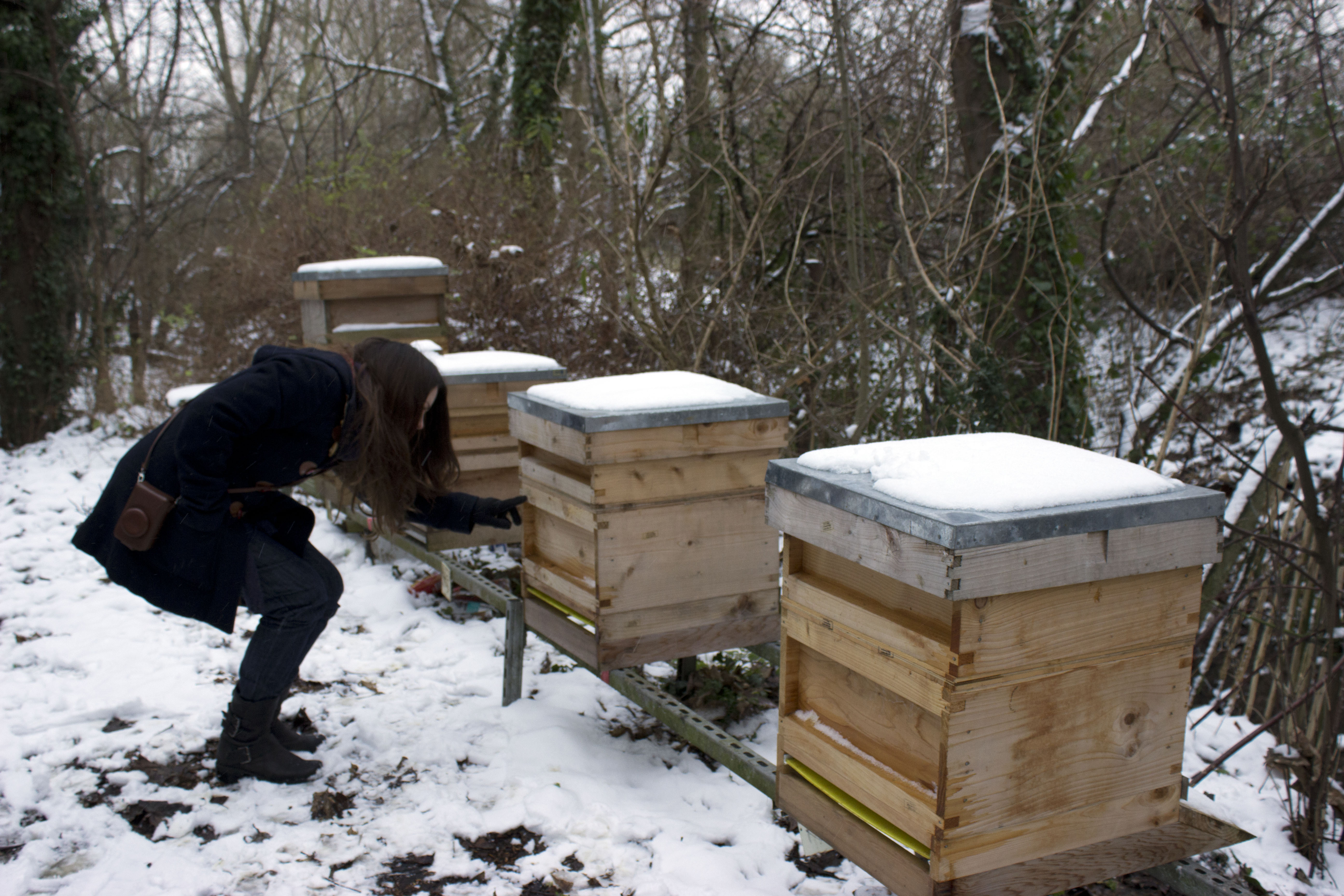
While Pat and John had wrapped most of the hives in chicken wire, I paid an early morning visit before work to finish the job on our colony and the two that we are looking after for Clare and Charles. A few bees were curious to see what I was doing and poked their heads outside the entrance, but it was far too cold for their noses and they soon went back inside.

000

Emily had spotted snowdrops trying their hardest to grow through the hard ground a few weeks back. Not long now till spring.

Related links

Snowmageddon
Winter watch for bees

You may also be interested to read this bittersweet post by Daniel J Marsh on Death of a colony – a beekeepers loss. A stark reminder that January to March is when colony losses are often reported. You can also follow Daniel on Twitter: @danieljmarsh

Snowmageddon

009

As temperatures in Sydney, Australia soared to a record-breaking 45.7˚C this week, my ex-pat friends complained that they were missing the snow in England. Holly Galt tweeted: ‘Ah London, you are making me so homesick! Love a good snow day. #Snowmageddon’ @hollygalt

The snow hadn’t yet arrived, but as Holly is from 12 hours in the future it was possible she knew something that I didn’t. And on Friday the snow arrived.

My work’s Medicinal Garden looked very pretty in the snow.

001 002 003 004 005

However, as nice as it looked around Regent’s Park, I didn’t want to sleep at my desk overnight, so we all left early while the trains and buses were still running. I enjoyed a snowy walk home through Northolt Village.

007 008 010

On Saturday morning I awoke to find Narnia outside my window and temperatures around 0°C. Positively balmy! Being one of the few beekeepers insane enough to prove that we can still have our tea and cake on a Saturday afternoon – even in snow, I arrived at the apiary not surprised to find a small crowd.

I found Emily, Stan and Albert doing some detective work having found evidence of bird footprints in the snow on hive roofs and a suspicious dent in the wood of John’s hive. Could it be that an Ealing woodpecker has discovered the tasty treats inside our hives?

snowbees5 snowbees3

Emily and I checked on our bees next. The hive is still quite heavy with stores, although they have eaten a large hole in the fondant. This allows us to observe the colony in winter and see that the bees look healthy and are active. A few workers were light coloured and fuzzy, they might be new bees if the queen started laying again in late December.

snowbees1 snowbees2 snowbees4

By now my body temperature was around -1°C, so we went to join John and the boys huddled around the kettle and Emily’s delicious jam cake.

Snow is forecast to return on Sunday, while the sun continues to shine in Sydney. As Holly would say, I know where I’d rather be. #London #snow

Winter studies: Social organisation of a honeybee colony and worker policing

Mod 6.5 leadA worker honeybee is patrolling the hive. She walks around the colony watching her sisters clean cells, nurse brood, build comb and fan nectar. She sees drones being pushed aside by returning foragers impatient to unload heavy baskets of pollen. She turns as the queen walks past looking for suitable cells to lay eggs.

Such is the constant activity of the hive that it almost causes her to miss a haphazardly laid egg. Almost. She pauses. The egg lies lopsided along the wall of the cell, not neatly deposited at the bottom. The queen, a precise egg-layer, is never so careless, so the worker climbs in the cell to investigate. Every egg laid by the queen has a signature scent (pheromone) but this egg does not have her mother’s tag – it has been laid by one of her sisters, a rebellious laying worker.

The queen does not need to fear insurrection because her daughters are very efficient at policing themselves. Without hesitation, our worker eats her sister’s egg and if she happens to catch her sister laying more eggs, she will not treat her kindly.

My fourth winter study post discusses the social organisation of the honeybee colony as a well-structured and highly hierarchical community. My post is summarised and illustrated by beautiful infographics created for my blog by designer Keith Whitlock.

The social organisation of the honeybee colony including worker policing.

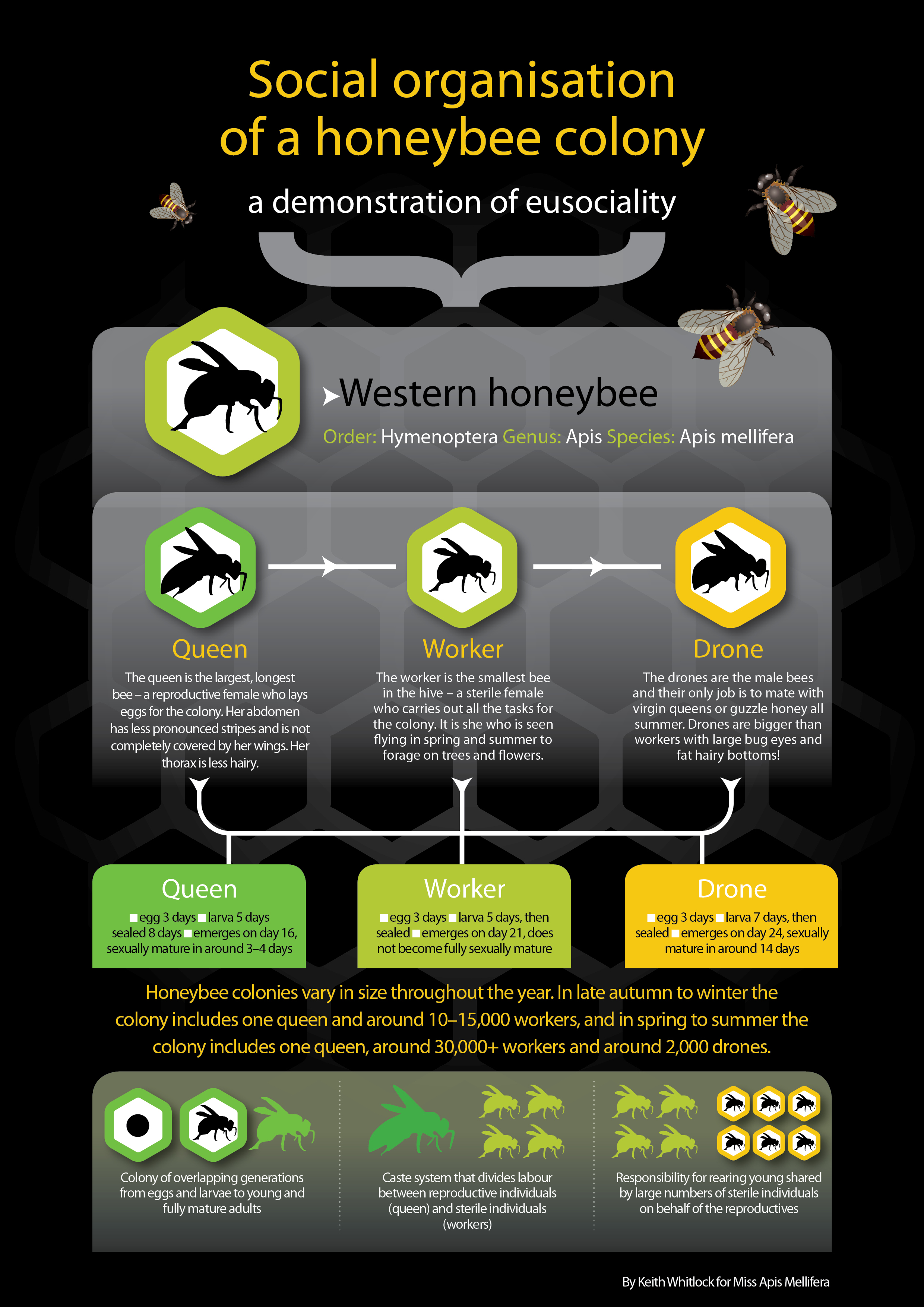
The honeybee is a eusocial insect, which describes an advanced level of social organisation. The most familiar examples of eusocial insects are bees, ants and wasps, which all belong to the insect order Hymenoptera.

Eusociality is demonstrated by:

  • colony of overlapping generations from eggs and larvae to young and fully mature adults
  • caste system that divides labour between reproductive individuals (queen) and sterile individuals (workers)
  • responsibility for rearing young shared by large numbers of sterile individuals on behalf of the reproductives

The organisation of a honeybee colony revealing a eusocial society is given below:

Mod 6.5 infographic eusociality

Now that’s understood, here’s how the bees get organised inside the hive.

The queen
(diploid, fertile reproductive individual)
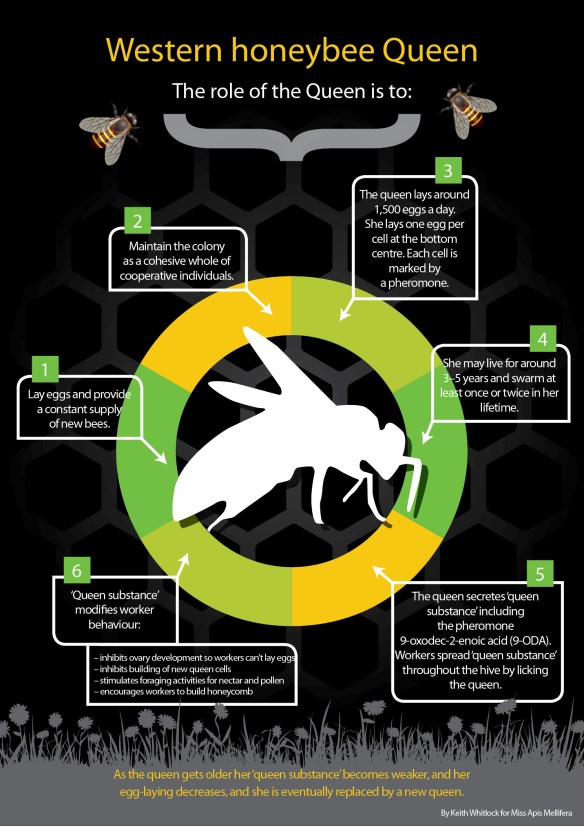
The queen is the most important bee in the colony. She lays eggs, providing a constant supply of new bees, and produces queen substance to control the workers and keep the colony working together as a cohesive whole.

Egg layer
The queen fulfils the role of egg-layer thanks to the royal jelly that she is continually fed in copious amounts as a young larva, thus ensuring she has fully developed ovaries and is able to mate. It is only the queen who can lay both fertilised eggs (which become female workers or potential new queens) and unfertilised eggs (which become male drones).

The queen mates not long after hatching and lays around 1,500 eggs per day; she may live between 3–5 years. She is not only a prolific egg-layer, she is also precise. With her long abdomen, she carefully deposits one egg, placed neatly in the centre, at the bottom of a cell (fertilised with a single sperm or left unfertilised) and marked by a pheromone so that the workers can recognise eggs laid by the queen.

Queen substance
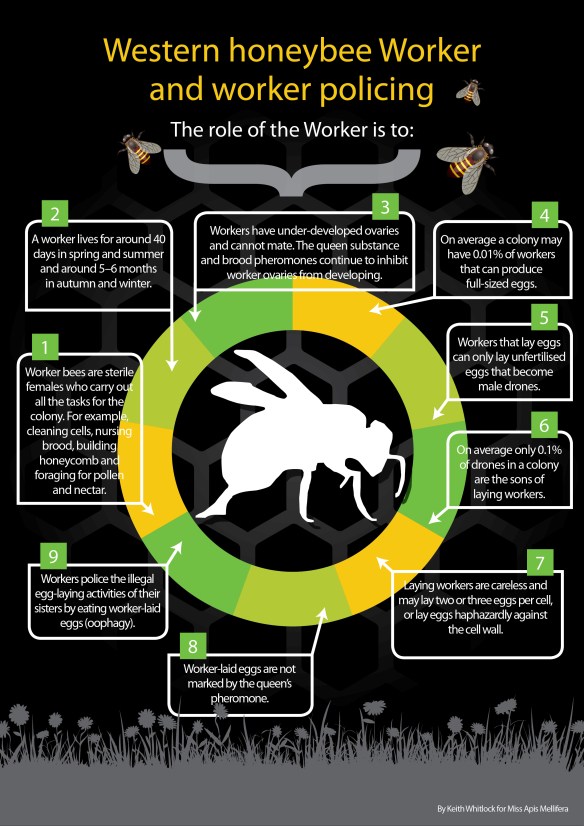
The queen secretes a substance from her mandibular glands called queen substance – a heady mix of chemicals of which the main component is the pheromone 9-oxodec-2-enoic acid (9-ODA). The queen substance is constantly spread throughout the hive as workers lick the queen and then pass the chemicals to other bees. Queen substance, combined with a pheromone given off by her own brood, inhibits the development of the workers’ ovaries – effectively it acts as a natural contraceptive! It is quite effective as normally only 0.01% of workers can produce full-sized eggs and only 0.1% of drones in a hive are the sons of laying workers.

Queen substance modifies worker behaviour in other ways:

  • inhibits building of new queen cells
  • stimulates foraging activities for nectar and pollen
  • encourages workers to build honeycomb

The pheromone 9-ODA is also released by the queen as a scent to attract male drones during her mating flight.

As the queen gets older her queen substance becomes weaker, and her egg-laying decreases, so that she has less control over her workers. They will eventually build queen cells to replace her.
Mod 6.5 infographic queen

Workers and worker policing
(diploid, infertile non-reproductive individual)
If you see a honeybee foraging on a flower in spring and summer she is likely to be a female worker. Almost every bee inside the hive is a worker and female.

Workers are the worker caste and carry out all the tasks for the colony. They live for around 40 days in spring and summer and between 5–6 months over autumn and winter.

Development of infertile females
After hatching, all young larvae are fed royal jelly for three days and then put on a diet of brood food, unless specially selected to become queens. Larvae who are continually fed royal jelly become queens with fully developed ovaries and are able to mate. Worker larvae are not fed royal jelly after day three of their development, have under-developed ovaries and are not able to mate. Their ovaries are unlikely to develop as adult bees due to the pheromones given off by the queen substance and the brood.

Worker policing
However, some workers may produce full-size eggs in their ovaries and become laying workers. Their progeny are destined to become drone because they cannot mate and have no sperm to fertilise their eggs.

Laying workers are quite careless. They may lay more than one egg per cell and because their abdomens are shorter than the queen’s the eggs are often laid haphazardly against the cell wall. They do not differentiate between worker-sized and drone-sized cells, laying drone eggs in worker-sized cells that hatch as drones with stunted growth.

Most importantly, worker-laid eggs are not marked by the queen’s pheromone, which helps other workers to police their illegal egg-laying activities. Worker-laid eggs are usually removed from cells and eaten by other workers (a practice known as oophagy).
Mod 6.5 infographic worker police

Drones
(haploid, fertile reproductive individual)
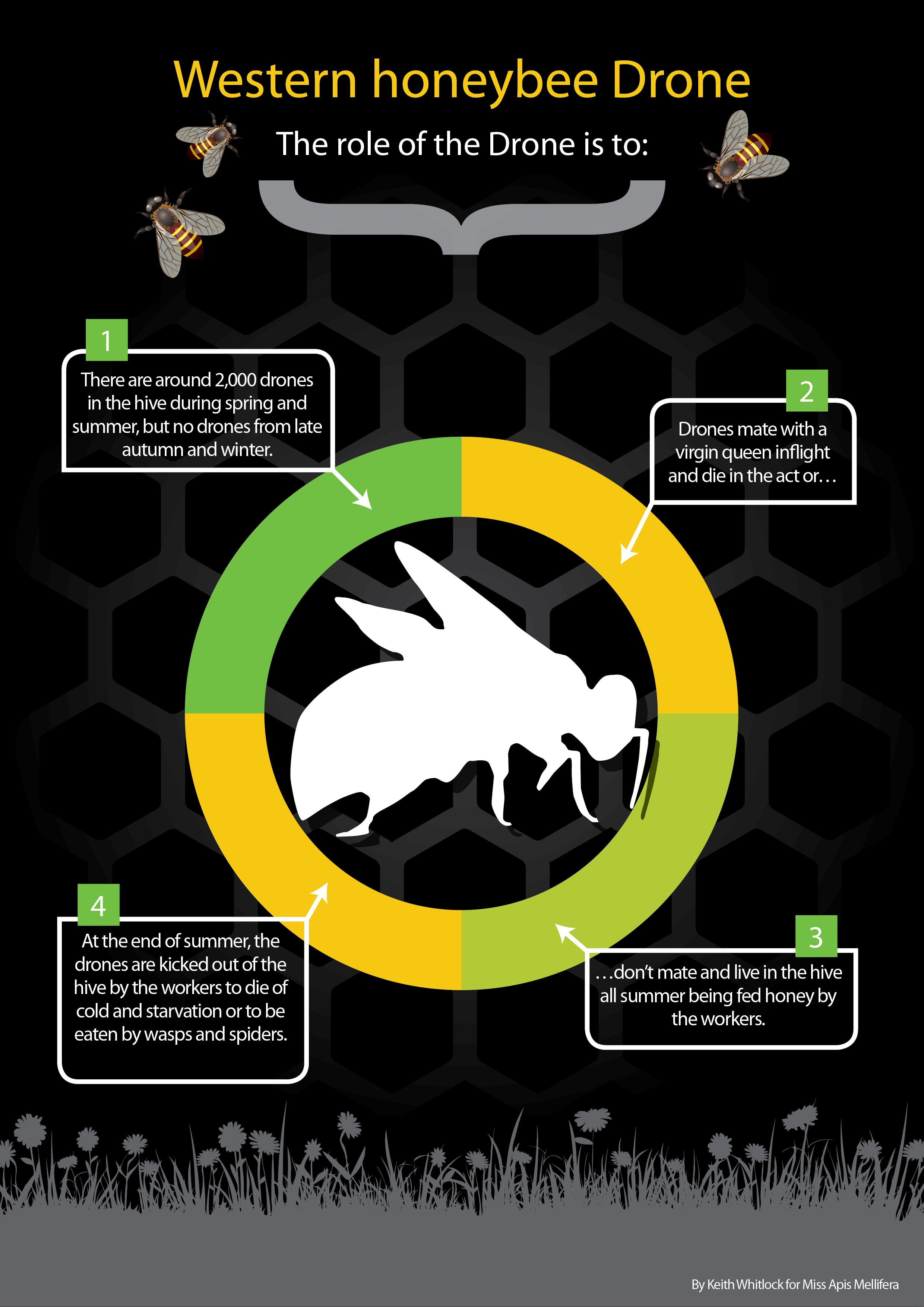
Drones are the male bees of the colony and it is thought that their only role is to mate with virgin queens. A drone hatches from an unfertilised egg and inherits one set of chromosomes from his mother, the queen; for this reason, a queen cannot mate with drones from her own colony due to the risks of inbreeding.

Drones that mate with a virgin queen on her mating flight will die in the act, and drones that don’t mate but live to the end of the summer will eventually outlive their usefulness to the colony and be evicted by their sisters.

Drones do no work inside the hive, although beekeepers have observed in spring and summer that colonies with fewer drones can be bad tempered. Perhaps drones fulfil another purpose not yet discovered.

Mod 6.5 infographic drones

I’m looking forward to exploring the next item on the syllabus – dancing bees!

Related links

Visit my blog index for more winter study posts.

A great revision post from Emily Heath of Adventures in Beeland: 4th Honeybee behaviour revision post: social organisation of the colony

Mid Buck Beekeepers Association Blog’s excellent revision notes for BBKA module 6

Recommended reading

Celia F Davis. The Honey Bee Inside Out. Bee Craft Ltd, ISBN-10: 0900147075
Ted Hooper. Guide to Bees and Honey. Northern Bee Books, ISBN-10: 1904846513

Winter watch for bees

woodpecker damage

‘Do they ever do any beekeeping at this cafe?’ asked someone while we sat around the apiary table on Saturday afternoon. The first weekend after new year and Ealing’s beekeepers had made no resolutions to give up tea and cake.

Luckily, Pat had brought something to show why bees need keeping in winter – a feeder tray with a hole bored in the side of the wood by a woodpecker. Woodpecker damage to bee hives is not common in West London, but this case of break-and-entry shows why we should keep watch. The woodpecker had attacked Pat’s hive at Osterley first by boring a hole into the top of the feeder tray, where it wouldn’t have found anything interesting, next drilling the wood below before getting fed up or disturbed and flying off. ‘It must have been very disappointed,’ said Pat.

Bee larvae can make tasty treats for hungry woodpeckers in cold weather, and maybe bees too, while causing considerable damage to the brood nest. However, Ted Hooper says that woodpecker damage to bee hives is a learned behaviour:

‘Woodpeckers learn that they can find a good meal in a beehive much in the way that bluetits learn to open milk bottles for the cream. You may keep bees in an apiary for years with lots of green woodpeckers about without any damage and then suddenly they learn the trick and through the hive wall they go, leaving behind a dead colony and several 3 inch holes. Whether all the damage is done by the woodpeckers or whether rats finish the job off I am not sure, but I have seen brood chambers in which the frames have been turned into a pile of wooden splinters, no piece being larger than a match. Covering the hive with wire netting or fish netting before the first frosts is the usual remedy.’
Ted Hooper. Guide to Bees and Honey.

The chicken wire is on order for the Osterley hives.

EDIT: Pat kindly let me use this photo of his hive at Osterley now safely protected by wire netting. He advises using chicken wire wrapped around the whole hive to keep woodpeckers off and to ‘make sure there’s a good clearance all the way round so they can’t peck through it’.

iaejaeif

Image © Pat Turner

A walk around our apiary showed that the woodpeckers haven’t learned about the delicious morsels inside our hives – yet.

I carried out a few other winter checks including:

  • hefting the hive to check the weight of stores – it’s heavy
  • lifting the roof to look at the fondant – the bees are tucking in greedily and the hole in the fondant (a ‘window’ into the winter hive) suggests the cluster inside is loose
  • observing the entrance – foragers are flying home with bright yellow pollen suggesting that the queen has started laying.

Overall, the signs indicate that our bees are well and active, perhaps because of the mild weather, although in January they should be conserving energy. All that flying means eating a lot of honey, but at this time of year there won’t be much nectar about to replace it. We’ll need to keep a close eye on the hive’s weight and amount of fondant between now and spring.

I went back to the apiary table to report my findings. John agreed: ‘It’s much easier to get a hive through a very cold winter than a mild one, because they don’t fly about as much.’ I asked where the bees might be finding the yellow pollen and Pat thought it was from mahonia. There wasn’t much else to be done except have another cup of tea and try Cliff’s culinary invention – the ‘pake’.

the pake

It’s a mix between a cake and a pie, explained Cliff. ‘The top half is a raspberry muffin and the bottom half is a mince pie.’ I wasn’t entirely convinced but the men beekeepers were thrilled to find the mince pie half-way inside. A pake was left on the table for the apiary’s family of robins who swooped down as we left. Hopefully, it will satisfy any peckish woodpeckers too.

Rain or shine, the otters like it fine

007

With the passing of the winter solstice and the lengthening of days, the bees are too busy preparing for spring for us to visit. Otters, on the other hand, are always happy to entertain their guests.

WWT London Wetland Centre is a popular nature reserve close to the heart of the city and described as a ‘haven for birds, wildlife and people’. Considering how close I live to the reserve it was the ideal place to enjoy a day out with my mum and walk-off recent over-indulgences.

It was a cold, grey Sunday with rain threatening in every cloud, but there was plenty of winter wildlife to see. The courtyard’s main glass observatory offered incredible views of the reedy lake, with ducks, geese and wading birds, against the misty, yet familiar, skyline of the BT Tower, London Eye and the Shard.

After bird watching – my mum’s a bit of a twitcher – and a walk around the lagoons, we went to see the otters being fed.

000 001

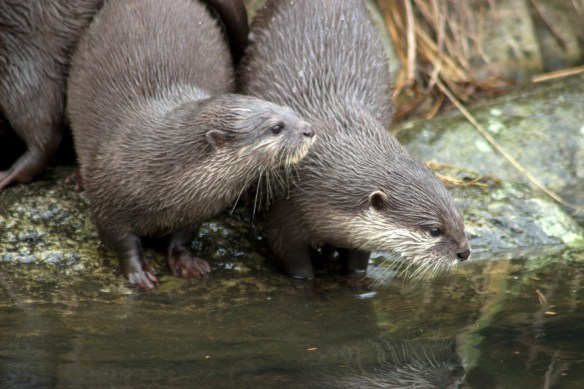
The wetland is home to a family of Asian short-clawed otters who live in a specially designed holt where visitors can watch them swim, play and feed. In the wild, Asian otters are threatened by habitat loss and hunting, so this family is part of a breeding and conservation programme. Why not the European otter? The keeper explained that the Asian otter provides better opportunities for observation and entertainment. ‘We know from experience that the Asian short-clawed otter exhibits well, whereas the European ones tend to be more solitary, more shy. If we had six or seven European otters, they would probably be at the back, drinking wine.’

The otters were fun to watch, but I’m not sure that they found us very entertaining. When they realised we didn’t have any food, they soon grew bored of us.

002 003 004 006

The sleepy otters yawned and dipped their tails in water until the keeper arrived for the daily feed. They watched him with intent as he entered the holt and chased him across the rocks till he stopped to throw pieces of meat.

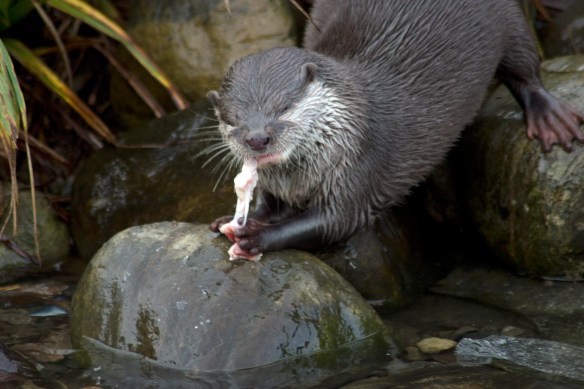
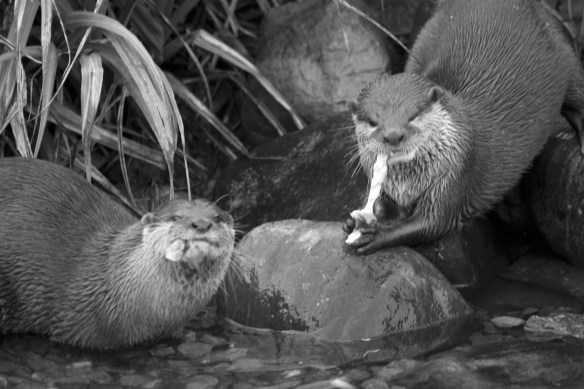
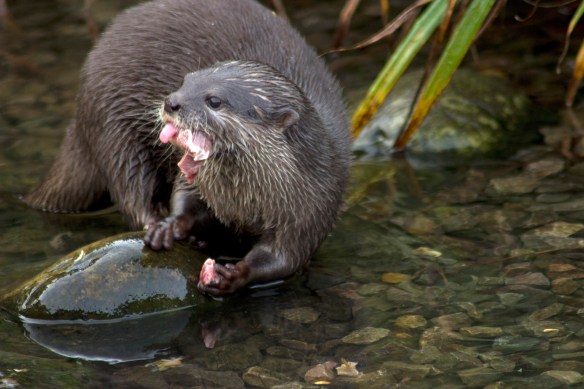
008 009What followed can only be described as an otter feeding frenzy. With tiger-like teeth, they easily tore and ripped apart chunks of meat, gulping and swallowing greedily.

010 011 012

While the otters enjoyed their meal, the keeper apologised to the crowd for making a quick exit. ‘They only tolerate me when I have food, but once they know it’s gone then my ankle might look tasty,’ he explained. ‘Not that I’m scared or anything’ as he cautiously backed away from the pool. As if on cue, the otters paused tearing chunks of meat to watch his hasty retreat behind the trees at the top of the holt. They looked at each other with narrowly slit eyes, then ran across the rocks and up the hill to cut him off. There was a commotion in the bushes, but to everyone’s relief the keeper ran out with both his ankles.

013 014

These otters will eat almost anything, apparently, which made me think that this morehen was braver than the keeper as he waded in their pool.

015 015a

The otters were not the only wildlife devising plans. I saw this plotting pigeon sitting on a bridge, until he caught me watching and purposefully looked like a pigeon again.

016 016a

The ducks and geese were more relaxed and happily enjoying swimming in the lagoons as the rain began to fall. I’m not sure what type of duck this green-eyed beauty is, but the exotic-looking goose is Egyptian.

016b 016cAt 3pm it was the bird feed with the warden. So we watched as the geese eagerly waddled up and the children threw feed in the water. By this time we were getting cold so it was time to leave, but I look forward to returning in spring to see more wetland wildlife including slow worms, dragonflies and bats.

017 018 019

I really recommend a visit to WWT London Wetland Centre. Rain, wind or shine – the animals don’t mind. There is lots to see in all seasons, although for me the highlight was the otter feed.

A very Happy New Year everyone and may 2013 bring luck, love, prosperity and good fortune!
This slideshow requires JavaScript.

Related links

WWT London Wetland Centre
Wildfowl & Wetlands Trust (WWT)
Nothing hotter than an otter – Emily Heath of Adventures in Beeland writes about her visit to WWT London Wetland Centre
ZSL London Zoo ‘Keeper for a Day’: dreams do come true – my favourite animal adventure of 2012, being a zoo keeper at London Zoo for the day