A new beginning

The sun broke through the light mist of raindrops as I walked up the leafy path to the apiary. It was late in the day and there was a chill wind in the air.

sunshine through leaves

I put on my bee suit to avoid late-returning foragers flying home to the hives with the last drops of nectar.

sunny glade

There was no need to light my smoker as I had no intention of disturbing the bees. I was here to begin preparations for the start of the beekeeping season. Winter had stretched far into spring this year and the bailey comb change was late. But the sun was coming and the bees needed to be ready.

sunny apiary

I collected brood boxes, supers, floors, crownboards and roofs to carry back to the apiary long table where my dad stood ready with a scraper and blowtorch. He made fast work of cleaning up the wood, which I then placed above our two hives ready for the bees to move into their new homes.

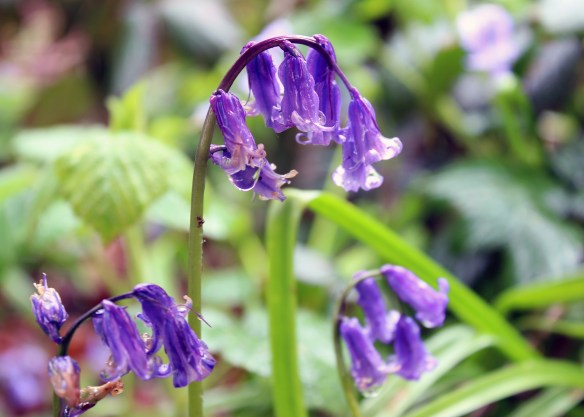
bluebells and barrows

The bluebells were out late too.

This was a few weeks ago and things have moved on. Emily and I have now started the bailey comb change and we will soon find out what sort of bees will be made by Myrtle, last year’s late summer queen, and the unnamed queens in our two new hives.

It’s all about to begin.

in memory

This post is in memory of my grandmother Antoiné Dees who passed away yesterday after a long illness. May she find peace and a new beginning in some other life.

Related posts

Bailey comb change for spring bees

Related posts by Adventuresinbeeland’s Blog

Beekeeping in a hail storm

First inspection of the year

Winter studies: How honeybees use nectar, pollen, propolis and water

purple crocus bee

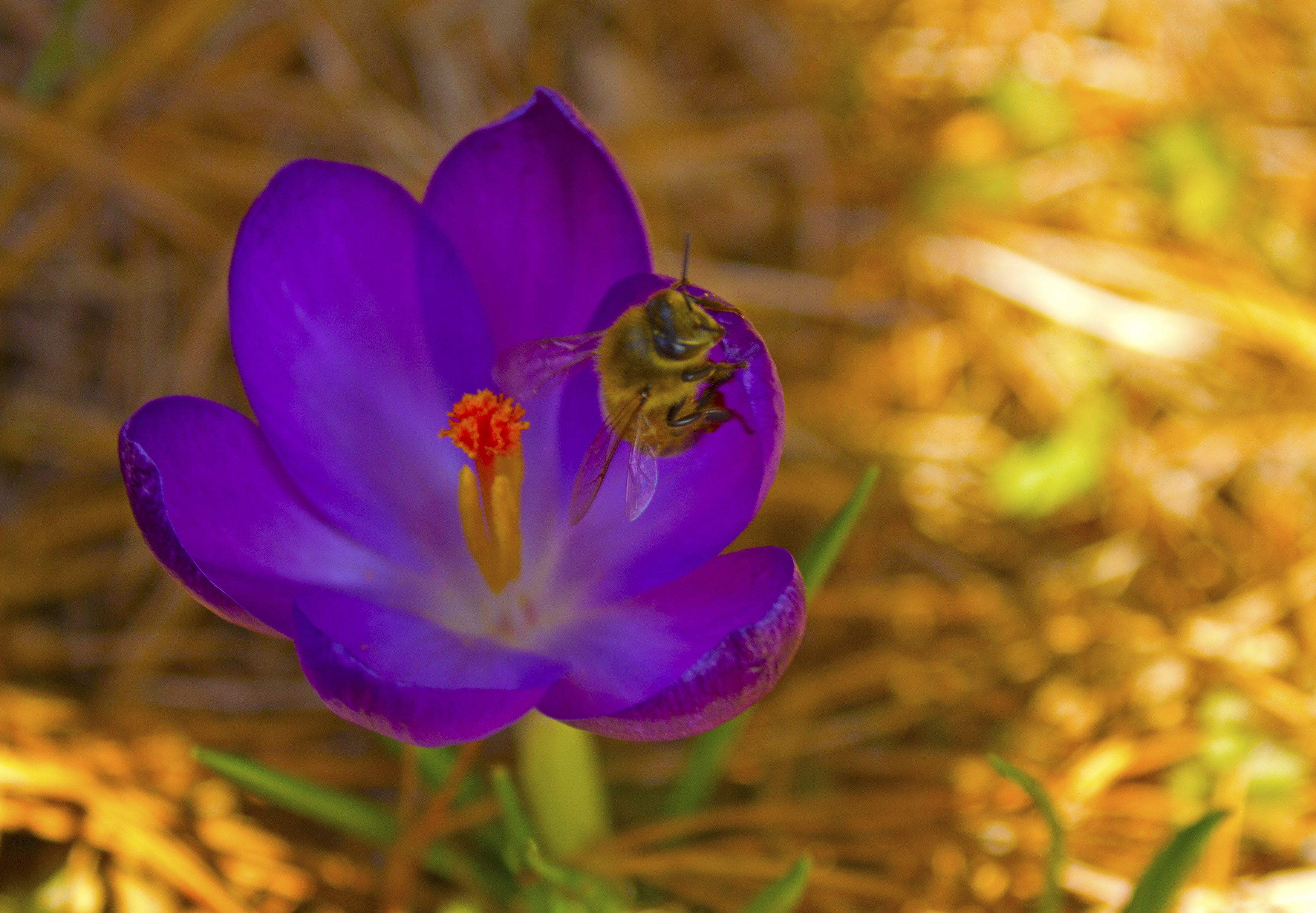
My friend Suzanne says, ‘I always know that spring is coming when I see my first big fat bumblebee popping out of a yellow daffodil.’ Last week I saw my first honeybee foraging for luminous orange pollen inside a bright purple crocus. Spring is coming.

In my next winter study post, I’m continuing to look at the collection, storage and use of nectar, pollen, propolis and water by the honeybee colony.

A honeybee sees a flower very differently to humans. As Alison Benjamin and Brian McCallum describe in A World Without Bees, the two compound eyes on the front of her head are sensitive to ultra violet light ‘expanding the already vibrant colours of the plant world into an explosion of differing hues, and directing the honeybee towards the area of the plant where the nectar and pollen are stored’. The honeybee’s eyes can see lines that guide her to the heart of the flower in a similar way that ‘the lights of an airfield direct planes to the landing strip’. Here’s what happens when she collects nectar for the colony.

nectar collection infographic

So that’s an overview of how the honeybee collects nectar, processes and stores the nectar as honey, and how the honey is used by the colony. The next flow chart specifically looks at the conversion of nectar to honey.

nectar to honey

Collection and use of water

Honeybees also collect water to bring back to the hive. They tend to collect water from unusual, or what we would consider ‘unclean’, sources such as puddles, drains, bird baths, cow pats and, on occasion, and at the risk of causing annoyance to neighbours, from hanging laundry. The stomach in which water is stored has a valve that microscopically filters and cleans the water that they bring back to the hive.

Water is not stored by the colony so it is collected and used when needed to:

  • dilute honey to be eaten
  • mix with pollen to make brood food (70% water) to feed larvae
  • dissolve hardened granulated sugars
  • cool the hive when temperatures are very high.

The inter-relationship of nectar, honey and water in the honeybee colony

So this is how nectar and water are brought into the hive and stored and/or used. The simple diagram below brings together their inter-relationship in the honeybee colony.

NECTAR-HONEY-WATER

There is a lot more to learn about nectar, water and honey (as shown on the syllabus for module 3 honeybee products and forage!) but for module 6 I’m focusing on honeybee behaviour.

The collection, storage and use of pollen by the honeybee colony

Emily and I enjoy watching our bees fly back home with baskets full of brightly coloured pollen. In January and February this is usually a sign that the queen has started to lay eggs again, because the pollen is needed to feed larvae and young bees who need the protein in pollen to develop their bodies. Throughout the year seeing our bees fly home with pollen is usually a good indicator that the colony is ‘queen-right’, meaning that the queen is present and that she is laying, and if our colony has recently re-queened it can be a sign that the new queen has mated successfully and is laying new brood.

p10009021.jpg

And the different colours of pollen packed into the cells in the honeycomb are not only beautiful to look at, but also give us an idea of what flowers our bees like to visit.

Emily and I use a pollen chart throughout the year to identify the pollen of various flowers brought home by our bees. This tells us what is flowering now and what our bees like to eat.

Emily and me keep a pollen chart in the roof of our hive to identify the different-coloured pollen brought home by our bees.

Foragers use a variety of methods to collect pollen from different flowers. Mark L Winston describes this in The Biology of the Honey Bee according to the type of flower:

Open flowers. The worker bites the anthers with her mandibles and uses the forelegs to pull them toward her body.

Tubular flowers. Workers insert the proboscis into the corolla searching for nectar, and pollen is collected incidentally when it adheres to the mouthparts or forelegs.

Closed flowers. The bee forces the petals apart with her forelegs and then gathers pollen on the mouthparts and forelegs.

Spike or catkin flowers. The bee runs along the spikes or catkins, shaking off pollen onto her body hairs.

Presentation flowers. The pollen is collected by workers pressing their abdomens against the inflorescence, causing a pollen mass to be pushed out of the flowers.’

Honeybees can often be seen in flowers their bodies covered with bright yellow or orange pollen grains, which they then ‘dust off’ and brush into baskets on their hind legs.

Here’s another infographic summarising the relationship between bees and pollen.

pollen collection infographic

And finally, propolis…

The collection and use of propolis by the honeybee colony

Our ladies were too busy sticking propolis on frames to notice we had opened the hive

On a mild day in September 2011, Emily and I visited the apiary while the other beekeepers were away to do some secret beekeeping. We had to work hard with the hive tools to prise open the hive, which was very sticky. When we looked inside our bees were so busy chewing and sticking propolis all over the hive that they completely ignored us!

Propolis, or ‘bee glue’ is a resinous substance collected from sticky buds or tree bark, and seen as shiny blobs on the third legs of foragers flying home. It is most often seen by beekeepers in late summer and in autumn when bees use it to insulate the hive for winter – it makes all the hive parts very sticky and inspections can become difficult.

Here’s why the bees like it though.

pollen collection infographic

Related links
Visit my blog index for more winter study posts.

Winter studies: the foraging honeybee

Tiger-bee! Orange and stripy!

‘On a warm, sunny April day a honeybee is attracted to a patch of bluebells. She – for almost all bees are female – is on a mission, and knows that she is close to her goal. She delicately clambers over the petals, as comfortable upside down as she is right way up, her legs working in unison. She pokes her head inside a trumpet-shaped bloom, searching for the sweet, sugary nectar.

‘Grasping the petal’s side, her legs force her head deep inside the flower, until her long tongue can get to the liquid. Once the tiny drop is all gone, she will move onto the next flower, and the next until she is full.’
A World Without Bees
by Alison Benjamin and Brian McCallum

Almost every honeybee seen foraging on a flower in spring and summer is a female worker bee in the second half of her 30–35 day life. Having spent the first half inside the hive as a ‘house bee’ carrying out various tasks, she now spends her days as a ‘forager’ collecting four essential things for the colony: nectar, pollen, propolis and water.

What do bees forage for?

  1. Nectar: a mix of sugar, water and various ingredients collected from flowers in the forager’s honey stomach (yes, bees have two stomachs and one is just for honey!) and brought back to the hive to store as honey. Nectar is a valuable source of carbohydrate energy for bees.
  2. Pollen: dusted from flowers into ‘baskets’ on her hind legs, the forager brings back pollen loads to the hive where it is packed and stored in cells. Pollen is a source of protein, and also vitamins and trace minerals, for bees, who use it to feed larvae (brood food) and for young bees so that their bodies grow strong.
  3. Propolis: or ‘bee glue’ is a resinous substance collected from sticky buds or tree bark, and seen as shiny blobs on the third legs of foragers flying home. Propolis is used for sticking down small holes and insulating the hive, usually in late autumn in preparation for winter. It is also used for varnishing and hardening comb, such as the ‘propolis dance floor’ at the entrance where dances are performed. It is not stored and only collected when needed.
  4. Water: is needed to dilute honey stores (to eat) or to mix with brood food, and it is also used to cool the hive in high temperatures. It is not stored and only collected when needed. Foragers tend to collect water from unusual (dirty) sources such as hanging laundry, bird baths, puddles and drains.

Who forages what and when?

What foragers collect, and when, depend on the needs of the colony, the time of year and the temperature: for example, nectar flows, and can be collected, at 150C and above; propolis hardens, and can’t be collected, at 50C and under; and pollen collection may decrease if the queen slows or stops laying because it may not be needed for brood food.

Ted Hooper suggests that nectar, pollen, propolis or water may be collected by most foraging bees during their lifetime and that they usually carry one thing at a time, although nectar and pollen may sometimes be carried together and ‘some bees exclusively forage for propolis’ (Guide to Bees and Honey). Emily Heath writes in her module 6 revision notes that ‘two studies of bee collection habits found that about 58% of bees collect nectar only, 25% pollen only and 17% both nectar and pollen.’

Understanding the behaviour of the foraging bee

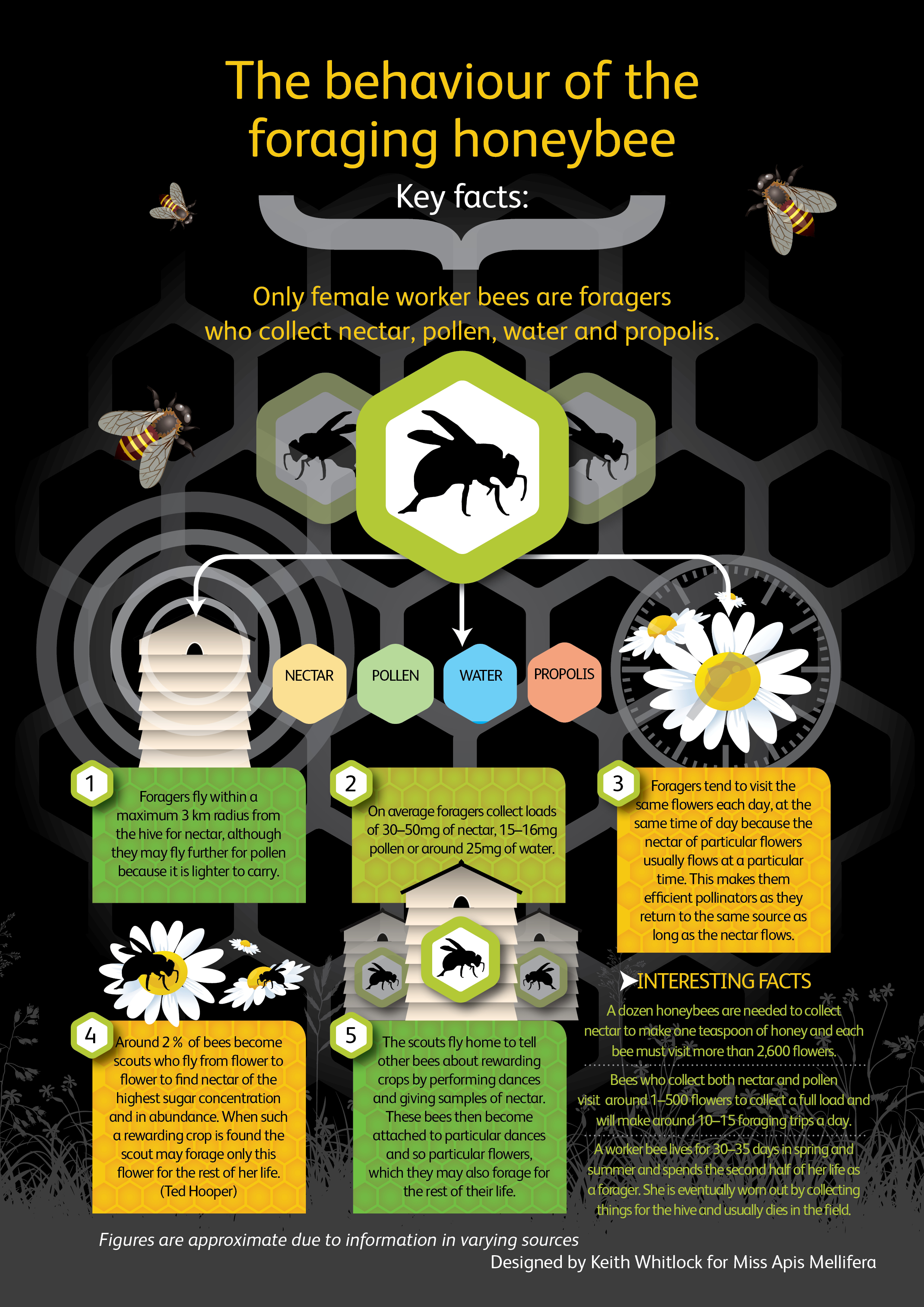
There is no doubt still a lot to learn about the behaviour of the foraging honeybee, although to summarise what we think we know is another beautiful infographic designed by Keith Whitlock for my blog. Click on the image to enlarge.

behaviour of foraging bee infographic

To really put into perspective the hard work of a foraging bee, here’s another excerpt from A World Without Bees.

‘The work demanded of the foraging honeybee is truly astounding. She will visit 1,500 flowers to collect just one load of pollen, which will weigh 15mg (1/1,900oz), about half as much as the nectar that she also brings back to the hive. To put these figures into some kind of perspective, it takes two million trips by a colony to collect the 30kg (66Ib) needed to raise its young, and four million trips to collect enough nectar to turn into honey for winter stores. This equates to around 45,000 trips per day per colony. Since a foraging flight may take a bee on a 10km (six-mile) round trip, collectively a colony can fly up to 450,000km (280,000 miles) a day. Each bee will fly around 800km (500 miles) in her lifetime, at times carrying loads equivalent to half her body weight; no wonder she will die of exhaustion about three weeks after her first flight.’

The figures of flowers visited, trips made and weights of loads all vary slightly from source to source and within different contexts such as nectar collectors vs nectar and pollen collectors, although all agree the bee is a master forager!

Are bees faithful to flowers?

The idea of ‘flower constancy’, meaning that bees become attached to foraging one type of flower for life, is a popular one and there are many theories to explain it – in another post! It may be an economic choice as by the time a forager learns a particular dance and becomes attached to a particular crop, she only has around 15 days to work it. Learning how to work different flowers might be a waste of time and energy. Ted Hooper says: ‘If, however, its [the bee’s] particular species of flower comes to an end in the first few days of the bee’s foraging, it will shift its allegiance to another plant, but should this happen towards the end of its life, it probably ceases to forage altogether.’

A honeybee easily wins the Bee Games for flowers visited per foraging flight.

In the field, the forager prefers dense patches of foliage so she can move from one flower to the next with ease – an important fact to remember when planting for bees or planting for efficient pollination. ‘For instance, in orchards where the trees are planted in tight rows, with much bigger spaces between the rows than between the trees within the row, bees tend to work up and down the rows with very few crossing from one row to another,’ says Hooper. Similarly, the forager reserves her valuable glycogen stores for flying by walking from flower to flower if she can to collect nectar and pollen. ‘In dense forage such as clover or crucifers grown for seed, or dense stands of heather, bees tend to walk rather than fly from one group of flowers to another.’

How do foragers find their way around?

For a creature who is only 12mm long and weighs around 100mg, the honeybee’s body is remarkably well equipped to finding her way around.

  • Two sets of eyes: a pair of compound eyes on the front of her head – each with 6,900 hexagonal lenses that interpret light (particularly sensitive to ultra violet light), colours and the position of the sun, and that have hairs to pick up wind speed and direction; and ocelli set out in a triangle on top of her head – light detectors that help to keep her the right way up.
  • Two antennae: these ‘tune’ into smells to find flowers and her way around the local area and back to the hive.

And considering that a bee brain is no larger than a grain of sugar, the honeybee stores and communicates complex information such as location of the hive and various crops. A World Without Bees describes the honeybee’s impressive homing instinct.

‘A honeybee knows which nest to go home to by mapping out its locale. The accuracy of its measurements is quite uncanny, and when a number of hives are located near to each other with the entrances separated by a distance of only a few tens of centimetres the honeybee will return to its own colony, rather than the one next door.’

Having returned home from a successful foraging flight, the bee may perform various dances used to communicate good sources of forage as described in my previous post.

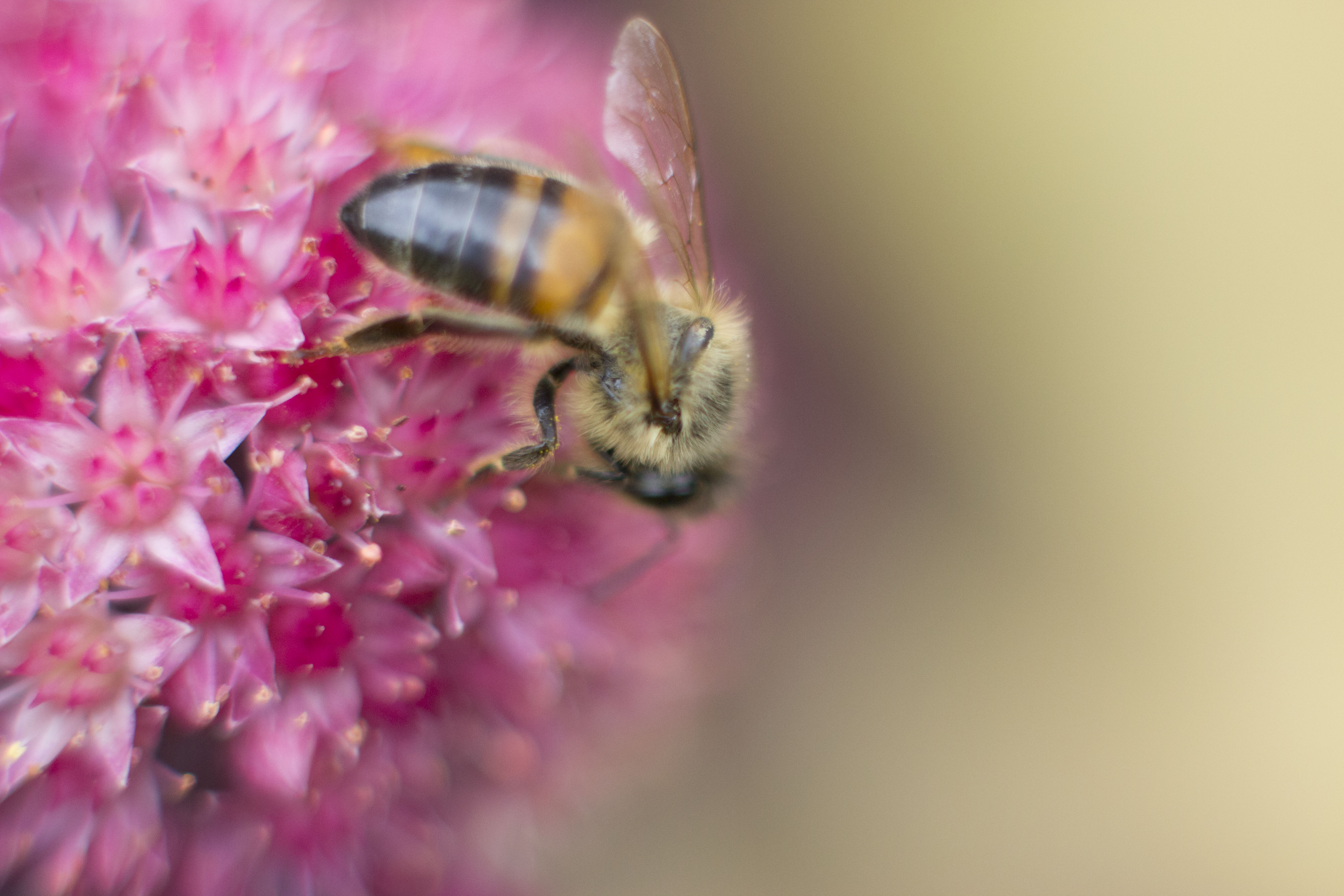
As a beekeeper, I love watching foraging honeybees in spring and summer as it brings home the magical alchemy of flower-to-bee-to-hive-to-honey-on-my-toast. I saw this forager on a clump of pink flowers in Regent’s Park last summer and filmed her with an extension tube on my camera as an experiment in macro video – it’s a little blurry. Enjoy!

Related links

Visit my blog index for more winter study posts.

Other links and further reading

Emily Heath has written two very interesting posts on bees and forage: 6th Honeybee behaviour revision post: bee foraging and “Bee foraging on garden plants: Sussex University research” – a talk by Professor Francis Ratnieks.

A recent article in Scientific American was brought to my attention by @andrewGouw on how bumblebees sense electric fields in flowers to guess where others have already fed on nectar. After following the link wait 15 seconds for the advert before the article appears.

Winter studies: The social network of honeybees

Olympic bees

A handful of foragers return home early one morning, their stomachs heavy with nectar. They have found a good source of food, but it will take more honeybees to collect it all.

Inside the hive a worker suddenly charges at a bee, pushing with her head and grabbing with her feet. She jumps on top of the bee and shakes her abdomen up and down. The bee responds to this strange behaviour by walking off to the hive entrance. There she will watch the waggle dances on the propolis dance floor and join the foraging efforts of her sisters.

The worker had demonstrated the dorsoventral abdominal vibrating dance or DVAV, a dance to recruit more bees to forage during a sudden or plentiful flow of nectar.

The DVAV might also be used on a queen bee to make her move towards the entrance when it is time to swarm.

This week in my winter study post it’s all about the social network. Honeybees have evolved a complex social network that involves communicating through dance, food and scents.

1 Trophallaxis (food sharing)
Unlike beekeepers who chat over tea and cake, bees exchange food and communicate by regurgitating into each other’s mouths. This makes me very thankful to be a beekeeper and not a bee!

Food sharing, or trophallaxis, is when two worker bees share the crop content (a mix of nectar and other substances) in their honey stomachs, which results in an exchange of information about each other and about the colony. The clearest account I have read of trophallaxis is given by Celia F Davis in The Honey Bee Inside Out (pages 106–7), making a potentially confusing topic actually simple to understand:
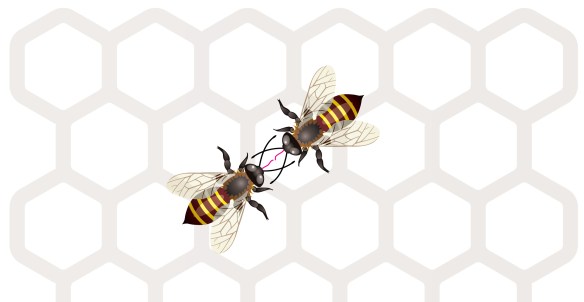
Mod 6.5 trophallaxis

‘It starts with one worker begging for food or another offering it. A begging bee pushes its proboscis [tongue] towards the mouth of another bee. The other bee then opens its mandibles, pushes its proboscis forward and regurgitates a drop of nectar from its crop, which the begging bee takes. An offering bee will regurgitate a drop of nectar and offer it to another bee. The result of this is that the crops of adult workers throughout the colony will contain the same mix of nectar and other substances at the same concentrations.’
Celia F Davis. The Honey Bee Inside Out

This method of food exchange is very rapid. Studies found that coloured or radioactive nectar fed to a few workers was spread to more than half the workers in the colony within 24 hours.

What’s the point of trophallaxis? Well, it gives each bee the ‘common colony stomach’, says Davis, so that they all have the same smell. This is how bees from the same colony can recognise each other; for example, guard bees can recognise returning foragers as members of their colony. It also ensures that ‘all the bees in the colony have a continuing appreciation of the quality of incoming nectar and pollen sources and their abundance in the colony’, which in turn can affect:

  • foraging behaviour
  • brood rearing and division of labour between house (inside) bees
  • queen’s rate of egg laying

Trophallaxis and other methods of communication
Trophallaxis can play a part in the exchange of scent (chemical) messages, when bees touch antennae during nectar sharing. Food sharing can also happen during the waggle dance when the dancer gives a taste of nectar to another bee to show how good it is.

2 Dancing
Honeybees are very good choreographers and they use different dances to communicate including the DVAV, round dance, sickle dance and, everyone’s favourite, the waggle dance.

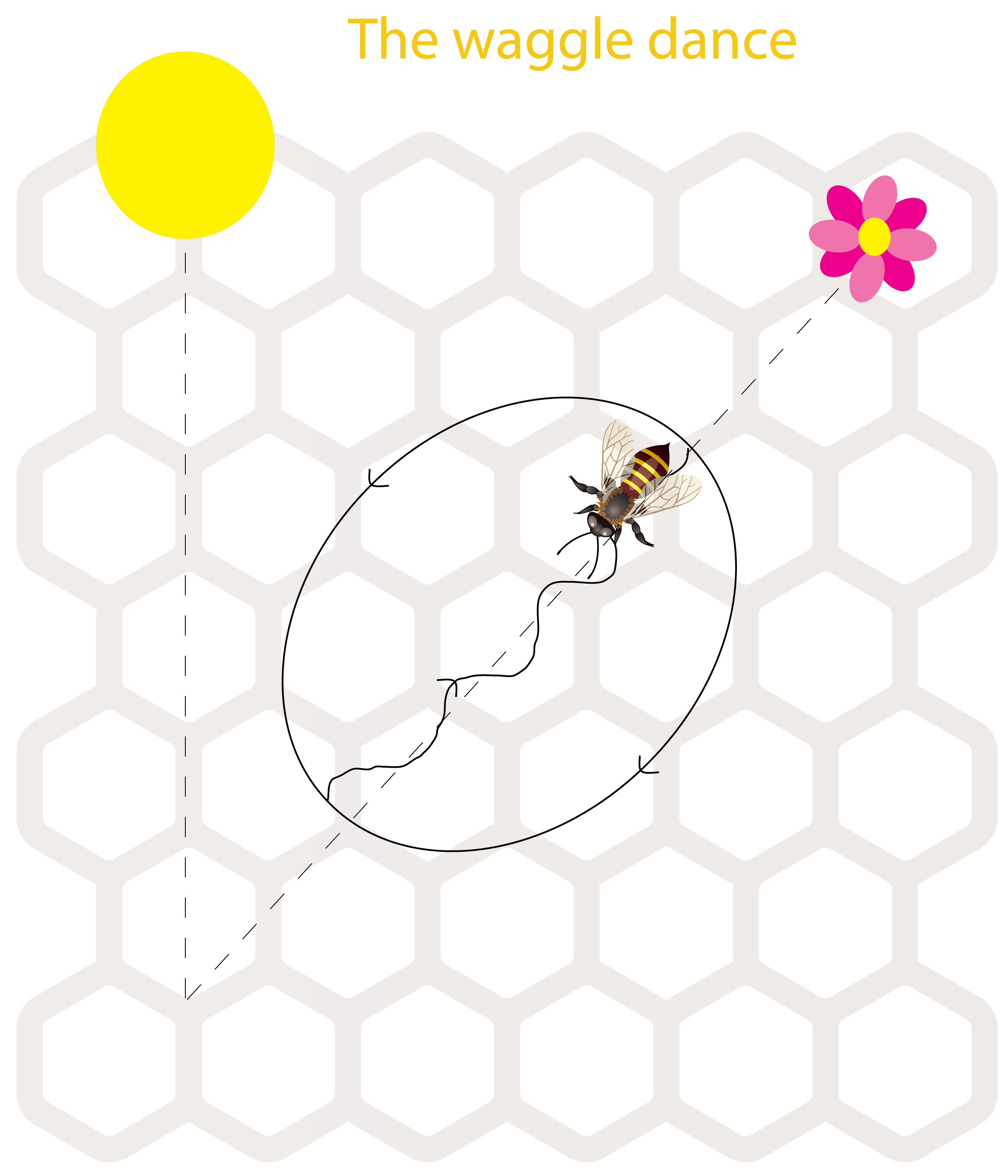
The waggle, or wagtail, dance is a figure of eight movement with a little waggle in the middle. It is performed by foraging honeybees who find a good source of forage (trees or flowers) and then fly home to tell everyone else.

It goes something like this…

Mod 6.6 waggle

The bee walks in a straight line waggling her bottom and buzzing her wings. She then turns and loops back to where she started. She walks along the straight line again, waggling her bottom and buzzing her wings, then loops back in the other direction creating a figure of eight on the dance floor. The straight line indicates the direction of the food and the number of waggles indicates the distance.

In the bee world, the vertical face of the honeycomb (imagine sections of comb hanging down inside the hive) represents the sun, and the angle of the straight line to the vertical indicates the position of the trees or flowers to the sun. For example, if the straight line is run at a 60 degree angle, then the food source is 60 degrees to the sun.

As the sun is always moving across the sky, the dancer calculates the sun’s movement by adjusting the angle of her dance every four minutes by one degree to the west.

If my clumsy attempt to describe the waggle has left you confused, then Sir David Attenborough explains it excellently in the BBC’s Trials of Life. Finding the way: waggle dance.

Round dance
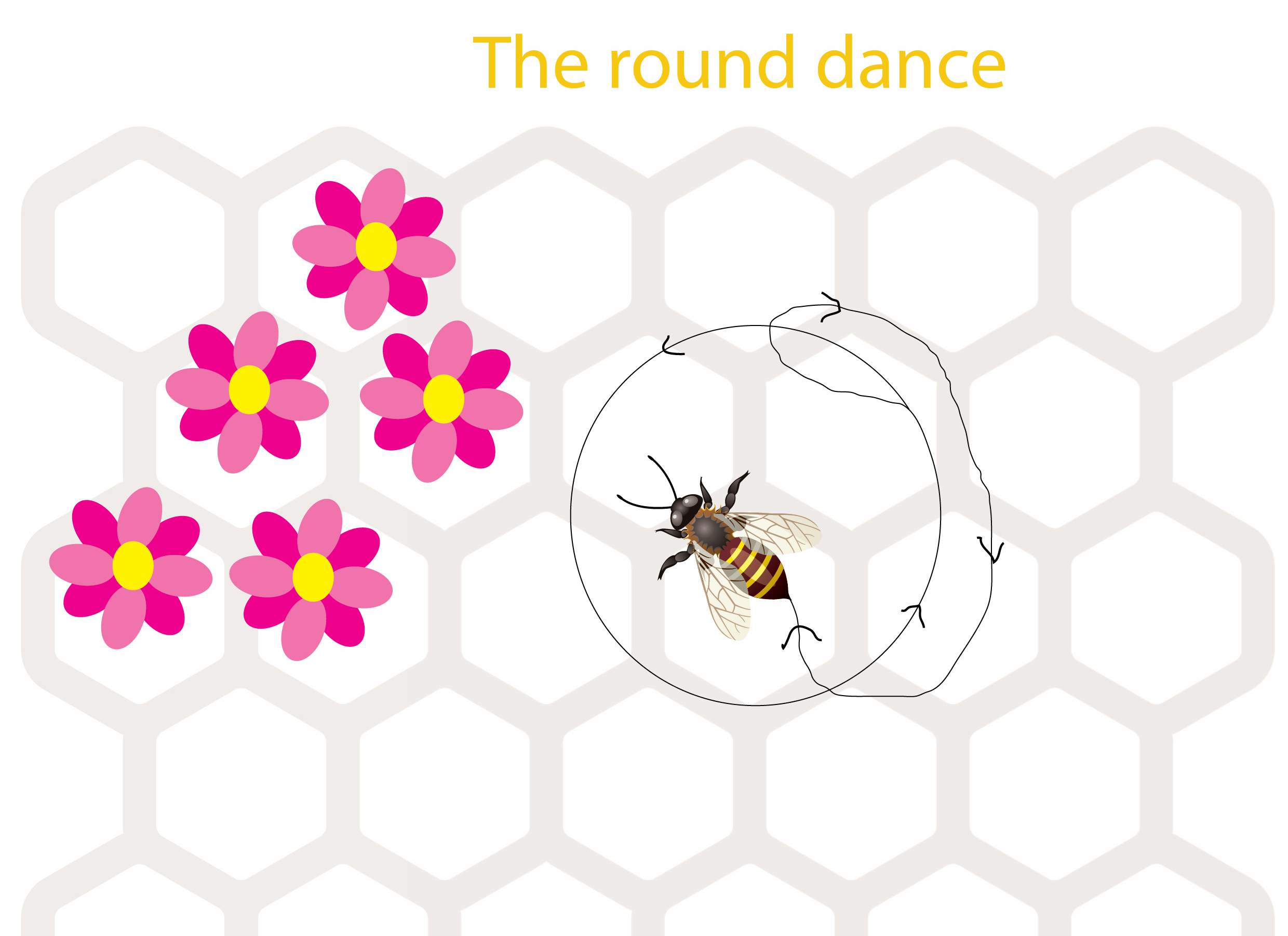
The round dance is performed as a simple loop. It doesn’t give directions like the waggle dance and simply says ‘Go get it!’ The round dance is used when a food source that has a particularly high sugar content is not far from the hive, for example: a field of oilseed rape, other hives or an M&M factory! There must have been a lot of excited French bees doing the round dance last year after discovering vast quantities of blue sugar syrup nearby.

Mod 6.5 round

Sickle dance
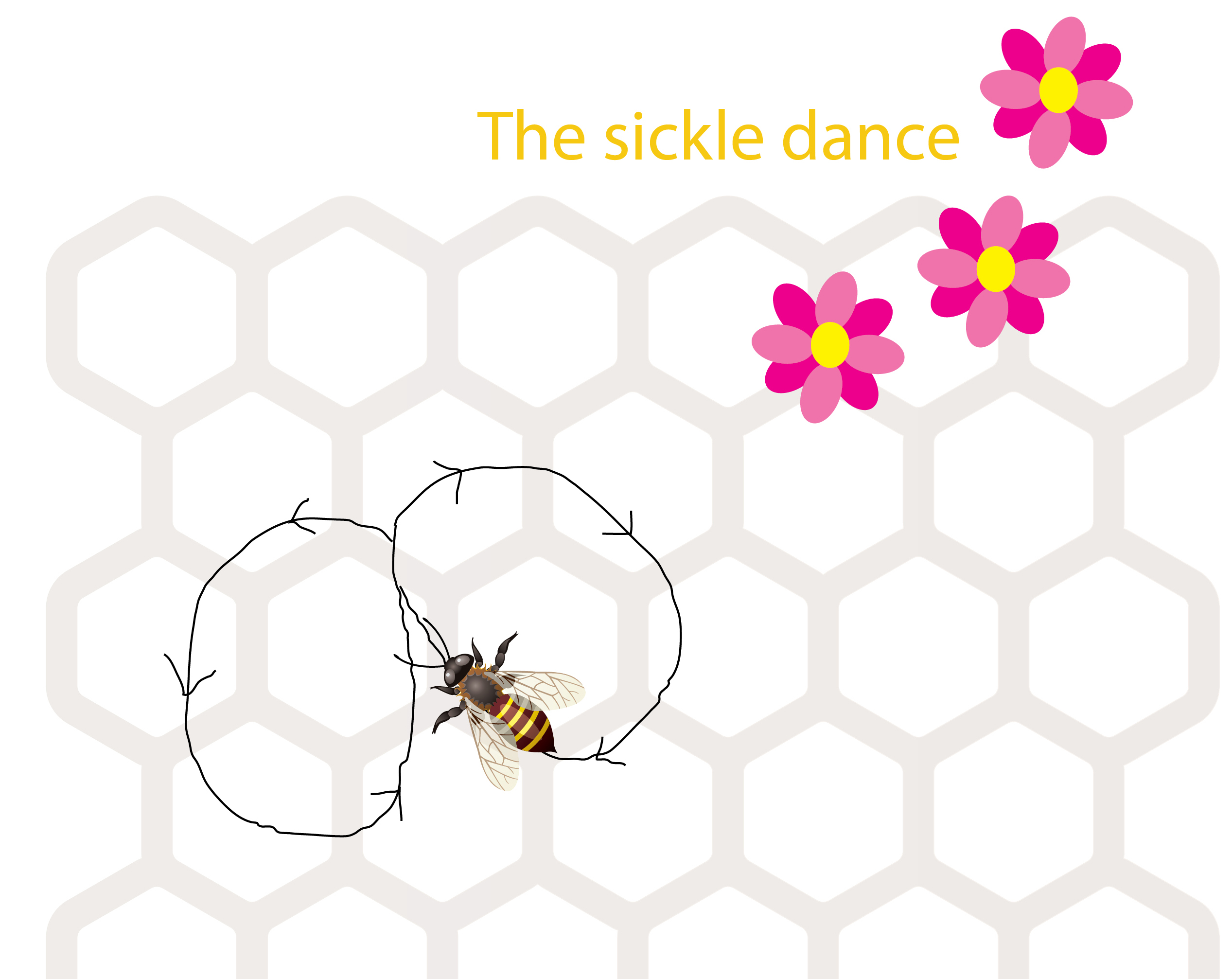
The sickle dance is a figure of eight without the waggle in the middle. It is somewhere between the round dance and the waggle dance and it is used when the distance to the forage is somewhere inbetween. It says, ‘around the corner and up the next street’.
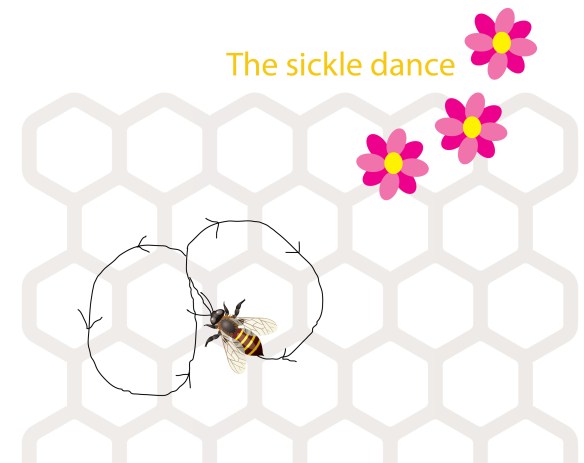
Mod 6.5 sickle

There are other dances that have been observed inside the hive.

  • Jostling dance: a prelude to the waggle dance. Foragers returning from a successful trip will run and push other bees to let them know they are about to do the waggle dance.
  • Spasmodic dance: a variation on the jostling dance that includes food sharing, and presumably gives the same message.
  • Trembling dance: while the DVAV dance recruits more foragers, the trembling dance seems to recruit more receiver and storage bees to help foragers unload nectar and pollen. Davis says: ‘A bee runs about on 4 legs and twitches and trembles. If it meets a bee performing a wagtail dance, it head-butts it and briefly pipes.’

Apparently, the time it takes for a forager to unload her nectar influences the type of dance that is performed. If the forager takes 20 seconds or less to unload nectar, the DVAV dance is performed to recruit more workers to forage. However, if the forager takes 40 seconds or more to unload, then the trembling dance recruits more bees to help process nectar being brought into the hive.

The dance language of bees is varied and complex, and care should be taken in the interpretation, says Davis. For example, the trembling dance can also be a request for grooming. Other dances, like the DVAV dance and the buzzing run, have also been connected with swarming.
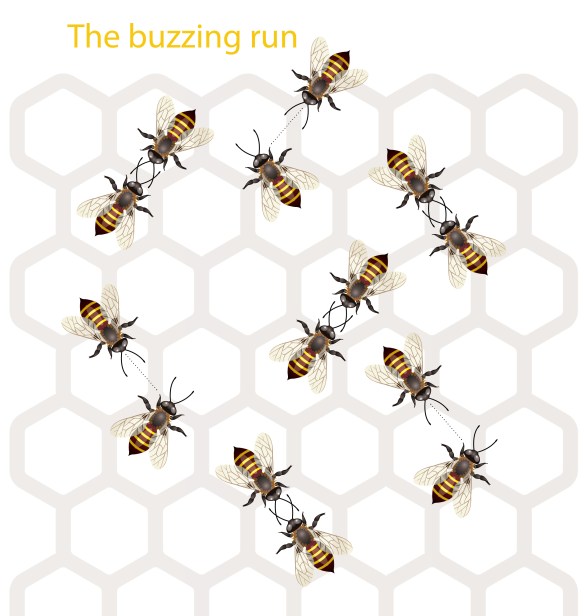
Mod 6.5 buzzing run

The buzzing run is where a bee runs in a straight line while buzzing its wings and collides with another bee – they touch antennae, buzz and run off to collide with more bees. The dance has a cascading effect across the hive with bees buzzing, running and colliding until they swarm. Davis says that the buzzing run is performed again by the swarm before flying off to its new home, and it is then sometimes called the break dance.

3 Scenting

I spied a worker waving her abdomen in the air, exposing her Nasonov gland and fanning her wings to spread the scent to guide foraging bees back to the colony. She may have been doing this because we kept Lavender's hive open longer than usual to complete the Bailey comb change.

A worker waving her abdomen in the air – exposing her Nasonov gland and fanning her wings to spread the scent to guide foraging bees back to the colony.

As an aromatherapist, I envy bees living in a world of aromas. The hive is like a perfume factory with a scent for every occasion, including: to communicate, to stimulate and suppress behaviour, to coordinate activities, to attract and to alert among many other things.

These important scents are pheromones – chemical substances that are secreted to affect a specific reaction. A helpful definition of pheromones was coined in the 1950s:

‘Pheromones are substances which are secreted to the outside by an individual and received by a second individual of the same species in which they release a specific reaction which may be behavioural, developmental or physiological.’

The chemicals are made in glandular cells and secreted by glands, specifically exocrine glands, that secrete substances outside the body. (Humans, for example, have an endocrine system – endocrine glands – that secrete chemical substances such as hormones inside the body. A very basic biology lesson!)

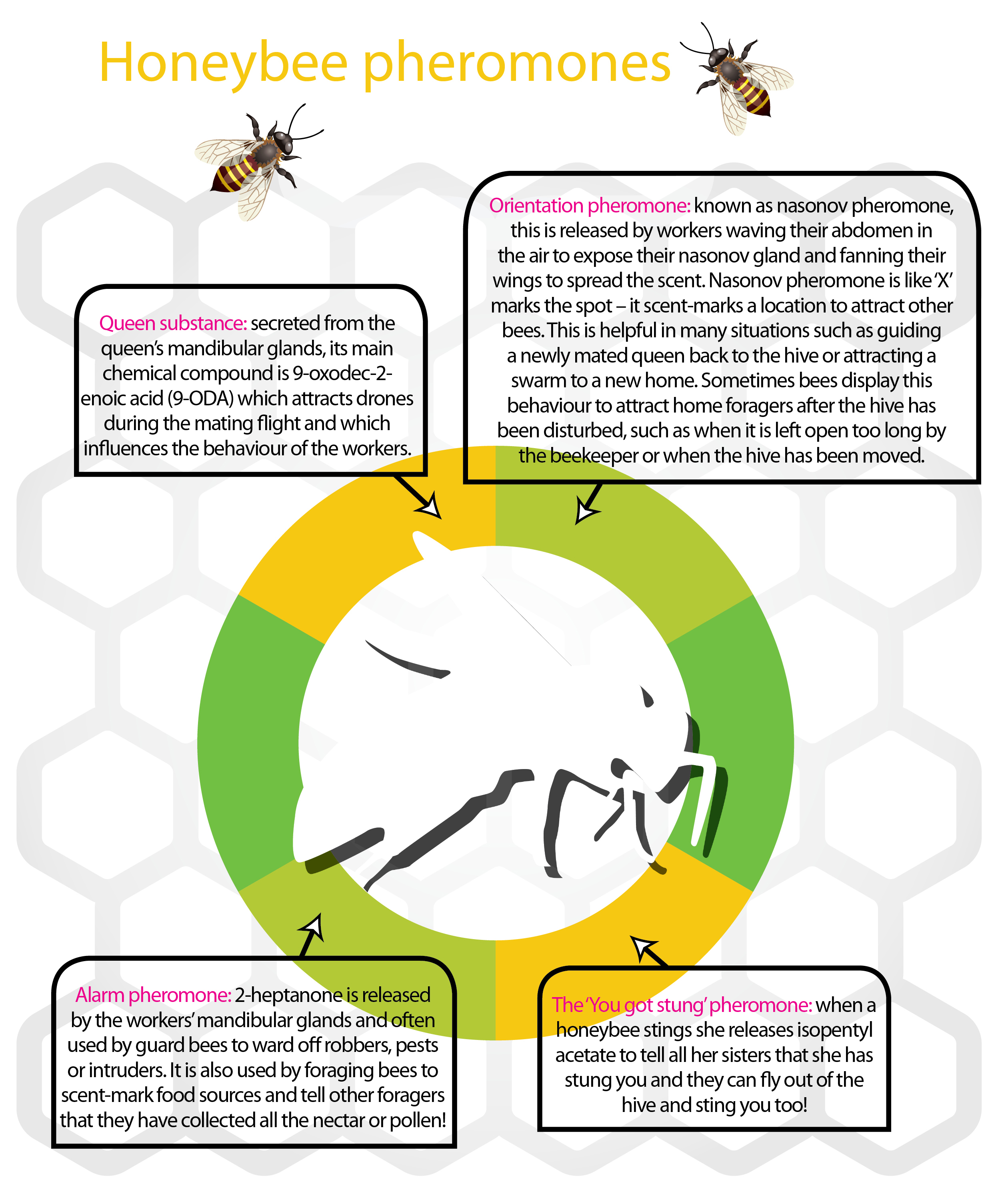
In the hive, pheromones are released by queens, workers, drones, brood and even comb. As many pheromones used by honeybees have been covered in other posts, for the purpose of this part of the syllabus here’s a quick summary:

Mod 6.5 infographic pheromones

There is so much to explore about the world of pheromones that I may revisit this in another post.

4 Vibrating

A queen cell from our swarmed hive placed in Myrrh's old hive had failed to produce a new queen for this dwindling colony of bees.

Finally, a form of communication largely used by queen bees, although sometimes used by workers, is piping and it can be associated with swarming. Virgin queen are known to pipe inside their cells and it is thought that they are warning their sister queens-in-waiting that they have a rival for the throne! After emerging from her cell, an unmated or mated queen also makes this noise by resting her thorax on the comb and vibrating her powerful flight muscles.

Related links

Visit my blog index for more winter study posts.

A great revision post from Emily Heath of Adventures in Beeland: 5th Honeybee behaviour revision post: bee communication

Mid Buck Beekeepers Association Blog’s excellent revision notes for BBKA module 6

Recommended reading

Celia F Davis. The Honey Bee Inside Out. Bee Craft Ltd, ISBN-10: 0900147075
Ted Hooper. Guide to Bees and Honey. Northern Bee Books, ISBN-10: 1904846513

Too cold for a bee’s nose

001

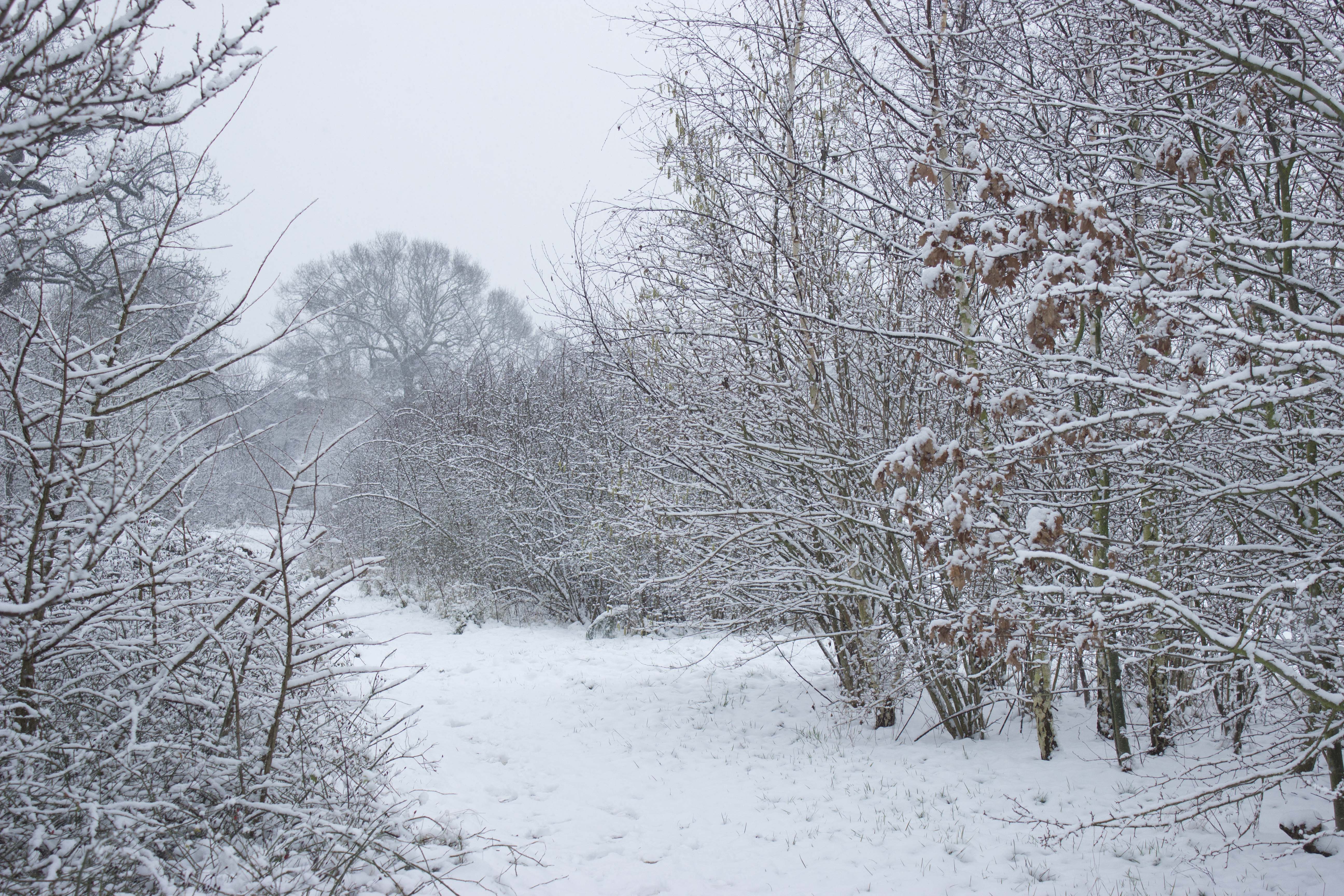
Another fine day of sunshine and showers in London and it is hard to remember that just over a week ago a blanket of snow had fallen and transformed the city into a winter wonderland. The weekend that it snowed I had been caught in a wintry blizzard when walking in Wimbledon woods and froze these scenes on camera.

002 003 004 005 006 011 012 013

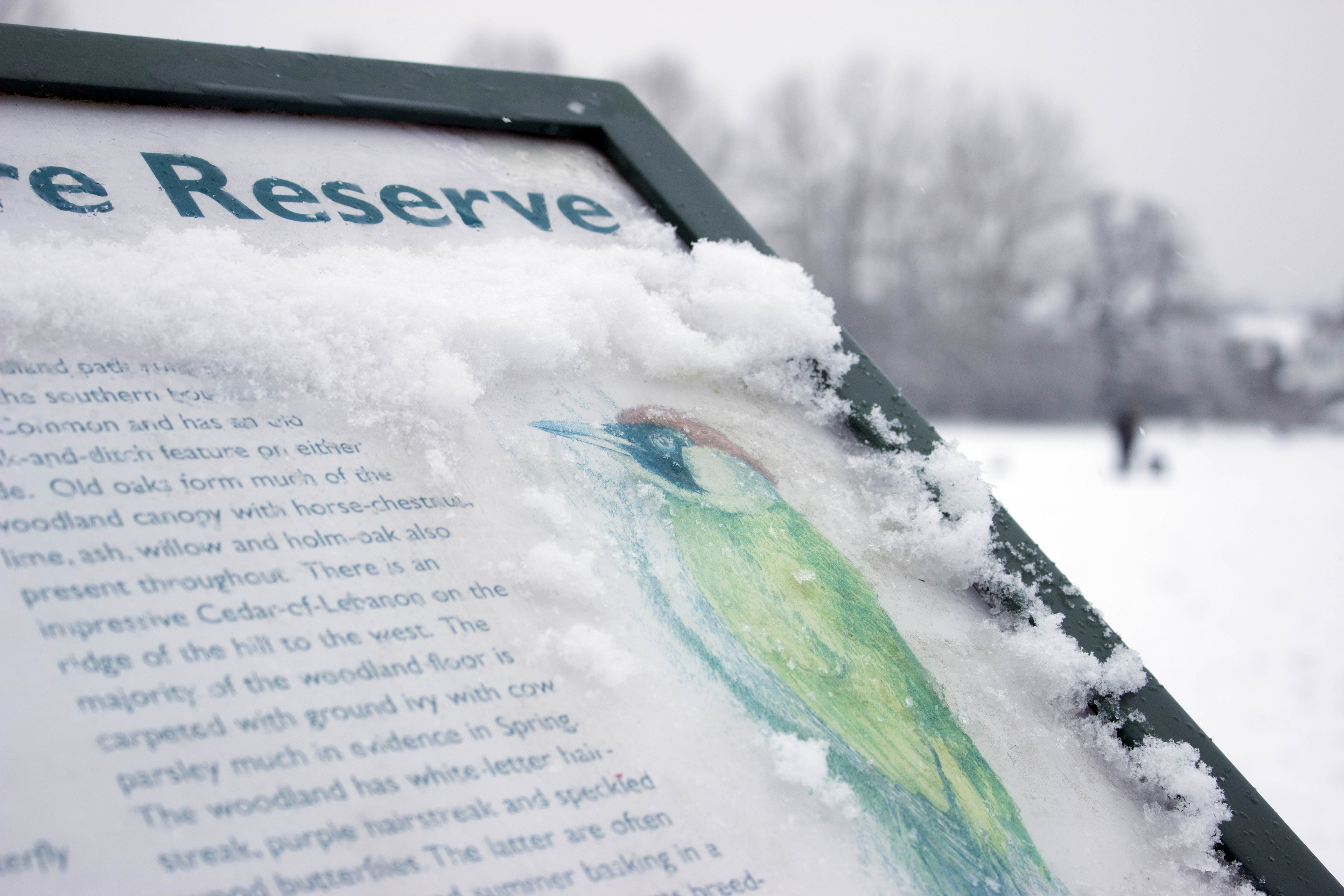
The woodlands were part of a nature reserve with signs to indicate local species, including the green woodpecker. This inquisitive bird can live in an apiary for years before, one day, it learns that tasty treats of bee larvae and honeycomb may be found inside the hives.

001 002

More on woodpeckers later…

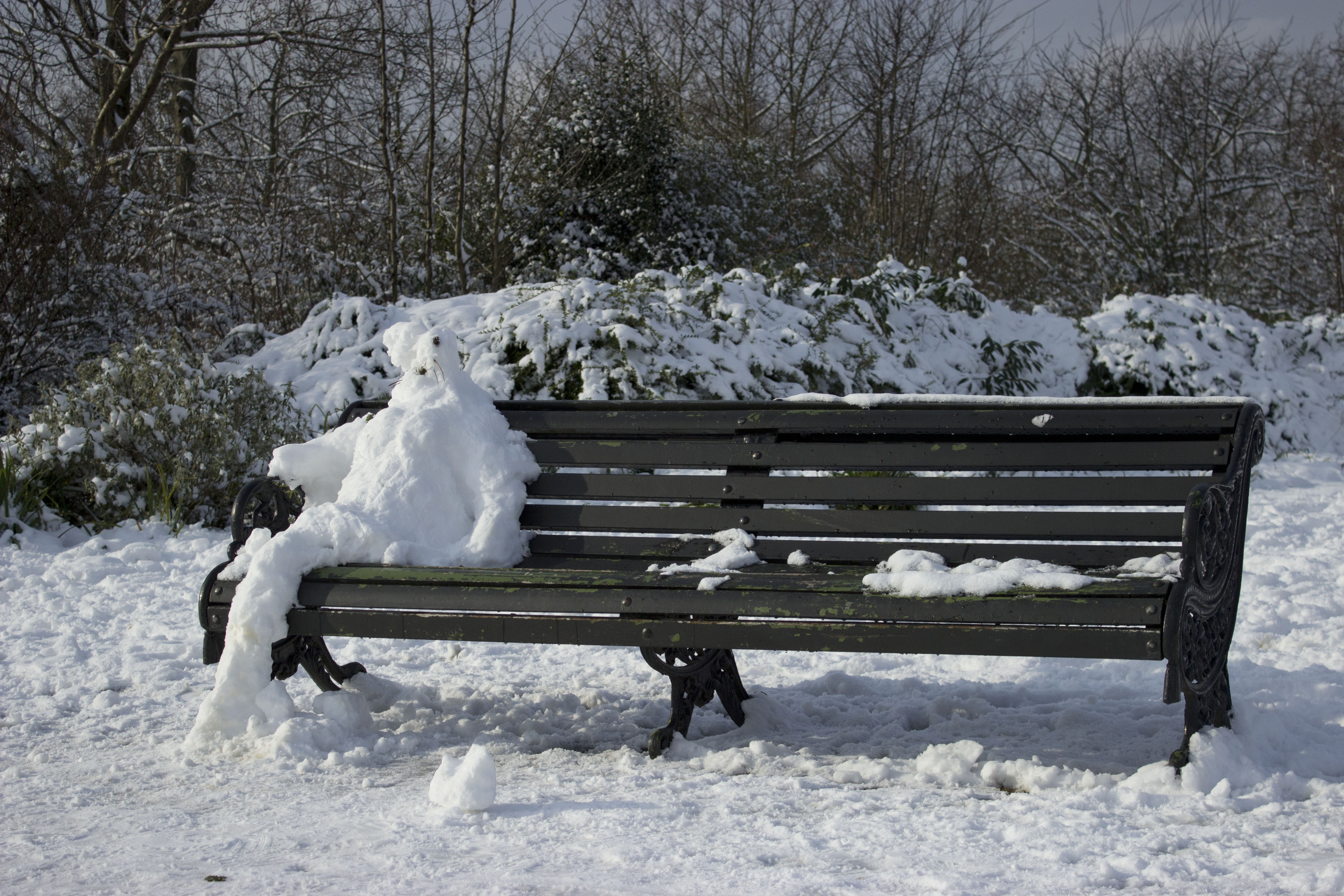
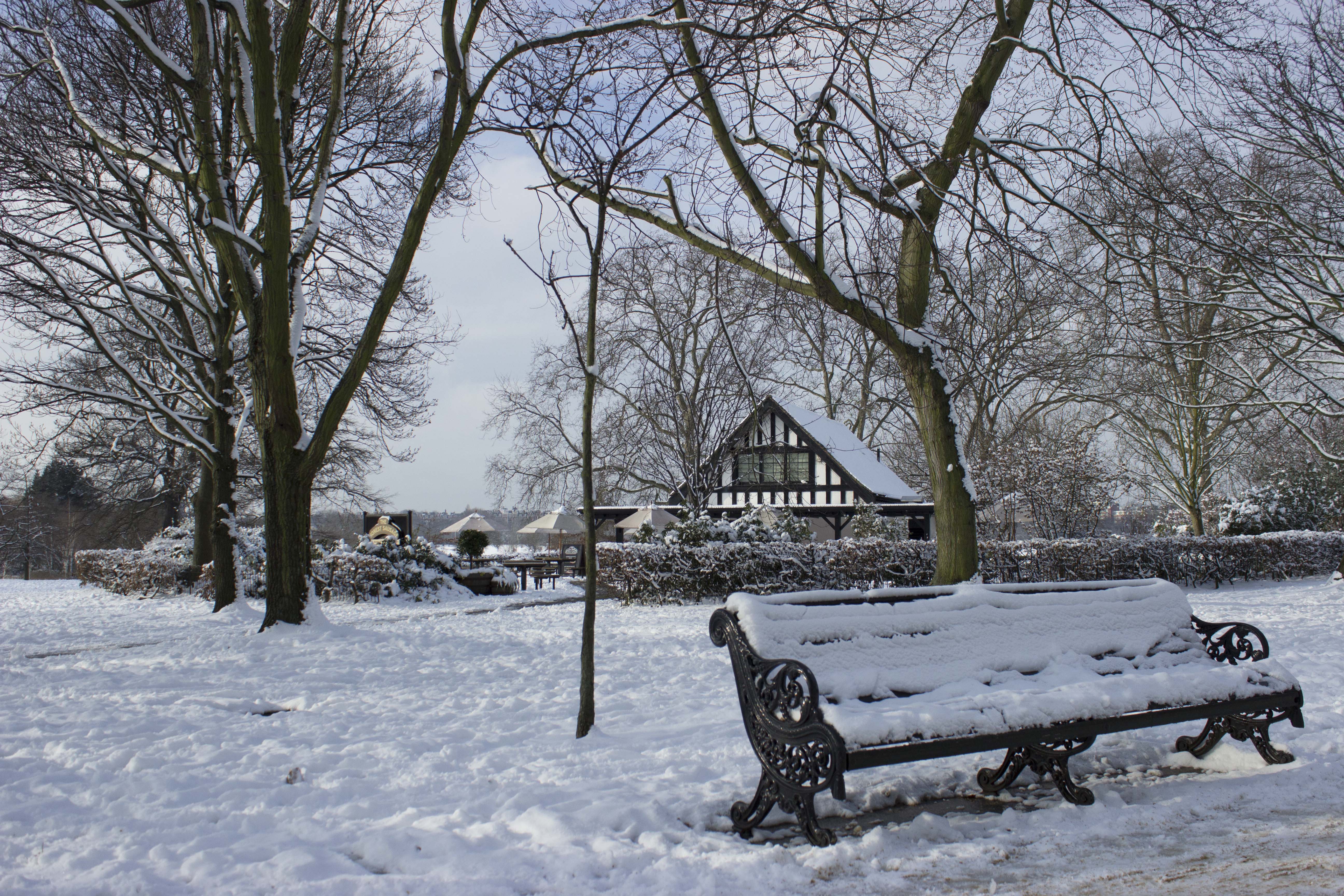
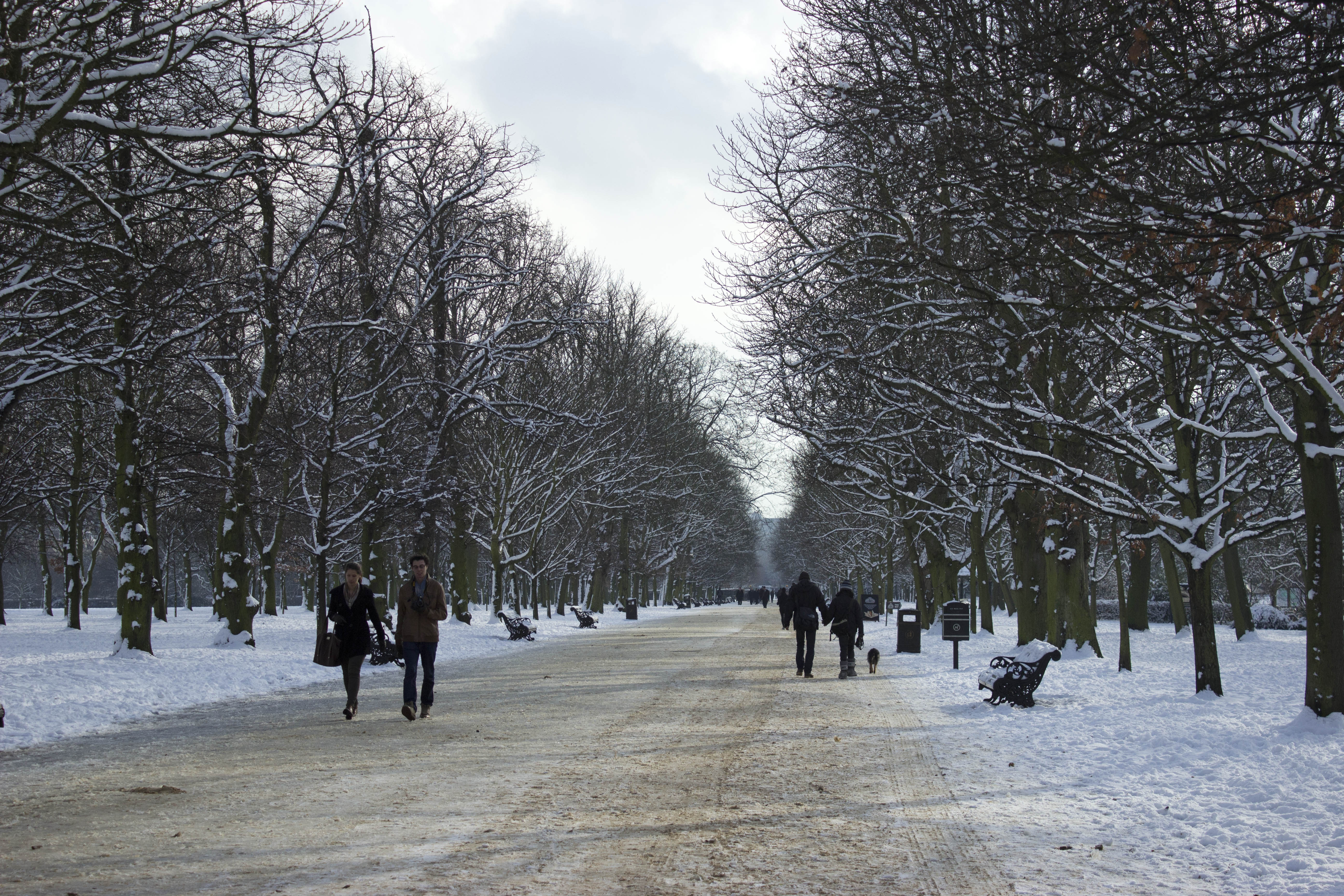
The snow had lasted after the weekend until Monday. Those who made it into work enjoyed a lunchtime walk around Regent’s Park as the afternoon sunshine took a sideways slant through the trees.

000 005 006 007 008 009 012 013 014

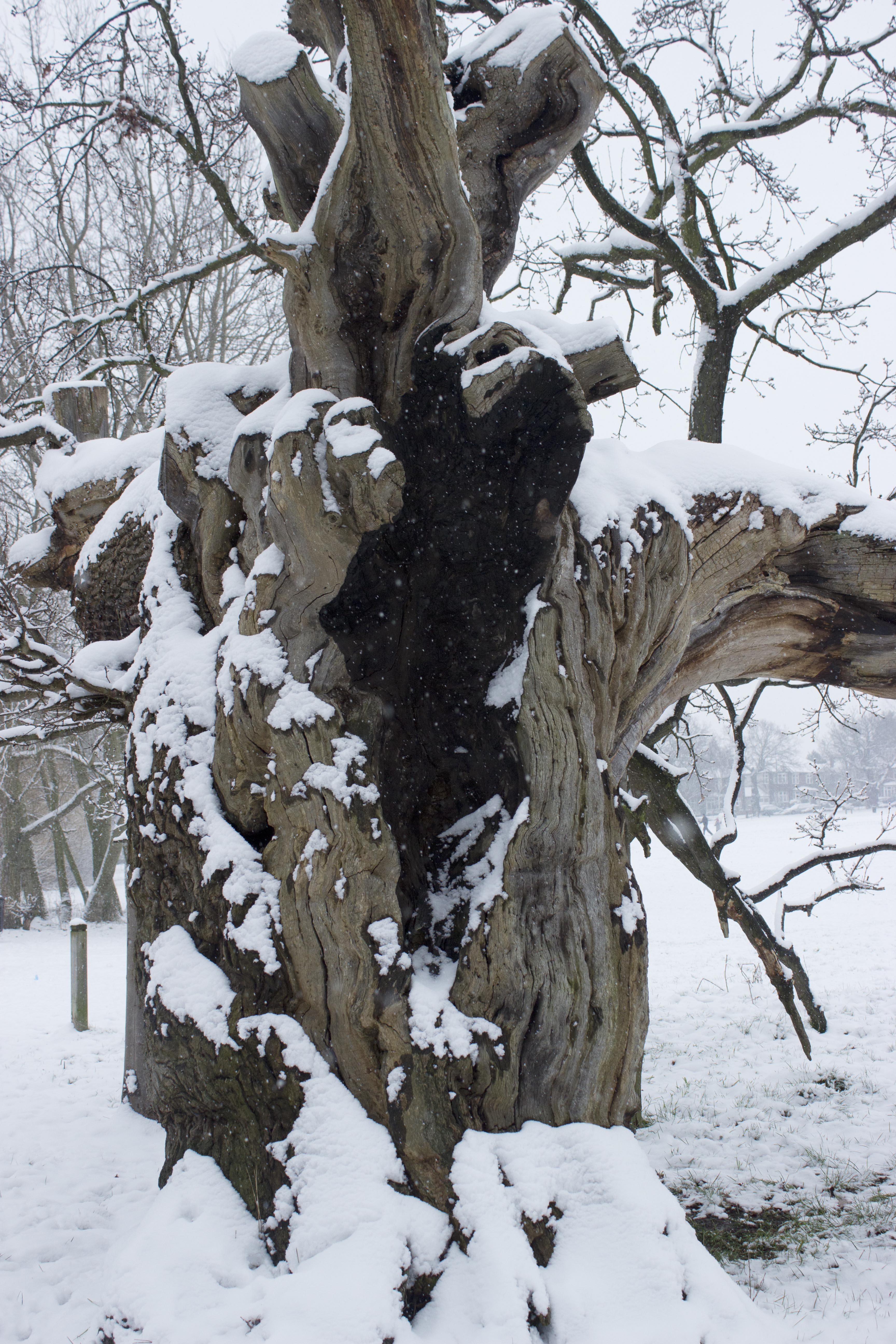
There was more to see than just snow – this tree has eyes!

003

And these pigeons huddled on top branches to keep warm.

004

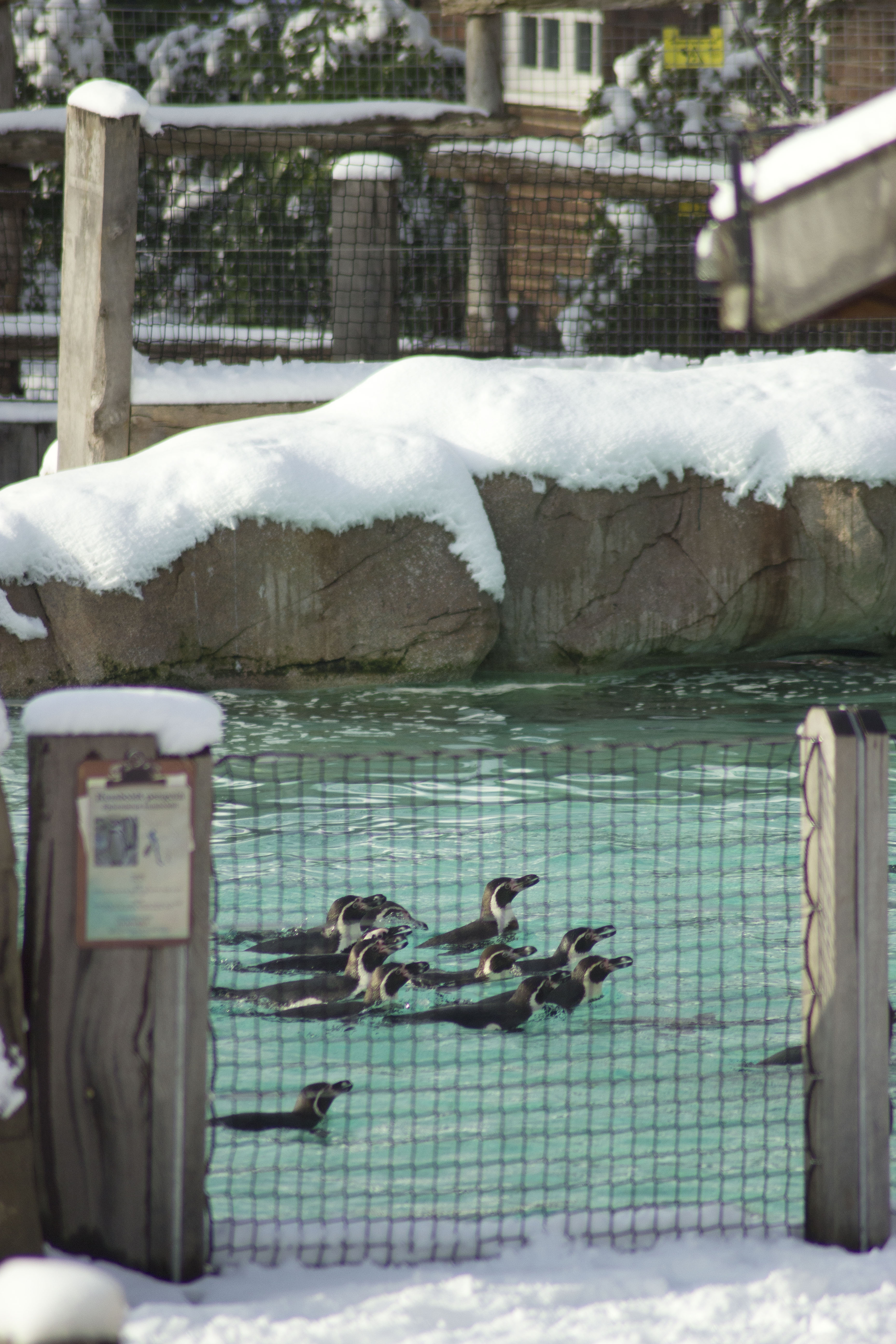
And spying through the bushes on the penguins at London Zoo!

011

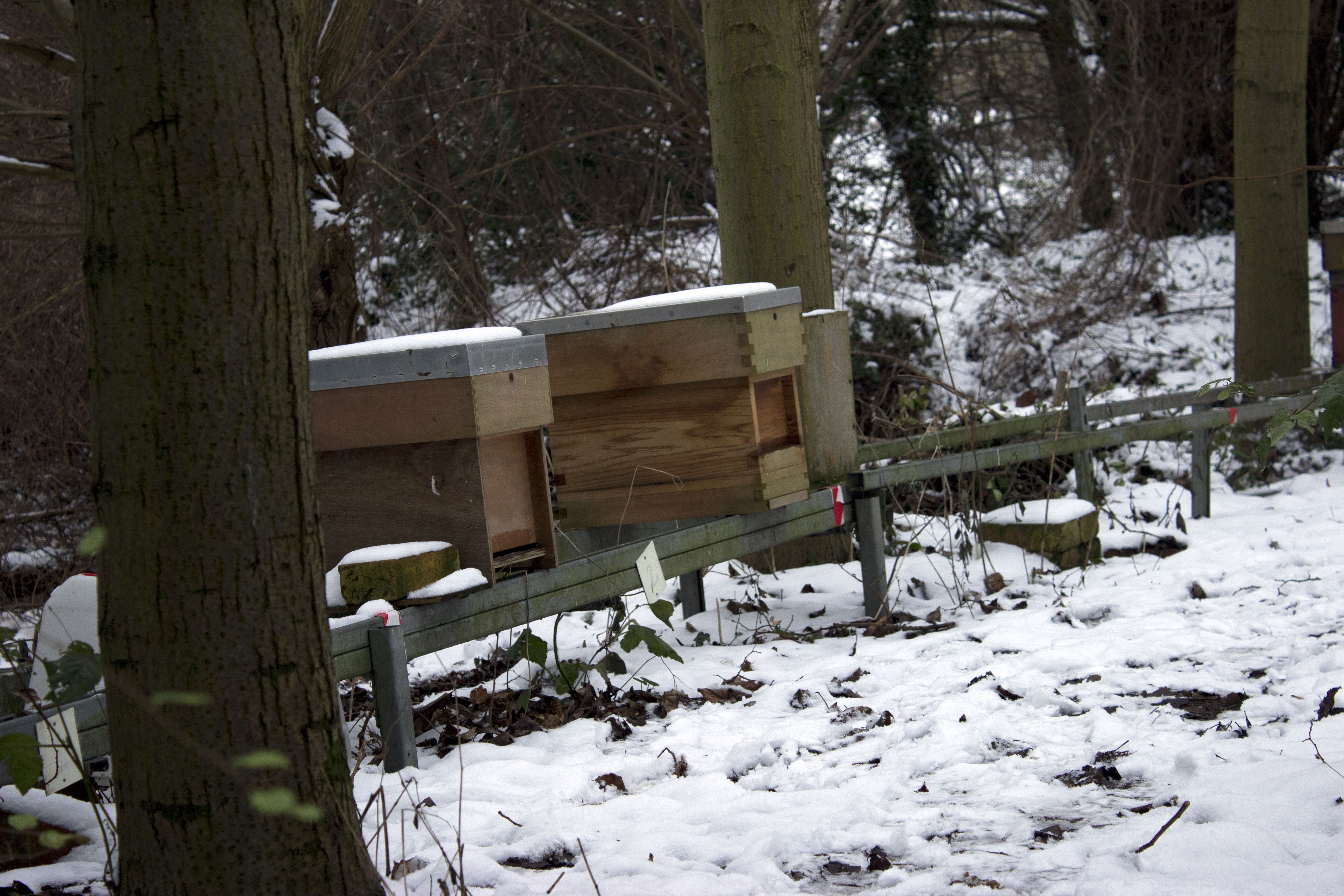
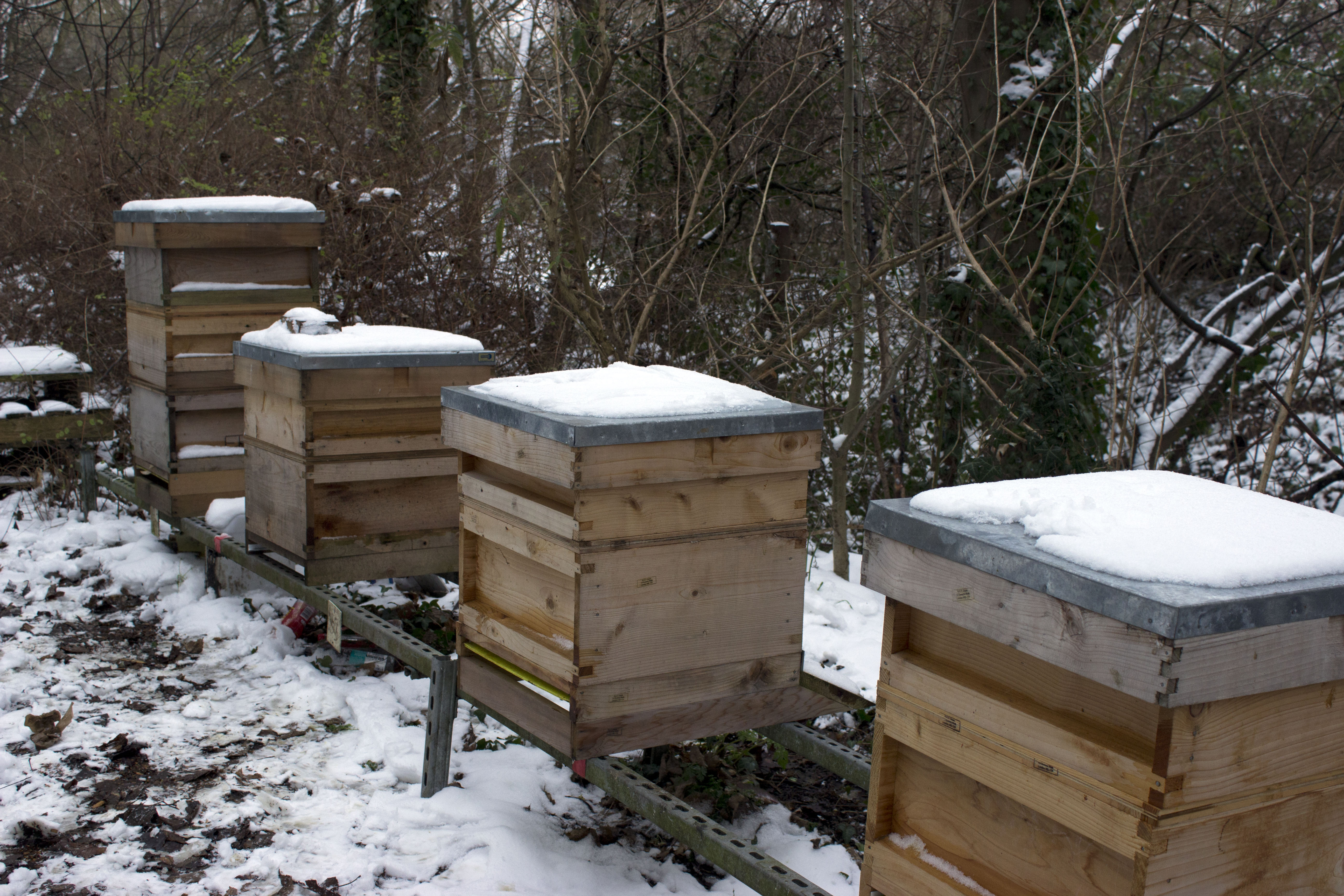
London has its own microclimate and by Tuesday the snow had left the inner city completely. In the meantime, a little visitor had landed at the apiary in search of food – woodpecker-bored holes were found on the side of one of the hives. Pat had found similar holes in his hives at Osterley a few weeks ago, so it appears that the woodpeckers are spreading the word.

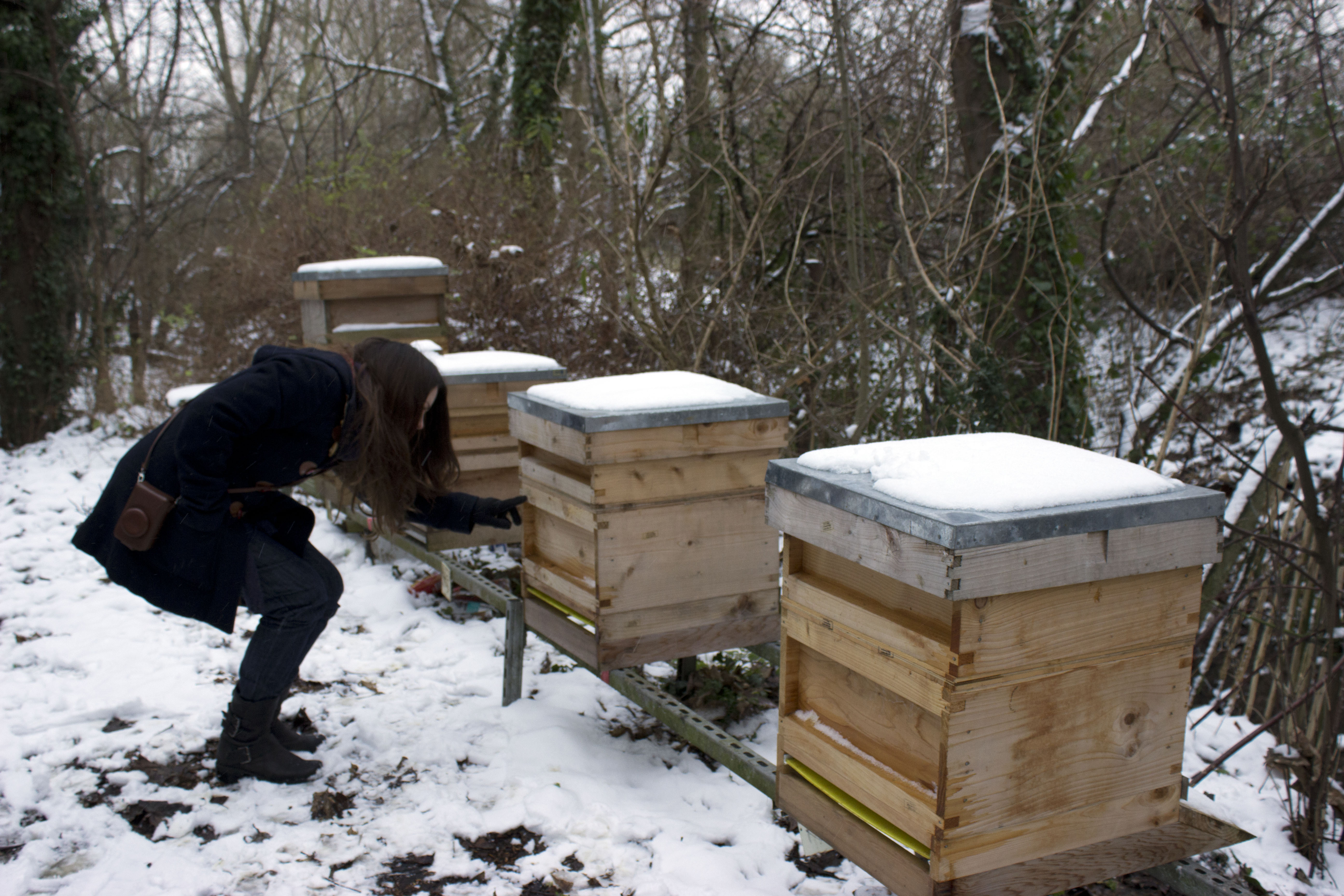
While Pat and John had wrapped most of the hives in chicken wire, I paid an early morning visit before work to finish the job on our colony and the two that we are looking after for Clare and Charles. A few bees were curious to see what I was doing and poked their heads outside the entrance, but it was far too cold for their noses and they soon went back inside.

000

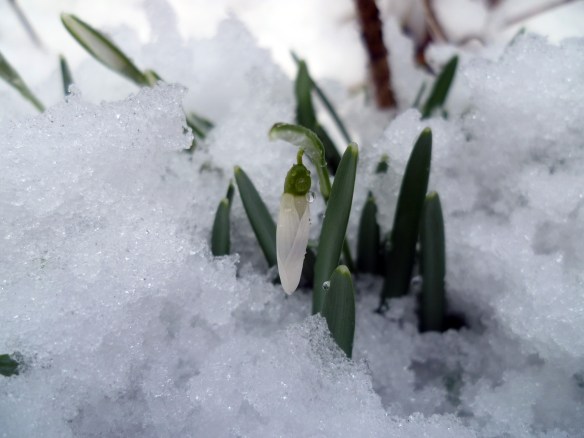
Emily had spotted snowdrops trying their hardest to grow through the hard ground a few weeks back. Not long now till spring.

Related links

Snowmageddon
Winter watch for bees

You may also be interested to read this bittersweet post by Daniel J Marsh on Death of a colony – a beekeepers loss. A stark reminder that January to March is when colony losses are often reported. You can also follow Daniel on Twitter: @danieljmarsh

Snowmageddon

009

As temperatures in Sydney, Australia soared to a record-breaking 45.7˚C this week, my ex-pat friends complained that they were missing the snow in England. Holly Galt tweeted: ‘Ah London, you are making me so homesick! Love a good snow day. #Snowmageddon’ @hollygalt

The snow hadn’t yet arrived, but as Holly is from 12 hours in the future it was possible she knew something that I didn’t. And on Friday the snow arrived.

My work’s Medicinal Garden looked very pretty in the snow.

001 002 003 004 005

However, as nice as it looked around Regent’s Park, I didn’t want to sleep at my desk overnight, so we all left early while the trains and buses were still running. I enjoyed a snowy walk home through Northolt Village.

007 008 010

On Saturday morning I awoke to find Narnia outside my window and temperatures around 0°C. Positively balmy! Being one of the few beekeepers insane enough to prove that we can still have our tea and cake on a Saturday afternoon – even in snow, I arrived at the apiary not surprised to find a small crowd.

I found Emily, Stan and Albert doing some detective work having found evidence of bird footprints in the snow on hive roofs and a suspicious dent in the wood of John’s hive. Could it be that an Ealing woodpecker has discovered the tasty treats inside our hives?

snowbees5 snowbees3

Emily and I checked on our bees next. The hive is still quite heavy with stores, although they have eaten a large hole in the fondant. This allows us to observe the colony in winter and see that the bees look healthy and are active. A few workers were light coloured and fuzzy, they might be new bees if the queen started laying again in late December.

snowbees1 snowbees2 snowbees4

By now my body temperature was around -1°C, so we went to join John and the boys huddled around the kettle and Emily’s delicious jam cake.

Snow is forecast to return on Sunday, while the sun continues to shine in Sydney. As Holly would say, I know where I’d rather be. #London #snow

Winter studies: Social organisation of a honeybee colony and worker policing

Mod 6.5 leadA worker honeybee is patrolling the hive. She walks around the colony watching her sisters clean cells, nurse brood, build comb and fan nectar. She sees drones being pushed aside by returning foragers impatient to unload heavy baskets of pollen. She turns as the queen walks past looking for suitable cells to lay eggs.

Such is the constant activity of the hive that it almost causes her to miss a haphazardly laid egg. Almost. She pauses. The egg lies lopsided along the wall of the cell, not neatly deposited at the bottom. The queen, a precise egg-layer, is never so careless, so the worker climbs in the cell to investigate. Every egg laid by the queen has a signature scent (pheromone) but this egg does not have her mother’s tag – it has been laid by one of her sisters, a rebellious laying worker.

The queen does not need to fear insurrection because her daughters are very efficient at policing themselves. Without hesitation, our worker eats her sister’s egg and if she happens to catch her sister laying more eggs, she will not treat her kindly.

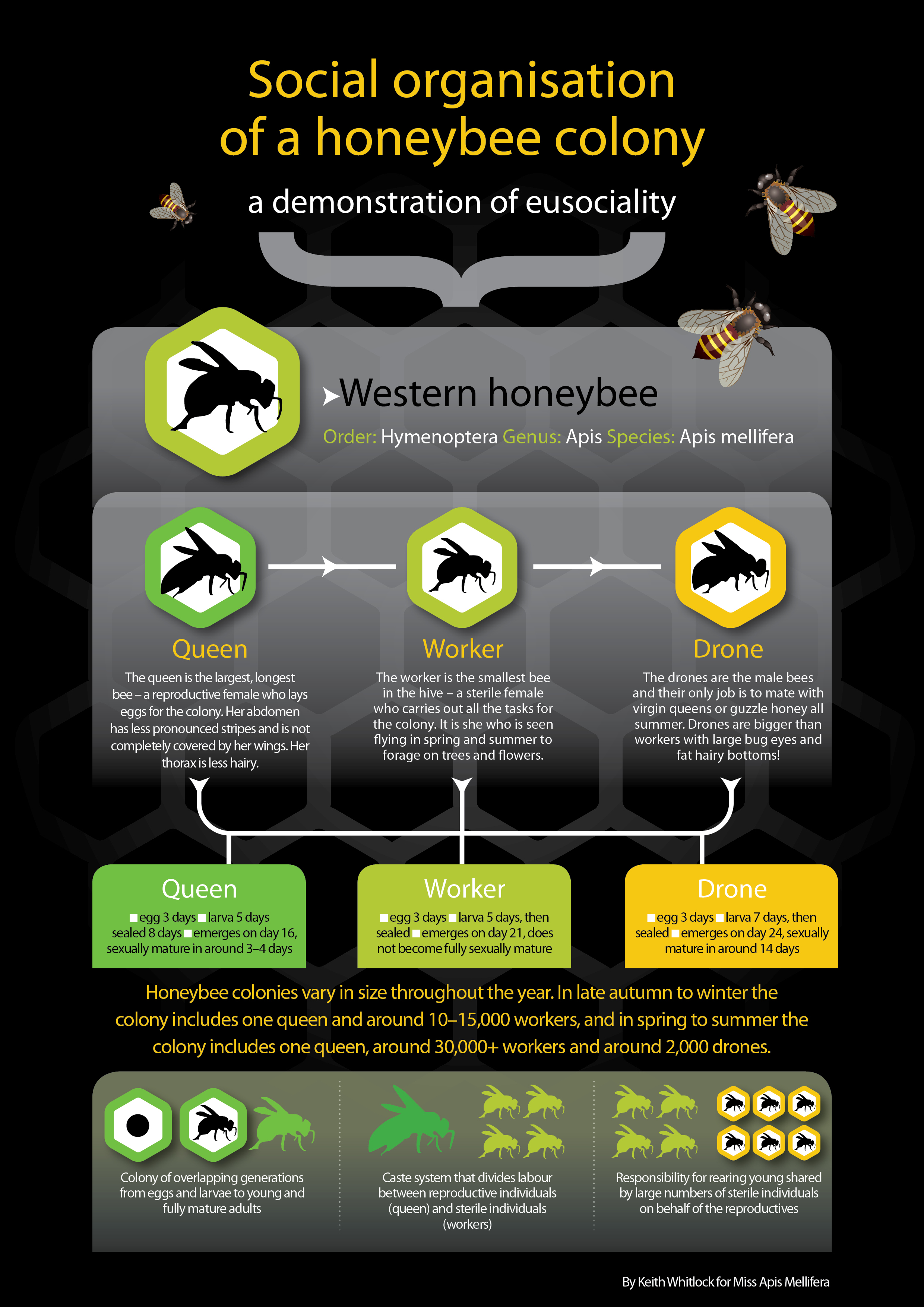
My fourth winter study post discusses the social organisation of the honeybee colony as a well-structured and highly hierarchical community. My post is summarised and illustrated by beautiful infographics created for my blog by designer Keith Whitlock.

The social organisation of the honeybee colony including worker policing.

The honeybee is a eusocial insect, which describes an advanced level of social organisation. The most familiar examples of eusocial insects are bees, ants and wasps, which all belong to the insect order Hymenoptera.

Eusociality is demonstrated by:

  • colony of overlapping generations from eggs and larvae to young and fully mature adults
  • caste system that divides labour between reproductive individuals (queen) and sterile individuals (workers)
  • responsibility for rearing young shared by large numbers of sterile individuals on behalf of the reproductives

The organisation of a honeybee colony revealing a eusocial society is given below:

Mod 6.5 infographic eusociality

Now that’s understood, here’s how the bees get organised inside the hive.

The queen
(diploid, fertile reproductive individual)
The queen is the most important bee in the colony. She lays eggs, providing a constant supply of new bees, and produces queen substance to control the workers and keep the colony working together as a cohesive whole.

Egg layer
The queen fulfils the role of egg-layer thanks to the royal jelly that she is continually fed in copious amounts as a young larva, thus ensuring she has fully developed ovaries and is able to mate. It is only the queen who can lay both fertilised eggs (which become female workers or potential new queens) and unfertilised eggs (which become male drones).

The queen mates not long after hatching and lays around 1,500 eggs per day; she may live between 3–5 years. She is not only a prolific egg-layer, she is also precise. With her long abdomen, she carefully deposits one egg, placed neatly in the centre, at the bottom of a cell (fertilised with a single sperm or left unfertilised) and marked by a pheromone so that the workers can recognise eggs laid by the queen.

Queen substance
The queen secretes a substance from her mandibular glands called queen substance – a heady mix of chemicals of which the main component is the pheromone 9-oxodec-2-enoic acid (9-ODA). The queen substance is constantly spread throughout the hive as workers lick the queen and then pass the chemicals to other bees. Queen substance, combined with a pheromone given off by her own brood, inhibits the development of the workers’ ovaries – effectively it acts as a natural contraceptive! It is quite effective as normally only 0.01% of workers can produce full-sized eggs and only 0.1% of drones in a hive are the sons of laying workers.

Queen substance modifies worker behaviour in other ways:

  • inhibits building of new queen cells
  • stimulates foraging activities for nectar and pollen
  • encourages workers to build honeycomb

The pheromone 9-ODA is also released by the queen as a scent to attract male drones during her mating flight.

As the queen gets older her queen substance becomes weaker, and her egg-laying decreases, so that she has less control over her workers. They will eventually build queen cells to replace her.

Mod 6.5 infographic queen

Workers and worker policing
(diploid, infertile non-reproductive individual)
If you see a honeybee foraging on a flower in spring and summer she is likely to be a female worker. Almost every bee inside the hive is a worker and female.

Workers are the worker caste and carry out all the tasks for the colony. They live for around 40 days in spring and summer and between 5–6 months over autumn and winter.

Development of infertile females
After hatching, all young larvae are fed royal jelly for three days and then put on a diet of brood food, unless specially selected to become queens. Larvae who are continually fed royal jelly become queens with fully developed ovaries and are able to mate. Worker larvae are not fed royal jelly after day three of their development, have under-developed ovaries and are not able to mate. Their ovaries are unlikely to develop as adult bees due to the pheromones given off by the queen substance and the brood.

Worker policing
However, some workers may produce full-size eggs in their ovaries and become laying workers. Their progeny are destined to become drone because they cannot mate and have no sperm to fertilise their eggs.

Laying workers are quite careless. They may lay more than one egg per cell and because their abdomens are shorter than the queen’s the eggs are often laid haphazardly against the cell wall. They do not differentiate between worker-sized and drone-sized cells, laying drone eggs in worker-sized cells that hatch as drones with stunted growth.

Most importantly, worker-laid eggs are not marked by the queen’s pheromone, which helps other workers to police their illegal egg-laying activities. Worker-laid eggs are usually removed from cells and eaten by other workers (a practice known as oophagy).

Mod 6.5 infographic worker police

Drones
(haploid, fertile reproductive individual)
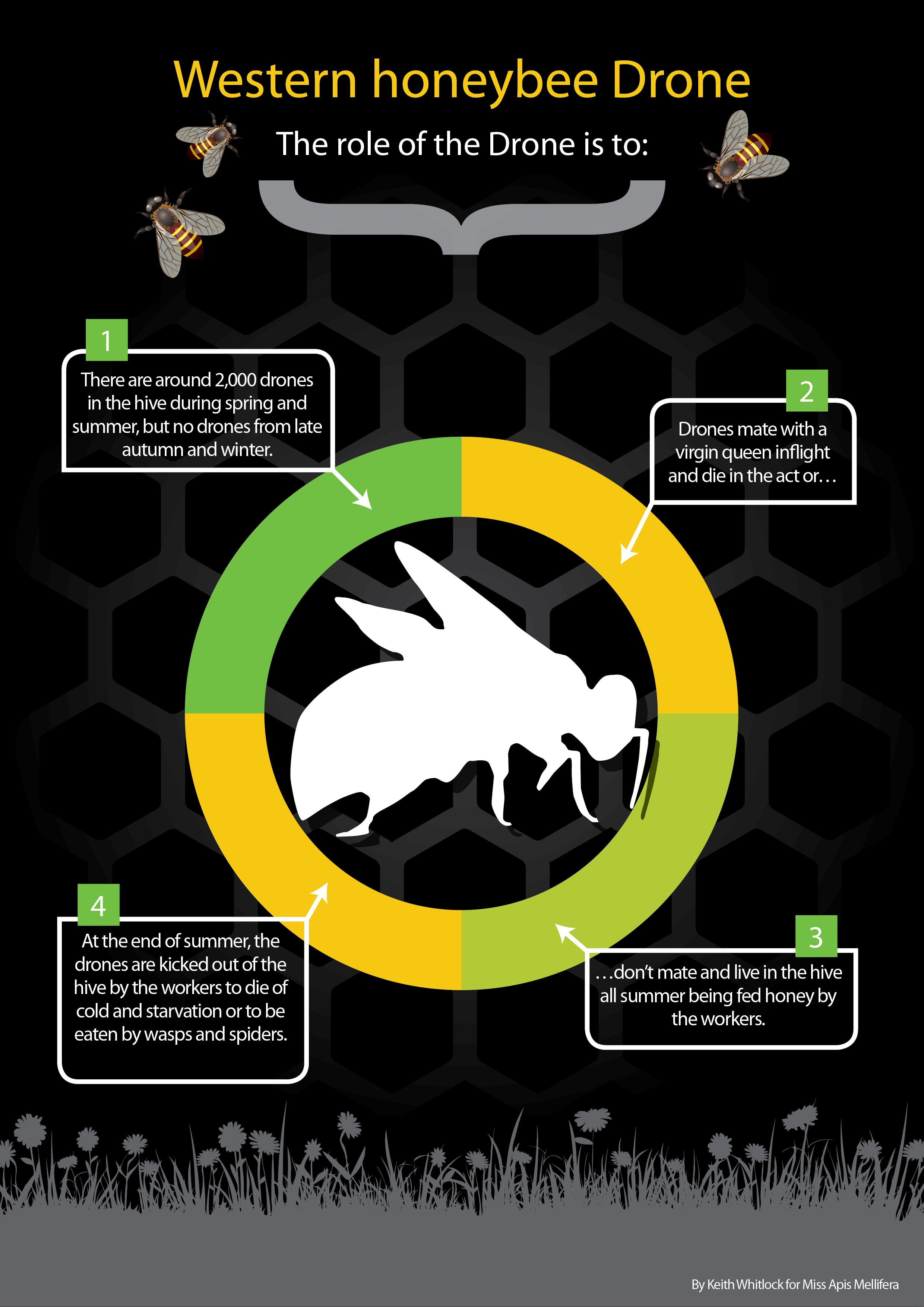
Drones are the male bees of the colony and it is thought that their only role is to mate with virgin queens. A drone hatches from an unfertilised egg and inherits one set of chromosomes from his mother, the queen; for this reason, a queen cannot mate with drones from her own colony due to the risks of inbreeding.

Drones that mate with a virgin queen on her mating flight will die in the act, and drones that don’t mate but live to the end of the summer will eventually outlive their usefulness to the colony and be evicted by their sisters.

Drones do no work inside the hive, although beekeepers have observed in spring and summer that colonies with fewer drones can be bad tempered. Perhaps drones fulfil another purpose not yet discovered.

Mod 6.5 infographic drones

I’m looking forward to exploring the next item on the syllabus – dancing bees!

Related links

Visit my blog index for more winter study posts.

A great revision post from Emily Heath of Adventures in Beeland: 4th Honeybee behaviour revision post: social organisation of the colony

Mid Buck Beekeepers Association Blog’s excellent revision notes for BBKA module 6

Recommended reading

Celia F Davis. The Honey Bee Inside Out. Bee Craft Ltd, ISBN-10: 0900147075
Ted Hooper. Guide to Bees and Honey. Northern Bee Books, ISBN-10: 1904846513

Winter watch for bees

woodpecker damage

‘Do they ever do any beekeeping at this cafe?’ asked someone while we sat around the apiary table on Saturday afternoon. The first weekend after new year and Ealing’s beekeepers had made no resolutions to give up tea and cake.

Luckily, Pat had brought something to show why bees need keeping in winter – a feeder tray with a hole bored in the side of the wood by a woodpecker. Woodpecker damage to bee hives is not common in West London, but this case of break-and-entry shows why we should keep watch. The woodpecker had attacked Pat’s hive at Osterley first by boring a hole into the top of the feeder tray, where it wouldn’t have found anything interesting, next drilling the wood below before getting fed up or disturbed and flying off. ‘It must have been very disappointed,’ said Pat.

Bee larvae can make tasty treats for hungry woodpeckers in cold weather, and maybe bees too, while causing considerable damage to the brood nest. However, Ted Hooper says that woodpecker damage to bee hives is a learned behaviour:

‘Woodpeckers learn that they can find a good meal in a beehive much in the way that bluetits learn to open milk bottles for the cream. You may keep bees in an apiary for years with lots of green woodpeckers about without any damage and then suddenly they learn the trick and through the hive wall they go, leaving behind a dead colony and several 3 inch holes. Whether all the damage is done by the woodpeckers or whether rats finish the job off I am not sure, but I have seen brood chambers in which the frames have been turned into a pile of wooden splinters, no piece being larger than a match. Covering the hive with wire netting or fish netting before the first frosts is the usual remedy.’
Ted Hooper. Guide to Bees and Honey.

The chicken wire is on order for the Osterley hives.

EDIT: Pat kindly let me use this photo of his hive at Osterley now safely protected by wire netting. He advises using chicken wire wrapped around the whole hive to keep woodpeckers off and to ‘make sure there’s a good clearance all the way round so they can’t peck through it’.

iaejaeif

Image © Pat Turner

A walk around our apiary showed that the woodpeckers haven’t learned about the delicious morsels inside our hives – yet.

I carried out a few other winter checks including:

  • hefting the hive to check the weight of stores – it’s heavy
  • lifting the roof to look at the fondant – the bees are tucking in greedily and the hole in the fondant (a ‘window’ into the winter hive) suggests the cluster inside is loose
  • observing the entrance – foragers are flying home with bright yellow pollen suggesting that the queen has started laying.

Overall, the signs indicate that our bees are well and active, perhaps because of the mild weather, although in January they should be conserving energy. All that flying means eating a lot of honey, but at this time of year there won’t be much nectar about to replace it. We’ll need to keep a close eye on the hive’s weight and amount of fondant between now and spring.

I went back to the apiary table to report my findings. John agreed: ‘It’s much easier to get a hive through a very cold winter than a mild one, because they don’t fly about as much.’ I asked where the bees might be finding the yellow pollen and Pat thought it was from mahonia. There wasn’t much else to be done except have another cup of tea and try Cliff’s culinary invention – the ‘pake’.

the pake

It’s a mix between a cake and a pie, explained Cliff. ‘The top half is a raspberry muffin and the bottom half is a mince pie.’ I wasn’t entirely convinced but the men beekeepers were thrilled to find the mince pie half-way inside. A pake was left on the table for the apiary’s family of robins who swooped down as we left. Hopefully, it will satisfy any peckish woodpeckers too.

Merry Christmas Queen Myrtle and her bees!

tinsel for our hive

Not to be outdone by the elder beekeepers reading books to bees, this afternoon Emily and I made sure our hive was the most festive at the apiary. A Christmas card to ‘Queen Myrtle and bees’ was also slipped under the roof.

However, if it sounds like we were having too much fun, there was some proper beekeeping to be done: giving the bees oxalic acid.

Pat giving his bees oxalic acid

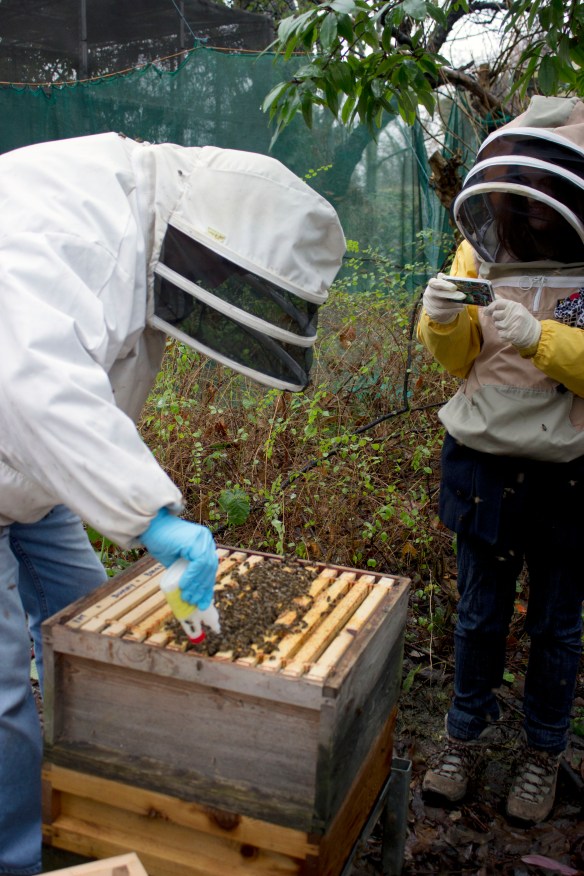
Oxalic acid is a winter treatment for bees. Above, you can see Pat treating his hive with Emily looking on.

Oxalic acid burns the feet and tongues of varroa mites so they fall off bees. The treatment is particularly effective in winter when the mites are living on adult bees, because there is little or no capped brood for them to hide inside.

Our apiary uses a pre-mixed solution of 3% oxalic acid in sugar syrup and about 5ml is dribbled on each ‘seam of bees’, that is the gap between each frame which has bees. It is important to get the dosage right as over-dosing may be harmful. Last year I took this video of Giving the bees oxalic acid.

The British Beekeepers Association (BBKA) has a good advisory leaflet on oxalic acid. Not all beekeepers like to use this treatment for a number of reasons, such as: it is not ‘natural’ (although oxalic acid is a naturally occurring substance; although cyanide is naturally occurring too, so this might not say much!); accumulative effects of annual treatments may harm the queen (I haven’t read enough to know if this is a risk); it may harm the bees (the winter workers will die in spring to be replaced by new bees so its effects on the colony may not be long-lasting). I think it is advisable to treat hives in an apiary environment in a city, because disease may spread more easily.

giving bees oxalic acid

After a challenging year for our bees, it was great to see them alive and well for their midwinter oxalic acid ‘gift’. When we lifted the roof they were happily tucking into the bag of sugar fondant, although the hive is quite heavy with honey stores. They should be tightly clustered inside the hive, but today was quite mild and the cluster had become loose.

Above, Emily treats our bees with oxalic acid. They were much better behaved than last year and didn’t make much fuss. Myrtle must be a gentle-natured queen.

There was a small crowd led by Pat and John to treat all the hives at the apiary and after all that hard work it was time for tea with homemade mince pies and a generous-sized apple pie! There was also honey mead so the banter was quite lively. Yet another exposé on what Ealing beekeepers really get up to!

mince pies and apple tart

Soon it will be January and we will be looking for the first signs of spring when we can see our bees again. Merry Christmas everyone from Queen Myrtle and her bees!

Winter studies: A honeybee year

winter bees

In this winter study post, I look at the honeybee colony throughout the seasons.

Winter to spring
In winter when the days are short and the nights are long, frost bites the air and snow covers the ground, the bees cluster together inside the hive to stay warm. As outside temperatures reach around 18°C the bees begin to huddle and as temperatures continue to fall the colony forms a small, tight ball around the queen. She may have stopped egg-laying completely, but there are still tasks for her workers in a broodless hive.

At the centre of the broodless cluster the bees vibrate their flight muscles to maintain a core temperature of around 21–24°C, while the outer edges are insulated by a layer of resting bees. The bees at the centre of the cluster take turns in changing places with the bees at the edges of the cluster, so everyone has a chance to stay warm! However, many bees will freeze to death during the coldest months of winter; 8°C is thought to be the lower lethal temperature at which a bee will die. Occasionally, on a clear, mild day, the bees will venture outside on a ‘cleansing flight’ to avoid defaecating inside the hive.

feeding snow bees

The bees tuck into their honey stores, because generating all that heat requires a lot of energy. ‘During the winter a colony will use an average of about 1kg per week just for heat production. (So do not skimp on feeding!)’ says Celia F Davis, The Honey Bee Inside Out.

The population of the overwintering colony is around 10–15,000 worker honeybees and the queen. In late January, as daylight hours increase, the queen begins egg-laying again and the workers raise the temperature for rearing the brood to about 34°C.

Spring to summer
The days grow longer and warmer and the plants begin to flower bringing nectar and pollen. The queen’s egg-laying depends on how much she is fed, so as the weather improves and more forage becomes available, particularly pollen for brood, the queen will lay more eggs. It may be as soon as late February or early March that honeybees are seen flying home laden with baskets of pollen to feed the spring brood.

This is a perilous time for bees. The old, overwintered workers are dying off as brood is increasing and new bees are hatching, but their winter stores are now very low. The colony relies heavily on fair weather to forage to feed the growing number of hungry mouths. Between January and March is when many colonies are most likely to die and beekeepers should keep careful watch.

spring forage

As spring moves into early summer the queen may lay more than 1,500 eggs a day, including drones to mate with virgin queens. A healthy, well-fed colony should grow from strength to strength and vary from 30,000 to 40,000 individuals at the height of the season. The colony continues to build up from May to June, which is usually the swarming season, although they may swarm earlier or later than this.

The workers put the queen on a diet to make sure that she is light and slim enough to fly – as a result, her egg-laying drops a week or two before the swarm. Swarming causes the population of the colony to fall by about a half and this combined with the break in brood both before and after the swarm, while waiting for a new queen to mate, means that the remaining population must work hard to build up numbers and stores again.

Summer to autumn
The longest day of the year has passed and daylight hours grow shorter and cooler. The queen’s egg-laying slows, less brood is produced, fewer bees hatch and the shorter-lived summer workers are dying off. The colony is becoming much smaller in size.

Foragers can be seen bringing home red-jewelled propolis on their legs. This sticky, resinous substance exuded by trees is used to disinfect and insulate the hive as the colony prepares to overwinter. In early autumn, the drones, having served their purpose throughout spring and summer to mate with virgin queens, are evicted by their sisters who do not want to feed them in winter. The bees that hatch in autumn will live for almost six months surviving on summer stores.

The seasons turn full circle as temperatures begin to drop and the colony clusters together waiting for spring to return.

snowdrops

Related links

Visit my blog index for more winter study posts.

A great revision post from Emily Heath of Adventures in Beeland: 3rd Honeybee behaviour revision posts: the queen’s egg laying behaviour & seasonal variations in the size of a colony

Mid Buck Beekeepers Association Blog’s excellent revision notes for BBKA module 6

Recommended reading

Celia F Davis. The Honey Bee Inside Out. Bee Craft Ltd, ISBN-10: 0900147075
Ted Hooper. Guide to Bees and Honey. Northern Bee Books, ISBN-10: 1904846513