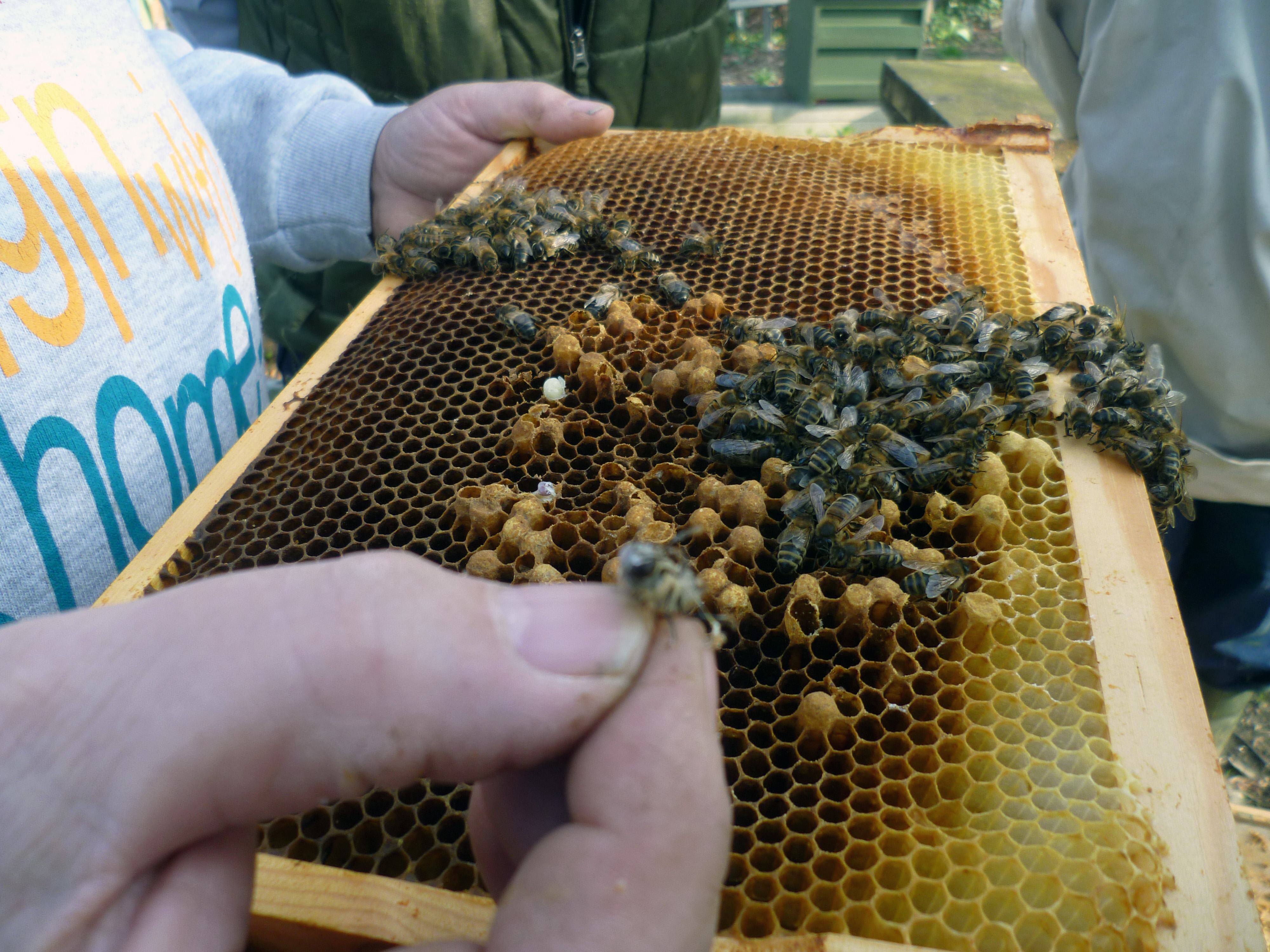
Bee Health Day at the London Beekeepers Association

‘We are going to talk about varroa, which you will ignore at your peril,’ said John Chapple, chair of the London Beekeepers Association (LBKA) in his opening comments at Bee Health Day. Emily and me had attended this varroa workshop with talks by the National Bee Unit’s (NBA) inspectors and hosted by LBKA, because it is vital that all beekeepers remain up-to-date on how to manage the varroa mite.

Varroa destructor – a truly insidious creature – is the mite that propelled the plight of the honeybee into the public eye. While there are many causes behind the decline of the honeybee, varroa is responsible for more colony losses than any other bee disease.

Varroa destructor – the insidious mite that afflicts honeybees and infects them with nasty viruses. © Crown copyright 2012

Since its discovery in England in 1992, the mite has spread rapidly across the country and invaded the hives of unsuspecting honeybees. This was a reconnaissance mission – Emily and me had come to find out more about the enemy.

We learned a lot – so here are highlights.

‘Know your enemy’ Alan Byham, south east regional bee inspector

‘Imagine what it feels like to have one of these on your back,’ said Alan, holding a life scale drawing of a varroa mite on his shoulder. ‘It would get in your way.’ Varroa mites feed on adult honeybees and their brood by clinging tooth and claw to suck their blood (picture a small, vampiric rabbit biting your back), weakening the bee’s immune system and transmitting a vile cocktail of harmful pathogens. Varroa accounts for thousands of colony losses each year in comparison to 800 hives lost annually due to European foul brood or American foul brood.

Varroa mites clinging to the back of a honeybee and sucking its blood! © Crown copyright 2012

As a parasite that frequently kills its host, varroa might not seem very effective. However, it was originally a parasite of the Asian honeybee (Apis cerana) which has natural defenses against the mite, and spread to the defenceless European honeybee (Apis mellifera) through globalisation and the transport of honeybees around the world.

Varroa is incredibly well-adapted to the life cycle of the honeybee and spends its entire life within the colony. It is so highly specialised that the female mite can sense the pheromone given off by bee larvae ready to be capped before the worker bees! The mother mite buries herself underneath the larval food unseen by workers as they cap the cell. Sealed inside, she waits for the larva to eat the food and release her. The mite then feeds on the juicy larva as it develops into a bee. During this time, she lays eggs that hatch and mate with each other (inbreeding is not a problem for varroa) and the entire mite family are released when the fully-grown bee emerges from its cell. Insidious.

Mother mites hide in cells and then feed on bee larvae as they develop. © Crown copyright 2012

Varroa are hitchhikers too, and spread from hive to hive by drifting bees who are mostly drones. ‘Drones can do bed and breakfast in any hive,’ said Alan. ‘The workers don’t see them as a threat and so they are well tolerated.’ Beekeepers may be unaware of varroa in their hives during spring and summer, because the mites are mostly hidden within the brood. Varroa particularly prefer drone brood because they take longer to develop, which gives the mite more time inside the cell. Queen cells are rarely invaded by varroa because the queen larva develops very quickly, thus if a queen cell does have varroa this indicates that the colony is overrun.

Varroa counts may appear to rise suddenly in hives at the end of summer, but this is because there is less brood as the queen slows down her egg laying in preparation for winter. Winter or summer, varroa is always there.

You may not be able to see the varroa in your hive, but it is there.

Varroa is a problem to larger colonies because they have more brood, whereas its natural host, the Asian honeybee, tends to live in smaller colonies. Varroa can also rise to harmful levels inside the hive when the colony does not swarm very often or is prevented from swarming, whereas again the Asian honeybee swarms frequently. Swarming is a natural method of varroa control because the queen flies away from the nest with half her bees and leaves behind the brood and varroa.

This is a risk of beekeeping, explained Alan. European bees are usually kept in large ‘super’ hives, sometimes with double brood boxes, in order for the beekeeper to get more honey. Their natural swarming instinct is managed by various swarm control methods to make sure that half the colony doesn’t fly off with the honey! However, beekeepers often report that their biggest and strongest colonies succumb to varroa over winter. So it seems the mite problem is exacerbated by the lifestyle of bees living in hives and, unlike feral honeybees living in the wild, requires good husbandry methods to keep it under control.

Varroa can cause a lot of damage to colonies as seen by this varroa-infested hive. The comb and bees look very unhealthy, or, um, dead. © Crown copyright 2012

Alan’s talk prompted plenty of questions from the audience, including can we breed varroa-resistant bees?

No one has bred varroa-resistant bees yet and using breeding principles to replace good husbandry is risky, because when a queen swarms her progeny will mate with local drones that are not varroa-resistant. In a city like London where most bees are mongrels, it would not be possible to control breeding. It may be possible that a varroa-resistant bee is bred in future, or that Apis mellifera itself adapts to life with the mite, but in the meantime good husbandry techniques are essential to control varroa.

If you keep bees you keep varroa…

…I remembered this comment from Scott, a member of Ealing’s beekeepers, at last year’s Bee Health Day. All beekeepers keep varroa as well as bees no matter what we do or don’t do with our hives, so we may as well learn how to ‘keep’ it!

Alan took us through the treatment options available to beekeepers to kill varroa many of which are based on naturally occurring chemicals, such as thymol and oxalic acid. He explained that beekeepers are also dealing with a food product (honey) and so need to be careful what treatments they use and when. For example, the thymol-based Apistan varroa control strips taints honey with a strong smell and can only be use after the honey crop is removed at the end of the season.

While you can treat the brood nest for varroa, treatments shouldn’t be used while supers are on the hive and being filled with honey. Here I caught a little bee flying off from the comb!

The group asked about the effectiveness of using natural methods like sugar dusting. Bee are dusted in a light coating of icing sugar, which encourages them to clean each other and knock off the varroa. However, sugar dusting only knocks off around 29% of varroa mites and an effective treatment must kill 80% of the mites. It is a useful method during spring and summer when the supers are on the hive, because it won’t taint the honey, but it should not be used alone against varroa. Alan advised a multi-approach to managing varroa and to keep records of what works and what doesn’t.

A practical apiary session followed with Caroline Washington, bee inspector for North of the Thames, and the inspector who visits our apiary. Caroline is an effortlessly glamorous beekeeper and very, very firm. No bee would misbehave for Caroline!

Caroline gets her smoker going with a pine cone.

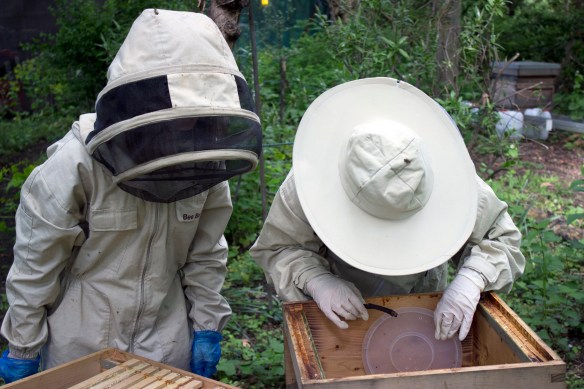
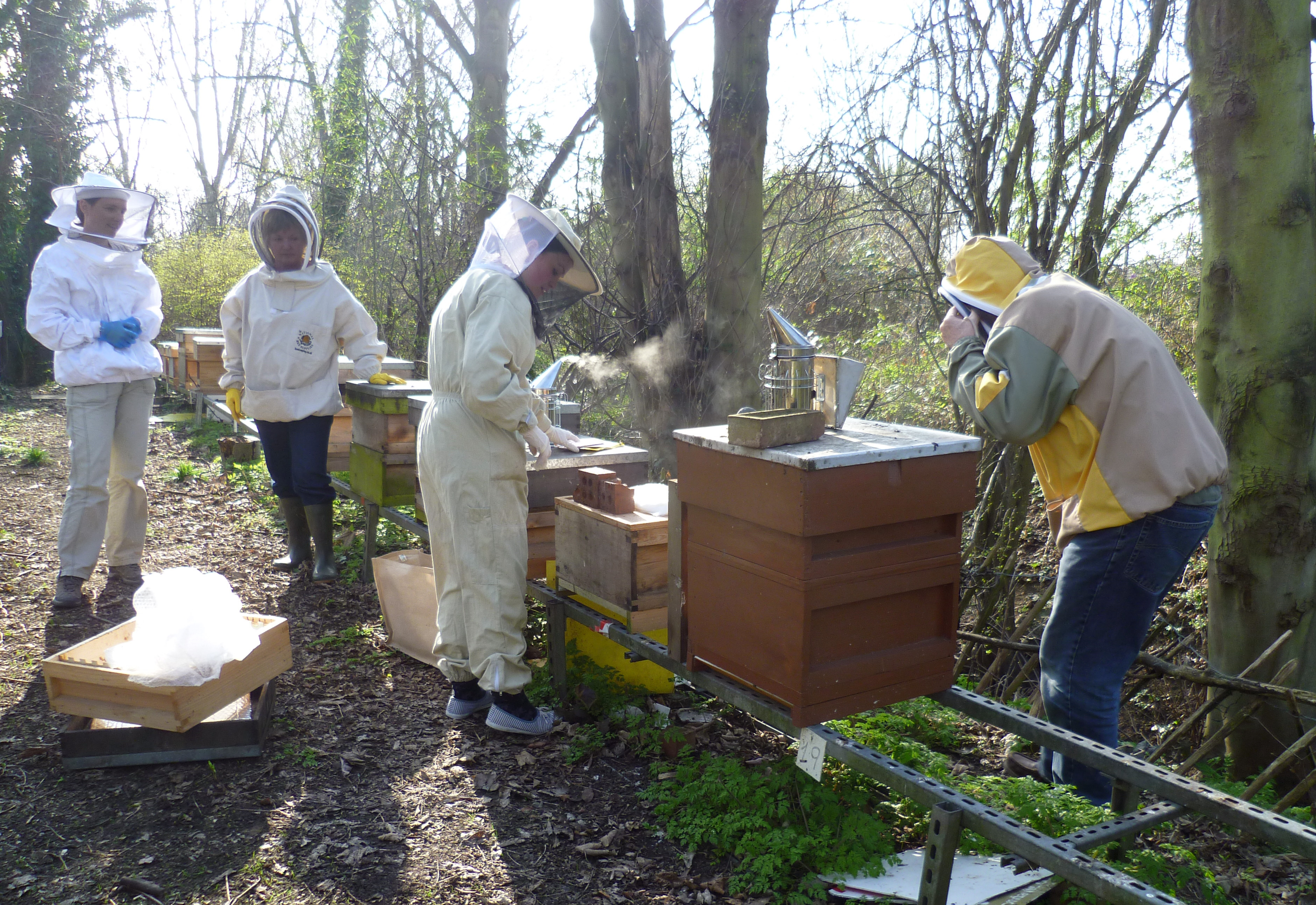
After getting her smoker going with a pine comb, Caroline demonstrated an inspection of a hive that she described as ‘very boring’. I think the bees were too in awe of Caroline to do anything other than what they should.

The bees behave for Caroline while she inspects their hive. In the background, my lovely hive partner, Emily!

It was a lot of learning for one Sunday morning, so we took a break for lunch and sat on the lawn of LBKA’s base at Roots and Shoots in Lambeth.

‘Virus in varroa’ Caroline Washington, bee inspector North of the Thames

The afternoon sessions kicked off with a talk about the world of bee viruses by Caroline. She listed the top six bee viruses that we should all know:

  1. deformed wing virus*
  2. sacbrood virus
  3. chronic bee paralysis virus
  4. acute bee paralysis virus
  5. black queen cell virus
  6. Kashmir bee virus

The virus that should most interest London beekeepers is deformed wing virus, which is often transmitted to queens when they mate with infected drones. Caroline commented that there has been much talk lately in the beekeeping world about failing queens, but no one ever thinks to look at the drones.

I demonstrated uncanny queen-spotting skills in the earlier apiary practical session by spotting this queen winding her way across the frame before it had even been lifted out!

The Food and Environment Research Agency (FERA) suggests that deformed wing virus is associated with most colony collapse, and the problem has become worse because there are many more beekeepers now and not all are managing varroa. Bees have the same problem as people living in crowded cities like London – disease spreads faster. Hives that are not treated for varroa will have bees that will infect neighbouring hives, which seem very antisocial!

‘The claw chooses who will go and who will stay’

The most valuable lesson that Caroline gave us was to use a pair of tweezers for inspections – not to groom the bees and make them more lovely, but to look for nasty stuff on the comb. ‘I have been trying to get beekeepers to look more closely at the comb for years,’ said Caroline. ‘Bad comb is easier to spot than disease or mites.’ Caroline passed round some particularly grotty-looking frames and got us to have a close look at them.

‘Husbandry techniques’ Brian McCallum, seasonal bee inspector 

The final workshop of the day was with Brian McCallum who talked us through a practical checklist of good husbandry including using open mesh floors and varroa monitoring boards, a varroa calculator (available on the NBU website) and drone monitoring.

Drone monitoring is an effective method of checking levels of varroa in a hive, because the mites are most attracted to drone brood. This is done by taking out of frame of drone brood and de-capping it, then counting how many larvae are infected with varroa rather than counting the number of mites. This number can then be checked on the NBU varroa calculator, which will indicate if varroa has risen to harmful levels and requires treatment.

A capping fork is used to un-cap drone brood on a test frame and to count the number of larvae that have varroa – like the one here with a big red mite. © Crown copyright 2012

At the end of the day I suspected that my brain is not much bigger than a bee’s because it was hurting quite a bit. So Emily and me wandered round the beautiful garden of Roots and Shoots, and were introduced to the resident solitary bees by the gardener, David Perkins.

After all that varroa nastiness, here are some lovelier pictures of solitary bees and bumbles happily not worried about mites.

A little bumble bee John found in the morning that hitched a ride. Morgan Bowers, who comments below, says. ‘Your ‘little bumble bee’ is Andrena fulva, the Tawny Mining Bee.’

A solitary bee flies home. They are brilliant carpenters and make little homes for themselves. 


David has made a bee tower for the solitary bees at Roots and Shoots. These bees may be Osmia rufa, Red Mason Bee – thanks, Morgan!


A bee hurries off to get the last nectar of the day. She has no time to stop for photos and passes like a blur!


Useful links
National Bee Unit
London Beekeepers Association
Roots and Shoots

Related posts
Disappearing bees – countdown to catastrophe or one to watch?
Myrrh, Queen of the Monsoon

A tough little tree grows along the Red Sea and arid regions of Northeast Africa, Libya and Iran. Surviving against the odds, the little tree weeps a bitter red-brown resin with remarkable healing properties. Its name is myrrh.

Like her namesake, Queen Myrrh emerged from her cell into adversity. She arrived as the rains came to the desert bringing plants, trees and flowers back to life, while she waited inside the hive. Myrrh, who inherited a dying colony from her drone-laying mother, Rosemary, was desperate to go out on her mating flight, but every beat of her wings would have been a race against the wind and rain.

In Guide to Bees and Honey, Ted Hooper says, ‘The queen mates on the wing during the first ten to twenty days of her life. Once she has emerged from her queen cell she becomes mature within a couple of days, but by the time she is three weeks to a month old she is no longer capable of mating properly. During her mature period the worker bees become more and more aggressive towards her up to the time she mates. This behaviour has a possible value in driving the queen out for her mating flight before she is too old to accomplish it efficiently.’

A mild spring of sunshine and showers is vital for bees to forage and build-up their stores after winter, and fine days are needed for the mating flights of virgin queens. However, the torrential rain over the past six weeks has trapped bees inside hives and left hungry mouths to feed.

Warm, sunny days are needed for drones to fly out to congregation areas where they swarm about thirty to ninety feet above the ground and wait for virgin queens to fly past. No one knows for certain how drone congregation areas are found by drones and queens, but each spring they make amazing spectacles of life and death.

If the weather had been fine, Myrrh would have flown through the air like a comet with drones forming a comet’s tail behind her. The best and fastest drones would catch the queen and die in the act of mating, falling to the ground below. ‘At the time of mating the drone genitalia enters the queen and literally explodes, separating from the drone, which dies.’ (Ted Hooper)

During the course of three mating flights, the queen would mate with up to 40 drones, filling her abdomen with sperm and allowing her, potentially, to lay fertile eggs for the colony for two to three years. ‘Mating having been accomplished, the queen starts egg-laying within a few days, and is from then on very carefully looked after by the worker bees… now she produces a scent which causes them to turn and face her if she is close, thus forming the ring of workers usually found around the queen, and called her “retinue”.’ (Ted Hooper)

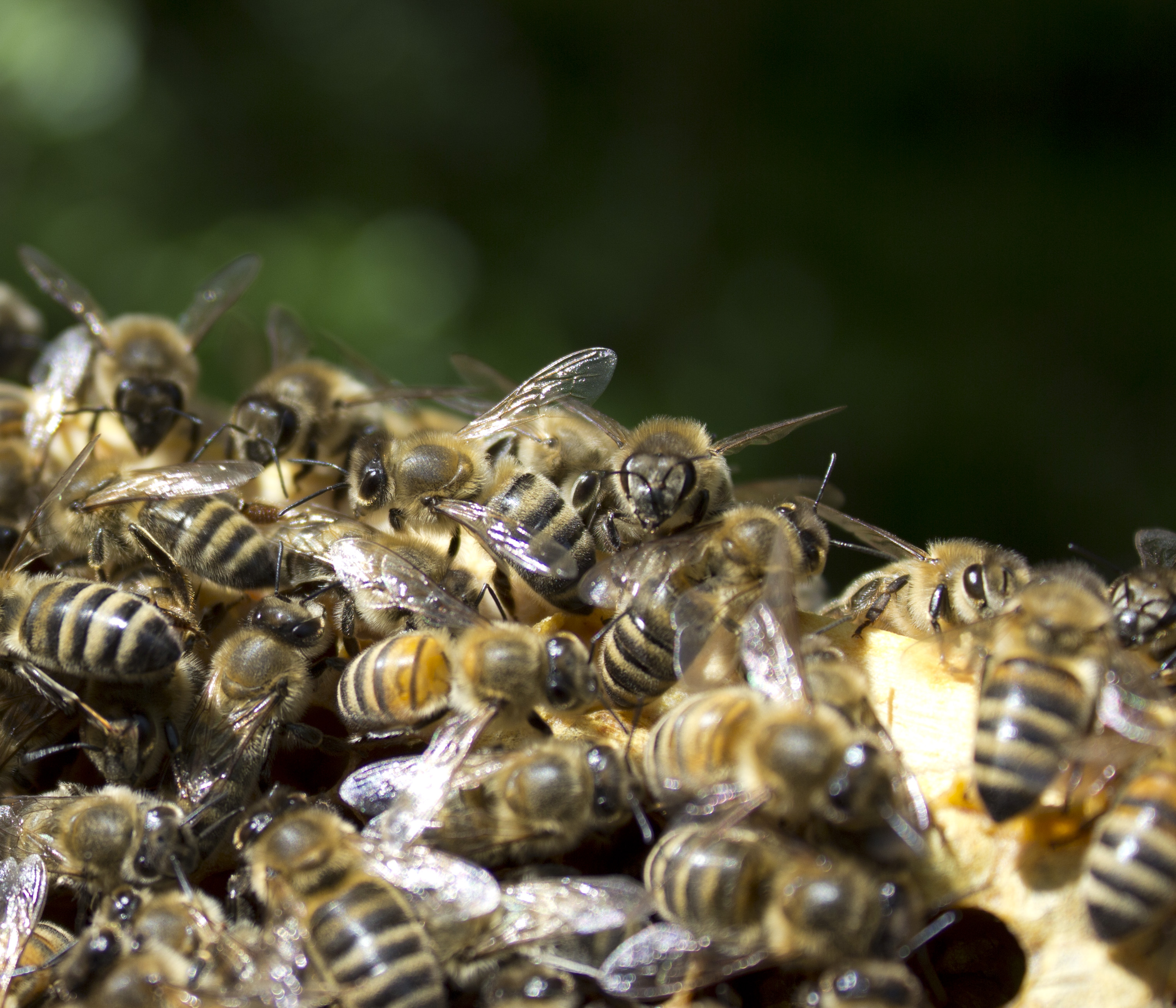
Queen Lavender is surrounded by her retinue – a circle of worker bees – as she walks across the frame. (Sorry the queen’s a little blurry – it’s tricky to hold a frame of bees, spot the queen and take her photo!)

However, the weather was not kind and Myrrh never left the hive. Unable to mate with drones from her own colony because of the risks of inbreeding, she could not lay eggs to replace the workers reaching the end of their life cycle and the drone her mother had laid. The colony had become quite small by the time Emily and me were able to open the hive for an inspection.

We were sad to see Myrrh walking across the frame without her retinue of workers and her small abdomen indicating that she had not mated. We continued to check through the hive to make sure that there were no eggs or larvae – the queen can also look small and slim before swarming when she is starved by the workers to make her fly, but this was unlikely to be the case with Myrrh. A few weeks ago we had put in a frame of larvae from Lavender’s hive, but this was uncapped probably because there are not enough workers to raise brood. We didn’t find new brood.

Worker bees having a chat. Chilly temperatures this spring meant that opening the hives would do more harm than good, leaving nature to decide the fate of Myrrh. We could not introduce a newly mated queen while Myrrh was inside the hive, because the workers would see her as an intruder and kill her.

Emily and me talked over the options because, while there was nothing we could do for Myrrh, there were the surviving bees to consider. It was too late to give the colony another frame of larvae from Lavender’s hive, because there were not enough workers to rear a new queen and her bees. For the same reason, it was too late to introduce one of the mated New Zealand queens recently bought for the apiary.

The dying colony was mostly drone, but could be saved by combining with Lavender’s hive. It was a big decision to finally collapse this colony, so we decided to close the hive for a few days to consult wiser beekeepers than ourselves.

Drones carry the characteristics of their hives to other colonies through mating with the local queens. Emily and me have good-natured, hard-working bees, and we would want our drones to survive and mate with other queens in the area.

Queen Lavender’s hive was a happier picture full of bees, brood and stores. The bees had completed the Bailey comb change by themselves – clever bees! – and the brood in the bottom had hatched and moved up to join the queen. We took away the old brood box and placed the new brood box on the hive floor, removing the dummy board to give them space to expand. The old brood box, with straggler bees shaken out into the queen’s nest, was placed on top with an empty super in-between for the bees to rob the remaining stores.

We saw signs that Lavender’s bees are trying to make queen cells – it is the swarming season – but with more space in the brood box this instinct may be delayed. We will have to watch them carefully over the next few weeks.

I spied a worker waving her abdomen in the air, exposing her Nasonov gland and fanning her wings to spread the scent to guide foraging bees back to the colony. She may have been doing this because we kept Lavender’s hive open longer than usual to complete the Bailey comb change.

Emily and Drew had brought along their friend Owen, who was scouting out the situation about bees for his girlfriend, Fran. So we wandered round the apiary for a while and topped up the sugar syrup in the other hives and nucs. In May we wouldn’t normally feed bees because the supers would be on the hive, which we would like the bees to fill with nectar not sugar. However, the wettest April on record for the past 100 years in the UK has bought famine to many bee colonies and the National Bee Unit has issued a starvation warning to beekeepers to continue feeding their hives.

At the height of summer, a forager bee visits around 2,000 flowers a day to collect enough nectar and pollen to feed around 50,000 hungry bees inside the hive, and new bees are hatching all the time. So if bees can’t fly out and stores are low, they need a lot of sugar!

Drew kindly took some nice shots on my new camera…

Me pouring Ambrosia sugar syrup – food of the gods and of bees. I hope the bumbles and solitary bees found food, warmth and shelter during the rainy spring.  © Drew Scott

Rain is needed to stimulate the nectar flow, but then sunshine is needed to evaporate the water from plants, flowers and trees so bees can forage. Too much rain dilutes nectar and washes away pollen leaving no food for bees. The honeybee relies on the delicate balance of nature for its survival or doom! © Drew Scott

Bees can be a bit forgetful so Emily and me use Pat’s sticky twig trick to remind them of ambrosia in the roof. A twig is soaked in sugar syrup and left inside the feeder hole leaving a trail of gooey sweetness for bees to follow. © Drew Scott

Beekeepers sharing a bee joke – hope the bees enjoyed it. © Drew Scott

Beekeeping done for another Saturday and the sun still shining, Emily, Drew, Owen and me ended the afternoon in the beer garden at The Fox Inn, in Hanwell.

The reign of Queen Myrrh has been painfully short and bitter, but she has inspired an aromatherapy blend.

Warming bath blend

  • 4 drops myrrh
  • 2 drops clove
  • 2 drops ginger
  • 4 teaspoons of olive oil

Run the bath and then sloosh round the blend to disperse the oil as much as possible (you can use full fat milk or cream or an unscented bath gel as a carrier agent, if preferred). Patch test the blend if you have sensitive skin. Do not use if you are pregnant.

This is a dark, smoky and reflective blend. In The Complete Guide to Aromatherapy, Salvatore Battaglia describes myrrh’s effect on the mind as ‘one of inner stillness and peace, of an awareness free from restlessness and the mundane’. Clove and ginger were added for depth and warmth.

Emily and me attended the London Beekeepers Association Bee Health Day on Sunday (we were really as busy as bees this weekend!) and listened to very useful talks from our local bee inspectors on how to manage bee diseases and keep happier, healthier bees, which will feature in future posts.

The case of foul brood and the diabolical baby

Emily and me did less tea drinking and more proper beekeeping last weekend, captured beautifully on camera by Emily's 'entourage' Drew Scott!

Things can happen fast in bee-land. Barely a month has passed since the Bailey comb change, but there has been a drone-laying queen, a suspected case of foul brood and the unexpected appearance of a virgin queen. That’s just one hive. I sat on this post for a while thinking back on the lessons learned in the past few weeks.

Rain had prevented our hive inspections for two weekends following the Bailey comb change, but when the sun came out after Easter bank holiday Emily went to check on our bees. What she found inside Queen Rosemary’s hive would worry most beekeepers, so she raised the alarm by emailing the secretary of our association, Andy Pedley.

‘I am worried our hive has some kind of brood disease,’ wrote Emily. ‘There is virtually no healthy worker brood, lots of drone brood, and some dried up larvae, some that look a bit scaly, and some that look a bit bloated.’

Emily thought our bees were grumpy and a bit aggressive, which can be a sign of a failing queen or being queenless. She spotted cells filled with pollen with a film of honey on the top, which can also indicate being queenless.

Andy is a very experienced beekeeper, a sentinel apiarist for the Middlesex area, and apprentice to the queen’s beekeeper, John Chapple. So he really is the bees knees! Andy offered to meet at the apiary on Saturday to test our hive for bacterial disease.

What followed was a week of worry as I wondered how our bees could have declined so quickly. At the last inspection every cell in every brood frame had been scrutinised while we tried to find the queen and eggs, and there was no sign of disease. But now we had a suspected brood disease like European foul brood (EFB), which is not good but can be treated, or American foul brood (AFB), which is untreatable – destroy the hive, burn the remains and salt the earth!

I downloaded these educational images of EFB and AFB from the National Bee Unit.

Healthy bee larvae are curled in half-moon shapes inside cells and are pearly white with yellow tummies from the pollen that they eat. © Crown copyright 2010

Unhealthy brood with EFB look misshapen, dark and slimy. © Crown copyright 2010

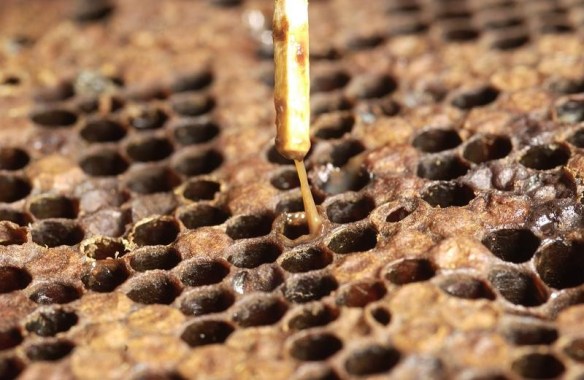
The classic 'snot test' for AFB, a matchstick is dipped into a cell – if a stringy mess of slime is pulled out there may be bacterial disease. © Crown copyright 2010

On Saturday we arrived at the apiary to find Andy was already there. When I told how beekeepers from New York had kindly tried to help identify the brood disease on Emily’s blog, Andy shook his head in amazement and marvelled at the inter-web, then he said cheerfully, ‘Right, let’s go have a look’.

Andy used tweezers to pull out and examine a few larvae, then disposed of them in the smoker for hygiene. The first few were healthy white grubs with yellow tummies from the pollen they had eaten. So far so good. He then found a couple of larvae that were discoloured and slimy, and used the EFB and AFB kits to test for disease. The kits are similar to pregnancy tests: a sample is dropped onto an indicator, then you wait three minutes and…

One larvae is popped into a vial of spirit and shaken. It is important to use only one larvae for the test or this can affect the results, Andy explained, because EFB is always present in bee colonies at low levels.

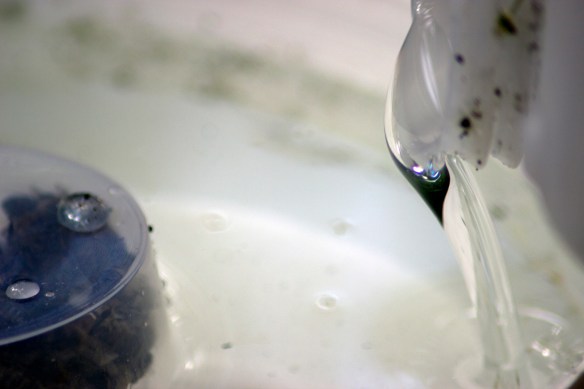
Andy used a pipette to drop a sample on the indicator. Then we waited three minutes. Breathe.

One line under 'C' for 'control' is a negative result, two lines under 'C' and 'T' for 'test' is positive. Both our tests for EFB and AFB only had one line under 'C', phew! You can't see it clearly on this photo so I have drawn a pink line.

All clear! Both tests for bacterial disease were negative, phew! But it was not over…

This was not a case of EFB or AFB but a lack of TLC. The larvae had become cold and hungry because Rosemary was a drone-layer, explained Andy, so there were not enough workers inside the hive to nurse the baby bees. Unless the queen was replaced the whole colony would die out.

This is the moment I had been dreading as a beekeeper – disposing the queen for the good of the hive. In the past, our bees have been very good at superceding their own queens, and Emily and me have preferred to let them do this. However, they may have been unable to supercede Rosemary without enough viable fertile larvae. I felt I should step up to the plate and get the job done, but Andy kindly and quickly did the deed. It seemed fitting because he has a history with our flighty queen.

Andy mashed the honeycomb around the young larvae to encourage the bees to find it and build a queen cell.

Blissfully unaware of the untimely death of her sister, we took a frame from Queen Lavender’s hive that had young worker larvae and placed this inside Rosemary’s hive hoping that our bees would now raise a new queen. Andy mashed the honeycomb around the larvae to encourage the bees to find them and build queen cells.

A frame of young larvae placed in Rosemary's hive so her daughters can raise a new queen to ensure the colony survives. They will have to work fast as there are not many workers left, I caught one on camera immediately flying over the frame to where we had put the new larvae.

Lavender’s hive was thriving with healthy-looking bees, lots of workers and brood. I found Lavender happily climbing on a frame so we caged her to complete the Bailey comb change. With Lavender now in the top brood box and queen excluder beneath, all the bees can move up into their new home.

Emily releases Queen Lavender from her cage and into the top brood box. (She is the largest bee in the colony, I have put a pink circle around her.)

Emily’s boyfriend, Drew, took these lovely shots of us doing some proper beekeeping.

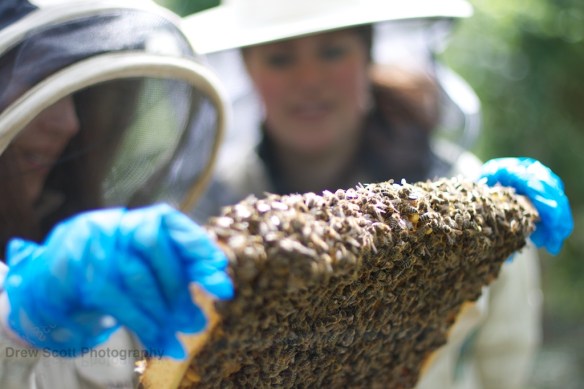
Looking for the queen. © Drew Scott

Still looking. It's difficult to spot one bee among hundreds of fast-moving insects on a frame! © Drew Scott

It was a busy day at the apiary, Andy and Pat were also shook swarming a couple of hives.

Andy shook swarming the hive belonging to David. This is a prolific colony of very fierce bees. Ghetto bees.

Drew took a shot of me shooting Pat! I gave David's bees oxalic acid treatment in December which they didn't enjoy, so I kept my distance in case they remembered. © Drew Scott

The business of beekeeping done for the day, there was still the afternoon meeting at the scout hut for the second Saturday of the month. Elsa had brought a chocolate celebration cake and I got the tea on.

On Monday the bee inspector visited the apiary and there was a surprise email from Andy titled ‘Rosemary’s baby’:

‘When Caroline checked the hive, we found an emerged queen cell in the bottom corner of one frame. Caroline then spotted a queen – very dark coloured. The frame that we put in had not got queen cells pulled out and indeed the section that was prepared for queen cells was being repaired!’

I thought we were one step ahead of our bees. Silly beekeeper. The workers were already preparing a new queen. © Drew Scott

So it seems our bees were one step ahead of us as usual, and were already raising a new queen to replace Rosemary. While we are hoping that Rosemary’s baby is not diabolical, it has inspired a name for our new queen thanks to Deborah Delong of Romancing the Bee who gave me this verse about myrrh:

‘Its bitter perfume
Breathes of life of gathering gloom.’

Queen Myrrh has emerged in a storm of rain and wind this week – not good for a virgin queen who must fly out and mate. Fingers crossed that our diabolical queen will have fair weather soon!

Bailey comb change for spring bees

The sun arrived in London last weekend reaching highs of around 20°C and not a cloud in sight. It was perfect timing for my friend Marina to visit from Malmö, Sweden, and for Emily and me to shook swarm our bees.

On Saturday Marina, who is allergic to bee stings, went for coffee with Italian friends at Notting Hill, while I hopped on a bus to Stockdove Way in Perivale with instructions from my Swedish friend not to come home ‘all bitten’.

Blue skies at the apiary were a contrast to last week’s rain, when Emily and me had spent the afternoon blow torching hive boxes and getting frames ready for this year’s bees. Each spring we give our bees a clean brood box and fresh frames for the year ahead. It is like spring cleaning the house when the warm weather comes to clear out clutter and freshen the home.

Me blow-torching hive equipment to kill off all nasties. I didn't burn down the apiary but there were a few 'interventions'.

Bees naturally live with lots of different bacteria, viruses and fungi (just like people), but when the numbers of parasites rise above manageable levels this can cause problems. Changing the brood comb regularly helps prevent the build up of disease such as European foul brood (EFB), American foul brood (AFB) and nosema.

There are two methods of replacing the brood comb:

  • Shook swarm: bees are literally shaken into a new hive with fresh foundation and the old brood comb and unhatched bees are burned. The shook swarm gets rid of everything (including the varroa feasting on unhatched winter bees) and starts the year with almost no disease in the colony.
  • Bailey comb change: a gentler version of the shook swarm, bees are gradually moved into a new hive by encouraging the queen and her colony to climb up into a clean brood box frame by frame.

A picture of health – our bees were looking healthy and not much sign of varroa. It seemed a bit extreme to subject them to a shook swarm this year.

While chatting over tea and munching on Sarah’s lovely homemade ginger biscuits, Emily and me had a change of plans and chose to do the Bailey comb change instead of the shook swarm. With not much varroa in either hive, it seemed unnecessary to destroy all the unhatched brood.

That decided, we lit our smokers and went to open our hives for the first time this year. First, Queen Rosemary’s hive, our biggest colony going into winter, whose bees had been seen flying home with lots of bright yellow pollen in the past few weeks. Little faces peered up as we lifted the crownboard and a few bees buzzed curiously around our veils, but as usual this lot were pretty chilled and didn’t need much smoking. We found and caged our queen to keep her safe as we worked.

Queen Rosemary safely caught in Emily's queen cage. We put this frame aside to avoid damaging the queen during the comb change. Emily also re-marked Rosemary with a white dot, which makes her easier to find.

Emily and me were unfamiliar with the Bailey comb change method, so John kindly talked us through. John Chapple, beekeeper to the queen’s bees at Buckingham Palace, is a very experienced beek – he has a beard – and is a really good mentor to new beeks.

We put a clean brood box with new frames and foundation above the old brood box. Dummy boards were placed beside the brood nest in both the bottom and top brood boxes to encourage the bees to move up into the new box.

The method works because bees are naturally inclined to climb upwards and to fill empty spaces with honeycomb. It’s what they do, and it is understanding this principle that also helps beekeepers to manipulate bees to make surplus honey.

Me pointing to a dummy board (a plain wooden board) next to the last frame of brood in the bottom box to 'close' the nest and encourage bees to climb up. The same arrangement of frames is made in the top box.

Rosemary's hive now has two brood boxes for the Bailey comb change to be carried out over the next few weeks, and a third shallow super box on top to put a feeder with syrup under the roof.

John told us what the bees would do next: ‘They will climb up and find the new frames, and start to draw out wax comb. In a week or two, you should find the queen and put her in the top box with a queen excluder between the two boxes. The bees in the bottom box, including newly hatched bees, will move into the top box to join the queen.’

Hopefully, if all goes to plan, the bottom box will be removed and the old frames burned (the safest way to dispose of hive equipment). We’ll put the top box with the queen and nest on a new floor with a clean queen excluder, crownboard and roof above. A new hive for a season of flowing nectar ahead!

Happy to see our bees but the inspection of Rosemary's hive showed that all was not well...

I was so happy to see our bees again, but all was not well in Queen Rosemary’s hive. Our inspection showed signs that the queen may be failing: there were very few eggs and Emily noticed drone brood (male bees) in the middle of frames where there should be worker brood (female bees). Emily and me will have to check the situation over the next few weeks and decide what to do.

John, who was inspecting another hive at the apiary, brought over a frame of bees to show us. ‘What can you see?’ he asked. The frame was filled with drone brood, but John wanted us to look at the bees. The bees were small like workers, but their large beady eyes revealed that they were drones whose growth was stunted probably from being hatched in worker cells. Drones can’t look after themselves or future brood, so a hive with a drone-laying queen will collapse. ‘It’s all doomed,’ said John.

John shows us a frame of bees from a 'doomed hive'. The queen is only laying drone brood – you can see the raised domed-shaped cappings of drone brood in the middle of the frame.

Happily, Queen Lavender’s hive told another story. Our baby hive is flourishing – the queen is laying a healthy pattern of worker brood and the bees are building up honey stores. We carried out a Bailey comb change on this hive too, and fed both colonies with sugar syrup to help them along.

Winter bees feasting on sugar fondant under the roof in Lavender's hive. We took away the fondant and replaced it with sugar syrup for spring.

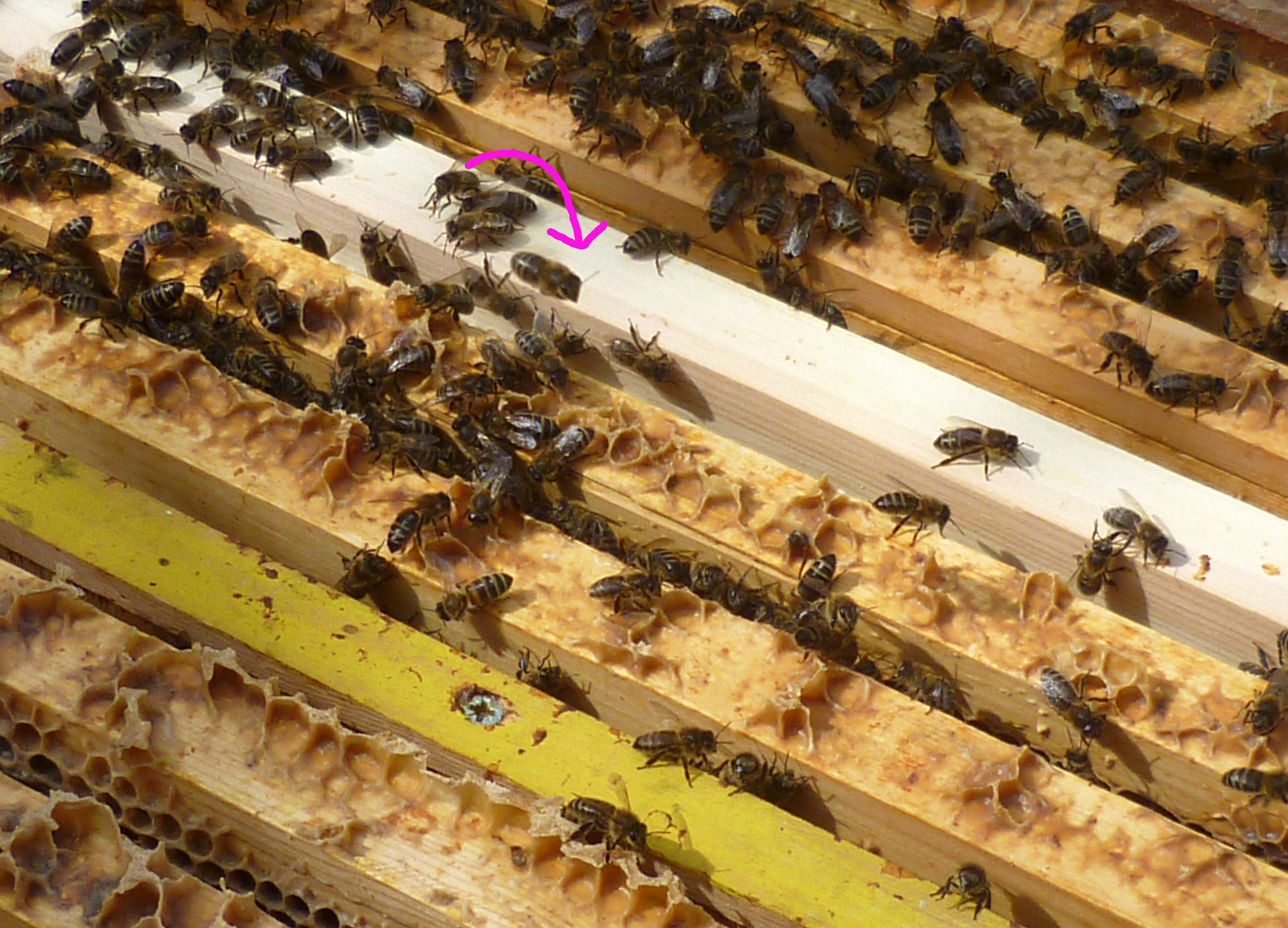
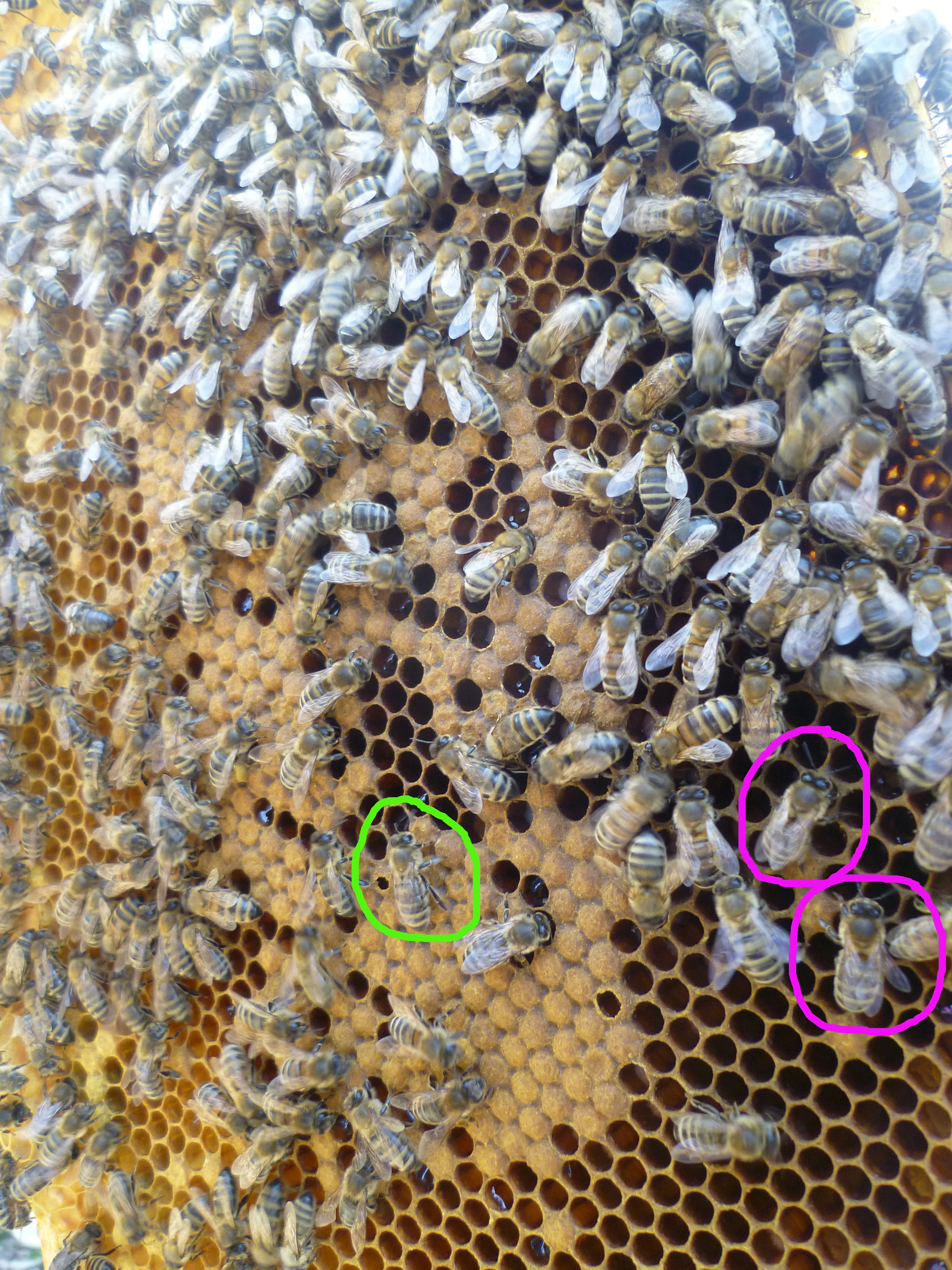
Lavender's hive is flourishing with lots of flat capped worker brood on the comb waiting to hatch. The pink rings show normal-sized drone bees (they have big beady eyes and fat bottoms) and the green ring shows a smaller worker bee going about her business.

Lavender, who is Rosemary’s sister, had a ride on my thumb after a new beekeeper, Rosemary, spotted the queen basking in the sun on the crownboard sitting next to the hive!

Emily kindly sent me this photo of Queen Lavender hitching a ride on my thumb back to the hive. Two workers are attending to her. Image © Emily Heath

I feel very honoured to have had a queen bee on my thumb, because they are notoriously shy.

On Saturday night the clocks went forward and British Summertime started. Sunday was another gloriously sunny day, so while our bees were out foraging Marina and me explored the local nature reserve just around the corner from my flat.

Then we climbed the hills at Northala Fields before stopping for ice cream. A wonderful weekend in spring, as Marina would say ‘It doesn’t get much better than that!’

A beautiful path of daffodils.

A tasty daff for bees to munch!

From the top of the first hill at Northala Fields – a local council project to construct four hills next to the A40 and surrounding nature reserve. This old bit of wasteland is now filled with families playing and people walking every weekend.

Useful links

The National Bee Unit has useful advice about replacing comb here, scroll down to ‘Fact sheets’. Many beekeepers also like the David Cushman method of Bailey comb change, which you can read here.

Emily’s posts on our Bailey comb change go into further detail about the method:

Exams over – and the Bailey comb change begins…
Lavender on the loose 

Disappearing bees – countdown to catastrophe or one to watch?
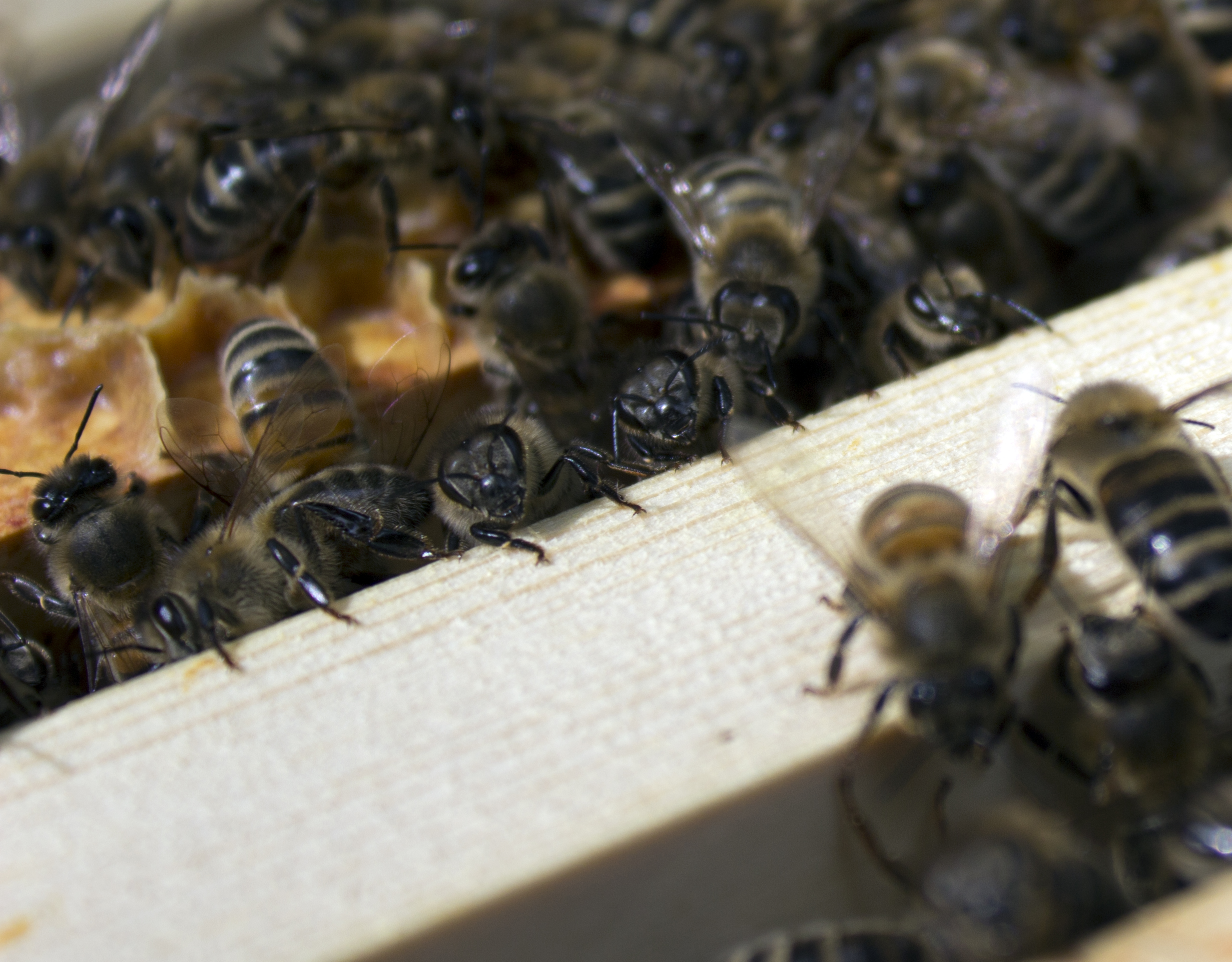
The familiar sight of the European honeybee (Apis Mellifera) pollinating flowers in spring and summer. Image © Shutterstock

‘You would have to be living on Mars for the past few years not to be aware of the bee problem,’ said Dr Stuart Roberts of Reading University’s Centre of Agri-Environmental Research, speaking at the Federation of Middlesex Beekeepers Association’s annual Beekeepers Day on Saturday 25 February.

Like many new beekeepers, I had heard about the ‘bee problem’ and started beekeeping to find out why this was happening and what I could do to help. So I was excited to find out that Dr Roberts would be giving a talk on ‘The decline of insect pollinators’ at our Beekeepers Day. His presentation looked at whether bees are disappearing, what are the drivers of their decline, why does it matter, and what can be done about it.

But first, what do we already think that we know about the bees disappearing?

Bee decline – a widely held belief?

‘If the bee disappeared off the surface of the globe then man would only have four years of life left. No more bees, no more pollination, no more plants, no more animals, no more man.’

This quote, attributed to Albert Einstein, may have catapulted the plight of the bee into the public imagination. However, there is no real evidence that Einstein said this – the earliest written record is from a group of French beekeepers in 1992 – and also the statement is not entirely true. While life on Earth would be considerably less pleasant without bees, it is unlikely that we would vanish with them.

Yet almost every week there seems to be another headline about bee disaster and imminent catastrophe – from varroa mites and chemical pesticides to giant Asian hornets and zombie parasites, the poor old bee isn’t having much luck. The media has helped to raise public awareness about the bee, but also may have promoted a few bee myths.

Dr Roberts’ talk sorted fact from fiction with evidence-based research from Reading University, and left me feeling encouraged that we can all do something to help both the honeybee and other bee species.

Are the bees disappearing? A lightning overview

Bumble bee feeding on burdock flowers. I love bumbles! Image © Shutterstock

To discover if the decline of bees is real or imagined, we need to ask the question: ‘Does it affect all bees everywhere?’ said Dr Roberts. While in the UK we have only one species of honeybee (Apis mellifera), which the media often refers to as ‘the bee’, we also have around 25 bumble bee species and around 240 other bee species such as solitary bees. Worldwide there are about 9 species of honeybees, 240 species of bumble bees and 19,300 other bee species of incredible variety. So counting numbers of bees to determine whether all bees are in decline is a huge task.

Diversity of bee species is not the only challenge to scientists. Data also presents a problem because it is inconsistently gathered across different countries, and often widely scattered in obscure journals. The migration of colonies across vast areas for the pollination industry, such as in the US, makes it more difficult to gather reliable information about bee colonies.

Therefore, Dr Roberts and his colleagues at Reading University’s Centre of Agri-Environmental Research have spent the past four years collecting data on the numbers of honeybees, and other bee species, in the UK and the Netherlands. Their findings revealed that there has been a 23% decline in bee colonies and a 36% decline in beekeepers in central Europe since 1985. The diversity of bee species is also now in decline, although, as Dr Roberts commented, it is worth noting that some species of bees are simply rare! Unsurprisingly, this research suggested parallels in the decline of insect pollinators and the plants that they pollinate in both the UK and the Netherlands.

So: ‘Are bees declining?’ Yes
But also: ‘Does it effect all bees?’ Yes.
And: ‘Does it occur everywhere?’ Yes.

This led to the next question.

What are the drivers of decline?

For each theory on why the bees are disappearing, there is an outlandish suggestion, said Dr Roberts. Some of these are merely fanciful from car exhausts and electro-magnetic fields, ‘For which there is not enough evidence’, to mobile phones, ‘Responsible for every evil on the planet’. Then there are theories that are just bonkers from Osama Bin Laden, ‘At least now testable’, to the Rapture, ‘Difficult to test’.

Unfortunately, the most likely driver of decline is an unlikely driver of news headlines around the world. The cause of the decline of pollinating insects is multifactorial, Dr Roberts explained: ‘Science would be easier, but a lot less interesting if everything could be hung upon a single cause’.

A variety of stressors are affecting bees:

  • Monoculture
  • Exposure to agricultural chemicals
  • Long-distance migration

So basically:

  • Boring diet
  • Exposure to pollution
  • Too much travel

All things that make humans feel stressed and unwell too!

Combine the bee’s stressed and weakened immune system with varroa, the small hive beetle and a pathogenic cocktail of other bacteria, viruses and parasites – and you can see why there might be a problem.

However, there is one headline on which most experts do agree.

Habitat loss is a major cause of bee decline

Perhaps the bees are all hiding in flowers. Image © Shutterstock

There is already a concern among some London beekeepers that there may not be enough plants to support the increasing numbers of urban hives. While you might imagine that this could be a potential problem for city bees, who face the same problems as people living in densely populated areas, unfortunately their country cousins aren’t doing much better. Reading University is continuing to look at the synergy between insect pollinator decline and the decline of their natural habitat, but other studies show that this is very likely to be a significant driver of decline.

Climate change is currently not too much of a threat, said Dr Roberts, although it has the potential to be a clear driver for the future.

Who cares if bees disappear?

Beekeepers and farmers do. Häagen-Dazs is also quite worried about the bees disappearing, apparently, because many ingredients of their flavoured ice cream are dependent on insect pollination. Wider society should also be worried: the value of insect pollinators to UK agriculture is £402m per annum; of which honeybees contribute £38m per annum. Everyone who enjoys eating apples should care, because they are solely pollinated by bees.

What’s the alternative to insect pollination? There isn’t an alternative. Dr Roberts sent a group of students from Reading University armed with paint brushes on a mission to find out how long it would take for people to pollinate plants. The results were painstaking and confirmed that the value of protecting insect pollination is high.

Human pollination vs insect pollinators. The bee is a much more effective pollinator than us! Image © Shutterstock

This is similar to a story that I have heard before. Last year, John Chapple of Ealing and District Beekeepers Association and beekeeper to the queen’s hives at Buckingham Palace, told us about his visit to Oman, as part of a group of beekeepers, to help reintroduce the honeybee to the country. One of Oman’s major exports is dependent on bee pollination – dates! The Omani government is now investing in a state-funded national beekeeping programme, after finding out to their cost that human labour to pollinate date palms is not a viable option.

What can we do to help the bees?

‘Is it a catastrophe? Not yet, but it could be,’ said Dr Roberts. Fortunately, we may have become aware of the bee problem in time to stop the honeybee, and other bees, disappearing from the world, and with them perhaps strawberries, watermelons, tangerines…

Dr Roberts said that governments could help bees by adopting agri-environmental policies, promoting conservation action and continuing to raise public awareness about the bee problem. He stressed the need for monitoring programmes, investment in sound science that is evidence-based, and consistent data that is made readily available.

While government strategies may have the greatest impact on the decline of insect pollinators, applying individual measures will maximise the effect. This means that we can all help the bees, as Dr Roberts suggests:

  • Bees need gardeners – plant bee-friendly plants in your garden and make sure that there are enough flowers for bees to forage from early spring to autumn.
  • Solitary bees need keeping too – put up a ‘bee hotel’ to make a home for other bee species in your garden.

Other ways to help bees include telling your family and friends how they can help too, taking part in a sponsor-a-hive scheme, and fundraising for bee charities by organising a cake sale or a book swop!

So it seems the disappearing bee is one to watch rather than a countdown to catastrophe. Dr Roberts gave me a clearer picture of why bees are starting to decline and also what we can do to prevent it.

Miss Apis Mellifera isn't gone yet and hopefully we can stop her from flying away altogether. Image © Shutterstock

Parallel declines in insect pollinators and insect-pollinated plants

Dr Roberts very kindly sent me the paper on which his talk was based, ‘Parallel Declines in Pollinators and Insect-Pollinated Plants in Britain and the Netherlands‘ by JC Biesmeijer, SPM Roberts, M Reemer et al. The abstract below describes the probable link between the decline of insect pollinators and the loss of habitat and insect-pollinated plants:

‘Despite widespread concern about declines in pollination services, little is known about the patterns of change in most pollinator assemblages. By studying bee and hoverfly assemblages in Britain and the Netherlands, we found evidence of declines (pre- versus post-1980) in local bee diversity in both countries; however, divergent trends were observed in hoverflies. Depending on the assemblage and location, pollinator declines were most frequent in habitat and flower specialists, in univoltine species, and/or in nonmigrants. In conjunction with this evidence, outcrossing plant species that are reliant on the declining pollinators have themselves declined relative to other plant species. Taken together, these findings strongly suggest a causal connection between local extinctions of functionally linked plant and pollinator species.’
Science 21 July 2006: Vol 313 no 5785 pp 351-354 DOI: 10.1126/science.1127863

With thanks

I would like to say a special thanks to Dr Roberts for speaking at our Beekeepers Day and for sending a copy of his paper. You can find out more about Dr Stuart Roberts work on his web page at Reading University’s Centre for Agri-Environmental Research.

A few useful links

You can read more about Dr Roberts’ talk ‘The decline of insect pollinators’ on Emily’s blog and I highly recommend her post on John Chapple’s talk about the disappearing Omani bee.

Bees, Wasps & Ants Recording Society (BWARS) is the national society dedicated to studying and recording bees, wasps and ants (aculeate Hymenoptera) in Britain and Ireland, of which Dr Roberts is the chair.

The British Beekeepers Association (BBKA) is the UK’s leading organisation representing beekeepers with useful information on planting bee-friendly plants, bee hotels for your garden, and an adopt-a-bee scheme.

The Bumblebee Conservation Trust (BCCT) aims to prevent further declines, and to raise awareness of the problems bumble bees face.