
‘Your blog is like a soap opera. Each week I tune in to find out what the bees will do next,’ my friend Danielle had said a few years ago. ‘The twists and turns of your queens has been really dramatic!’ She was talking about the bee saga of 2012 when a season of prolonged rainfall and drone-laying queens had made beekeeping more interesting than usual.
This year I was hopeful for strong colonies, steady queens, fair weather and plentiful flows. How we get the season going is an important part of its success and this year we were well prepared, but as Emily and I have learned, anything can happen in bee land.
This is a long post, written in the raw to get my thoughts and feelings down.
Day one
Last Saturday’s all-day sunshine made it a great day to kick off the season. The apiary was pretty in the sun as I waited for Emily. We were going to change the comb. Regular readers will know that beekeepers in the UK are advised to replace the old brood comb once a year, with fresh comb, using methods like the shook swarm or Bailey comb change. The thinking behind this is to manage the levels of diseases and parasites that often live within a bee colony. Even if you can’t see any visible signs of disease, there are parasites that live with the bees all year round and it’s best not to let them get out of hand.

For the past two years we had used the Bailey comb change, because this is a gentler method, and while we had enjoyable seasons beekeeping and learned a lot, the bees had not done that well. They were slow to complete the Bailey – whether due to poor weather, failing queens, or the collective characteristic of the colony being too complacent and slow – and last year our longest-standing hive didn’t complete the Bailey at all, which meant some comb was now two-years old.
I had a positive experience in my first-year beekeeping of shook swarming my hive. The bees had risen to the challenge and the colony had boomed, thrived and burst over with bees and honey. Having thought and read about this for months in winter, I wondered if it was time to try out the shook swarm again, at least with a couple of colonies, to re-invigorate the bees and to get rid of comb that wasn’t changed last year. Emily’s inspection of the bees, while John and I were in Dubai, showed Myrtle’s and Chili’s hives were strong enough to shook swarm, but Chamomile’s was weak and might be better for a Bailey.
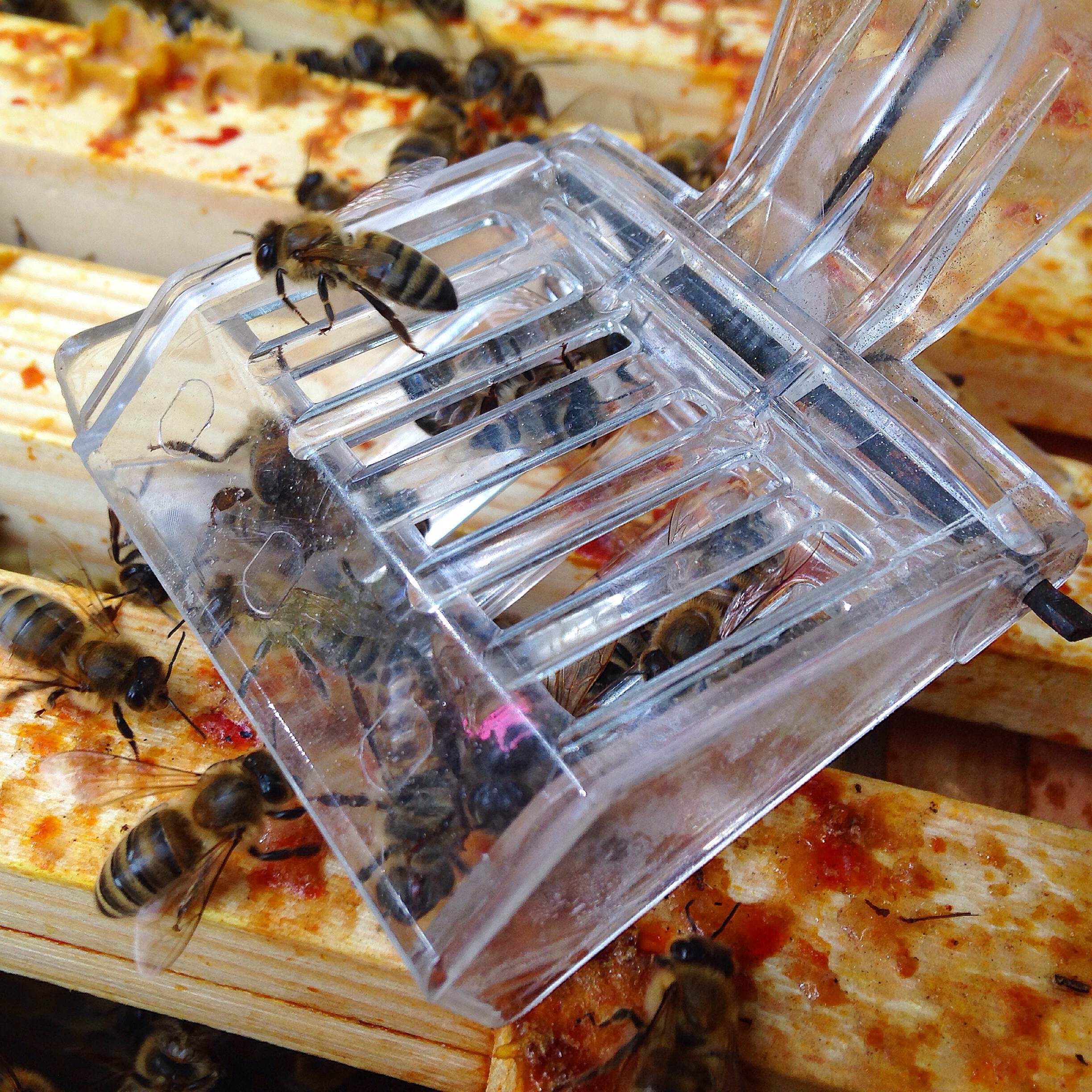
That decided, I lit my first smoker of the season and we opened up Myrtle’s hive. After a few frames in, I was delighted to see our favourite queen. There she was big, beautiful and dark with an amber tinge. Emily gently caged her with a few workers to keep her company, then placed the cage in a small blue tub to the side of the hive, in the shade to keep the queen cool and safe.

That done, we did the business of the shook swarm. The original hive was moved to one side and a clean floor placed on the original hive site – so the foraging bees will not get confused when flying home to the same spot – then we placed a queen excluder on the floor, so the queen can’t abscond with her colony after the shook swarm, which she might do if the upheaval upsets her. On top went the new brood chamber with fresh frames, the centre four frames removed to provide a space to shake all the bees from the old combs.
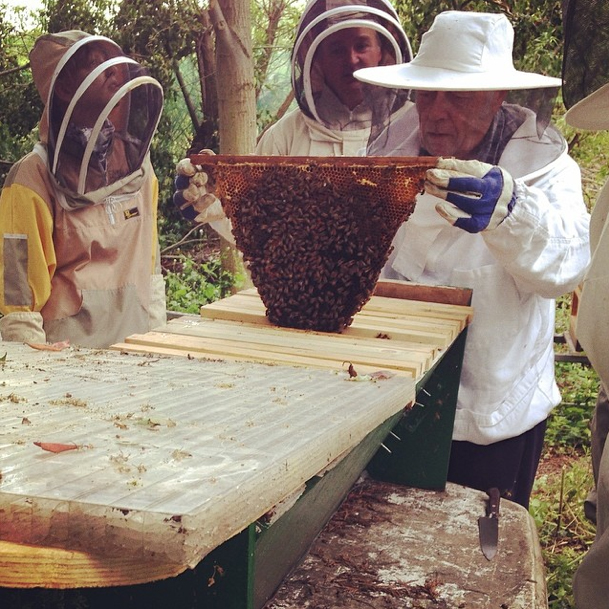
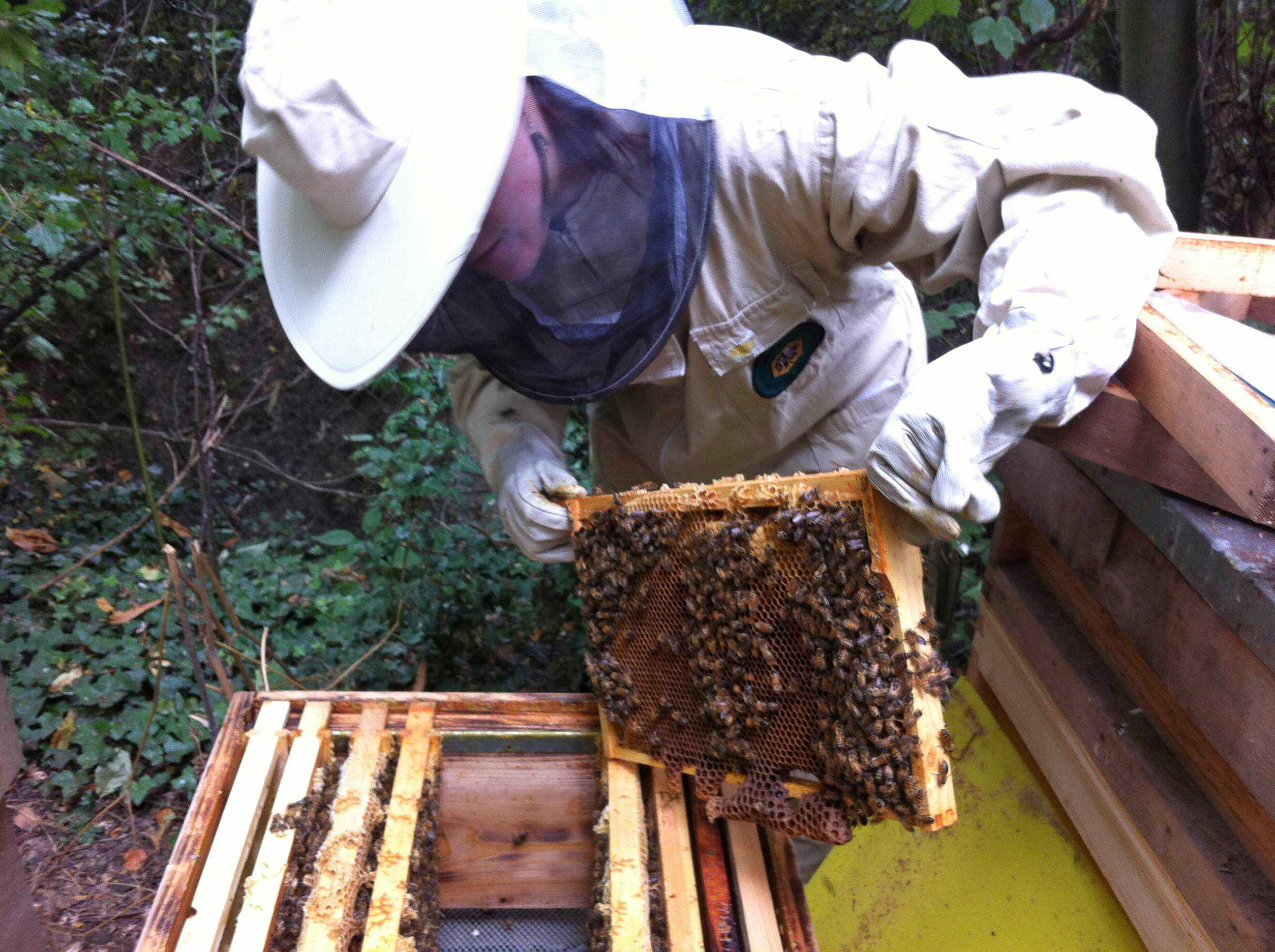
I shook the bees from the old hive into the new hive as one of my first-year mentors had taught me: holding each of the old brood frames a third of the way into the empty chamber of the new hive and giving a sudden shake downward, careful not to knock the frame or bees against the sides. My shaking method was successful as almost all the bees fell off, leaving Emily and I to brush off the rest with leaves.
Incredibly, we barely had to use the smoker at all! Our lovely girls were well behaved throughout the whole shook swarm process and we worked quickly together as hive partners to make sure the upheaval to the bees was over as soon as possible. I shook and handed Emily the old frames to put into bin liners (to be tidy as we worked) ready to be discarded into the apiary’s burner.

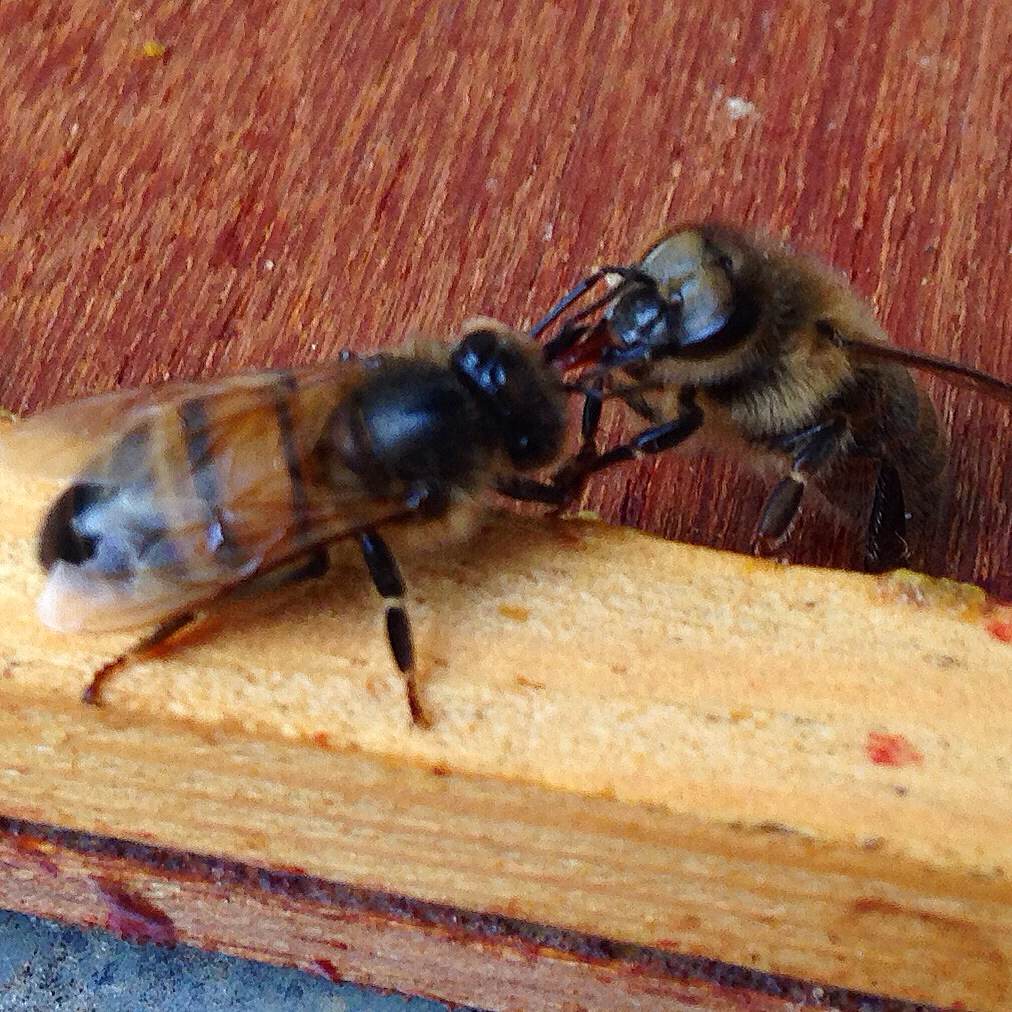
The old brood frames, some with unhatched brood, is burned. Thankfully, as it is still early in the year, there was not much unhatched brood on the frames, so we wouldn’t have to destroy many un-emerged bees. I noticed a few bees were starting to chew away the wax cappings and, not being completely heartless, I suggested Emily use the tweezers in our kit to help these bees emerge before the frames went on the bonfire. Emily rescued as many unhatched bees as she could, while I continued shook swarming.
It was soon over. We carefully put Myrtle into the new hive with her daughters and placed the crownboard (not a queen excluder, this is an important point to remember later in this post) on top of the new brood nest. The bees would now be busy drawing new comb from the foundation in a completely clean hive for a fresh start. I was particularly hoping the shook swarm would invigorate this laid-back colony, though it is my favourite, from ambling around all summer to properly ‘get-going’ this year.

Even so, shaking two boxes of bees into another box isn’t easy – a lot of workers stubbornly stayed in the old hive boxes around the corners and sides. I used Joseph’s trick of propping up these old hive parts near the entrance of the new hive. The bees would soon figure out that the queen was inside and walk in to join her.
Next, Chili’s hive. This queen took us longer to find than Myrtle, but then we spotted her familiar red dot and long orangey-brown striped body. I thought again how lovely it was to see our queens after winter. We caged Chili and shook swarmed her colony into the new hive, propping up the old hive boxes to the entrance so unshook bees could walk in.
Both Myrtle’s and Chili’s colonies would now be fed lots of sugar syrup over the next few weeks to help the hives build up – the bees use the sugar to produce wax for comb-building. The nectar flow is strong at the moment, so if the bees don’t want the syrup then they can leave it, but we liked it there just in case.

As Chamomile’s hive was weaker we decided to leave the comb change till next week, to give these bees a chance to settle into the season and us more time to decide what to do. The apiary was also starting to get busy with beekeepers and I always find it harder to concentrate when there are lots of people around.
Pat had kindly helped Emily get started with the burner and as the fire roared the old brood frames were destroyed, to be hygienic to the apiary and neighbouring hives. I had a quick scout around the apiary to collect up dead wood to be burned.
Walking back to our newly shook-swarmed hives, I saw Joseph’s trick had worked its magic again. The straggler bees had gone into the new hives and the old hive parts were now completely empty. I neatly stacked them the side and cleared everything away into our kit box. These empty hive boxes, along with wooden dummy boards, crownboards, queen excluders, roofs and floors, would be blow-torched clean in a few weeks’ time, ready to fill with new frames should the bees expand this season or kept aside for next year’s comb change.

With our two hives shook swarmed I suddenly felt very nervous. What if it was not the right decision? What if our colonies were not strong enough to survive the upheaval? The Bailey now felt like a better choice where we didn’t lose all the honeycomb, brood and stores from the hive in one day and anxiously waited a week for the bees to recover and rebuild. However, if I’ve learned anything as a beekeeper it’s that I must have the courage to make my own decisions and learn from my own mistakes. The decision to shook swarm seemed right at the time given the strength, personalities and circumstances of the colonies in past years where the Bailey hadn’t quite worked. So we’d just have to wait and see.
I think it’s important as a beekeeper to try the different methods and observing their effects a number of times for yourself in the first 5–10 years’ beekeeping, because you build the skill and experience to know what to do and how to do it when faced with different colonies in different situations. Whether it’s a shook swarm, Bailey or doing nothing at all, it’s about having a big bag of tricks as a beekeeper. I’d only done a shook swarm once before, it was time to learn about it first-hand again. Nature would soon tell me if I was wrong.
Day two

The day after the shook swarm John drove me back to the apiary to refill the feeders with syrup. I remembered in my first year that shook-swarmed colonies need to be fed a lot of sugar to help them recover. John waited outside as I suited up and walked to the hives. I took the roof off Myrtle’s hive and my heart stopped. There she was, our precious queen, floundering in the feeder with the workers. Her long body dipping precariously in the syrup.
Before I could think why the queen had wandered into the feeder, where she should never be, I quickly removed it, got out the queen and hastily put her back inside the hive where she rolled unceremoniously to the floor. The bees were furious and I had to ignore them as I closed up, this time putting a queen excluder on top (remember earlier, the shook swarm instructions don’t include putting an excluder above the nest) so the queen could not possibly find her way into syrup again. As I topped up the feeders in both Myrtle’s and Chili’s hive, I reflected on why Myrtle had walked up there. Day two after the shook swarm, the queen has nowhere to lay eggs and nothing to do but wait for the workers to build comb with cells to lay eggs. To do this, the workers need lots of energy, from sugar, to produce wax, and they would all cluster in the feeder taking down syrup. It was probably warm and tempting up there for Myrtle, who went to join her daughters or maybe she was just looking for a place to lay. Whatever the reason, I couldn’t risk this inquisitive queen falling into the syrup to a sweet sugary death.
I thought about putting a queen excluder on top of Chili’s hive too, but it was late in the day and the bees were testy after the disturbance. So I left the apiary and worried about the bees for three days.
Day five

Midweek I went back to the apiary to feed the hives again. Myrtle’s hive had half taken the syrup down and Chili’s had finished theirs. I’ve read that you shouldn’t disturb a shook-swarmed hive for a week – just feed and feed – but I couldn’t resist a peek inside Myrtle’s colony to see all was well. Taking off the crownboard, I stared through the queen excluder and five seams of bees stared back at me. To my relief the colony was calm, suggesting Myrtle was alright, and appeared to be building wax across five frames already. I closed up and left the bees in peace.
Day eight

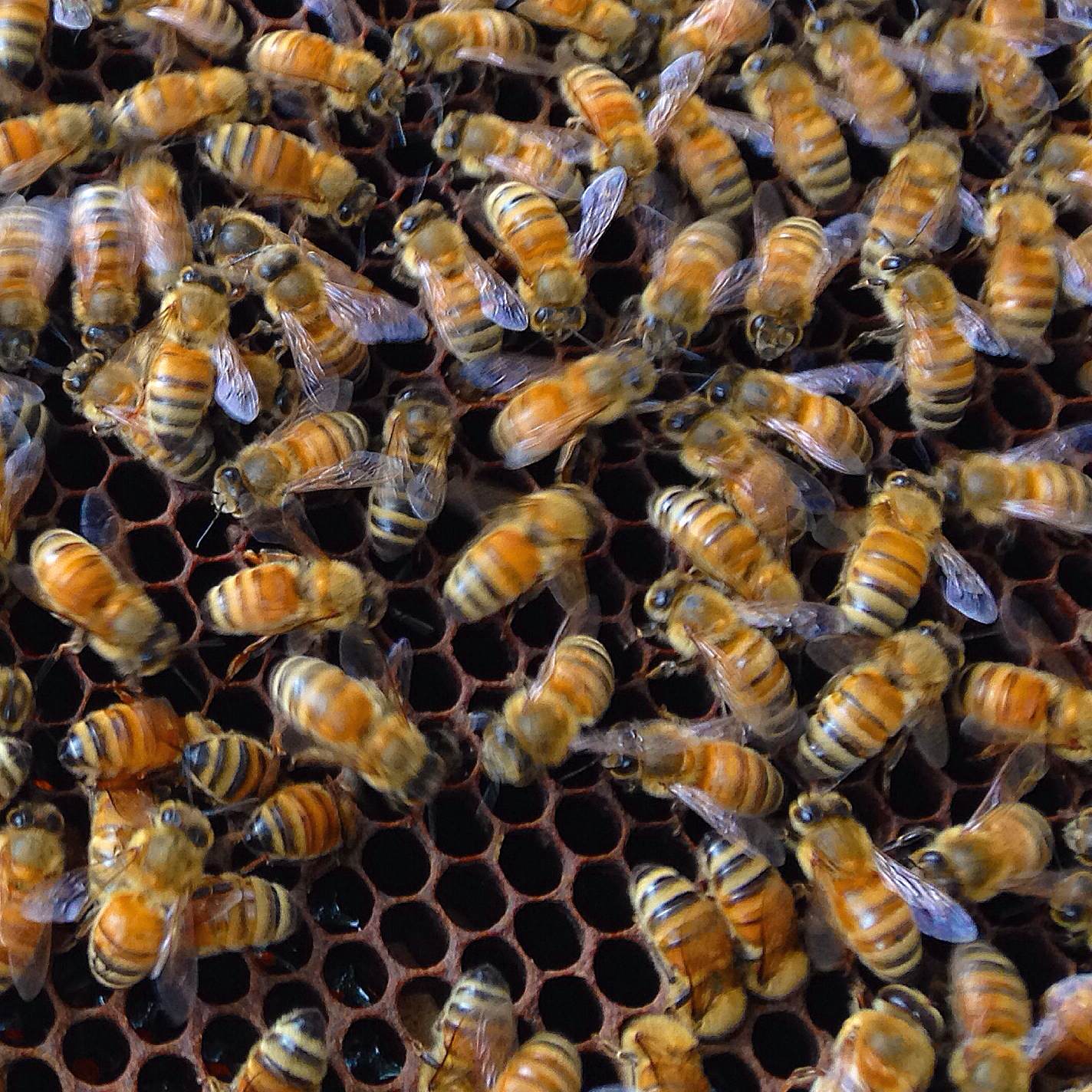
Yesterday Emily and I carried out the first inspection on the two hives since the shook swarm. I was nervous what we would find – and it was a happy discovery. Myrtle was alive and well in her hive, walking in her playful way across the frame. The bees were building comb across five–six frames and the queen had even laid eggs. Not bad for our normally complacent bees, they had risen to the challenge and I was very proud of them. The more cautious Chili was found scrutinising cells in her hive and her bees had industriously started drawing comb on eight–nine frames, there were even rainbows of pollen alongside glistening stores of nectar.
While I’m not sure that I would shook swarm every year, it felt like what was needed this year and so far the signs were good. Let’s hope it stays that way.
We fed the bees more syrup and will continue feeding them until they don’t want it anymore. Emily also left pollen supplements alongside the frames – as we’d caused the upheaval to the bees, it was up to us to give them a helping hand.
The overcast weather meant it wasn’t a good day for a full inspection, and we were satisfied that we’d seen the queens and the two colonies were recovering well from the shook swarm. So we closed up and went for a cup of tea and cake.
While all this drama was happening in Myrtle’s and Chili’s hives, Chamomile’s hive was having its own misadventure. More on that next time.
Reflections…
This was a difficult post to write – I expect many beekeepers, particularly those who use natural methods, will disagree and criticise me for doing a shook swarm. I’ve nothing against any method, in particular, if it works for the beekeeper and their bees. But I need to learn my own way. Here, I’ve dissected all my thoughts and feelings around the decision to shook swarm and my reaction afterwards, and I’ve been harder on myself this past week than anyone else could be. Whether I shook swarm again or not, this was a valuable learning experience to record, so that it will help guide me in future years as a beekeeper.













 Mrs Apis Mellifera