Behind The Bee Book

IMG_2845

My friend Joanna asked me to recommend a book about bees and beekeeping several years ago. I gave her a spare copy of Bees at the Bottom of the Garden from the beginners’ course that I took at Ealing and District Beekeepers Association. Bees at the Bottom of the Garden by Alan Campion is a bestselling book for novice beekeepers that explains very simply how to set up a hive and what to expect in your first few years of beekeeping. It’s an easy-to-understand, practical guide for beginners with useful diagrams and seasoned advice from an experienced beekeeper. Joanna found the book interesting but too technical, for her: “I don’t want to keep bees, Emma,” she said, “It’s a very good textbook, but I just wanted to have a read about bees and beekeepers for enjoyment.” I was surprised by her comment; by then I was already a beekeeper in my second year and still closely reading Alan Campion’s book alongside all my beekeeping activities.

When Alastair Laing, an editor at Dorling Kindersley (DK), approached me to write a section for The Bee Book, I thought of my conversation with Joanna. The publisher had an idea for a book that would open a window onto the amazing world of bees and show what the beekeeper does for everyone to enjoy. There would also be a section on planting gardens for bees and pages of recipes for making the most of bee bounties like honey and beeswax at home.

IMG_2847

My family and friends have asked many questions about bees and beekeeping over the years: “What’s the difference between honeybees and bumble bees?”, “Why do bees swarm?”, “How do you get the honey?”, and “What do beekeepers do in winter?” I have always enjoyed telling people about the bees, although I have seen a few glazed eyes from sharing too much information. DK is well known for their beautifully illustrated books that make a detailed topic accessible to every reader – so I loved the idea of being part of a book that would allow my non-beekeeper family and friends to enjoy the wonder of bees. Alastair needed a writer for a section that showed how a beekeeper cares for bees and for a recipe section. So I accepted the job. I hoped that my pages would provide a helpful look at the year ahead for the novice beekeeper about to take their first steps, as well as an enjoyable read about a fascinating hobby for the arm-chair enthusiast.

IMG_2849

Writing for The Bee Book was a lot of fun and I felt lucky to be part of the team as the pages were brought to life by the beautiful design of Kathryn Wilding and the wonderful photography of Bill Reavell. Alastair commissioned Judy Earl and Bill Fitzmaurice of Harrow Beekeepers Association for their expert knowledge on crafting with beeswax, candle-making and recipes on honey, beeswax and propolis, and to take part in the photoshoots as well. My favourite story from the making of the book is how a swarm of honeybees happened to settle on a tree around the corner from a photoshoot one day. This allowed Bill Reavell to capture Bill Fitzmaurice demonstrating swarm collection in action (pages 158–159)!

The chapters that I enjoyed reading most, however, were on the amazing world of bees by Fergus Chadwick, and how to plant a garden to attract bees by Steve Alton. I hadn’t seen these pages during the production of the book and was full of curiosity by the time my copies arrived in the post. Fergus reveals a treasure chest of bees around the world including the Himalayan honeybee, Australia’s sugarbag bee, and the blue carpenter bee of southern Asia. His section is beautifully illustrated by Bryony Fripp. Steve explores how to attract bees to your garden with an array of bee-friendly plants and guides to making bee homes.

IMG_2848

I wrote my pages with my first year of being a beekeeper in mind. I remembered there was so much to learn and I couldn’t know everything at first. The Bee Book is a great introduction to bees and beekeeping for those who would like to become beekeepers but are not quite ready to own a hive yet, and for the novice beekeeper about to take their first steps, it illustrates what might be expected of the year’s work ahead.

My acknowledgements thank my first-year mentors Ian Allkins, Andy Pedley, Pat Turner, John Chapple, and Alan Gibbs, and also my hive partner Emily Scott of Adventures in Beeland. Mentoring doesn’t stop after your first year and there is always more to learn, which is why it’s so important to be part of a beekeeping association. I’ve enjoyed keeping hives at Ealing apiary alongside practical beekeepers like Thomas Bickerdike, of Beekeeping Afloat, and Llyr Jones, often a beekeeping partner-in-crime, and many more. I’d also like to say special thanks again to David Rowe for his assistance during the photoshoot at Ealing apiary, to John Chapple for his tip about the winter tunnel (page 166), and a huge thanks to Ealing and District Beekeepers Association and Harrow Beekeepers Association for letting DK photograph the hives at their apiaries.

thebeebook

You can find out more about The Bee Book and order a copy from DK or Amazon. And if you are thinking about becoming a beekeeper, do follow one of the most important pieces of advice in the book – join your local association and take their introductory course! You won’t learn everything you need to know about bees and beekeeping even with a library of books at your disposal, but hopefully The Bee Book will be one of many that you’ll enjoy reading.

The Bee Book published by DK (1 Mar. 2016). ​ISBN-10: 0241217423 | ISBN-13: 978-0241217429. Order from DK or Amazon.

Links

Ealing and District Beekeepers Association website
Harrow Beekeepers Association website
William Reavell Photography
Bryony Fripp Illustrations
Bees at the Bottom of the Garden by Alan Campion

The decay of spring

img_2279

“Morning drizzle at ten a.m. We open the hive, bee friend, last time & it’s like entering Pompeii…I did not expect to see a bee’s point of death.” From Bee Journal by Sean Borodale.

Pepper’s hive had been losing weight for some time. The bees had stopped flying in and out of the hive entrance. It wasn’t too much of a surprise when Emily sent a text to say the colony had perished. I followed up her grim discovery a couple of days later by opening the hive to find comb upon comb of frozen bees. Each one had a purpose, a job to do, cleaning, foraging, feeding, until they just stopped moving.

It must have been the arrival of winter in February. The mild weather had tricked the bees into using all their stores and when a sudden cold spell blew through their starved house it swiftly took each and every one. I didn’t look for the queen, it was too sad.

I bagged up the dead bees and empty brood comb for the bonfire. Pepper is the first hive that Emily and I have lost to winter in around five years.

That was two weeks ago. Today Emily and I met at the apiary to inspect Peppermint’s and Melissa’s hives for the first time this year. We wanted to see what was what before the spring comb change. The story was much the same in both hives: plenty of bees, some leftover honey stores, and almost no brood except for two or three patchy frames. We consolidated the hive boxes by removing empty frames and combs of useless hardened honey and replaced with dummy boards to keep the bees warmer and bring the fondant closer to their nests.

As for the queens, we spotted Peppermint walking across a frame, but there was no sign of Melissa. The bees were well behaved, if a little skittish for their first proper inspection in around five months, and workers were bringing home pollen. These were perhaps signs that Melissa is alive and well, and perhaps indicated that both queens are still capable of laying enough brood to build up their colonies again this spring.

I propped up the empty super that had been taken off Melissa’s hive to the entrance. It was occupied by around 50-70 bees. This is something I like to try when unsure whether the queen is still inside or not, and it has worked in the past. The bees walked inside the hive entrance and cleared the super in 10 minutes suggesting that the queen could be with the colony, or maybe they were simply attracted to the colony’s common scent. It was clinging to a small straw.


Emily suggested that the persistent cold weather could have prevented the queens from laying much brood, and it seemed that both colonies had the appearance of only just surviving on the remaining stores and fondant. They were hanging on, they weren’t ready for a comb change.

We decided to close up and feed the bees sugar syrup for a couple of weeks to see whether this stimulates the queens to lay, and to find out whether Melissa is still inside the hive, before springing into action. We’ll then reassess the situation after Easter.

Spring is in decay this year. The mild winter has left autumn leaves in the garden at the same time as daffodils. I think the worst of the cold weather is behind us, but nature may struggle to spring back to life. A lot of TLC is needed.

Life can’t always be honey

IMG_1880

Pepper’s colony had eaten their first block of winter fondant. The hive had lost weight and it was possible to heft the boxes slightly off the stand. I stared down the hole of the crownboard into the dark abyss of empty honeycomb. There was no sign of activity. Then a single worker crawled up a wall and stopped a few inches beneath the crownboard. She stared back as I slowly lowered a new block of fondant over the hole.

The neighbouring hive belonging to Pepper’s daughter, Peppermint, had become heavier over winter. The workers seemed to have made good use of the milder days to find forage for stores. I lifted the insulation to discover a small crowd of bees had found their way under the roof. They looked like young bees judging from their soft fuzzy thoraxes and perfectly shiny folded wings. They were too busy exploring the new space to notice me. I put back the insulation and closed the roof.

IMG_1881

Melissa’s hive had plenty of fondant under the roof and the boxes were still too heavy to heft. This is our longest-standing hive which has been carried through five winters by the same line of queens. I try not to think too much about Melissa’s hive in winter other than hope for the best in spring.

I slipped the varroa boards under the hives to monitor the mite drop for February. It was a windy and damp afternoon, the sort of day to stay at home in the dry and warm. There was little activity outside the hive entrances, although Emily and I had seen the bees flying for a few weekends in January.

Trying my best not to disturb the colonies, I quietly knelt down at the entrances to look through the mouseguards and saw light shining under the metal mesh floors. This reassured me that piles of dead bodies weren’t accumulating at the bottom of the hive and blocking the entrance for surviving workers. But to prove I wasn’t as stealthy as I thought, workers from all three hives flew out to investigate my activity. They soon settled down and perched on the chicken wire wrapped around the hive boxes.

IMG_1859

“Life can’t always be honey,” my grandmother had said in the last few days of her own incredible life. It’s true. In February the frosts aren’t quite finished even as the first crocuses and daffodils come into bloom. The two strongest colonies had plentiful stores going into winter and even the weakest had sufficient to last till early spring, but was it enough for a mild winter when the queen continued to lay and the workers continued to consume honey almost as they did in summer? On the coldest days in February the bees would need to keep warm while sending out workers to reach the fondant or remnants of honey at the furthest frames of the hive. On warmer days the workers could take advantage of the year’s early forage of hazel catkins and snowdrops to replace their stores.

Thinking of my grandmother’s words at the entrance of the hives, I whispered to the bees to persevere for a few more weeks, because it might be difficult now but a good spring is around the corner.

A beekeeper’s notes for December

IMG_1247

Winter hasn’t come for the bees. They were enjoying the mild weather today bringing home lots of pollen. A drone sat comfortably on a hive roof looking well fed and a young-looking worker was resting on the side of the hive boxes. Else was over-the-moon about the unseasonably warm weather, which brought back memories of Christmas in Australia. She produced a box of deliciously festive cup cakes to cheer up the British beekeepers complaining about the prospect of a sunny Christmas.

IMG_1244

The cakes were baked by Else’s friend and were scrumptious with raisin-and-spice sponge and frosted-chocolate icing.

The unseasonably warm weather meant it was unlikely that the hives would be treated with oxalic acid today. The bees hadn’t slowed down for Christmas. “One hive is heavier now than when I put on the fondant in October,” said Andy. He had treated his hives last month during a brief cold snap on a day when the bees were less likely to be active and protest about being disturbed.

Oxalic acid is usually given as a midwinter treatment when the days are frosty and there is little or no brood inside the hive. It’s most effective when applied during broodless periods, or as close to broodless as you can get, because the varroa have fewer places to hide. The fixed points on the beekeeping calendar are turning as the seasons become uncertain, however. Perhaps it’s best to say the bees can be treated with oxalic acid when the weather is wintry and conditions inside the hive are right, rather than in the winter. That’s assuming you treat your hives to oxalic acid.

IMG_1245

After tea and cake, Emily and I checked that our three hives still had enough stores. Pepper’s and Melissa’s hives were a generous weight when hefted and Peppermint’s hive had also pulled off the trick of getting heavier since putting on the fondant. The hive entrances were as busy as a mild spring day and the weight of the hives suggest the bees might be finding nectar as well as pollen to fill up the boxes.

IMG_1246

Melissa’s bees has tucked into their fondant despite having two supers of honey at the end of autumn. These bees do like their sugar.

That done, we got the bees ready for Christmas with tinsel and festive decorations. The apiary needed a little sparkle if the frost wasn’t coming this year.

IMG_1248

Beekeepers take note for December – it’s the tinsel that gets the bees through winter.

A beekeeper’s notes for November

IMG_8285

In November the leaves fall from the trees and the drones fall from the hive. The trees are preparing to rest for winter as their leaves drop to the ground, and the bees are getting ready to close the hive factory as the drones are thrown outdoors.

Autumn and winter are good times of the year for consolidation. The beekeeper can take stock of the hives and colonies, clear up apiaries, clean up equipment, disturb a few spiders, and plan ahead for the next season.

IMG_0641

The ebb and flow of the seasons are not constant, however, and the points on the beekeeping calendar can move each year. The autumn syrup may be poured a month earlier in August for late summer rains. The mouseguard might be pinned to the entrance a month later in November for the workers still bringing home baskets of pollen. Wasps may be seen gliding around the creepers beside the hive, and drones found sitting on the roof as late as December.

This sometimes makes the question “What does a beekeeper do in winter?” a difficult one to answer.  This is because a beekeepers’ checklist is only a guide to the beekeeping year and not a set of rules.

IMG_0758

My step-nephew Sam films what beekeepers do in winter at the apiary, while Andy Pedley tells a visitor what the bees do in winter.

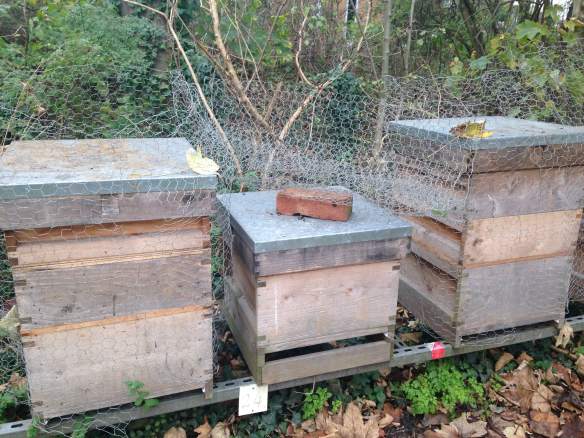
Emily put on the mouseguards at the hive entrances when she noticed that fewer bees were carrying home pollen. The hives were wrapped around in chicken wire as a precaution against possible woodpeckers watching from the bare branches overhead. We tackled the task of removing the syrup from Peppermint’s hive and replacing the feed with fondant, despite a crowd of protesting workers, because the days had become cold and short.

Winter also comes to London despite talk about our city’s microclimate and of bees making queens to swarm on a warm October’s day, which, of course, might happen. But if it’s true the season can sometimes be mild, overall there are fewer days when either bees or beekeepers feel like going outside. On those days both bees and humans are glad of a well-stocked cupboard, an insulated roof, and a secured entrance.

IMG_0753

Every autumn and winter, Emily and I will ask each other “Shall I bring more syrup?”, “Have you got pins for the mouseguard?”, and “Do you think the fondant can go on?”, and each week our plans change as frequently as the weather. We both know that between the two of us the bees will be ready for winter as and when they need to be. We both watch the days and the bees, and tick off items from our checklist when it feels right to do so.

A beekeeper’s notes for November often turn to thoughts of what we have and haven’t done, none of which matters now, and then to dreams of the bees returning in spring.

From Tintern to Tintagel

Cornwall2010150000a

It was a dark and foggy autumn day when we set off from the farm in Hereford. We were driving through Wales on our way to Cornwall. Our route took us past the ruins of Tintern Abbey rising above the wreaths of cold mist.

Tintern Abbey, or Abaty Tyndyrn in Welsh, seemed as unreal as its pictures in a book of poems. Yet there it stood, founded in 1131 near Tintern village in Monmouthshire on the Welsh bank of the River Wye. I looked at the remains and imagined the music that once filled the monastery now replaced by roosting crows.

Cornwall2010150000c

The skies brightened as we passed through the border to England and headed to the Cornish coast. St Ives didn’t offer sunshine, but it did provide peaceful seaside views and a tasty Cornish pasty.

The next day we were on the road again to Land’s End. It was our three-year anniversary. The sun came out and the sky was brilliant blue along the winding cliff roads. It had been almost 10 years since I last visited Cornwall and to me it hadn’t changed a bit.

Cornwall2010150002

At the end of the country John took me past the famous signpost to a quiet spot overlooking the sea. Here he asked me to marry him and I said yes. That done in a manner that suited us, we were engaged.

A short walk along the cliff path took us to a small farm where we met a cat called Felix the Mighty and his human friend Edward, who I thought might be a pirate. Felix has the honourable title of first and last cat of Britain because he lives at Land’s End where planes fly over to and from the British Isles.

Cornwall2010150022aCornwall2010150022b

Edward told us a story about memory and time travel, which I won’t share with you here because it is his story. To say thank you, I shared our secret with Felix and I was rewarded with a semi-precious stone from the mighty cat’s treasure box. John was not so lucky. Edward told him the points along the coastline of Land’s End where a proposal must be done and to take me there immediately.

And so we walked further up the cliffs where John proposed twice more – in all, three times for the three years we have been together.

Cornwall2010150019Cornwall2010150020

The sun was starting to fade as we drove to the charming village of Marazion. We parked for a late afternoon stroll across the Giant’s causeway to St Michael’s Mount – we had till 6pm before the tide returned. “Keep an eye on the sea,” said a local as we went across. “Because God and tide are two different things.”

Cornwall2010150025Cornwall2010150027

The castle at the top of the mount is almost 900-years-old and belongs to the St Aubyn family, who have lived there since the 17th century. According to Cornish legend, a giant’s stone heart is trapped within the mount.

The island village itself is all cobbled streets and cottages surrounding the castle’s subtropical gardens. When the tide is out, the beach is the children’s playground and when the tide is in they have the sea all to themselves.

Cornwall2010150027a

Our journey through Cornwall, or Kernow in Cornish, continued from St Ives to Newquay to visit The Eden Project. John drove off the map to discover more of the rugged Cornish coastline like Perranporth. Here the blustery week had turned out perfectly for kite-flyers and dog-walkers.

The surfers’ paradise of Newquay offered us a brief moment to catch our breath before taking off again to explore Eden.

Cornwall2010150035d

Another surprise was waiting at The Eden Project – bees! These three colourful bee hives are part of a project to conserve the British black bee (Apis mellifera mellifera) in Cornwall and the UK.

Cornwall2010150036

The Eden Project is home to artificial biodomes housing a captive rainforest and a Mediterranean habitat with thousands of plants collected from all around the world.

As a beekeeper, the giant bee resting in the flower beds and the hexagonal-celled biodomes made me feel quite at home. Of course, there was lots more to see.

Inside the rainforest we found exotic flowers, curious birds, waterfalls and a baobab tree offering welcome refreshment for the humidity.

From Eden to King Arthur’s country, the remains of Tintagel castle waited on the last day of our holiday.

It was a steep climb up the stone steps to the legendary birthplace of King Arthur. The ruined Medieval fortification is split in two by rocks and sea, which make views of Tintagel simply breathtaking.

Cornwall2010150078Cornwall2010150086Cornwall2010150084

Even more exciting than the castle was the discovery of the Tintagel Honey Shop owned by very charming beekeeper. A whirlwind shopping trip and a couple of jars of honey later, we were due back in Hereford for tea time, I had tasted some delicious local honeys and had a nice chat about bees.

IMG_0542

From Tintern Abbey to St Ives, we’d travelled to the end of the country, seen a giant’s castle and explored King Arthur’s land. I said farewell to Cornwall and a thank you to John for our surprise engagement holiday. That done, we drove back to Hereford racing hot air balloons along the way.

Cornwall2010150090

LINKS

You can follow the adventures of Felix the Mighty, the first and last cat of Britain, on his Facebook Page.

All about Cornwall
St Ives
Land’s End
St Michael’s Mount
Perranporth
Newquay
The Eden Project
Tintagel
Tintern Abbey

This slideshow requires JavaScript.

I will have a lot to tell the bees next Saturday! My next post will be about beekeeping notes for November with a flurry of snow.

A beekeeper’s notes for July

“It was clever of you to buy a house with a honey extraction room,” said Emily. The garage had been fixed up and painted white by Len, my dad, a few weeks ago. I’m not sure this was exactly what he had in mind – there was some talk between him and John about a dartboard – but the newly decorated tool shed worked perfectly well as a honey extraction room.

The supers were placed on the floor and the frames decapped on a work bench. In the corner of the room a new manual steel extractor, kindly gifted by the lovely people at DK Publishing (more on that in another post), spun out the honey beautifully.

Tom had generously helped Emily and I to take the supers off of the hives, and drove us from the apiary to my house. He had patiently waited as we single-handedly picked off each and every bee still straggling the frames.

The rhombus board had done a good job of clearing the supers, but there were around 50 bees in each super. “I love how you two do beekeeping,” Tom joked, because our method of taking away the supers was so painfully slow! I worried that my house was further than the three or four miles estimated for a forager bee to fly from the hive. It was sad to think of ‘lost bees’ trying to find their way home from my garden. A feather lent by Tom helped speed up the process.

After lunch at home we made short work of extracting three supers of honey in the factory set up in the garage, with John also taking a turn at spinning. First Emily’s super from Andromeda’s hive at the allotment was spun out to reveal dark, deeply floral-scented honey. Then we cleaned out the extractor to spin the next batch from Melissa’s hive – a beautiful rich gold, fruity honey with hints of blackberry and lime. Finally we spun out Pepper’s honey which was again darker and smelt of forests.

Three different types of honey from three differently tempered hives. It was a good job the garage doors were closed because a determined wasp headbutted the back window desperate to get inside. We had to see her off a couple of times.

That done, I poured us some old fashioned still lemonade and we had a walk around the garden. I was happy to show Emily the bees at the bottom of the garden and, of course, the fish. The masons and leafcutters are no longer flying about, but I did find a small sweat bee to show Emily on one of the creepers. The air may feel like autumn is coming, but the nectar flow is attracting bees of every size and shape to feed off the Passion flowers, jasmine and primroses.

Later that evening we drove Emily home and got treated to a curry by Drew for all our hard work.

The honey has sat in my kitchen for a week to allow air bubbles to settle to the surface. It is less clean than last year’s crop and will need filtering before jarring.

The cut comb was easy to put into trays – a happy accident thanks to a super frame not returned to Pepper’s hive one week.

Yesterday a month’s rain fell in one day and I got home to find the fish pond almost overflowing. The fish were inquisitively peering over the edges. I thought it best not to satisfy their curiosity and removed a bucket of water to lower the water level. It continued to rain all night.

This morning felt fresher but still unsettled. John drove me to the apiary to return the wet supers for Melissa’s and Pepper’s bees to clean up. The wasps were out and a few robber bees, so we had a quick look inside, put the supers on, and closed up.

Emily had seen Melissa (our best queen for hiding) last weekend, and all seemed fine with the other two colonies. At this time of year, when the wasps and robbers come, I find it’s better to keep the hives closed and less stressed by skirmishes. Emily put entrance reducers on to help the guard bees better defend the colonies, and I started the Apiguard treatment on Melissa’s hive.

Jonesy was inspecting his neighbouring hives. “Can you smell banana?” He asked.

“Isn’t that the smell of the alarm pheromone?” said Emily.

“Do you smell banana a lot?” I asked.

“All the time,” said Jonesy.

That done and we all finished up for tea and cake. Alan had started a bonfire to burn up some rubbish. Jochen arrived to tell us about a swarm he collected with Bill at Harrow Beekeepers.

The weather had made the bees irritable this weekend and even the gathering of beekeepers was modest. I left the apiary as Alan’s bonfire started to roar higher and the skies darkened with clouds.

When summers turn out to be this good for the bees, I wish that I could keep hives full time. The BBC recently had a great feature on learning to be a bee farmer: http://www.bbc.co.uk/news/uk-33663048

With plenty still to come in bee land, I left the apiary to return in August.

Sorry if the formatting of my post is off. I’ve been without a computer for over a month, getting online is a little challenging but another set of beekeeper’s notes are done.

A beekeeper’s notes for June: secrets inside the hive

IMG_8070

“Quick! Take the egg!” whispered the worker to her younger sister. “Hide the new princess in the upper chamber where the queen won’t find her!” The young worker gently picked up the precious egg in her mandibles and ran as fast as she could past the queen’s retinue, and up the stairs where her majesty couldn’t follow. Higher and higher she climbed till she stopped with exhaustion beneath a special cell. The smells of nectar in the loftiest chamber were overwhelming and the scent of the queen seemed far away. 

The young worker placed the egg carefully inside the secret cell already prepared to receive the new princess. The egg would be safe from the queen who would be unable to get through the nectary gates and tear down the hidden queen cell.

The longest day of the year had passed on the summer solstice last Sunday. At the apiary talk had turned to the honey crop and how much could be harvested this year. Emily and I had put two supers on Queen Melissa’s hive, which were filling up nicely. “Let’s check the super frames to see which can be taken,” I said going through the top super. Around the fifth frame in, I found her. A tiny, coiled, pearly larva in a silky white bed of royal jelly at the bottom of a damaged queen cell. Emily and I stared at her curiously wondering how the queen larva had got into the top super. The queen excluder was above the brood chamber and, we hoped, the queen had not gotten past to start laying in the supers.

IMG_8133

The queen cell looked partly torn away and whether that had happened when I pulled out the tightly fitted super frame or by a worker tearing down the cell, we could not tell. We marked the frame and carefully put it back for a further investigation of the hive.

I didn’t find any brood or further queen cells in the supers, but I did find several collections of pollen-packed cells, which is unusual. It seemed the workers were preparing to raise a special brood in the top super, and though the workers can move eggs, nectar and pollen around the hive this seemed a long way to carry an egg from the brood chamber. “Perhaps they heard us saying that we wanted to try queen rearing,” I joked to Emily.

A beginner beekeeper, Mark, was watching our discovery with interest and asked why the workers would hide the queen cell. “To keep it a secret from us,” I said, “Or more likely the queen who would tear it down.”

IMG_8124

Then it was time to go through the brood nest. Here there were only stores and brood, but no queen cells. Emily spotted the queen as I held up a frame, so I caged and marked her with a pink marking pen from Pat.

We closed up the hive. With only one queen cell hidden in the super, and now appearing partly damaged, this seemed a case of attempted supersedure rather than swarm. Emily and I have always let our bees get on with supersedure in the past, the workers know best when to replace a queen. Melissa and her hive were left to their royal secrets until next week.

In the artificially swarmed colony the still unnamed queen was also found and marked by Emily. Two queens now wear pretty pink crowns thanks to Pat’s pink queen-marking pen from Thornes. I wish they would make a glitter pen too.

Emily is mentoring new beekeepers for the London Beekeepers Association (LBKA) and had already checked Queen Pepper’s hive with Mark. This left us time for tea and cake (Polish cake from Clare and home-made ginger cake from Emily) and a casual visit to Den’s hive.

IMG_8125

Den was puzzled about why his bees were making waves of honeycomb above the frames. This was ‘bee space‘, we explained. There was a gap, more than 8mm, between the top bars and the top of the box. The bees would fill up any gap bigger than 8-9mm with honeycomb. The importance of bee space demonstrated and lessons were almost done for the day.

From the apiary to the garden there were fewer butterflies than bees, and I was hoping to attract more winged visitors to our flower beds. A butterfly supper of brown mashed banana on a plate and sugar syrup in a jar was prepared. These were simple to make and, I thought, an ideal activity if you’re entertaining young nieces…

How to make a butterfly supper

(null)_1

You will need: 

  • Plastic plate
  • String
  • Over-ripe brown banana
  • Decorative flowers

1. Pierce four holes in the plastic plate to pull through the string and tie handles on either side.

(null)_2

2. Stick on plastic flowers to make the plate look pretty for butterflies.

(null)_3

3. Mash a brown banana that butterflies love.

IMG_8129

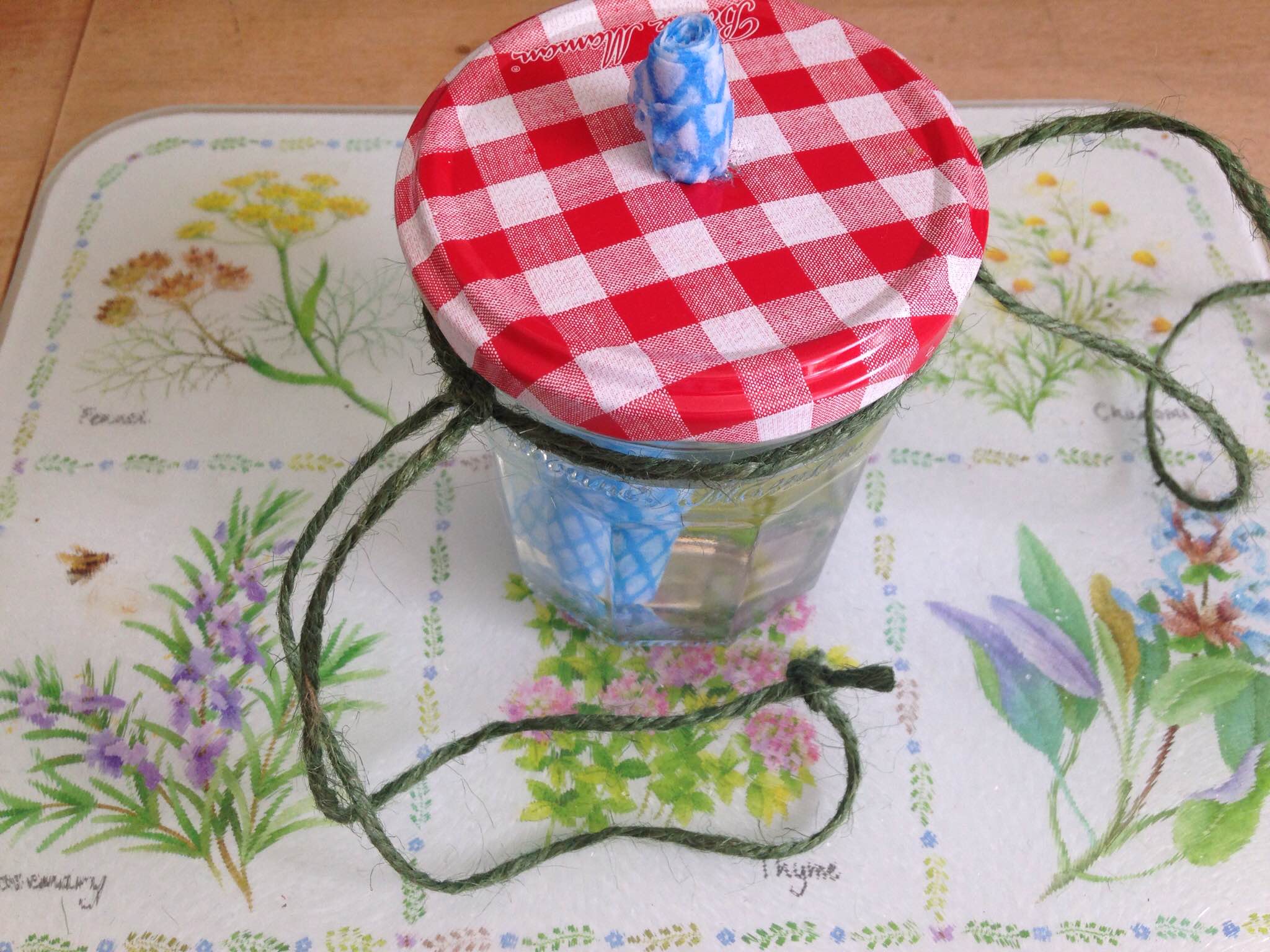
How to make a butterfly sugar feeder

(null)_5

You will need: 

  • Jam jar
  • String
  • Sugar syrup

1. Mix one part sugar to four parts water to make sugar syrup.

(null)_6

2. Pierce a hole in the jam jar lid and poke through a brightly coloured kitchen cloth.

3. Pour the sugar syrup in the jar and screw on the lid so the cloth can absorb the syrup.

IMG_8128

4. Secure with garden string and/or elastic bands to hang upside down.

The butterfly feeding stations were hung up high in the flowering bush that is busy with bees. We’ve had no customers yet, but I’m hopeful.

So the bees don’t feel neglected in the garden, my niece had a bright idea a couple of weekends ago. She asked me to pick one of each flower to put on a saucer. We then drizzled the flowers in honey. “This is a bee bed,” she said proudly putting her creation on the flower bed wall. “For tired bees.”

IMG_8139

edit: my story of the worker moving the egg is anecdotal (see comments below) and pure guesswork as I can’t know for certain how a suitable egg got into the super for the bees to try and make a queen. Moving eggs is one theory I’ve heard over the years, laying workers is a possibility though these eggs would become drone not queens, or a small queen able to slip through the excluder after all or even a second queen in the hive still unseen…

When does spring come for the bees?

bee crocus

As every beekeeper, and aromatherapist, knows spring can come more than once for the bees and the flowers. Today was a perfect spring day with glorious sunshine, balmy blue skies and a warm 14–15°C. There would be only one thing on the minds of beekeepers across the UK – the comb change.

Each year many British beekeepers give the hives a spring clean. The bees are moved onto fresh comb in cleaned-up brood boxes to start the season again. The comb change may be carried out using a shook swarm or Bailey depending on the health and strength of the colony, and also relying on ongoing warm weather with availability of local nectar and pollen.

emily blowtorching

The reason for the comb change? To keep down the diseases and pests in the colony. The timing of the comb change? That’s up for discussion.

There are some beekeepers who like to shook swarm their hives as soon as the weather allows in late February to early March. The reason being that the earlier you shook swarm the less brood you lose, and the bees can get a head start to the season.

Then there are some beekeepers who prefer to change the comb from late March to early April. They like to wait for consistently warmer days and for the trees to be blossoming.

bee drinking

In March the weather is not always consistent and spring can come and go a few of times before it stays. It is important to get the timing right for the comb change: too soon for a weak colony or before a string of warm days might make it more difficult for the bees to recover from a shook swarm or to build-up a Bailey; too late in the season means losing more brood (in a shook swarm) and perhaps leaving the bees less time to yield a honey harvest that year.

A couple of experienced beekeepers at the apiary had already shook swarmed some or all of their hives. If you’re a more professional beekeeper or commercial bee farmer with 50, 100 or more hives, I can understand the eagerness to get going early in the season.

For the hobbyist or backyard beekeeper with three or five hives, perhaps we have more time on our side to do a couple of inspections first and wait for the warmer weather to hold before carrying out a comb change.

a jonesey beekeeping

When do you prefer to do your comb change? And how do you decide when spring has arrived for your bees?

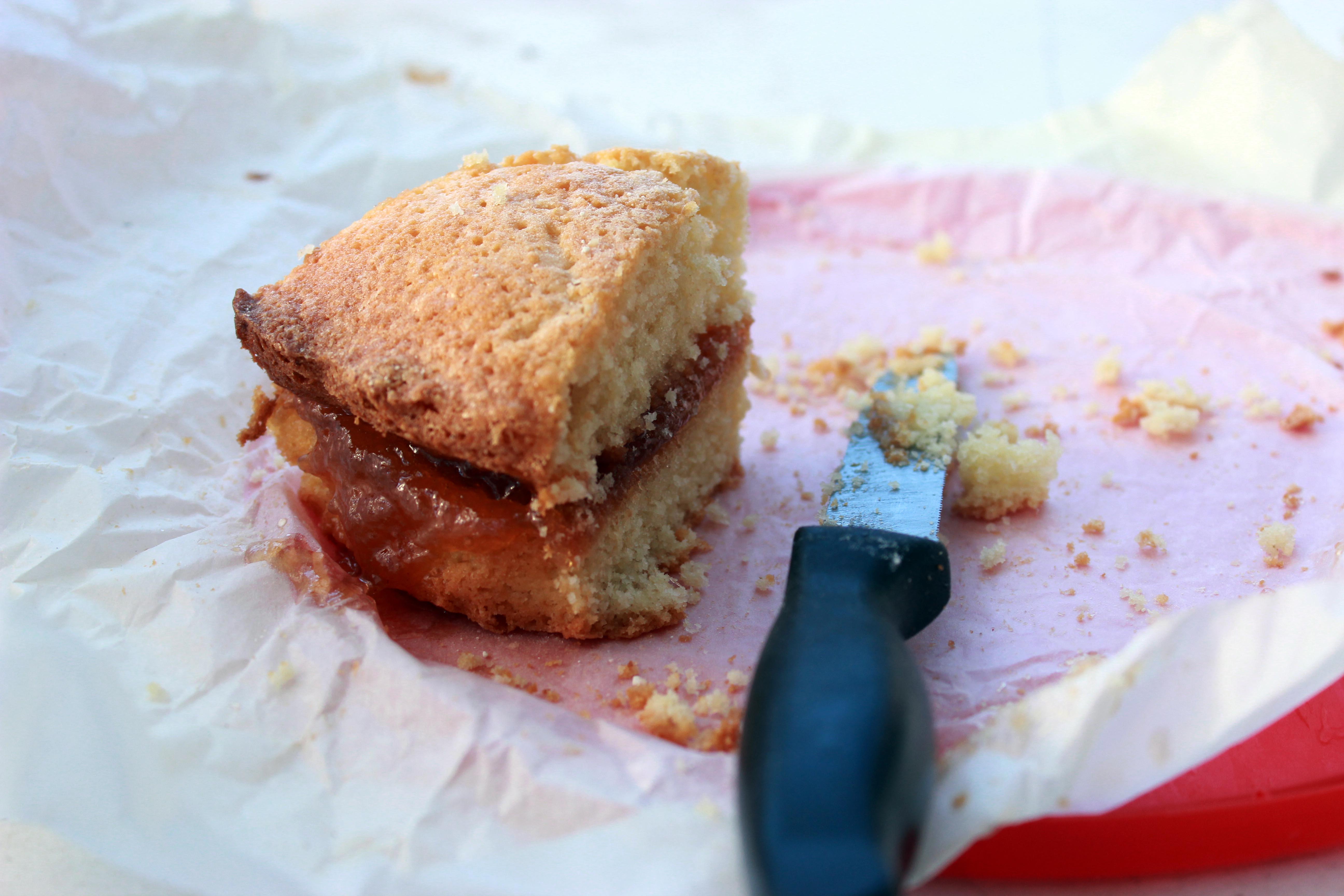
The first best day of the year at Ealing apiary brought bigger concerns for the beekeepers. Who was making the tea and would there be cake? Luckily Emily had baked a cake and Elsa was busy making tea to keep everyone content. We had a couple of German beekeepers visiting the apiary who were fascinated to learn more about our bees. After a cup of tea and a slice of cake, Emily and I satisfied their curiosity, and ours, by taking the first look inside the hives this year.

emilys cake

A feast of tea and cake for beekeepers.

a robin feast

A feast of mealworms and biscuit crumbs for the robin.

Melissa’s and Pepper’s hives were doing very well with bees busily pouring in and out. Chili’s and Chamomile’s hives were weak and though both queens were spotted there was virtually no brood. We closed up the weaker colonies with dummy boards to keep them warm and fed them spring sugar syrup to try and stimulate their activity.

a queen chili

Pink-crowned Queen Chili was easy to spot.

a queen chamomile

Queen Chamomile sees her first sun of the year.

Jonsey kindly helped us to blow torch the empty brood boxes in readiness for the comb change, and Emily and I have started to make new brood frames. Tomorrow forecasts rain with cooler temperatures to follow next week. Spring should be here to stay, hopefully, by the end of March and we can move our bees into cleaned hives, though we may need to make a decision about our weaker hives before then.

bees play crocus

A beekeeper’s notes for February

purple crocus opens

On Saturday 14th February I saw the white snowdrops in flower and the purple crocuses opening. Winter aconite and catkins of the hazel and the willow will also blossom bringing the year’s first forage for bees.

Ealing beekeepers were at the scout hut for their monthly meeting. I stood outside the entrance of the hives and noticed not a single bee took to the wing. The stillness made all other movements sharper.

I watched a red-breasted robin hopping in the thorny foliage and breathed as a magpie swooped down to pick a twig to build her nest.

I found a spider crawling on the fondant under the roof of a hive and two slugs sliding in the dead leaves beneath the floor of another.

snowdrops

Alan Gibbs arrived just as I had put under varroa boards to check this month’s mite drop. He had come with his spade on this cold, rainy day to lay more paving stones in the communal area. Betty Gibbs was sensibly waiting in the car outside the apiary, reading a book.

We then looked at the fondant under the roofs. I had brought more in case it was needed, but Alan said they had “quite enough”.

A chilly February can be a time of uncertainty for beekeepers with thoughts of wakeful bees kept inside the hive as the winter larder runs bare. I gave each hive a heft for weight of stores. In particular Melissa’s and Pepper’s were very heavy, while Chili’s and Chamomile’s were lighter. Nothing to do but observe, February is also a time to rest and wait as everything unfolds.

With that, I said goodbye to Alan and the bees, and waved to Betty on my way out. John too was sensibly waiting for me in a warm car. There were flowers, cards and chocolates sitting at home.

valentines flowers pink

This is a short and sweet post like the month.

Emily and I have decided to use paper records for our hives again. Our blogs provide an online diary of beekeeping, and I’ve found electronic records or apps sometimes difficult to access or just fiddly to use on my phone during a hive inspection. Also, it seems better to keep records under the hive roofs at the apiary, in case other beekeepers need to read them.

Here’s a start on preparing our hive record sheets for the season ahead, based on others we have used and ideas for monthly reminders. Let me know in your comments if there’s anything you would include, I’d be interested to know how to improve them:

Hive records 2015 pdf
Hive records 2015 Word doc

And a note on something less practical and more frilly… Sometimes there is snow in February, which makes me remember my favourite passage from The Snow Queen, A Tale is Seven Stories, by Hans Christian Andersen.

In the second story about a little boy and a little girl, Kay and Gerda sit by frozen windows to watch the snowstorm. They lay heated copper farthings on the windowpane to make a peep-hole to look outside…


”Look! The white bees are swarming,” said the old grandmother. “Have they a queen bee, too?” asked the little boy, for he knew that there was a queen among the real bees. “Yes, indeed they have,” said the grandmother. “She flies where the swarm is thickest. She is biggest of them all, and she never remains on the ground. She always flies up again to the sky. Many a winter’s night she flies through the streets and peeps in at the windows, and then the ice freezes on the panes into wonderful patterns like flowers.”

“Oh yes, we have seen that,” said both children, and then they knew it was true.

“Can the Snow Queen come in here?” asked the little girl.

“Just let her come,” said the boy, “and I will put her on the stove, where she will melt.”

But the grandmother smoothed his hair and told him more stories.

In the evening when little Kay was at home and half undressed, he crept up on to the chair by the window, and peeped out of the little hole. A few snowflakes were falling, and one of these, the biggest, remained on the edge of the window-box. It grew bigger and bigger, till it became the figure of a woman, dressed in the finest white gauze, which appeared to be made of millions of starry flakes. She was delicately lovely, but all ice, glittering, dazzling ice. Still she was alive, her eyes shone like two bright stars, but there was no rest or peace in them. She nodded to the window and waved her hand. The little boy was frightened and jumped down off the chair, and then he fancied that a big bird flew past the window.

The next day was bright and frosty, and then came the thaw—and after that the spring.”

valentines flowers white

A beekeeper’s notes
A beekeeper’s notes for January