BBC Gardeners’ Question Time and why we should take lavender to Mars

BBC Radio 4 Gardeners' Question Time – a panel of horticultural experts answer gardening questions with wit and wisdom

What do unruly rubber plants, sulking evergreens and intergalactic colonisation by plants have in common? They were all questions to a panel of horticultural experts on BBC Radio 4 Gardeners’ Question Time. The show was recorded beside Regent’s Park on Monday 23 January and featured practical advice about gardening served with inspiring ideas and sparkling banter.

Triffids, peashooters and quail eggs

I went to the show with Emily, although first we enjoyed the host’s drinks and canapés. After sampling a quail egg, Emily was left to ponder how you go about eating more of these delicious mini foods. Filled with quail eggs, stuffed green olives and cheese straws, we made our way to the recording in the Wolfson Theatre.

Tiny quail eggs – I am constantly plotting and scheming how to eat more

The programme was presented by Eric Robson with a group of gardening experts, Chris Beardshaw, Bob Flowerdew and Christine Walkden. The panel answered a variety of questions from what to do about a rubber plant that was growing like a hooligan (some clever pruning) to how to grow a vertical garden (involving a peashooter).

My favourite question was ‘What plant would you take to another planet?’ As an aromatherapist and beekeeper, I have often thought a packet of garden seeds and a nuc of bees essential to terraforming another world. If I could choose only one plant it would be lavender, because it is the most versatile herb and essential oil, and bees love it.

Lavender is also a friendly plant and least likely to mutate into a triffid.

Absconding bees

From alien plants to disappearing bees, there was a sad discovery at the apiary this Saturday. A hive belonging to one of the beekeepers was found mostly empty with little dead bodies frozen on the comb. It looked like the colony had succumbed to varroa as the mite count had risen sharply in January.

The gentle and hard-working Italian bees were very active during a mild autumn and winter at our apiary, but this may have contributed to the rise in varroa among the winter bees

This is a common problem for winter bees who are more susceptible to varroa. As the colony grew smaller they would have been unable to keep each other warm and the remaining stragglers probably froze to death. We also found newly hatched bees dead in the cells because there were no nurse bees to feed them. There was plenty of uneaten honey leftover that could be harvested for marmalade and mead.

However, in a strange turn of events another beekeeper reported that his colony had almost doubled in size and, unlike his black bees, the new bees were light coloured. So we suspect that many of the golden Italian bees from the dying colony had absconded and bribed their way with honey into a new home. It was nice to think that the collapsed hive was enjoying a second life.
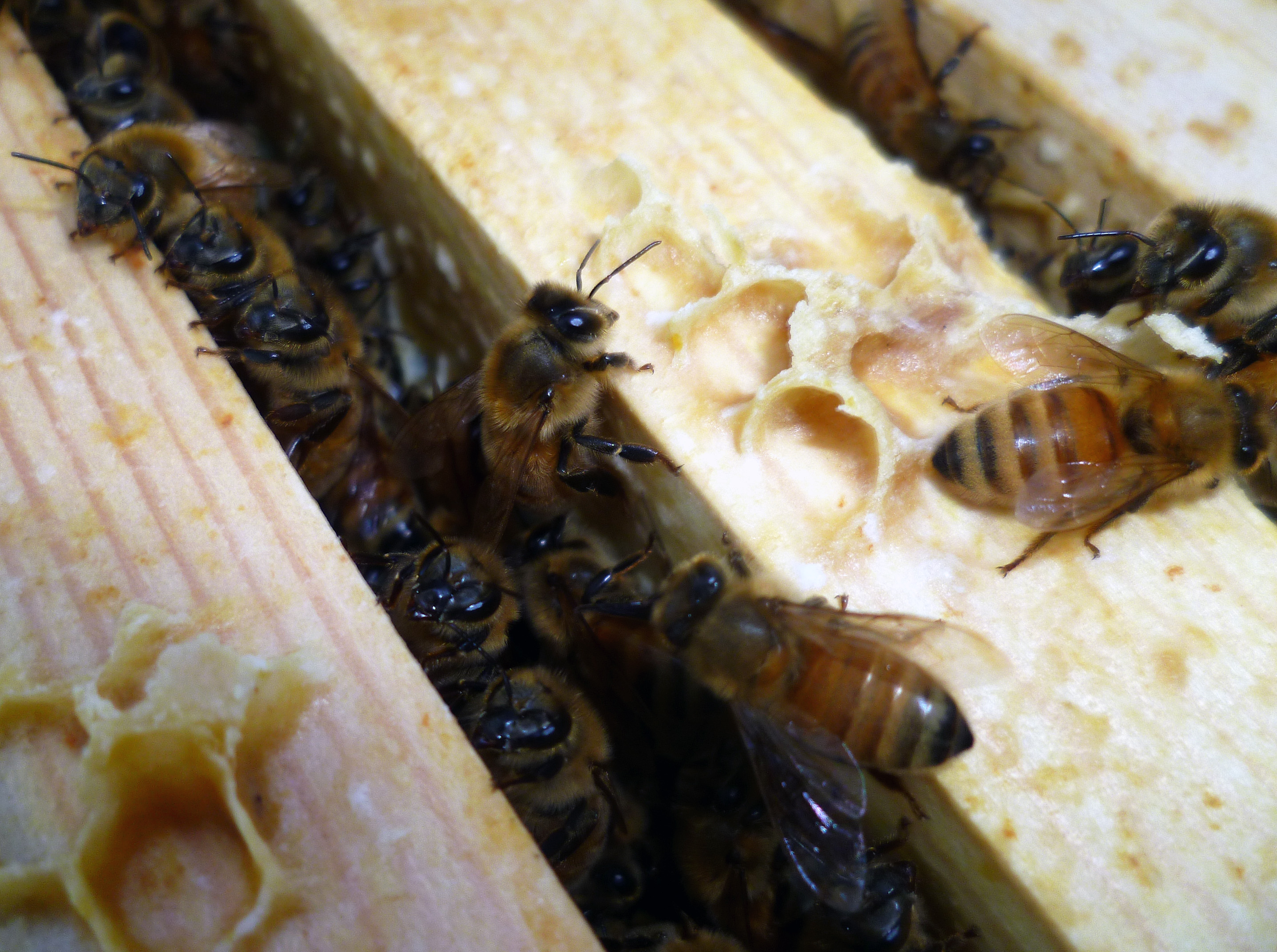
Did these light-coloured Italian bees find a secret second life in the hive across the path?

Listen to BBC Gardeners’ Question Time from Regent’s Park

Eric Robson chairs a programme of BBC Gardener’s Question Time from the Royal College of Physicians beside Regent’s Park, London, with Chris Beardshaw, Bob Flowerdew and Christine Walkden on the panel.

BBC Radio 4 Gardeners’ Question Time 
Friday 3 February, 15.00
Sunday 5 February, 14.00

To find out more about BBC Gardeners’ Question Time visit the website.

Read more about how to live with lavender (not on Mars).

Beebase have lots of advice for beekeepers on how to manage varroa.

10 years of pretending to be a beekeeper

The bees at our apiary playing, 'pretend the beeks keep us'.

While I have only pretended to be a beekeeper for two years, some people have been pretending for much longer than that. A group of beekeepers from Ealing and District Beekeepers Association met last Thursday evening to celebrate Pat’s 10-year anniversary of being a beekeeper.

The average life span of a beekeeper is said to be the same as the queen, which is about three years. One year to find out what you have to do, another year to understand why you have to do it, and a third year for things to go wrong. This is why Pat’s 10 years of beekeeping is a real achievement and worth celebrating! This will be my third year.

With the bees on their winter break, beekeepers congregate like drones at the local pub.

We met at the Duke of Kent pub in Ealing and it wasn’t long before talk turned to our favourite topic – bees. Alan was telling us how he marks his queens with a ring, while John, who is an expert queen catcher, preferred the queen marking pen. Don commented ‘I would like to put a bell on mine so that I can find her’ and I joined in with ‘maybe a crown and a little dress’.

Knowing our bees I suspect orders would swiftly come from the top to remove any paraphernalia used to dress the queen. They quickly dispatched Emily’s queen cage last year.

Towards the end of the evening, after a pint or three, resolutions were made, ‘I am going to be ready for the shook swarm this year’ and promises given, ‘I am going to bring sausage rolls to the apiary on Saturday afternoons’. Beekeepers are, by nature, quite cautious so this was followed by, ‘Let’s not let the sausage rolls get out of hand’.

Emily wearing a very stylish bee hat for winter hive inspections. It saves time putting on a full suit, but protects from the odd bee flying and getting caught in long hair!

The following Sunday morning Emily and me checked our hives. February is a perilous month for bees, because it is the time of year when colonies are most likely to perish. The bees will have almost depleted their winter stores, the queen will begin to lay again, and they await good fortune in both weather and plants to forage. They are at their most vulnerable and more susceptible to pests and disease.

Sunday morning at the apiary, Emily comes across a purple crocus that is waiting for a bee to find it. If you look closely at the middle flower with petals starting to part, you can see a glimpse of the luminous orange pollen inside.

Emily found our bees flying into the hive dusted with yellow pollen. We hefted both hives to check the weight of honey stores and opened the roof to see how much fondant had been eaten. All was well and there was no sign of dead bees or disease at the entrances, so we took a stroll around the apiary to check the other hives.

Spring is coming. Snowdrops budding at the apiary.

Having not done a bad job of pretending to be beekeepers, there was little to do but go home for a cup of tea and cupcake, and dream of months of bees and honey to come.

A cake fit for a fairly good beekeeper, sugar sprinkled by the bees.

Emily took a great video of our bees returning home with pollen on her post ‘More signs of spring‘.

Aroma Yoga

Aroma Yoga

Aroma Yoga is an inspiring way to start the day by using fragrances that complement yoga moves. Simply put it means burning an essential oil or a blend of essential oils while practising yoga.

Aromatherapy is a natural partner to the five principles of yoga: exercise, deep rhythmic breathing, release from tension, relaxation and meditation. Essential oils can be used to energise the body, encourage deep breathing, awaken the senses, and promote calm.

I practise yoga every morning at home so it is easy to choose an aroma for my daily Asanas (yoga poses). To feel revitalised and renewed after a session, I choose essential oils that are energising and uplifting. Basil or rosemary oils stimulate the mind and clarify the senses, and burning one of these two fragrances brings a greater sense of awareness, aiding focus and balance.

Frankincense is another excellent oil to combine with yoga particularly for classic meditation poses like the Lotus. The orange oils (mandarin, petitgrain, sweet orange) are good choices because they are relaxing and uplifting. Lavender combines well with yoga because it balances the mind and emotions.

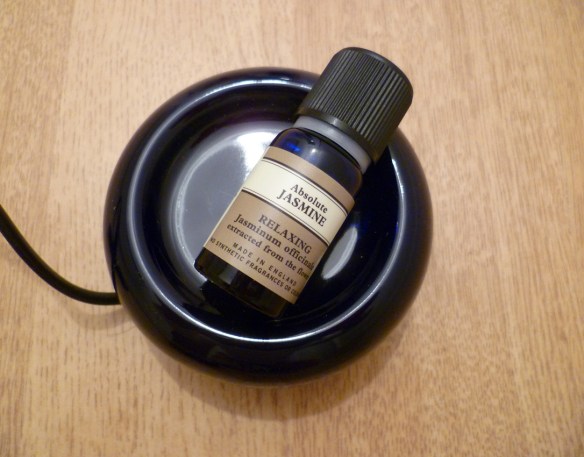
My favourite essential oil for yoga is not an obvious one – jasmine. The fragrance of jasmine is very inspiring while practising Salute to the Sun as the world awakes.

I would love to hear more ideas of how to use aromatherapy with yoga.

My essential oils are from Neals Yard, including the aroma stone in the image above.

Who is Monkey-Fish?

Image © Paolo Viscardi, curator at the Horniman Museum and Garden

In June 2011, the Horniman Museum offered to loan a genuine Japanese monkey-fish to the museum of the Royal College of Physicians (RCP). The RCP said ‘yes’, of course, because who wouldn’t want a genuine Japanese monkey-fish?

The monkey-fish was not due to arrive until December, but the word of his coming spread through the corridors of the RCP like wildfire. What was monkey-fish? Who was monkey-fish? ‘It’s the missing link,’ said some, while others speculated about a chupacabra roaming 11 St Andrews Place after dark. An urban legend was born. I work at the RCP and it is likely that I played a small part in the creation of the RCP’s very own cryptid.

So while the bees are on their winter break, here is a post about another species, or two, sort of.

Fakes, forgeries and quacks

Image © Paolo Viscardi, curator at the Horniman Museum and Garden

The RCP held two lunchtime talks on Tuesday 20 December with experts from the Horniman Museum and Wellcome Library on the subject of ‘Fakes, forgeries and quacks’, inspired by the loan of the Horniman monkey-fish. Japanese monkey-fish, or mermen, were popular attractions during the 19th century and were touted as being real creatures. The second talk, ‘Making mermaids: a fishy business’ by Paolo Viscardi, curator at the Horniman Museum and Garden, traced the chequered past of monkey-fish revealing the history of mermaids, tales of fraud, media manipulation and shipwrecks. Among the audience were a number of RCP staff who were eager to find out more about monkey-fish, or ‘Alan’ as he is affectionately called.

Paolo took us on a journey of mermaid sightings from the Sirenia, or sea cows, mistaken for mer-folk by ancient mariners, to the thousand-year-old shrivelled ‘mermaids’ of Japanese Shinto shrines, to the famous Fiji Mermaid exhibited by master showman PT Barnum in the 1840s.

This was all very well, but what I wanted to know was this: who is our monkey-fish?

Who is monkey-fish?

X-ray of monkey-fish. Image © Paolo Viscardi, curator at the Horniman Museum and Garden

On Tuesday, 2 September 1919, a Japanese merman was purchased by, or on behalf of, Henry Wellcome at an auction held by Stevens London auctioneers. The auction catalogue listed the specimen as ‘Japan, Mermaid, paper-mache body, with fish-tail 20 in. long x 9 in. high’.[ref] The merman came to the Horniman Museum from the Wellcome Collection in 1982, and somewhere along the way it gained the name ‘monkey-fish’ because of its appearance of a monkey’s head and torso sewn onto the body of a fish. Mystery solved, or is it?

What is a monkey-fish?

CT scan of monkey-fish. Image © Paolo Viscardi, curator at the Horniman Museum and Garden

I was curious to know, what is a monkey-fish made of? Is it the mummified head and torso of a monkey sewn onto the tail of a fish? The Horniman Museum had investigated the makings of monkey-fish through X-ray and CT scans – and the results? ‘What is a monkey-fish made of? Paper, wood, string and clay, with fish bits and chicken feet!’ said Paolo. ‘But no monkey.’

Monkey-fish babies and the dark sibling, Paul

As if that were not enough excitement for one afternoon, we were told that there could be 100s of monkey-fish out there, waiting to be found. There might also be monkey-fish babies, which led to a twittering of ‘I want’ tweets.

The Horniman monkey-fish even has a sibling on display elsewhere in the UK – a dark twin called Paul. I may have made up that last bit.

Come and see our monkey-fish!

Me (left) and monkey-fish (right)

The monkey-fish will be exhibited alongside items from the RCP’s own collections, which involve an element of fakery – whether intentional or not  – until 20 January 2012, and is open Monday–Friday, 9am–5pm. No booking is required and entry is free. The exhibition area is closed on public holidays and for RCP ceremonies. The RCP museum holds various events all year round and information on how to visit is here.

Monkey-fish will return home to the Horniman Museum at the end of January, which also looks like a pretty interesting place to visit.

Giving the bees oxalic acid

Oxalic acid is an effective treatment against varroa. It burns the feet and tongues of the varroa mites so that they fall off the bees! The treatment is only given in winter when the mites are living on adult bees and there is no brood for the acid to damage.

This weekend the apiary gave the hives oxalic acid as a way of saying ‘Happy New Year’ to our bees. The bees were not pleased, as they do not like their cosy cluster being disturbed in winter, and flew up as soon as the crown board was lifted. John Chapple, who is rarely seen behind a veil, observed that even he wears a bee suit when giving oxalic acid to the bees. Although the bees were not pleased, Emily and I enjoyed saying hello to our ladies again, and both hives looked healthy and strong.

The treatment is given as a pre-mixed solution of 3% oxalic acid in sugar syrup and warmed slightly so that it won’t chill the bees. About 5ml of solution is dribbled in-between each gap in the frames where the bees are clustered, called seams of bees. The British Beekeepers Association (BBKA) have a good advisory leaflet on oxalic acid cleansing. It is a simple treatment to do, but it is critical to get the dosage right as over-dosing will harm the bees.

Lavender’s ladies were quiet and well behaved for their treatment, while Rosemary’s ladies were livelier. Believe it or not, our bees are much calmer than this in the summer! My first video, I hope to do more this year, shows Emily treating Rosemary’s hive:

Look how disgusted our bees are that we tore apart the sticky propolis insulating the hive! Sadly one bee was squashed as we closed the hive, but we rescued stragglers who had got cold and slow in the roof and carried them around to the entrance of the hives. It was fun to watch them climb in and re-join their sisters.

The BBKA say that oxalic acid is an important part of varroa management alongside other treatments and methods to keep varroa ‘below a level that damages the colony’. As varroa levels at the apiary increased in late autumn, it is hoped that the oxalic acid will help all the hives to stay healthy until spring. There is some talk among beekeepers about replacing treatments like oxalic acid and fumidil with ‘natural’ treatments, but I will write about this in another post in 2012 alongside a re-launch of my blog coming soon.

Happy New Year to bees, beekeepers, everyone and world!

Note: If you have not given oxalic acid to bees before, Glyn Davies of the Devon Beekeepers Association demonstrates the method very well. Emily has more videos of our apiary receiving oxalic acid treatment that are less shaky than my shots!

Not much beekeeping doing

There is not much beekeeping to be done in mid-winter. The bees stay in and surround the queen in a cosy cluster. There are no brood, or drones, to care for. Workers may leave the hive on a warm day for a cleansing flight or to drop-off dead bodies.

The more hardier beekeepers – and Emily and me – continue to visit the apiary in winter, but this weekend had a definite bite in the air and I wondered who would turn up to drink tea. A generous-sized tupperware cake box sitting on the apiary long table was a clue that my hive partner had arrived. I found Emily and Albert wandering around the hives, and hefting a few to check the weight of food stores. It was too cold even for Albert’s or John’s bees to fly out.

I had brought a bag of bubble-wrap to insulate our hive roofs, but first we needed a cup of tea and a slice of coffee-and-walnut cake. Chat around the long table ranged from monkey-fish (inspired by the random exhibit of a Japanese merman at my work) to the question: can crocodiles climb trees? The deductive reasoning of beekeepers settled this debate, ‘Crocodiles are very good jumpers and they have long bodies,’ said Andy. ‘A croc could jump quite high and grip the trunk, and with its long mouth could reach up the tree.’ So if you get chased by a crocodile and climb up a tree, keep climbing.

After drinking tea and munching cake, we decided it was time to bubble-wrap our bees. First, we visited Rosemary’s hive to put a layer of bubble-wrap inside the roof. We startled, and were startled by, a bee who flew up from the entrance. She may have been a vigilant guard bee disturbed by the movements in the roof, but she looked equally surprised to see us mid-flight and flew past so quickly that I think the little lady was desperate for a cleansing flight.

Emily thought our bees might want to send some Christmas post

Next we visited Lavender’s hive and a heft test reassured us that our baby hive has enough food stores. We insulated this hive with bubble wrap too. Emily had already padded the roofs of both hives with jiffy bags, and this, with a layer of bubble-wrap, should keep our ladies nice and toasty.

Bees bubble-wrapped for Christmas!

Bees can heat the hive extremely well themselves and you can feel the heat that they generate if you hold your hand over a hole in the crownboard. But as Thomas reminded us, ‘Insulating the hive is the least that you can do for your bees in winter.’ Condensation and damp is more a problem for bees than cold, but the open mesh floor of modern hives provides enough ventilation.

Winter is a great time for beekeepers to catch-up on their reading, attend meetings, clean and mend equipment, and to keep up with tea drinking. In about three months, there will be plenty of beekeeping to do.

The day my mum met the bees

My mum who is highly suspicious of bees, wasps, gnats and ‘flying things’ finally met my bees this Saturday.

She visited the apiary on the promise of no bees, ‘The bees will be sleeping because it is almost winter’, I said. This isn’t entirely true. Bees don’t sleep. But the apiary is generally quieter in late autumn and winter, except for a few bees taking a chance flight in a pocket of warm air and a few crazy beeks huddled around the apiary long table in the hope of tea and cake.

A small crowd greeted my mum, step dad and me on Saturday afternoon and enjoyed watching my mother nervously approach the hive area. We visited Rosemary’s hive first and no one was flying so mum was very happy. ‘That’s very nice,’ she said of the hive. Opposite, Albert’s and John’s bees were active, but we walked past unnoticed.

Next we visited Lavender’s hive and I attempted to show my mum the mouse guard. She raised her head from where she stood at the back of the hive and pretended to see it: ‘Yes, that’s very nice’.

My step dad, Bryan, then became fascinated with inspecting the canal that runs behind the apiary. Meantime, I carefully lifted the roof off Lavender’s hive to see if they had drunk their syrup. About half an inch of syrup was left in the feeder and three bees were drinking. I beckoned my mum over so that she could see a real live bee, promising that it couldn’t fly out of the feeder. She quite liked watching it drink and said, ‘Ooh, look at that’.

I quickly put the roof back to keep our bees warm. Emily and I probably won’t open our hives until the apiary does the oxalic acid treatment in December. We do this to keep down the levels of varroa inside the hive until spring. I pulled out the varroa board underneath Lavender’s hive and showed mum and Bryan a few varroa. Most of the debris on the board was clumped together in one area, which suggests that our bees are clustered on brood frames towards the entrance of the hive.

So we left the bees in peace and went to enjoy a cup of tea. There was no milk and as my mum is not a hardened beek accustomed to drinking black tea I found her some coffee instead.

Don arrived with his dog Annie, a gorgeous, friendly alsatian. Mum and Bryan love dogs (and so do I) so this delayed our goodbyes. As we left, my mum and step dad were invited by the beeks to come back for summer inspections on the promise of ‘much more bees and also cake’.

Feeding our autumn bees

Last Saturday was a balmy 16 degrees in London, which is warm enough for bees to fly out. What will they find to eat? At this time of year the forage is scarce for bees and they may have little choice than to collect nectar from ivy. Honey from ivy nectar crystallises very quickly inside the hive and sets like hard candy, which is almost impossible for bees to eat. This can cause starvation if all, or most, of the colony’s winter food reserves are ivy honey.

Emily and I have been continuing to feed both our hives syrup and the bees have been taking this quite happily. Usually, we stop feeding syrup between the middle and end of October, but an unusually mild autumn has tricked our bees into eating their precious honey reserves so they can fly out and forage for more nectar and pollen. We want to make sure that our ladies are re-stocking their larder with honey made from sugar syrup and not from ivy nectar.

I played hookie this weekend and skipped the Saturday afternoon apiary session for an art class at the studio of artist Nick Malone. Painting bees instead of keeping them. Meantime, Emily reported that Lavender’s hive has drunk all their syrup and that a heft test showed the hive has built-up its winter reserves. Rosemary’s hive has not drunk all their syrup but this is not surprising. Rosemary’s hive had good honey reserves even after we extracted the honey crop and has continually eaten syrup throughout late August and September. The colony probably has little room spare to store more sugary goodness.

We have bought two bags of fondant – one for each hive – from our apiary, which I am impatient to put in the roof. It is fun to see bees climbing through the holes in the crownboard to tuck into a mountain of sugar. However, Pat advised that we wait until December to give them fondant, because it is better for them to stay warm inside the brood nest eating up their honey reserves first.

A second spring for bees?

I have been reading the BBC’s Autumnwatch blog and found a great guest post called Mild autumn, second spring by Matthew Oates, the National Trust’s naturalist-in-residence, who reports on the repercussions for our wildlife of November’s record-breaking mild weather.

Matthew says that flowers are enjoying a second spring: ‘dandelions and white dead-nettle prominent along verges, and Aubretia, Kerria, Magnolias, Skimmias and Viburnums blossoming in gardens’. He also comments that this has been a fascinating autumn for insects: ‘Butterflies, moths and dragonflies just won’t stop’. Our bees won’t stop this autumn, it seems! I just hope that they have been finding their flower friends waiting to greet them in gardens and not their nemesis ivy!

Why I love autumn

In autumn there are treasures to be found everywhere…

Mornings are my favourite kind: frost and sunshine and mists hanging heavily on the air. Sunrises and sunsets set the sky ablaze and smoulder into a purple flame along the horizon.

Trees burst into a riot of colour: crimson reds, burnt oranges and rusty golds. The wind charges through outstretched branches and leaves dance like dying embers on the air before falling to the ground.

I can wrap up with scarves and wear toasty gloves warmed on radiators. The weather is perfect for long strolls and kicking up leaves.

Autumn has all the best holidays: Halloween, Diwali and Fireworks Night. The smell of bonfires and smoke linger on the crisp air.

In Pagan traditions the veil between the worlds stretches thin and spells can be cast and wishes made.

Nature’s harvest ripens with apples, blackberries, elderberries, plums and pears. I can cook hearty root vegetable casseroles, tasty squash tagines and spicy pumpkin soup.

In autumn I can stay in without feeling guilty and indulge my hobbies: read, write, draw and create aromatherapy blends. I can enjoy cosy nights curled up on the sofa watching a movie and enjoying a glass of red wine.

The year winds down and there is time for reflection and contemplation. Autumn allows me to let go of the past and plan for the future.

Best of all, our autumn bees can rest from foraging and enjoy the hardwork of their summer sisters by staying warm inside the hive and munching honey.

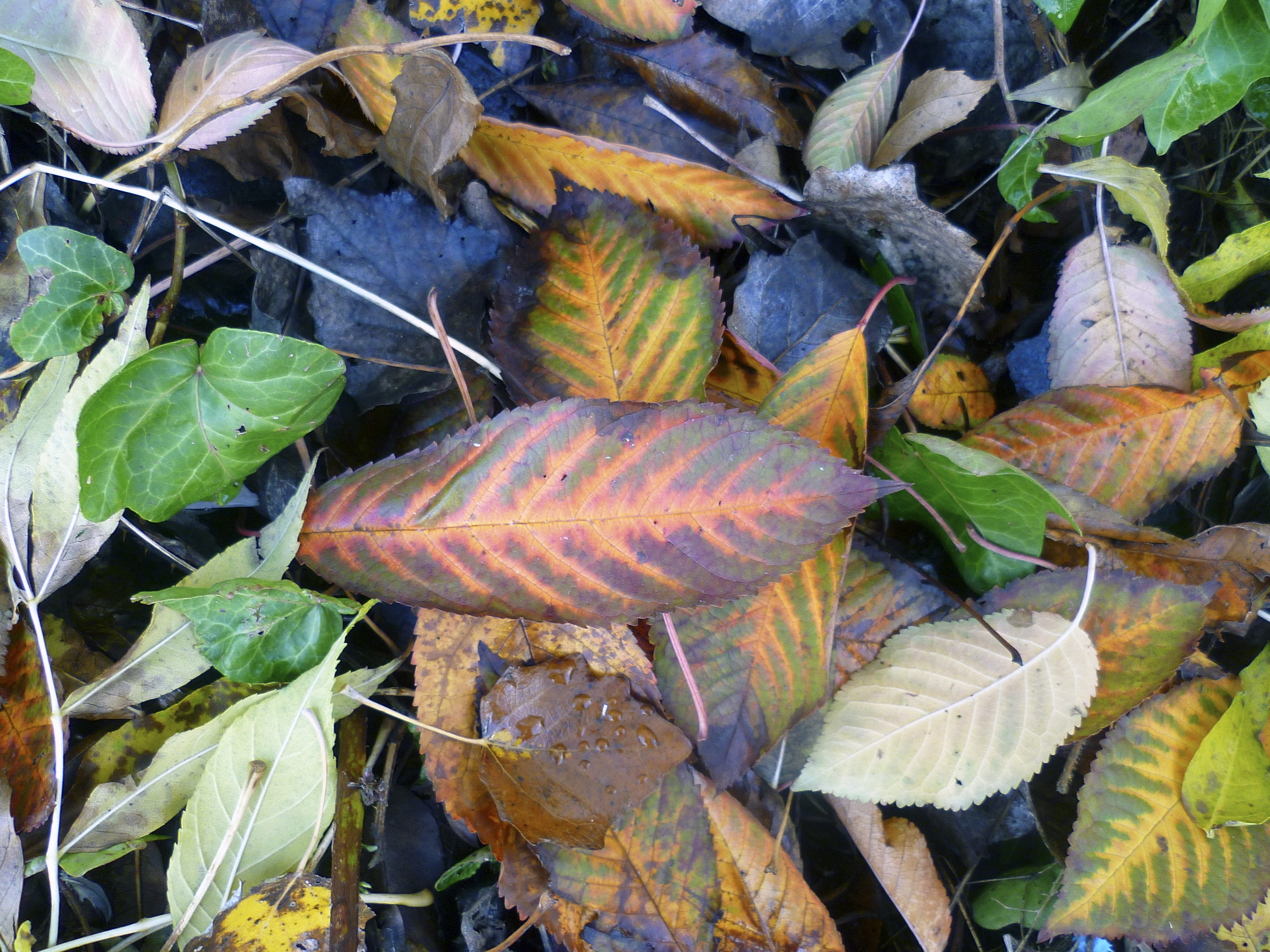
And finally, I can find leaves that are bigger than my hand!

This post is dedicated to three friends: Chris Matthias, an autumn-loving doood, Lisa Tenzin-Dolma, a source of inspiration and magic, and Bill McConkey, who sent me the best trick n’ treat.