How to extract honey

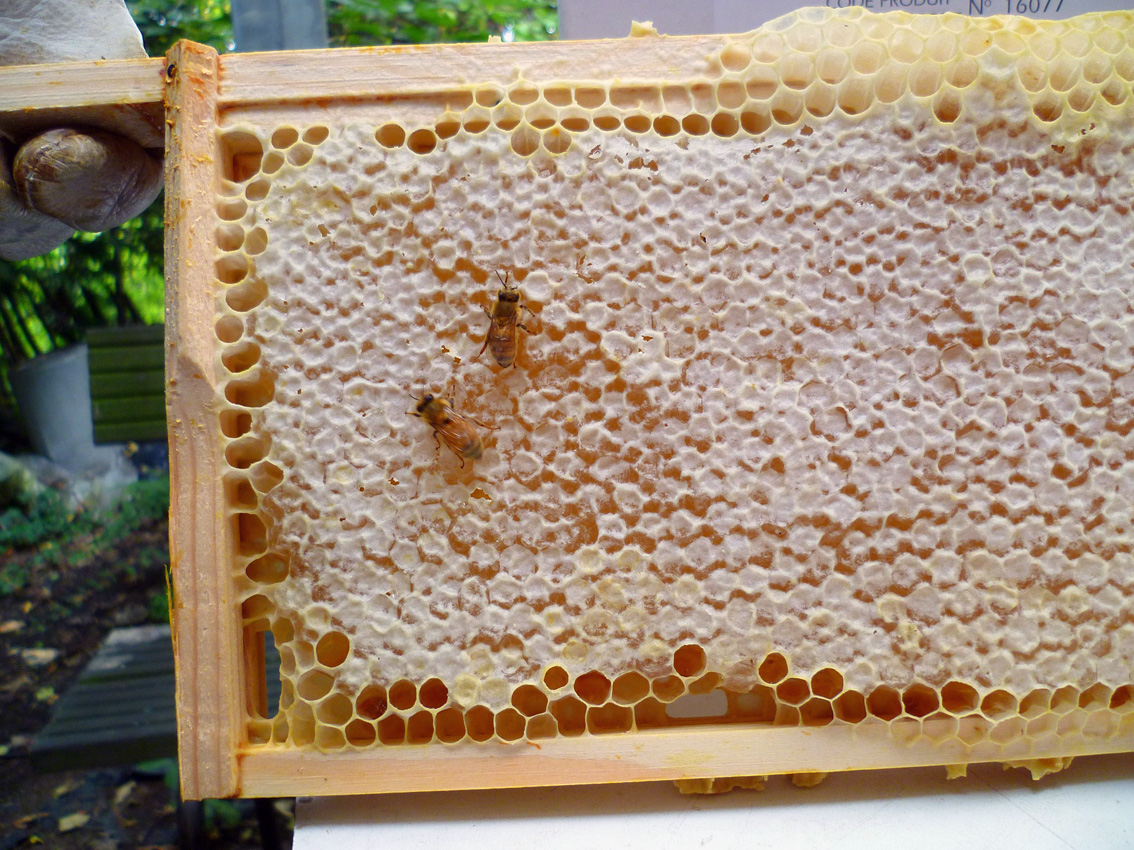
In the UK the honey harvest usually starts around July until August. When all the honey on a frame is capped it is ready to harvest.

I wrote this post one year ago on my old blog and, with the exception of a few edits, the process of clearing bees and extracting honey are the same. Our adventures took a few different twists and turns this summer, but here is how it’s supposed to be done.

I am aware that this is a slightly long post, so I have divided it into two parts and an addendum:

Part one: How to clear bees
Part two: How to extract honey
Addendum for treacle honey

It has been a good beekeeping year and you have a super or two of frames filled with capped honey. Great, but how do you get hold of it?

Part one: How to clear bees

Step 1: Clear bees from the supers

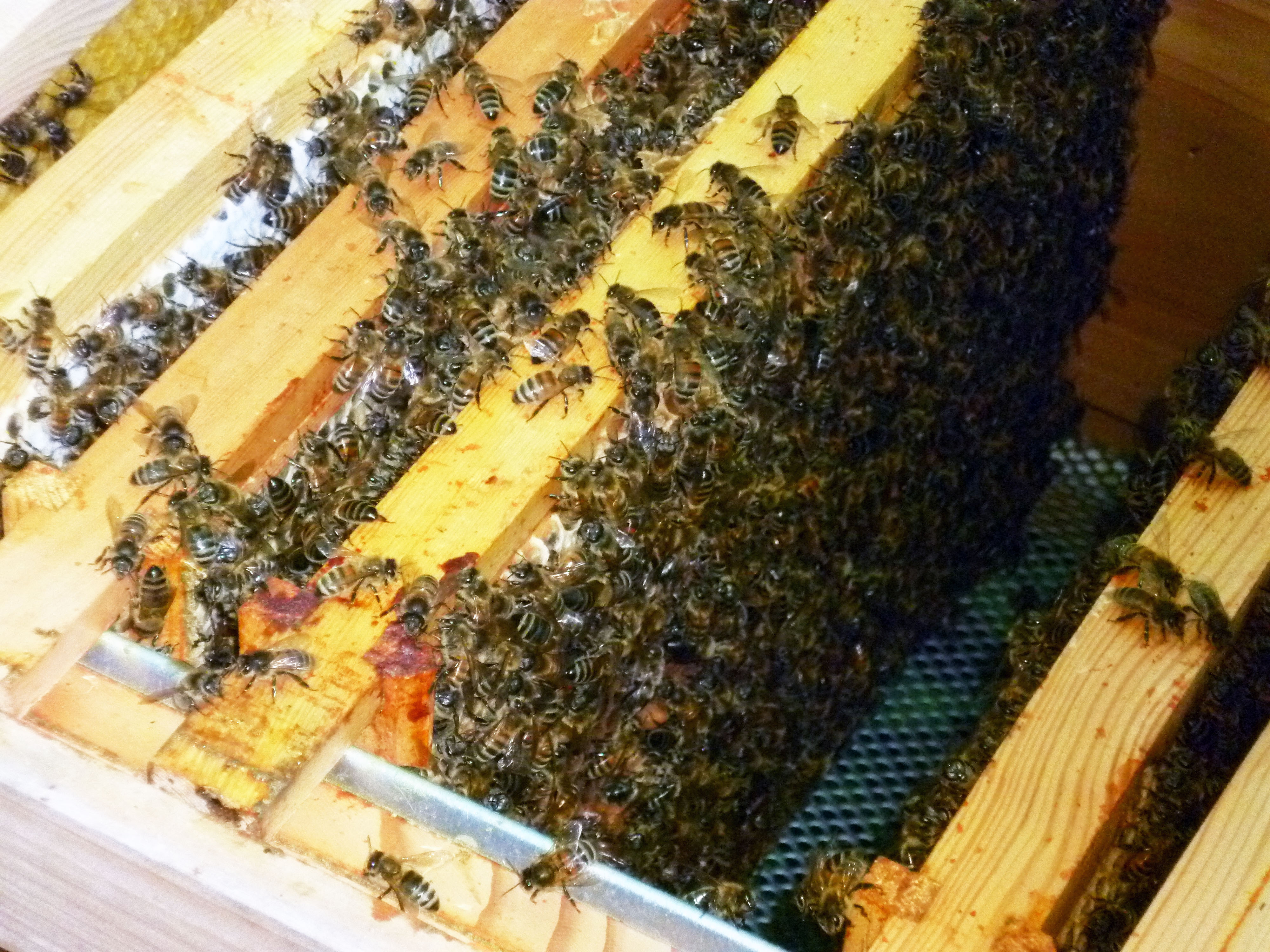
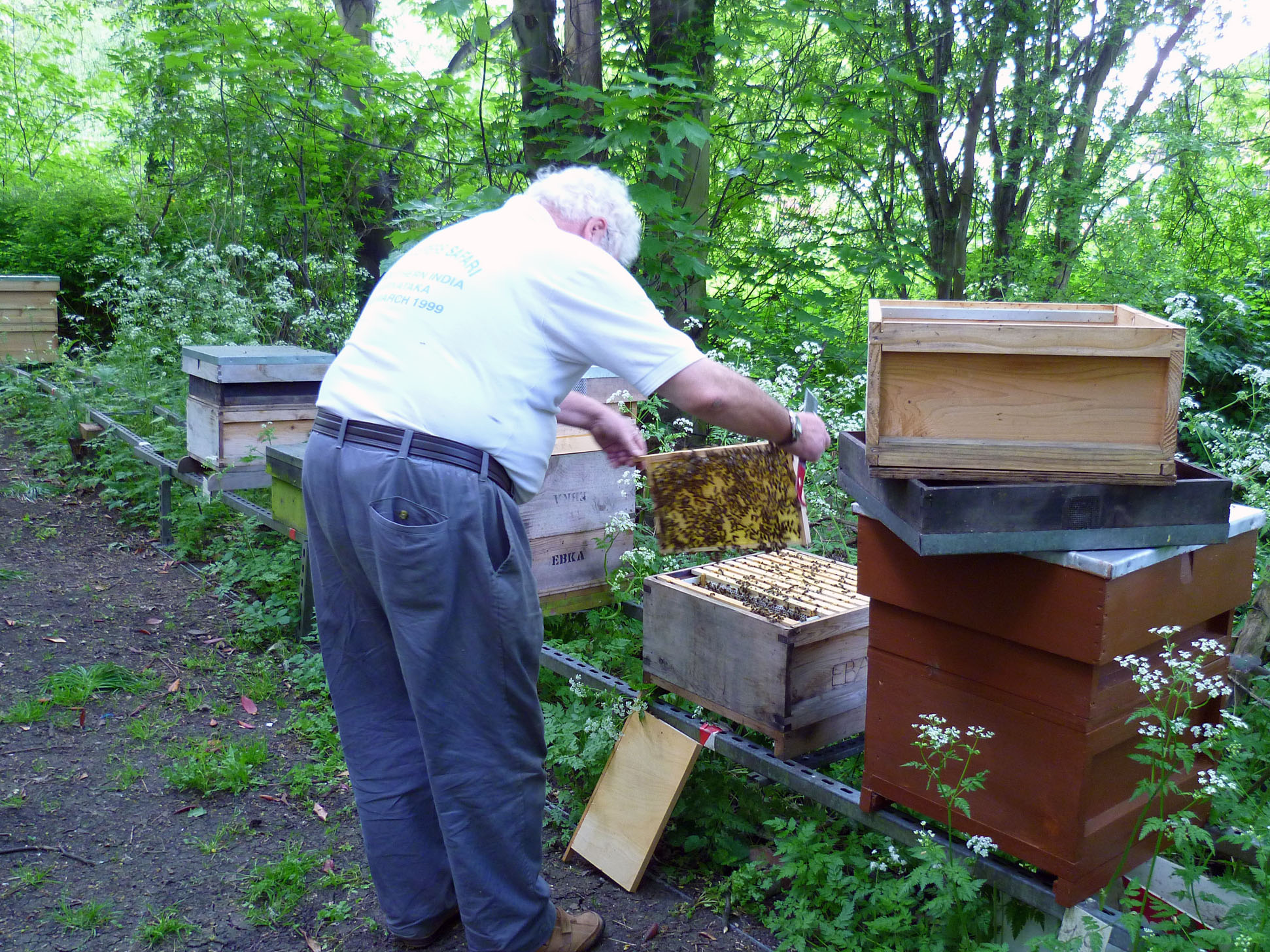
First, you need to remove the honey from the hive. Guarded by about 50,000 bees this could be Mission Impossible, but is in fact only Mission Slightly Difficult. There are these handy little inventions called ‘bee escapes’ that allow bees to leave supers, but which do not let them back in. You can get various bee escapes from beekeeping suppliers with instructions for use. I am reliably informed that rhombus escapes are very good, but we used Porter bee escapes and they worked quite well.
Bees don't give up their honey easily. Clearer boards trick them into leaving the supers overnight, so you can harvest a bee-free honey crop the next day.

Ideally, you need two crown boards to carry out the process of clearing bees from the supers. Place a crown board between the brood box and supers with the Porter bee escapes in the two holes.

The second crown board (with something covering the two holes like a tile or brick on top) should go on top of the supers before you put back the roof. This is because you are now going to leave the hive for 24 hours or overnight, during which time supers will be cleared of bees and left vulnerable to robbers. 24 hours is more than enough time for wasps to invade and clear out your honey. Check your hive, particularly around the roof and supers, for any holes or gaps, and seal with tape. Wasps are crafty.

Step 2: Remove the supers from the hive

Return to your hive 24 hours later and find the supers almost empty of bees. A bee brush or shaking can help to remove any remaining stragglers from the frames, before you take the supers back to your kitchen to start extracting honey.

If, like me, you have a kitchen in a studio flat not big enough to swing a cat, you will want to make sure you don’t bring any bees. Trust me, it’s not fun sharing your flat for a night with about 50 lost bees. You won’t sleep.
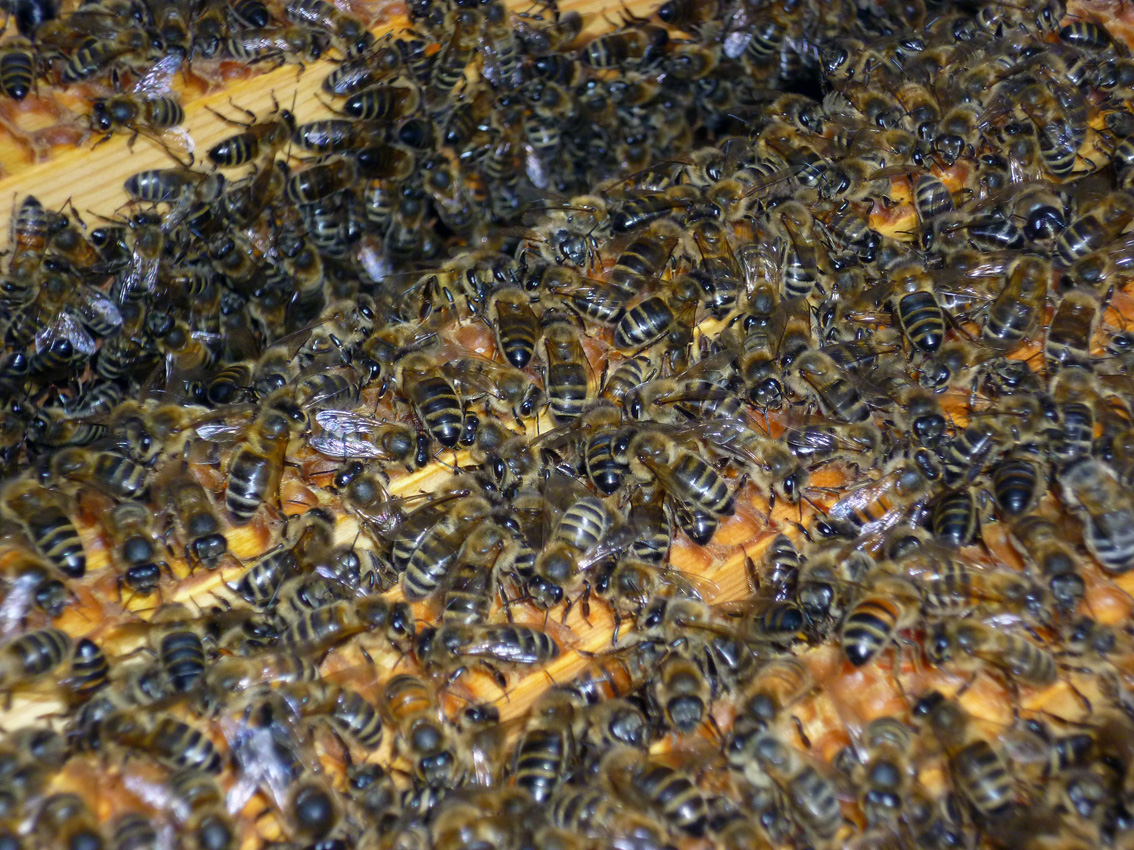
Your bees will try to help extract your honey unless you shake or brush off stragglers and quickly cover the frames.

So if you are super-organised (sorry for the pun), go to the hive with a partner in crime. Shake and brush bees off the frames, then quickly wrap each frame inside a plastic bin liner and hang on an empty super. This method makes sure that no bees hitch a ride back home.

This is a more laborious method of taking honey off the hive, but well worth it to take home bee-free frames. Emily and I did this, and enjoyed a bee-free extraction process.
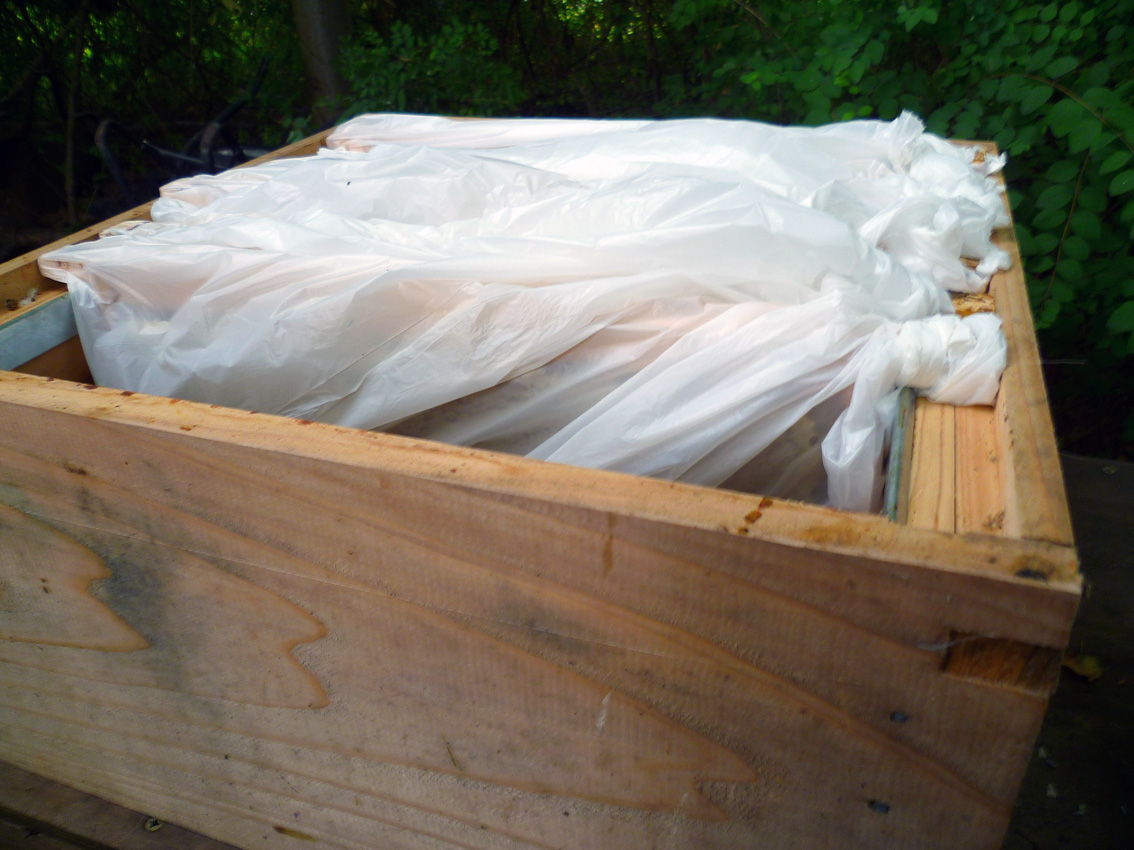
My dad, who is highly suspicious of bees, was secretly relieved we brought home bee-free frames.

Back to top

Part two: How to extract honey

Step 1: De-cap the honey

Ok, so that was actually the ‘slightly difficult’ bit. You have your supers, or box with honey frames, standing on your kitchen work surface. Now you need:

  • A de-capping fork
  • A centrifugal extractor
  • Buckets to collect your honey
  • A kitchen wire mesh strainer
  • Storage jars and labels

All of the above can be purchased at Thornes.

Be careful to keep your work area dry and free from water. Water is the enemy of honey.

Take a frame and place it over a bucket. Use the de-capping fork to run along the surface of the honeycomb and remove the wax caps. Super easy!

Hold a frame of honey over a bucket, and get a de-capping fork to take off the wax caps of the honeycomb

Run the fork lightly up the frame to remove the wax caps. Turn over the frame and repeat on the other side. Some honey will drip into the bucket but can be drained off from the wax later on
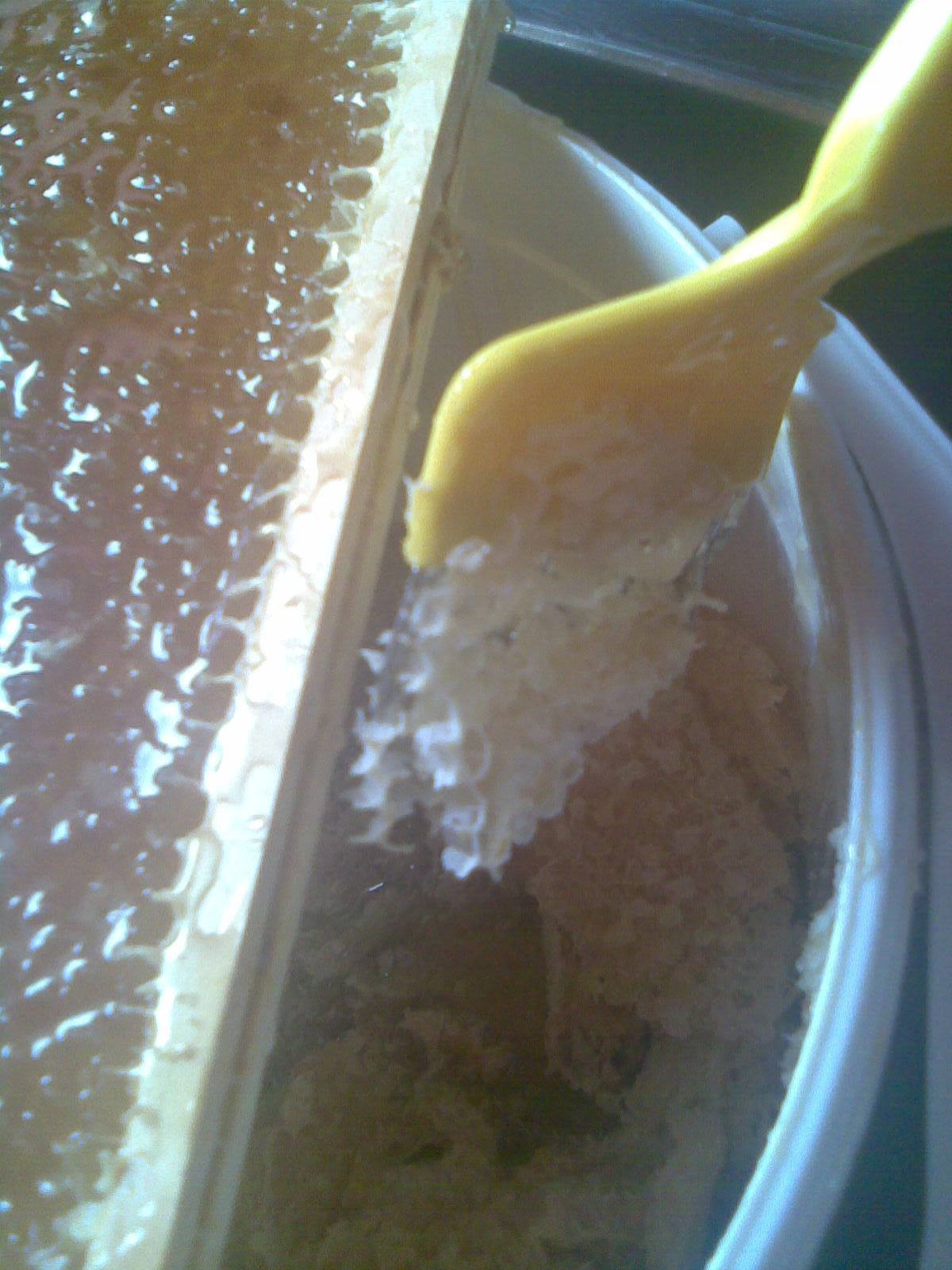
Place the wax from the honeycomb into the bucket. It can be separated from the honey dripping into the bucket at a later stage, cleaned up and used to make beeswax pellets for cosmetic recipes (face and hand creams) or to make candles

Step 2: Spin off the honey

Now place two frames of de-capped honey into a centrifugal extractor. Most are manual and are really hard work, so if you are going to do beekeeping seriously invest in a mechanical one.
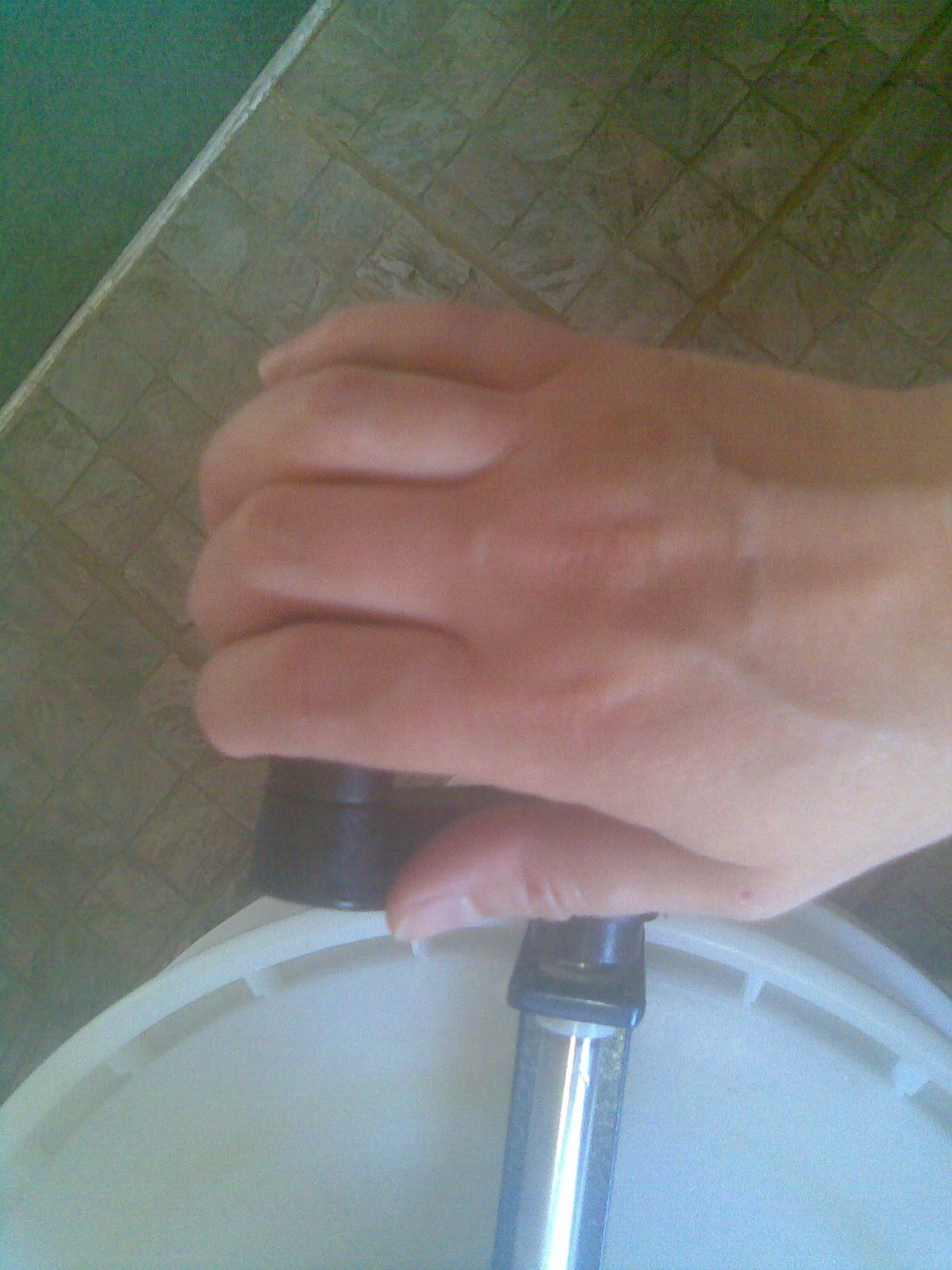
A centrifugal extractor has a metal basket in which to place frames of honey. Put on the lid and spin the frames round as fast as possible for about a minute. Then turn the frames around inside the extractor basket (so that the opposite side of honeycomb is facing out) and spin again

Honey spun off from the frame at the bottom of the extractor

A frame of honeycomb with the honey spun out. You'll notice how much lighter the frames are when you remove them from the extractor

Step 3: Drain off the honey

Spin off as many frames of honey as you can in the extractor until the level of honey at the bottom starts to reach the metal basket. It is harder to spin round the extractor with honey restricting the motion.

Lift up the centrifugal extractor to the kitchen work surface (if it is full with a couple of litres of honey, you may need someone to help you do this) and put another bucket in the sink. Open the tap of the extractor and let the honey pour out. Some manipulation of the extractor is needed to get the last dregs of the honey out.

It takes one bee a lifetime to collect one teaspoon of honey, so try and get every last drop.
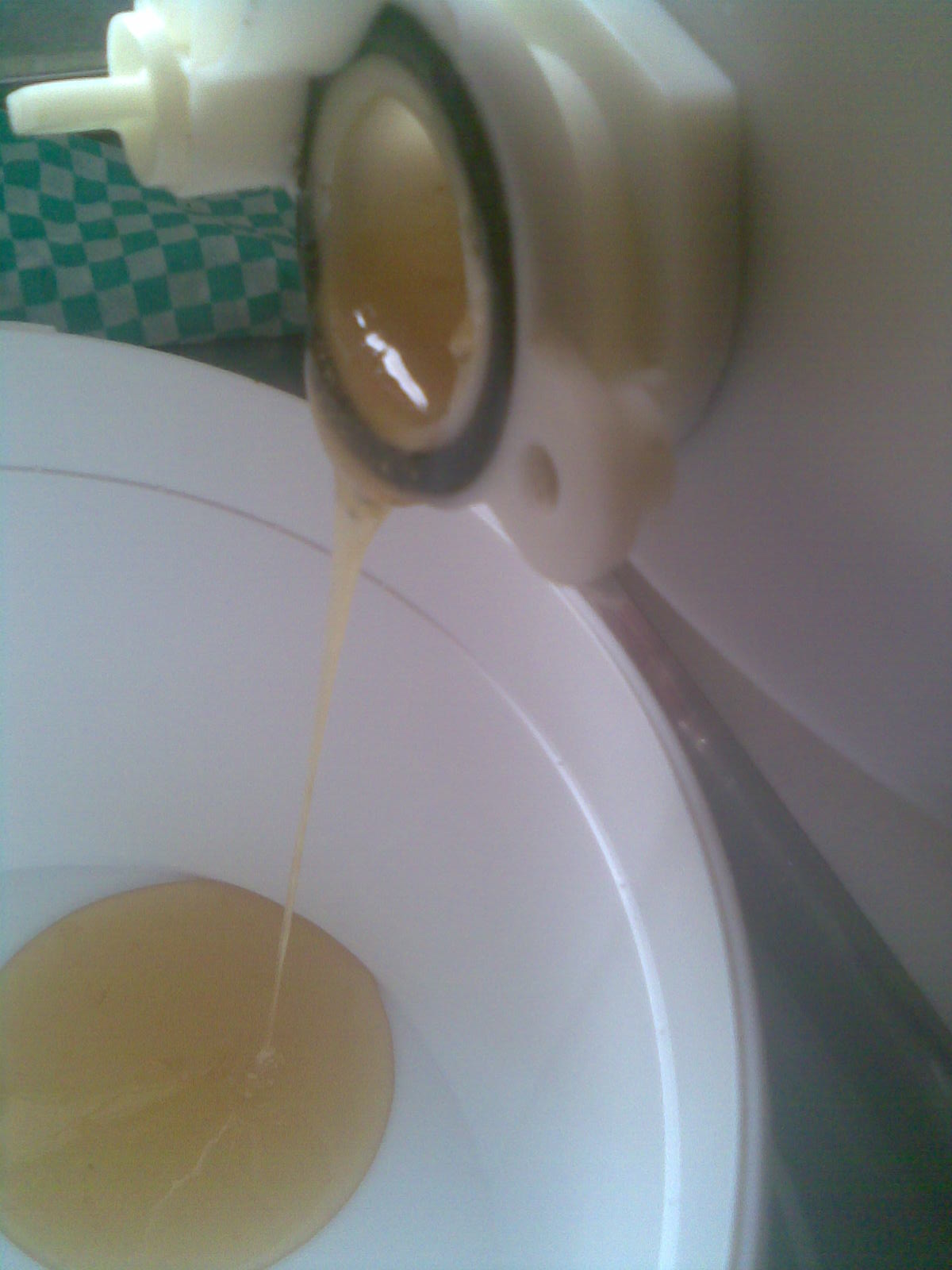
Open the tap of the extractor and let the honey pour out into a clean honey bucket
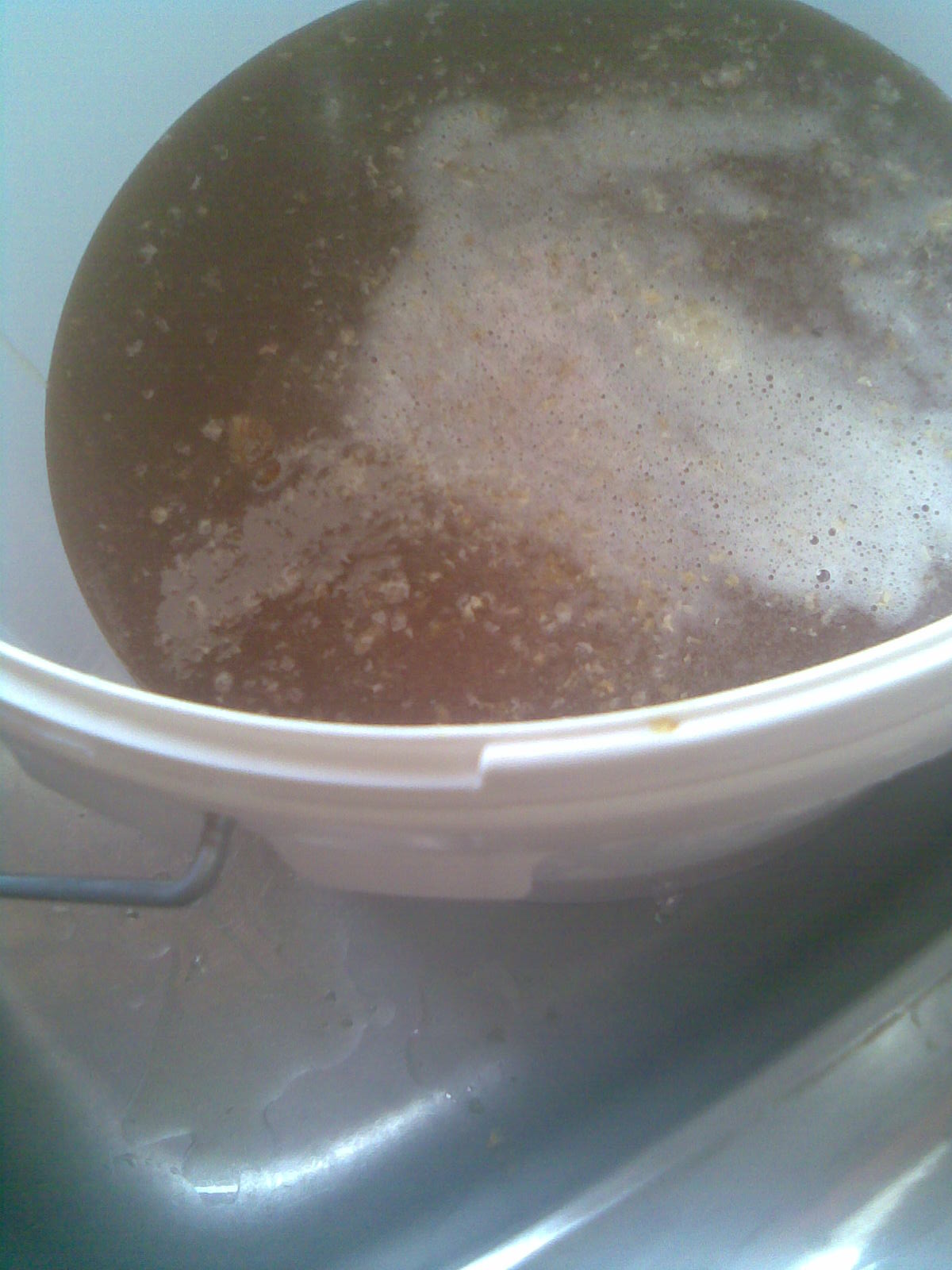
A bucket filled with freshly extracted honey ready to be filtered and strained off into glass jars

Step 4: Products of the hive

Remove the froth from the top of your extracted honey into separate containers. This can be used as a ‘marmalade’ on your toast or fermented for mead. As enjoyed by Vikings – ARG!

Filter honey from the buckets through a kitchen strainer into jars and label for family and friends.

Filter the honey in the bucket of wax to ensure you get as much honey harvested into jars as possible. Clean the wax in warm water and leave to dry. You can mould beeswax into pellets for beauty products or use to make candles.

Clean the extraction equipment, including centrifugal extractor, with washing soda and scrubbing brushes to get rid of stubborn sticky bits.

Simples.

Back to top

Addendum for treacle honey

My old boss, Bob Allan, kindly gave me his electric honey extractor this year. Bob used to keep bees but he gave up the craft, because his mother-in-law was allergic.  ‘One
winter the hive died out,’ said Bob. ‘It seemed only polite not to re-stock the bees.’ Most beekeepers at my apiary have balked at this. However Bob says, ‘I am rather fond of my mother-in-law’.

After last year’s hard graft of extracting two supers of honey manually, I was excited to try the mechanical extractor. Disaster! The first three frames almost spun apart on the highest setting. So we cleared up and started again, this time using a lower setting. Nothing. Our honey was like treacle! It didn’t even drip out of the comb when we de-capped it.

Plan B. So we decided to make cut-comb honey instead. An evening of delicate operations began and the result was rather spectacular.
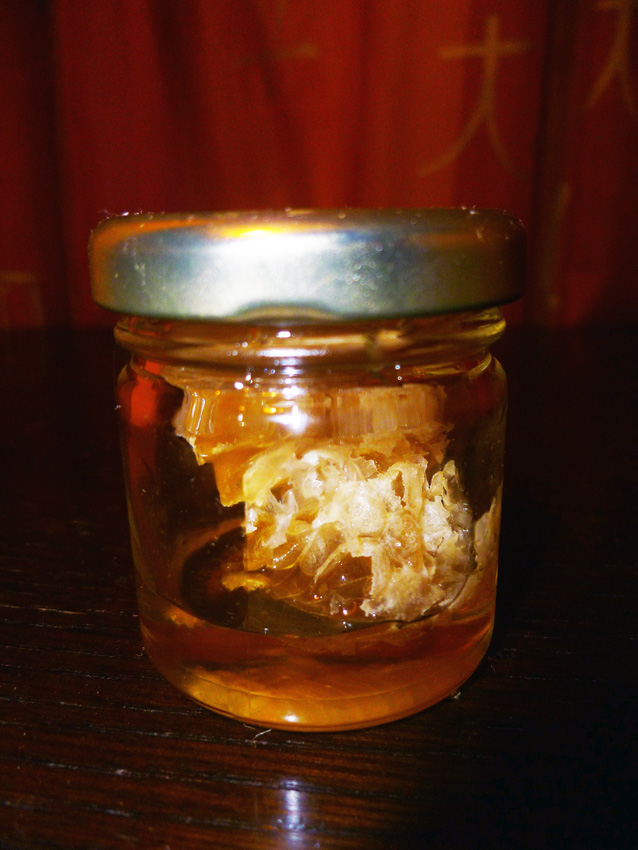
Taster pots of cut-comb honey for all our family and friends.

You can read all about it on Emily’s blog: Hunny time and Bringing home the hunny!

This post is dedicated to Bob Allen, who retired as medical director of publications at the Royal College of Physicians this year and to who we said a fond farewell, and to my dad who let us take over his house to extract our treacle honey.

Back to top

How do you get bee honey without bee babies?

'We're like Marmite, man. Love us or hate us' / image © Andrey Davidenko / 123RF

I was recently asked this question by friends: ‘How do you keep baby bees out of bee honey?’ At this time of year, when the honey crop is due, FAQs about beekeeping are popular. ‘I watched a nature program that showed bee larvae in honeycomb,’ said Damien, quite concerned. ‘Is it the same honeycomb that you use for honey?’

It is a good question: bees do make honeycomb both for raising brood and to store food. However, wily beekeepers manipulate bees to make sure only honey is harvested from the hive. Don’t worry, you are not spreading baby bees on your toast!

The hexagonal array of honeycomb is all the bees handiwork. / image © Andrey Davidenko / 123RF

People sometimes think that the honeycomb in hives is man-made. How could this geometrically-perfect hexagonal array be made by stripy little insects? But the bees do make it, because they are clever. They make the comb for bee babies and the comb for our honey.

Here are some secrets of the comb and how beekeepers get the honey bit.

#FAQ1: Why do bees make honeycomb?

Bees use honeycomb as a nursery, honey factory and food store. The queen lays eggs inside the cells, which hatch into white grub-like larvae. The larvae pupate and emerge as bees. Collectively, rows of larvae in honeycomb are called brood. Worker bees also use the cells in honeycomb to store nectar, which they convert to honey, and to store pollen, which they pack inside a cell by head-butting. Nectar, or honey, is a carbohydrate food source and pollen is a source of protein.

Honeybees head-butting pollen into cells. Pollen is a source of protein for bees. / image © Andrey Davidenko / 123RF

#FAQ2: How do bees make honeycomb?

Bees build honeycomb from wax secreted by their abdominal glands, which is passed along the legs to the mouth and moulded into hexagonal cells. The honeybee builds row upon row of geometric six-sided cells, each exactly the same size, in a precise interlocking hexagonal array.

#FAQ3: Why is honeycomb made of hexagons?

Marcus du Sautoy, on BBC’s The Code, explained why bees choose a hexagon rather than any other shape to build honeycomb. ‘The bees’ primary need is to store as much honey as they can, while using as little precious wax as possible,’ says Marcus. He describes honeycomb as an amazing piece of engineering, but asks why bees have evolved to produce this hexagonal pattern? ‘Actually they don’t have too many choices,’ explains Marcus.

The light shining through this honeycomb reveals the precise geometric sides of each hexagonal cell. / image © Olena Kornyeyeva / 123RF

To produce a regular-shaped interlocking network, bees can only choose three shapes: triangles, squares or hexagons. A hexagon requires the least amount of wax to build, which makes it the most economically efficient shape. ‘It is a solution that was only mathematically proven a few years ago. The hexagonal array is the most efficient storage solution the bees could have chosen,’ says Marcus. ‘Yet with a little help from evolution they worked it out for themselves millions of years ago.’

You can watch Marcus explore the mathematics of honeycomb in Behind the beehive on the BBC’s The Code.

#FAQ4: How do you keep baby bees out of the honey?

So how do beekeepers extract honeycomb that has only honey and not larvae or pollen? The answer is simple: by confining the queen to one area of the hive.

The queen is the egg-layer. She spends most of her life laying eggs inside the cells of honeycomb, which become female workers or male drones, or potentially a new queen. A beekeeper uses a ‘queen excluder’ to trap the queen inside the brood chamber of a hive.

A handy harmless queen excluder. The slots are big enough for workers to pass between but the queen is too large to get past.

This is a sheet of slotted plastic or a metal grid with holes large enough for worker bees to crawl through, but too small for the larger queen to pass. Unable to climb above the brood chamber, the queen cannot enter the main honey stores of the hive and lay eggs.

There are different types of hives, but most have a brood chamber (the nest containing the queen and larvae) and supers (boxes that store honey). The most common hive used in the UK is the National hive. Here’s one I built earlier.

This is the hive I built at New Year. You can see it is made of different-sized boxes. The deep bottom box is the brood chamber and the two shallow boxes above are the supers.

The queen excluder is placed over the brood box to keep the queen in the nest and prevent her from laying eggs in the honey stores. You don't want to eat honey with bits of baby bees, yuk!

With a queen excluder fitted between the brood chamber and supers, the queen can only lay eggs that hatch into larvae in the brood chamber. This leaves the supers baby-bee free and full of honey!

#FAQ5: Why do bees make bee-free honey?

So why do worker bees leave the cosy brood nest and the court of the queen to climb past the queen excluder into the supers and make us lovely bee-free honey? I want to believe it is out of the goodness of their tiny bee-sized hearts. Not true. It is all about instinct.

Honeybees have an instinctive drive to climb upwards and to fill whatever space they find with comb. If you place a super with empty frames on top of the brood, worker bees will instinctively climb up and start to build comb. The comb in the super is usually pollen-free too. Workers store this source of protein where it is most needed in the brood chamber.

Honeycomb showing capped and uncapped honey. Uncapped cells glisten with ripening nectar. Capped cells contain honey covered by white wax. Beekeepers harvest honey when all cells are capped. / image © Laurent Dambies / 123RF

So there you have it. That’s how beekeepers extract only honey-filled honeycomb and no mystery bits.

#FAQ6: How do you get the bees to leave the honey?

One final question remains. How do you get the worker bees out of supers so that you can nick their honey? In the height of summer, one hive is home to around 50–60,000 honeybees with many of these individuals busily working inside supers or guarding them. Beekeepers use a process called ‘clearing bees’ to make the bees leave the supers before the honey is taken off the hive.

I’ll cover clearing bees in my next post, which is all about the hunny! My hive partner, Emily, and I extracted the honey from our hive last weekend. You can read about our exploits in her Adventuresinbeeland’s blogHunny time and Bringing home the hunny.

This post is dedicated to Helen and Damien, who both enjoy ‘bee honey’.

All images on this post, with the exception of the hive, were taken from 123RF. Until I get a macro lens, you won’t see honeycomb as sharp with my pink camera!

Find out: How to extract honey

When the queen’s away the bees will play…

After waiting a week to find out what our bees did next, it rained. Then it poured. So it seemed the Mystery of the July Queens would have to wait.

Last week Emily and I made the unexpected discovery of five queen cells in Rose’s hive. The jury was out on whether our bees were planning to swarm or trying to replace Queen Rose who was MIA for a second week.

A break in the clouds came and we rushed to the apiary to find we were the only ones mad enough to visit the bees on such a blustery day. I was expecting to find very grumpy honeybees, because our little ladies don’t like the rain. Instead, we found them behaving quite strangely.

Someone forgot her umbrella – instead of flying in and out, our bees were clustered at the entrance of the hive out of the rain.

Emily thought they might be fanning their wings to create warm air vents, keeping the baby bees in the brood toasty and dry.

Fascinated, we lingered a little too long and forgot basic beekeeping 101 – don’t block the entrance of the hive. When we moved away there was a little dark cloud of bees hovering behind us, patiently waiting to enter the hive with their pollen loads. We made them wait in the rain, how awful!

We decided not to disturb Queen Rosemary’s hive in unsettled weather and moved on to Queen Rose’s hive. A ray of sunshine penetrated the dark canopy of the apiary, so we took a look inside hoping that our bees hadn’t swarmed.

Our ladies were there, along with a bright golden New Zealand intruder.

Can you spot the golden New Zealand honeybee among our darker British bees?

I suspect she is one of Albert’s bees who bribed her way into our hive with some good pollen.

Three of the five queen cells were no longer there. I can only imagine the dark turn of events during the week: a new queen, or two, hatched and tore down the cells of her rival sisters in an act of royal genocide. There was no sign of Rose and I suspect her crown has been passed. We’ll miss her – she was a good queen who gave us happy-tempered, hard-working bees. But such is life in the hive.

We found two remaining queen cells heavily covered in workers. I wondered if they were ‘taking down’ these cells, but Emily thought they might be trapping the unhatched queens as an insurance policy should the new queen not survive her mating flight. ‘Trapped queens “quack” in their cells,’ said Emily. ‘To tell the workers to let them out.’

It was then that we remembered beekeeping 101 again – don’t open a hive for a couple of weeks when you suspect a new queen has hatched. A hive inspection could upset a queen returning from her mating flight and, not settled in the hive, she may abscond. Drat! In our curiosity to see if our bees had swarmed or chosen supercedure, we forgot that. That’s why our bees have queens-in-waiting – as insurance against our blunders. Silly beekeepers!

As we finished our inspection we came across yet more strange behaviour. Look what our bees have done, the little weirdos!

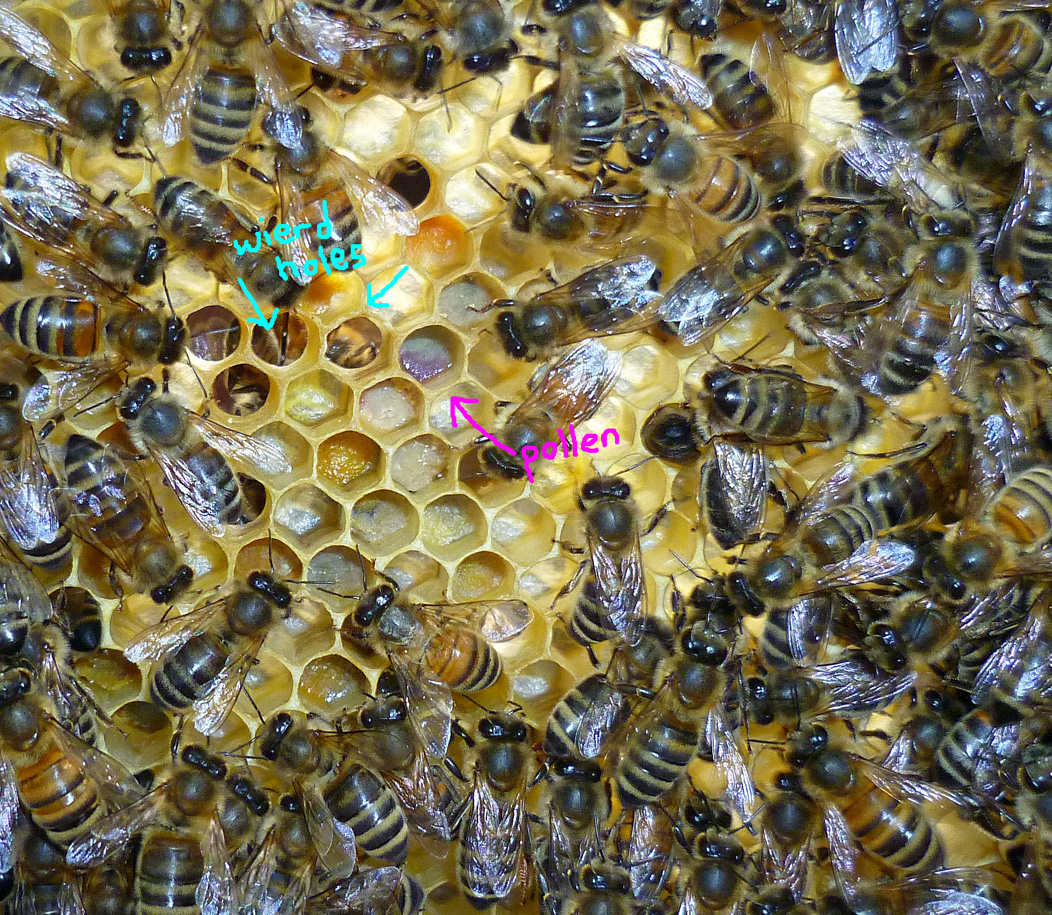
A rainbow of pollen on the honeycomb (pink arrow) but why are our bees eating holes through the wax (blue arrows)?

They had eaten tiny little holes through the wax. They are not supposed to do that! Perfectly round, I caught a couple of workers peering at each other through a peephole like these were the best thing ever. Perhaps this is what happens while the queen is away – anarchy. Does anyone know why our bees would do this?

More rainbows of brightly coloured pollen in the honeycomb suggests where our bees get their honey. Blue pollen may be from poppies.
It's a bit blurry, but peer closely and you'll see a worker carrying a basket of blue pollen. This might be from a poppy.

As we closed the hive, someone sped past and dropped a red dollop of propolis on the frames we had just cleaned. The culprit was a blur.

Hey! We just cleaned that. The culprit is caught on camera.

The forecast for the rest of the weekend was rain and more rain, so Emily topped up the feeder with syrup and the usual suspects clambered excitedly to drink manna from heaven.

During our inspection, we noticed that some of our bees had white stripes on their thorax, which wouldn’t rub off with our fingers. We found this same phenomenon on bees flying into other hives at the apiary.

White-striped honeybees that have collected pollen and nectar from Himalayan balsam – more clues about the origins of the honey from our apiary!

When bees forage on Himalayan balsam the white pollen rubs their back and leaves a white stripe that they can’t clean off. This also happens to wasps. So if you see a bee or wasp flying around with a white stripe, you know what flower they have just visited.

Not to be confused with white-bottomed bumble bees.

In space no one can hear you scream

'I'm afraid I have some bad news' – Bishop

This week we got a stark reminder of the dangers of missing a weekly hive inspection – the discovery of five queen cells.

Emily is always amused when I compare these peanut-like cells growing out of the honeycomb to the eggs from Alien. But I think if I stumbled upon one of these monstrosities in a dark tunnel, I’d want Sigourney Weaver on my side.

Last week all seemed well with both hives. Our ladies were impeccably well-behaved for some visitors to the apiary and remained calm as they were handled by a small crowd. While Queen Rosemary made a dignified cameo appearance, Queen Rose was elusive but the presence of eggs in cells revealed that she was there. Our hives had queens, eggs, good-tempered bees, stores and space. We were approaching the end of swarming season and it looked like plain sailing ahead.

Emily takes some snaps of our ladies performing for the tourists

So this week when we were going to the scout hut for our monthly meeting, I was tempted to skip the weekly inspection. Was it fate that compelled me to text Emily and suggest that we meet at the apiary beforehand for a quick check of our hives? Little did we realise what we would discover.

‘Busy little creatures, huh?’ – Burke

Our inspection of Queen Rosemary’s hive proved arduous thanks to a pesky queen excluder stuck down with propolis. It took both our hive tools to safely prise off the super. All was well inside – nothing suspicious.

We scraped off wax to make the queen excluder less sticky but these plastic excluders are a nuisance. I recommend getting a wood-framed wire excluder to make inspections easier.

We expected our inspection of Rose’s hive to be much easier. This is our ‘baby’ hive, recently transferred from a nuc, and still growing. There is plenty of space in the brood box. So imagine our surprise when we came across one of these…

'I think it's safe to assume it isn't a zombie' – Ash

The sight of a queen cell fills most beginner beekeepers with fear, because we don’t really know what to do about them. There are three types of queen cells: swarm cells (the colony is creating a new queen so that half the bees can swarm with the old queen); supercedure cells (the bees are trying to replace the old queen because they sense that something is wrong with her); emergency cells (the bees need a new queen because the old queen has gone missing or died).

You can never be 100% sure why your bees are creating a new queen, but you can be 100% sure that you don’t want to lose half your colony, and much of the honey stores, by allowing them to swarm. For this reason, beekeepers sometimes panic when they find a queen cell and destroy it to buy some time. Emily and I decided to mark the frame where we found the first cell, and to continue to inspect the hive to find out why our bees were trying to make a new queen. Perhaps something had happened to Rose and they were queenless? We found four more queen cells – unhelpfully, these were at the top and bottom of frames. Swarm cells are usually found at the bottom of frames and supercedure cells at the top. Proof again that our bees don’t read books.

Our nuc was still sitting next to the hive – should we split this small colony again to prevent a swarm or was Queen Rose dead and our bees were trying to replace her?

‘I can’t lie to you about your chances, but… you have my sympathies’ – Ash

We considered the evidence – no sign of Rose and no eggs, but Emily saw small larvae so she must have been there as recently as our last inspection. Five queen cells at top and bottom of frames – no real conclusion about whether these are swarm or supercedure cells. Two things swayed our decision: Rose’s normally mild-mannered family were behaving in an irritated manner and a cloud of guard bees had greeted our arrival, a sign that the colony might not be queen-right; and the colony is still quite small with plenty of space, there is no need to swarm.

We decided to leave our bees to their mysterious plans and find out what happens next week. Swarm or supercedure?! One thing we do know – any day now a new queen will hatch from her cell. She will find her unhatched sisters and tear down their cells to destroy her rivals, and if Rose is still in the hive…

'My mommy always said there were no monsters – no real ones – but there are' – Newt

Queen larvae ‘pipe’ when they are inside their cells to let the other unhatched queens know that they are not alone – they each have a deadly rival for the throne. Now don’t tell me that doesn’t sound like something out of Aliens!

I still wonder, wistfully, what would have happened if we’d skipped our weekly inspection. Ripley was off-duty for 57 years and look what happened then…

Imagine.

Making rainbows and honey

Both our hives are thriving after a slow start this year. A cold dry winter and a hot dry spring meant that forage was poor for London honeybees. Much-needed rain in May and June, interspersed with occasional sunshine, has been good for nectar flow. Our little ladies have built-up honey stores and made rainbows of brightly coloured pollen across the comb.

Home-made fairy cakes and ginger nut biscuits were on offer with tea at the apiary this Saturday afternoon. After a bit of chat and bartering over bee jewellery and blackberry jam, Emily and I got on with the business of beekeeping. I got the smoker going fiercely, as advised by our local bee inspector, with flames roaring out before settling into a dark-grey smoke cloud. My smoker always hurts my eyes and makes me cough – I can only imagine how it affects our bees. We use egg cartons and strips of cardboard because it burns for a long time, and is free, but I have heard that grass pellets and shaved wood are better. Any suggestions for bee-friendly smoker fuel?

Saturday was overcast with a storm hanging in the air, which can make honeybees grumpy and stingy. We definitely needed our smoker. Our first hive is ruled by Queen Rosemary – a feisty and forthright monarch. A cloud of about 50 guard bees circled the hive, a little more agitated than usual. We took off the roof and crown board and found out why – a super almost filled with honey. Emily thinks that they are now ‘on alert’ because they have food stores to protect. I am always amazed by the industriousness of these little creatures. The super only went on the hive about a month ago and it is nearly full of honey.
A full, or almost full, super is very heavy. Emily and I had to lift together to heft it off the hive. There was almost calamity as the queen excluder beneath and a few brood frames started to lift up, but helpful beekeepers were ready to prise away the super. This is why it is good to be joined to an apiary! The hive was rather sticky, so we had to work hard with hive tools to carefully remove the queen excluder and start checking the brood box.
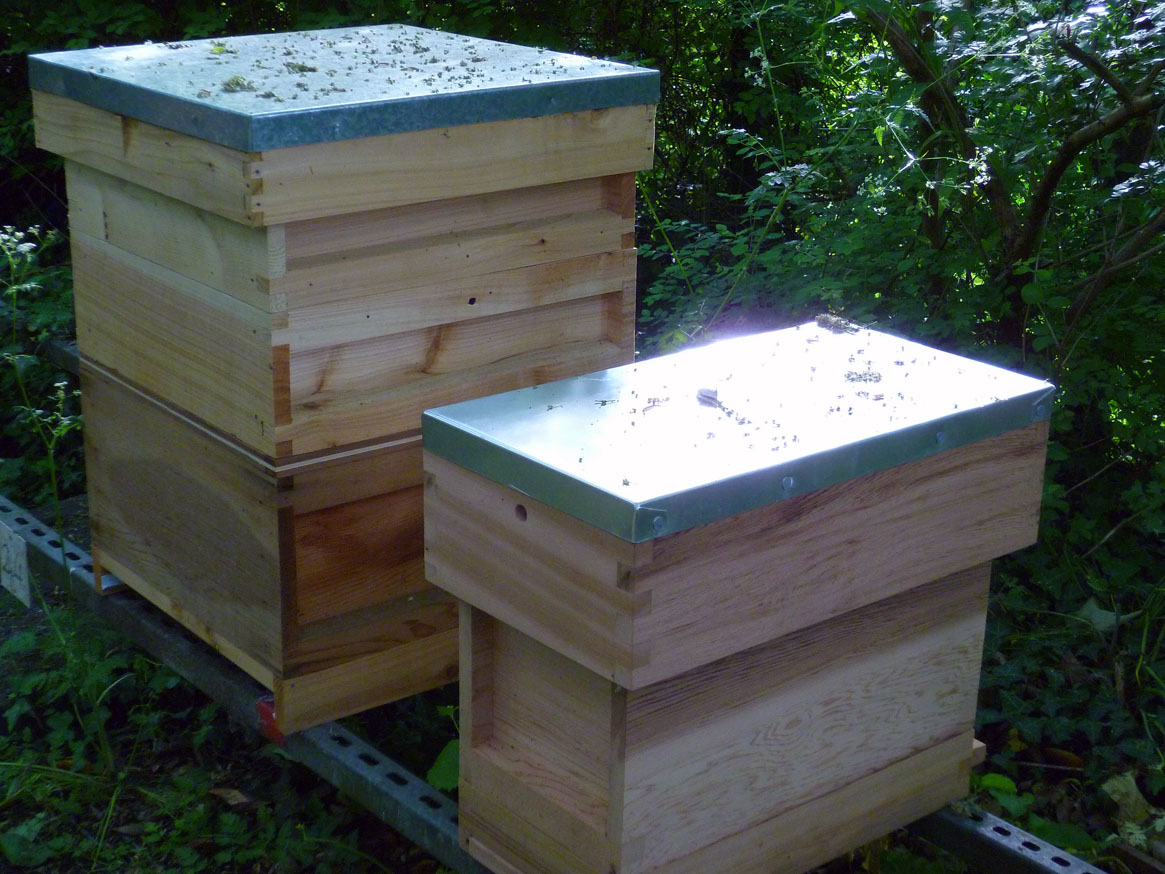
At the height of summer you need to check the hive once a week to make sure that there is enough space in the brood box for stores, rearing brood and for the queen to lay eggs. When the brood nest starts to run out of space the colony will attempt to swarm and you could lose half your bees and honey stores. There were at least two frames spare in our brood nest, but at this rate of expansion we may need to think about putting on a double-brood box by the end of the month.

Emily spotted Queen Rosemary running across a frame in the middle of the hive. I inspected cautiously and put the frame back carefully, because Rosemary is a flighty queen and I don’t wish to upset her! Emily checked the remainder of the brood – we have a good system going. There were newly laid eggs, healthy white brood curled up in cells waiting to be capped, and plenty of capped worker brood soon to be hatched. We have a lot of bees in this hive now.

While the hive was open, I retrieved the queen cage that had fallen to the mesh floor a few weeks ago. It was covered with worker bees, which I shook off, who had eaten away the thread criss-cross cage and destroyed it utterly. We suspect the orders came from the top.

Closing a hive with so many bees is a challenge not to squash and kill them. Some beekeepers say this is unavoidable, but I like to avoid it. As well as being ‘not nice’, squashing bees empties the contents of their stomachs into the hive and helps to spread disease. The other worker bees will eat up the dead remains of their sisters and any bacteria that have been living in their stomachs, thus spreading disease around the colony.

Emily had brought wooden levers to try and these worked a treat. Placing the levers on either side of the brood box, we eased the super back on top and gently lowered it. It was good not to hear the high-pitched buzz of bees getting trapped between boxes and to avoid the ‘crunch’ sound as the super rested onto the brood. We used smoke and levers to place the queen excluder and crown board back on too, and our ladies cooperated.

Our second hive is ruled by Queen Rose, who is queen-mother to Queen Rosemary. She is a hard-working and motherly queen. Her colony is always calm and well-ordered. Rose’s family was transferred from a nuc to a hive a couple of weeks ago and they are growing rapidly. I topped up their feed with some warm, very warm, sugar syrup, which made the workers very excited. Emily thinks that we may not need to feed this hive for much longer. We didn’t spot Queen Rose during our inspection, but we saw eggs and brood, so we know she is there. The colony is also behaving ‘queen-right’, which means that the bees are calm and obviously receiving orders from someone.

Emily spotted a rainbow of brightly coloured pollen on a few of the frames – gold, orange, blue-grey – beautiful. We also noticed the criss-cross pattern of worker brood across the frames revealing that Rose is a particular egg-layer. The cells in honeycomb above the v-shaped wire of the frame are sometimes deemed ‘imperfect’ by queens and they won’t lay inside them.

With smoke and levers we closed the hive. Another successful summer’s afternoon beekeeping.

It just got interesting

'Here come the people, Marty! Oh, I love the people!'

Our bees have been very secretive of late. About a month ago we found queen cells in the hive. We split our colony and put old Queen Rose and her court into a nuc and waited to see what would happen.

A new queen hatched in the hive, went AWOL and returned home again. Meantime, in the nuc, Queen Rose also went MIA for two weeks and eggs were absent from frames. What could be happening?

Our bees seemed to know because they were behaving calmly and happily going about their business as if everything was ‘queen-right’.

This week, all was revealed.

Who are they?

Before I arrived at the apiary I got a text from Emily, ‘There are about a million new people here!’, and she was right. There were a lot of new faces from Ealing Transition Community Garden who have started a community bee project in Ealing and were visiting our apiary to learn about beekeeping.

Unsure how effectively our bee suits would camouflage us from curious faces, Emily and I had a cup of tea and discussed tactics before stealthily visiting our bees. You always get a bit of a crowd when you open a hive at the apiary – but this was a big crowd!

They bounce

While sipping tea, I was introduced to another new arrival:

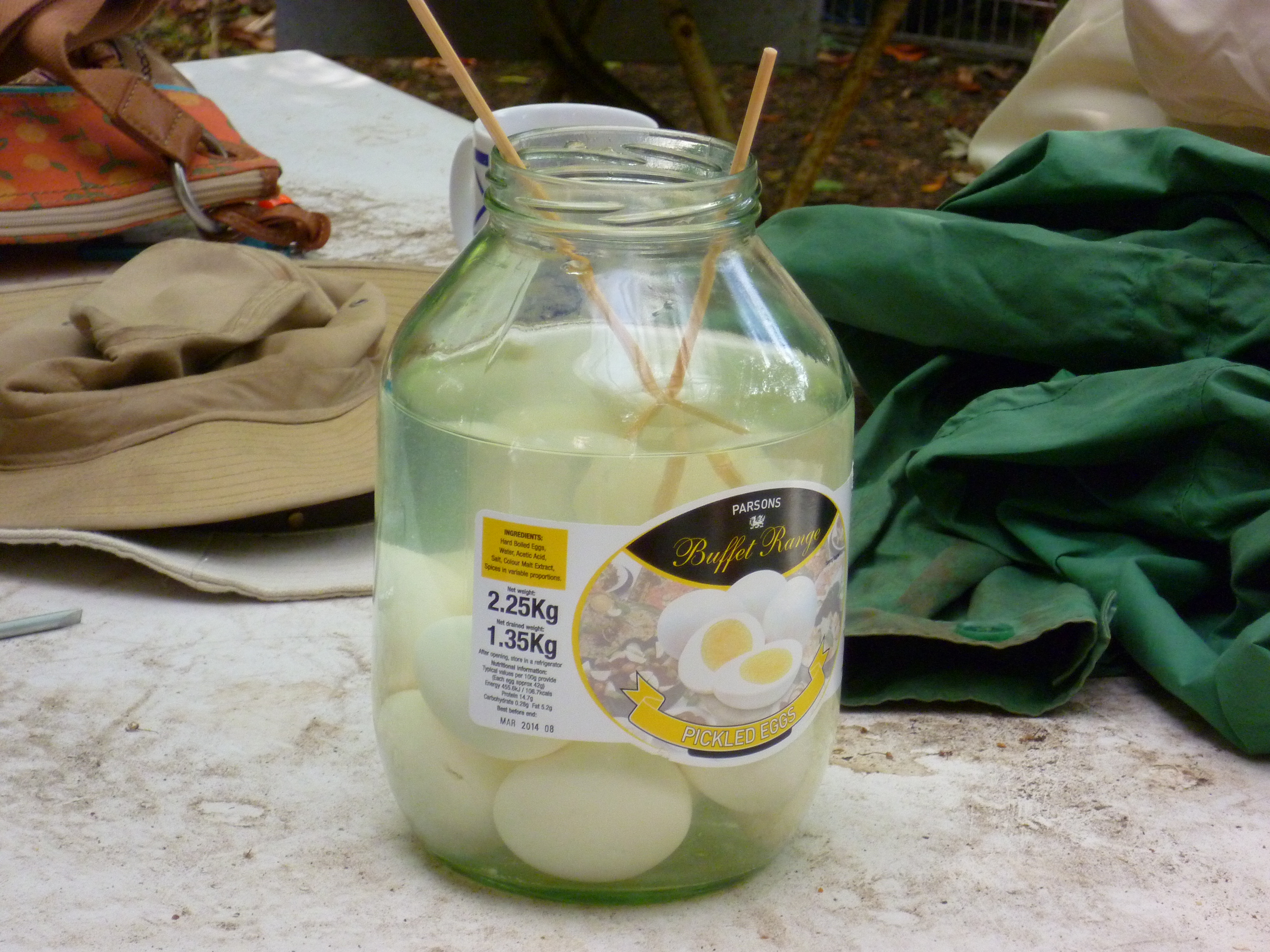
Pickled eggs – an olde English delicacy courtesy of Cliff

Albert reliably informed me that ‘they bounce’ and demonstrated. As everyone around the table had accepted the jungle challenge, I bravely tried a pickled egg. It was … rubbery. Cliff was kind enough to share my egg and polished off the other half.

If you are lucky, you sometimes get a black ring around the yoke...

That done, we got on with the business of beekeeping.

Mission Slightly Difficult

Emily suggested visiting our nuc first which meant taking a wide detour around the visiting group and ‘they might not notice us’. I was careful not to make eye contact and to be very stealthy.

A happy surprise awaited us inside the nuc – Queen Rose! She was running around the fourth frame looking healthy and well, but her blue mark was almost rubbed off which might have made her tricky to spot during previous inspections.

There were still no eggs and suspecting that the queen had no room to lay, because the frames were all filled with stores, we decided the nuc colony was ready to transfer to a hive.

Here’s one we made earlier

My old hive was ready and waiting, so Emily carefully put Queen Rose and the nuc frames in the centre of the brood box. I swopped the empty brood frames in the hive with frames from our other hive, because these already had wax foundation drawn out and would make the transition a little easier for the colony.

Our bees were rather reluctant to leave their old home and no amount of shaking or brushing the nuc would make the most stubborn ladies budge. We were lucky to have Joseph observing our efforts, who suggested propping up the nuc to the entrance of the hive and letting the bees walk in. So we left them to do just that and went to inspect our other hive.

'We don't belong here. It's just not natural. This is all some kind of wacked out conspiracy'

A little detour

Along the way, we visited Matwinder’s hive. Sadly, this hive is a bit notorious for having the nastiest bees at the apiary. But the colony was recently re-queened and the bees re-formed. Pat was amazed at how calm and well-behaved they were.

From left: Elsa, Albert, Pat and Emily prepare to be dive-bombed by Matwinder's bees

Happily reformed bees – a new queen has changed the character of the hive

Long live Queen Rosemary

We eventually got to our other hive and carefully opened it up – it is home to a feisty and unpredictable queen! The colony was doing well and had drawn out lots of frames in the super. Honey production has been slow at all the hives at the apiary partly because of the dry spring and summer we have had. There has not been much forage for Ealing’s bees. But I think we may yet get a jar of honey this year!

The queen was there and she was laying. So confident that all was well, Emily closed the hive. I am naming all our queens after essential oils and christened our feisty queen Rosemary, which suits as her mother is called Rose.

Meandering back to the new hive we found that the bees had walked from the nuc and into their new home – just as Joseph had said they would! So we now have two hives and two queens. Anything could happen next.

'This place is crackalacking. Oh, I could hang here. I could hang here'

Taste of Spain in the rain

And if that were not enough productivity for one weekend, I went to ‘Taste of Spain‘ with some girlfriends on Sunday afternoon for a bit of culture, music and paella. A typical British summer’s day, it rained, but this did not deter determined tourists from:

... making a sand castle with a moat in Regent Street

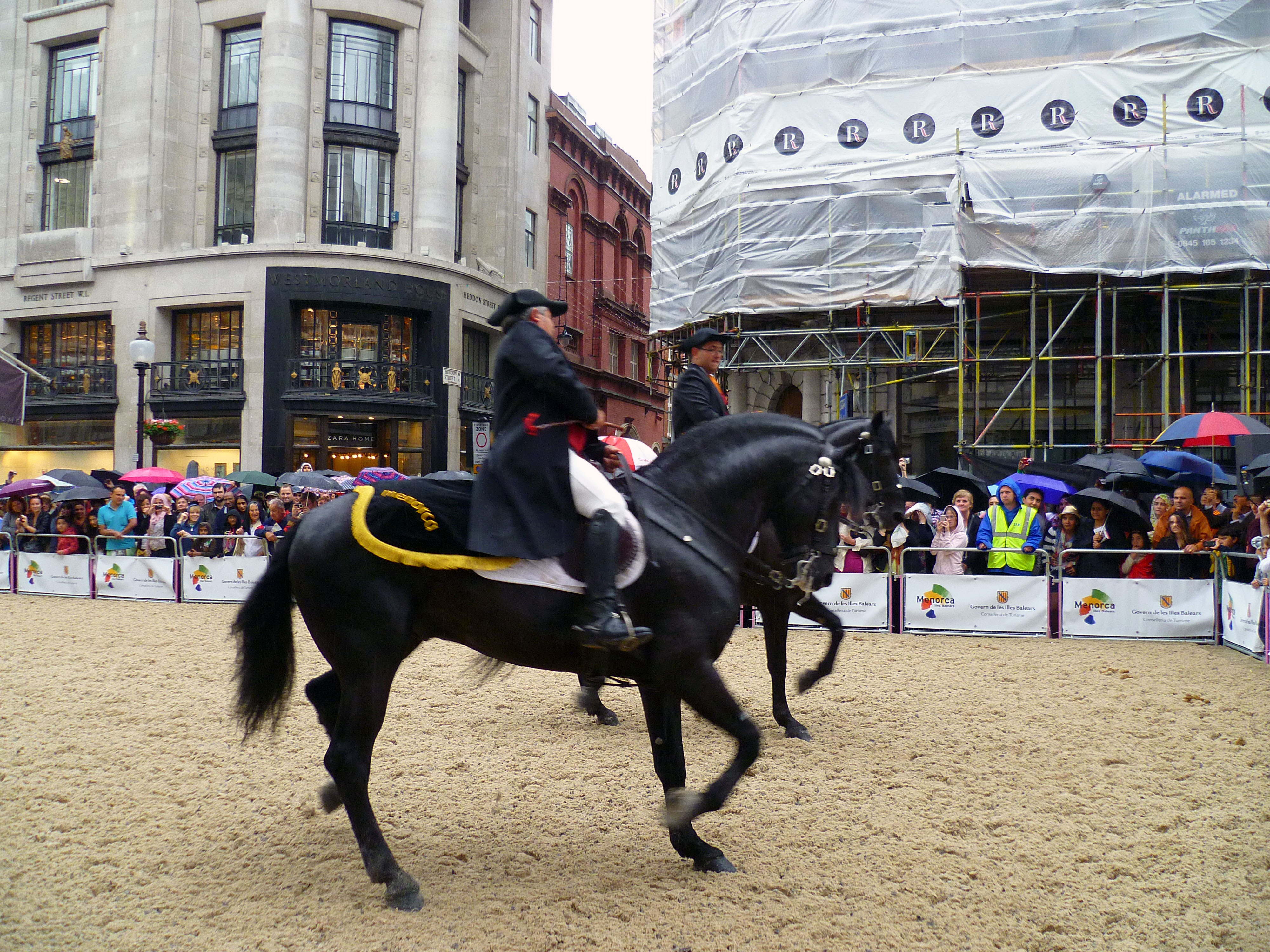
... watching Spanish horses dancing in the rain

... and tucking into paella and posh chips!

Salud!

All that glitters

Bee-dazzled – my first foray into jewellery-making

Good news this week. Andy spotted our ladies carrying pollen into the hive during a visit to the apiary. What does that mean? Well, it is thought to be a sign that a colony is ‘queen-right’ – our queen may have found her way home after flying off in a right royal huff on Saturday. Bees bringing pollen is usually a sign that all is right with their world and that they are busily stocking up their food stores and getting on with business. Fingers crossed!

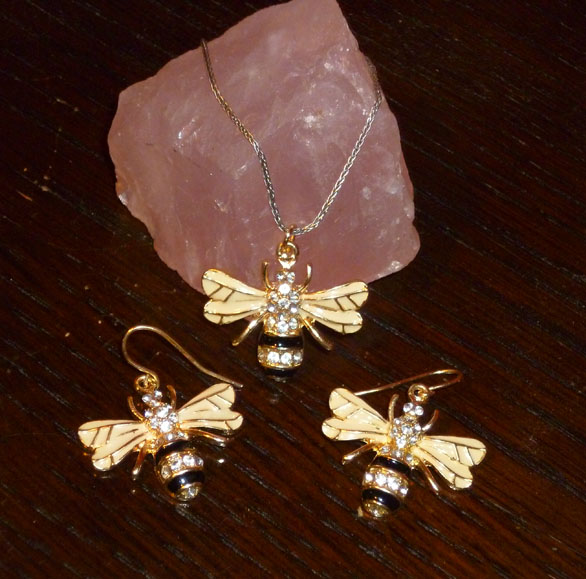
Meantime, I have been busy with a new venture – jewellery-making. First earring and necklace set – christened ‘Bee-dazzled’!

The Great Escape

Our queen saga took an unexpected turn today. After three weeks of waiting to see who would emerge from the queen cells, we discovered the new reigning queen of our hive – and promptly lost her again!

She would have looked something like this…

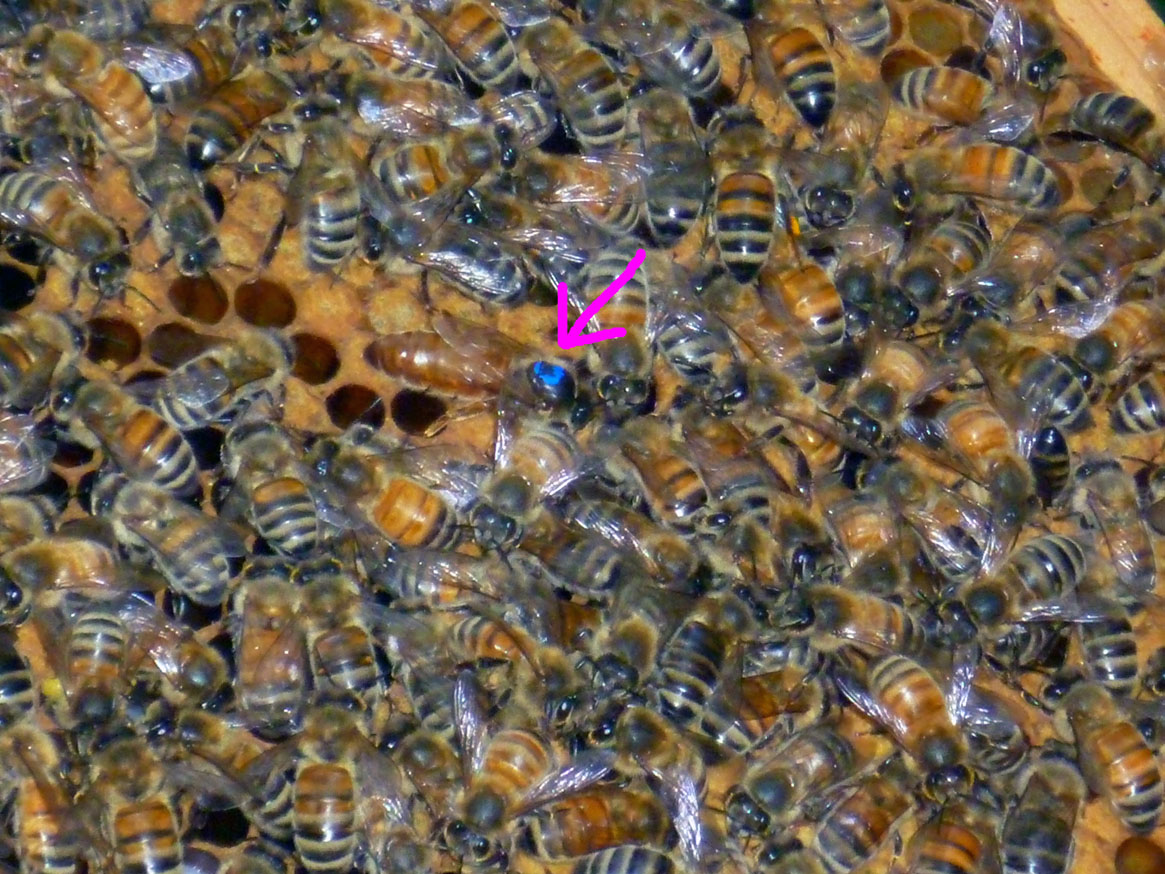
A photo taken of a queen from another hive at the apiary. You see the slightly larger bee on the frame with the longer abdomen and marked with a blue spot? Here, I have identified her with a pink arrow.

Unfortunately, there are no helpful pink arrows in real life indicating the whereabouts of the queen in your hive. Spotting the queen takes practice. A good tip is to observe the movement and behaviour of the workers. They often turn to attend her or move out of the way to let her pass. Thus, the actions of the workers betray the presence of the queen.

However, a queen moves fast and once she realises that she has been spotted then she will run away and hide. Queens are very good at hiding and are difficult to find again. So when you see her, cage her!

The elusive queen

Our feisty new queen was determined not to be captured, but Emily managed to cage her while I went to ask Andy, an experienced beekeeper at our apiary, to help mark her. Andy gave us some good tips for practising marking a queen:

  • Practise on drones – they are larger than workers and easier to grab, and they can’t sting. Andy helped us to mark a few confused drones before we had a go at marking the queen.
  • If you do pick up the queen rather than cage her, don’t hold her by the abdomen because this will damage her precious eggs and don’t hold her by one leg because she will panic and spin, and probably lose it. Hold her by the sides between your fingers, she is more robust than she looks.

Now ready to crown our new queen, Andy held the frame while I marked her with a blue dot through the cage – wrong colour for this year, by the way, but I forgot to pick up the white marker pen as I rushed out my door! – and simples, one marked queen. Or so we thought.

The runaway queen

The queen had other ideas. Offended by her undignified treatment – she flew away. Andy managed to catch her mid flight and put her back in the hive, but the queen was clearly determined to abscond and off she went again. Oh dear.

Fortunately, we have a nuc with a spare frame of young brood. We put this inside our hive in the hope that the workers will raise a new queen should our flighty one not return! Andy told us that it is best to choose a frame with very small and young larvae to give the workers the best chance of raising a good and viable queen.

Here is the lovely nuc that Thomas made for Emily and me to house old Queen Rose and her court, you can see how much smaller it is compared to a regular hive.

Queen Rose’s court

Our nuc appears to be doing very well and is starting to burst at the seams. I really like nucs – a shame that you can’t keep bees in these mini-me sized hives! Here is a photo of a bee sunbathing on the porch.

Depending on the outcome of our latest queen saga, we may recombine the nuc with the original colony and reunite Queen Rose with her older daughters, or if the runaway queen returns then we will need a new hive for the nuc colony. I am going to make new brood frames for our spare hive this week just in case. The best lesson I learned in my first year of beekeeping is never underestimate how much spare hive equipment you will need – and often at a moment’s notice! If you have a spare evening or weekend, swop ironing in front of the TV for making frames!

Matters tea-related

Today’s baked good was a delicious cherry cake from Emily. While being allergic to cherries, I decided to take my chances and pick the cherries out for our apiary’s resident robins. It was good!

Beard of bees

I arrived at the apiary one sunny Saturday afternoon to see a forlorn-looking Emily sitting on the bench under the awning. ‘I have some bad news,’ she said. I feared the worst – our hive had become the latest colony to be struck down by some nasty disease. ‘I didn’t make the frames for our new brood box, because I didn’t have the right nails.’ Phew. Mightily relieved that Queen Rose and her ladies-in-waiting were fine, I waved my hand and said breezily, ‘Oh, don’t worry, the two of us can make up the frames now in half the time.’ Oh, how naive.

What they don’t tell you when you become a beekeeper is that you need to become a carpenter as well. With the best will in the world, I will never be good at putting pieces of wood together and hammering. The hive hardware is the hardest part of beekeeping, only closely followed by knowing what to do when you find a queen cell – as I am sure my hive partner would agree.

Fortunately, there are many learned beekeepers at our apiary who are always willing to help. I have a theory that the more beardy the beekeeper is, the more wise and learned he becomes. John lent Emily his pen knife to cut the sheets of wax foundation to fit the frames. You usually need to trim about 1/2 centimetre off one side of the foundation to make it fit.

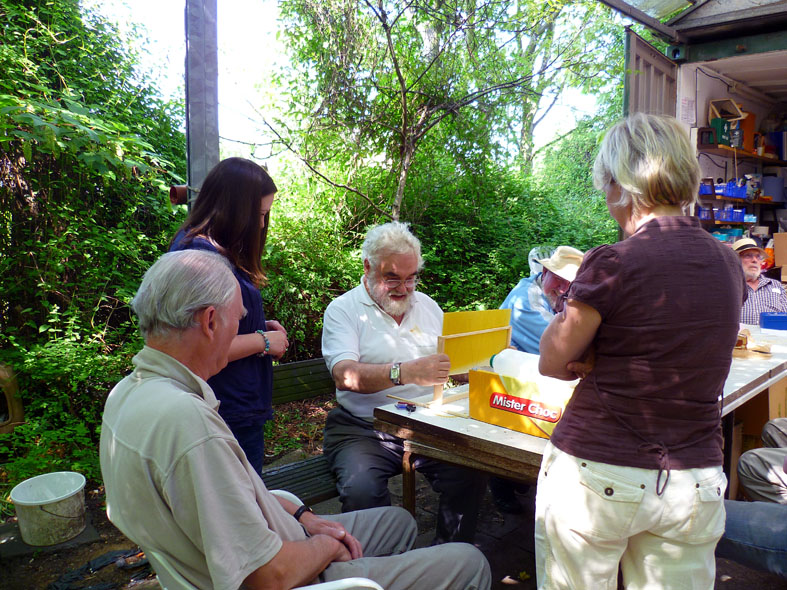
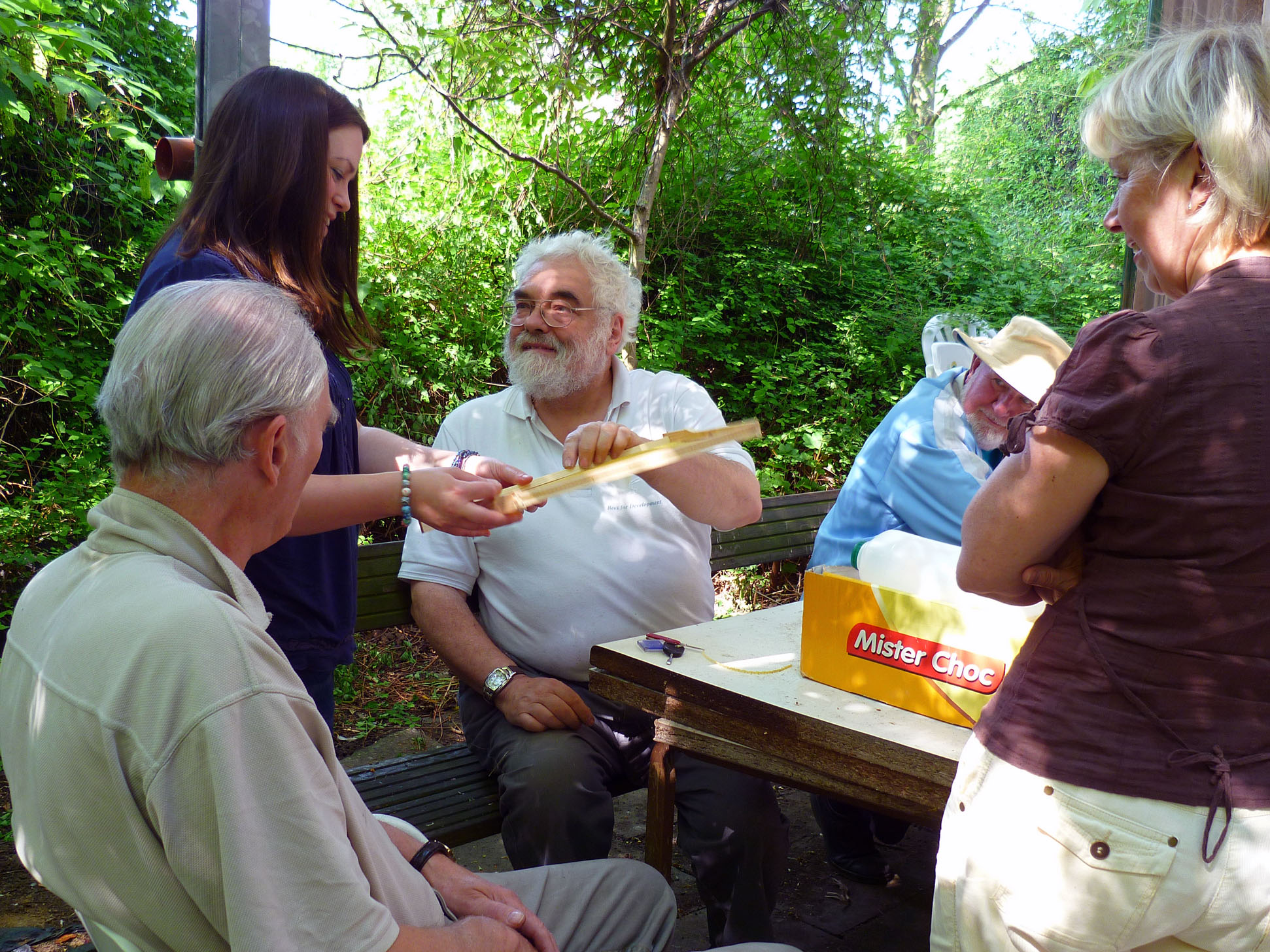
However, it was a very hot day and the wax was not cooperating. Emily and I soon drew a small crowd of beekeepers to watch our ‘How not to make frames’ workshop. I had particular difficulty with one nail that refused to go in straight and accidentally snapped it in half. Cliff thought it would be hilarious to pretend the nail had flown in his eye and blinded him. Quickly realising us girls did not find this as amusing, he retreated.

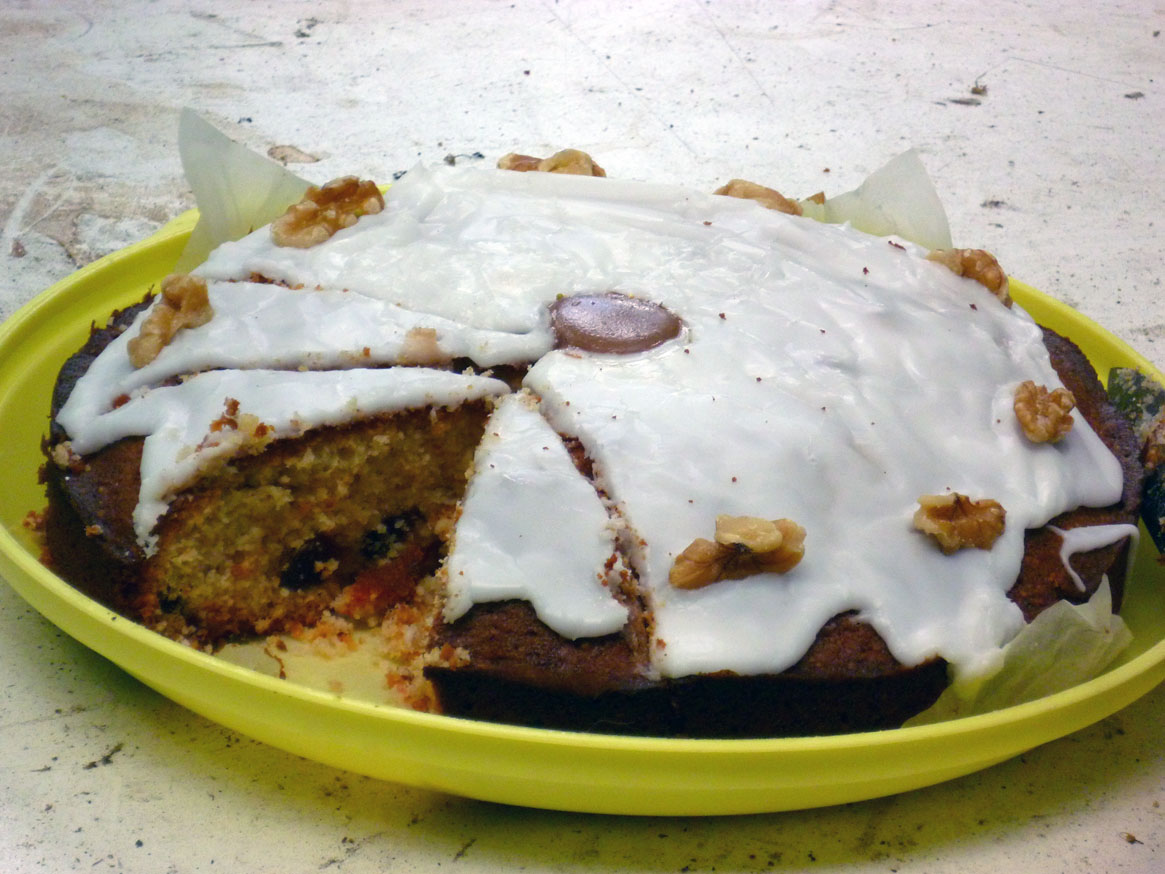
Exhausted by our efforts, Emily and I decided to take a break for tea and finish our last few frames after refreshments. Beekeeping is a front. We are really the Ealing & District Tea Drinkers Association. Elsa brought a cake baked by her friend – that cream filling really was as scrumptious as it looks. Five minutes later there were only crumbs and much licking of fingers.

A design student, Zachary, was visiting the apiary and showed us the photos he had taken a few weeks ago – capturing some rare beekeeping activities. We all agreed they were very good. However, John had other ideas. ‘You look like you are dressed for war,’ he said. ‘What you want is photos of these young girls [he pointed at Emily and me] holding a frame of bees without all that get-up.’

That decided, John marched to our hive without suit or smoker, and Zak, Emily and me followed meekly behind.

This is what happened next.

Our normally mild-mannered bees stormed out of the hive and flew at John’s beard. I think they objected to the beardiness – they are used to seeing our neatly veiled faces.

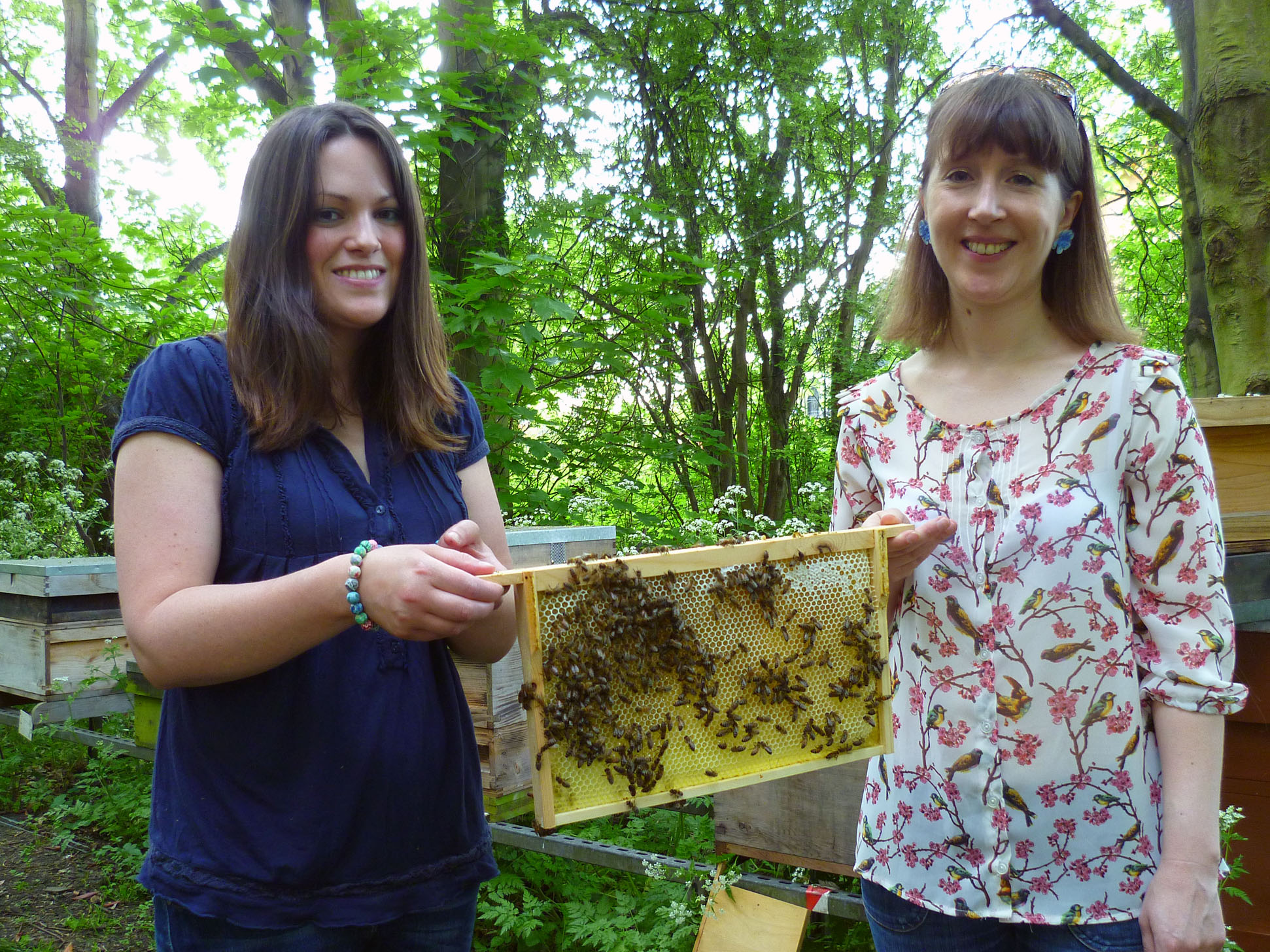
But John is not one to give up easily – he is, of course, the queen’s beekeeper. Ignoring our outraged ladies, he handed a frame of brood and gentle nurse bees to Emily and me. This is the photo Zak took – at a distance – with my new pink Lumix camera. That’s Emily on the left in the blue top and me on the right.

Our bees really are very gentle and we didn’t get stung. A little later on, we finished making our frames. I couldn’t resist a little beekeeper-baiting by remarking to Pat and John how much easier it is to buy ready-made frames from Thornes.

Double-brood box on and we were finished for the day. Another productive afternoon’s beekeeping.

Eight simple rules to build a beehive

It’s not every girl that asks for a new beehive for Christmas, but I am odder than most. ‘One national please’, I requested, ‘Complete with ventilated mesh floor, brood body with frames and dummy board, harmless plastic queen excluder, two supers, crown board and roof’. It was all going so well, ‘Yes, you can order it all from Thornes – flat packed’.

Rule#1: If you own a pink hammer never order flat packed

My new hive arrived after Christmas in an impossibly large box, which caused a proportionate amount of grumbling from my dad who insisted on carrying it himself up three flights of stairs. Why do men insist on carrying things without assistance and then grumble about it? The box sat in my living room for three weeks waiting for the next, most important, arrival – an Uncle David to help put my hive together.

Rule#2: Never underestimate the ability of men to talk DIY

Five minutes later, David had recovered from discovering that I had not opened the box to admire its flat-packed contents. Ten minutes later he had started to assemble the hive parts as easily as Lego. (Imagine that, Legoland hives for bees.) There was a Slightly Tricky Moment when we tried to work out ‘bee space’, but this was cleared up by the innate ability of men to communicate to each other in DIY. One phone call to the ever-helpful and kind Don, a beekeeper at my association, and: ‘I know bee space’ said David. Bee space is 8mm – the magic space that allows two bees to pass each other when building comb.

Rule#3: Let gravity do the work for you

While I may not have understood why we were doing everything that we were doing, I ably assisted with enthusiastic hammering. I also learned that if you hold the hammer at the end of the handle, gravity does most of the work for you. Who knew? Also, there are different types of hammers. David gave me a lighter one for making frames.

Rule#4: Have a cup of tea and admire the best beehive in all the land

A few hours later, David had left and a complete National hive stood grandly in my living room. I promptly made a cup of tea and sat down to admire it. I was sorely tempted to get out my paint box and stencil the brood and supers with flowers and honeybees, but resisted the urge. I am not sure how safe it is to paint a hive – opinion about this varies – and I didn’t want to suffocate Queen Jasmine and her bees with toxic paint fumes.

Rule#5: Post your step-by-step ‘How to build a hive’ on Facebook and amaze all your friends

Step 1: Build a floor with varroa board, entrance block and wire mesh for ventilation.

Step 2: Make the brood box. The queen lives here and lays eggs, while workers raise the larvae.

Step 3: Knock up 11 deep foundation frames for the brood box and 20 shallow foundation frames for the supers. The workers draw out the wax foundation into honeycomb for the queen to lay eggs in the brood box and to store honey in the supers.

Step 4: A handy harmless queen excluder. The slots are big enough for workers to pass between but the queen is too large to get past it.

Step 5: Place the queen excluder over the brood box to keep the queen in the nest and prevent her from laying eggs and rearing larvae in the honey stores. You don't want to eat honey with bits of baby bees, yuk!

Step 6: Make a couple of supers and fill with 10 frames each. One super of honey for the honeybees, and one super for me!

Step 7: Put the crown board on top of the supers to prevent naughty honeybees from climbing into the roof and making messy brace comb. The crown board can also be used as a clearing board in summer for honey extraction by placing it between the supers and the brood box. The slots are covered with rhombus escapes which allow workers to go down into the brood box, but don't allow them to get back up. This empties the supers of bees so that they can be taken away for honey extraction.

Step 8: Put on the weather-proofing roof and you have one National bee hive ready to put in your bees. And don't forget a handy Uncle David to help you put it all together!

Rule#6: Don’t tell your dad that you built a hive without him

One week later, my new hive and I waited for my dad to kindly drop us off at the apiary for a shook swarm. ‘How did you build that?’ he asked, amazed, and was then miffed that I had asked for help from another DIY expert. However, he was soon appeased when he saw that some of the wood in the brood and supers had moved apart. I was dismayed – how had this happened? Apparently, wood needs to breathe. ‘You should have kept the wood outside for a while to let it breathe before putting it together,’ said my dad smugly, before producing a scary-looking power drill and reinforcing the brood and supers with huge nails. No wasps are going to get into that hive and rob my bees now!

Rule#7: Keep your bees alive!

Retreating at the first sign of a bee, my dad left me at the apiary to set up the hive. I was so excited. A little bee landed on a frame as I was putting it into the brood. Not knowing if she was one of Queen Jasmine’s ladies-in-waiting or an interloper, I gently shooed her away. She flew to a nearby leaf and then sat there and closely watched me put the hive together.

Sadly, the tale of my new beehive does not have a happy ending. Without dwelling on terribly upsetting details, the shook swarm revealed that Queen Jasmine and her family had not survived the winter. A few were left, bravely hanging on, but there were many little dead bodies to be cleared away and burned with the frames.

Deep breath, and don’t embarrass oneself by crying in front of other people.

Rule#8: Get yourself a hive partner

One cup of tea later, a much needed and appreciated hug from Emily, a few sympathetic pats on my shoulder, and I returned home a little heavy of heart but determined to find out more about this horrible disease, nosema, which had destroyed my hive and at least two others at the apiary. There is a medicated fondant that you can order from the US which protects bees against nosema throughout winter when they are at their most vulnerable. Ok, nosema, this means war!

Later that evening I received a lovely email from Emily asking if I would like to share her hive and I happily accepted. So I have a new hive and a new hive partner, and beekeeping is now much more fun!

I named our queen, Rose, and our hive is really flourishing! Already the bees have been trying to make a new queen or two, and we have had to split the colony into a nuc. In a couple of weeks we may well have two hives! You just never know what adventures you will have in beekeeping.

All’s well that ends well!

Read similar stories from beekeepers: sadly colonies can die at any time of the year, although lessons are always learned: The day my first ever colony died by The Surrey Beekeeper.