The afternoon had turned out perfectly nice for beekeeping. A low sun brought its warmth closer to the bees who were flying out and about like on a spring day. Mushrooms with long shadows had popped up all over the place to remind me it was autumn.
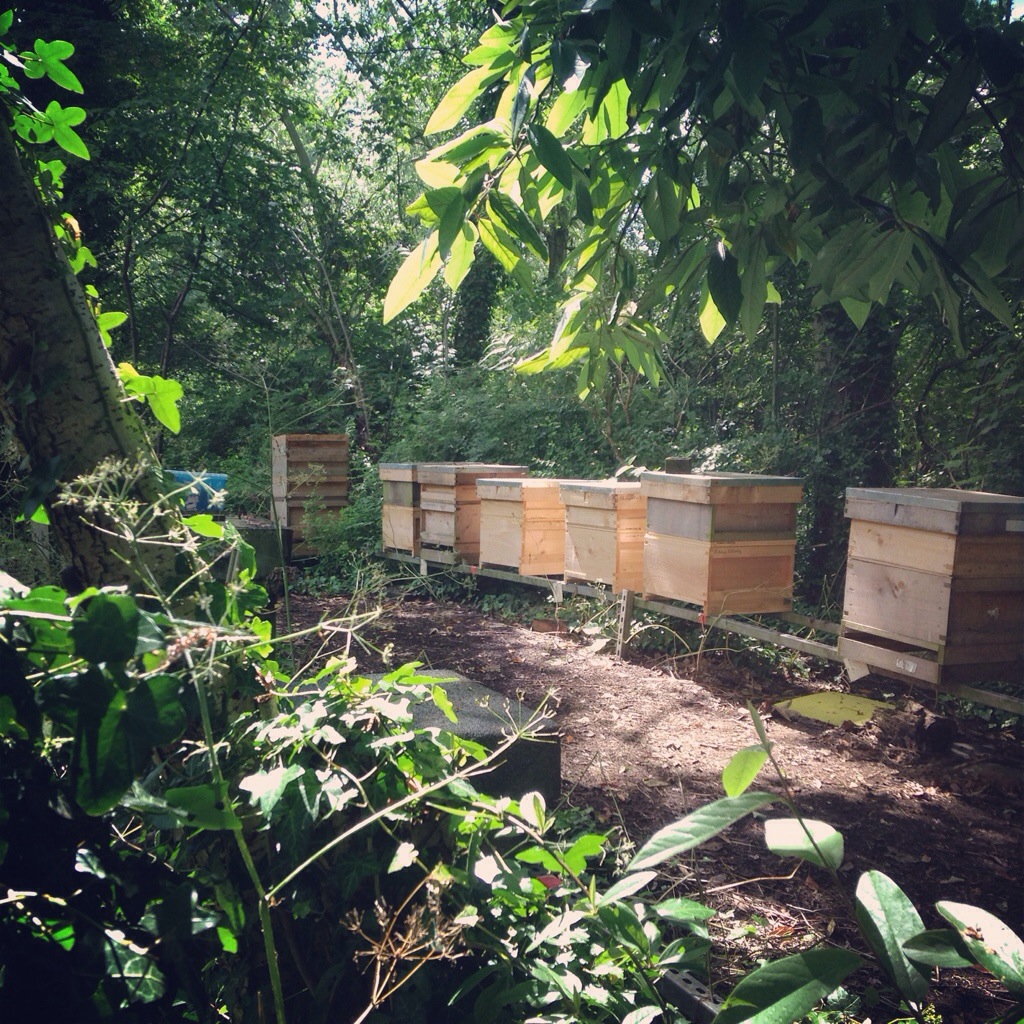
It was the second Saturday of the month which meant that Ealing beekeepers were at the scout hut for a workshop. But I was not the only visitor to the apiary, there were also the wasps. Last Sunday I had laid a couple of traps to deter wandering wasps from bothering our hives. Yesterday I found out it might not be so easy.
This is as close as l’m going to get to a (suspected) wasps’ nest, even in a bee suit. A small burrow in the ground with fast-flying insects coming and going in a blur. Too small for bumbles and too many for solitaries. Had I stumbled on a wasp palace?
Wherever the wasps were hiding, the Wasp Queen had given orders to attack Queen Chamomile’s bees. As Emily arrived and stepped through the mushroom path, I had found a dent in the woodwork of Chamomile’s hive that hadn’t been there before. It seemed too early for woodpeckers who would still have lots of other tasty things to eat. “They don’t usually become a problem until the ground gets hard,” said Emily.
EDIT: wood damage from rot, woodpeckers or very determined wasps! Some helpful suggestions in the comments below.
Irritated by the wasps circling the hive boxes like sharks in the water, I looked at the front and saw a row of wasps scraping and gnawing at the wood, determined to get inside.
Luckily, Emily and I had some spare duct tape and together we taped around the vulnerable seams of wood between the hive boxes and the crownboard. The wasps weren’t happy and retreated back to their queen for new orders.
There is nothing more tempting to a beekeeper on a sunny day than a wooden box full of insects. But we resisted the temptation to open the hives. The opportunity for wasps to fly in and stress the bees would be too great. Instead we cleaned and topped up feeders with syrup.
We also left small bags of dry sugar under the roofs of Melissa’s and Chamomile’s hives as an experiment. Emily had read that some beekeepers feed hives dry sugar in autumn and spring, leaving the bees to add the water themselves. Though all our colonies are heavy with winter stores, Melissa’s inquisitive workers immediately checked out the spilled sugar. We’ll see next week if they liked it or not, as it’s a useful tip to know if we’re ever caught short of syrup or fondant.
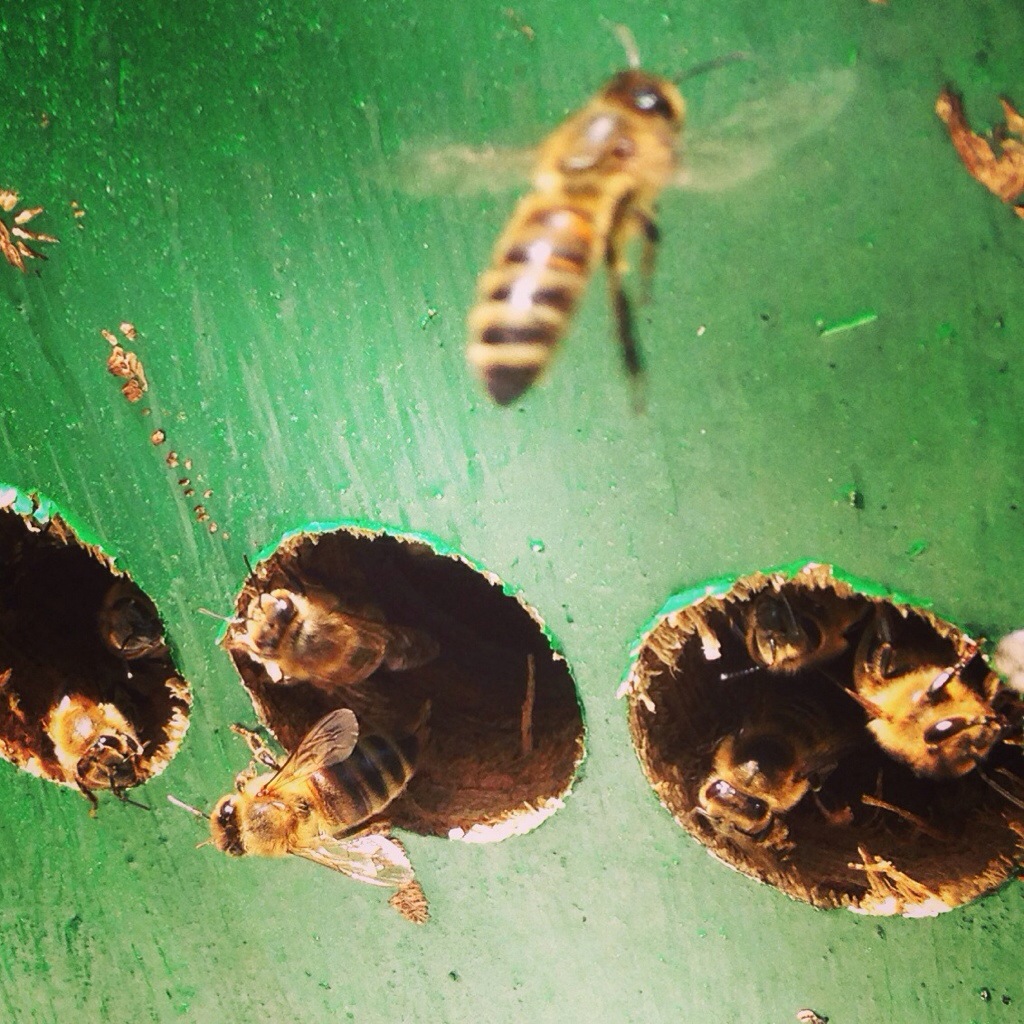
We then walked around the apiary to visit the other beekeepers’ hives. The new bees living in David’s old green hive seemed much better tempered and were content for us to watch them come and go. Although I spotted a hitchhiker on a returning forager (image above, bottom left).
Emily found a worker crawling beneath the apiary’s top bar hive with shrivelled wings, likely caused by deformed wing virus (DWV). Another clue that varroa was always lurking and that we must be ever vigilant against bee diseases even after a good season.
The wasps would probably finish off the hapless bee. They are, after all, useful scavengers. Incidentally, we should also thank wasps for beer and bread.
A new beekeeper had arrived not realising that everyone else was at the scout hut. He had recently got a colony of bees from John Chapple and was giddy with excitement. “I can’t stop watching them.”
John Chapple would tell us to leave the bees alone as, despite appearances being contrary with bees flying in and out with brightly coloured pollen, they were making preparations for winter. Preparations that would be undone by nosy beekeepers pulling at frames to say hello.
With that we closed the gate and left the bees, and the wasps and the mushrooms, to enjoy the rest of the afternoon in peace.
Postscript notes
Aside from the wasps, this has been a great year beekeeping. Check out my new blog index for posts on this year’s and past year’s beekeeping adventures, along with posts about lots of other things!
When you first start learning to be a beekeeper, you may be taught that 8 mm is the magic number of the ‘bee space’. Perhaps this is easier to learn when starting to build your own hives. In truth, it’s closer to 6–9 mm.
What is bee space? Imagine an alley between the neighbouring combs within a bee hive, or indeed a natural bee nest. The ‘bee space’ leaves a gap so that bees can work on the opposite sides of the combs and have enough space to move past each other back to back.
This gap or ‘bee space’ is widely considered to be around 6–9 mm (1/4–3/8 in) and is a key principle in the design of most modern bee hives allowing the bees free passage between the frames and the hive wall and above or below the frames.
Bee space is the gap between the frames in the hive, and around the walls and above and below the frames. This gap gives the bees enough space to work on opposite sides of the comb and pass each other back to back.
I’ve read that the variation in spacing might be due to the varying sizes of the different species of honeybee, although 6–9 mm seems a pretty uniform measurement to me.
Why is it important to remember bee space? Because any gap that is too small (less than 6 mm) the bees will fill with propolis, a sticky resinous substance, and any gap that is too big (more than 9 mm) the bees will fill with brace comb (bridges of honeycomb). This, of course, makes it harder to move the frames and boxes of the hive during an inspection.
Beekeeper David A Cushman describes bee space as “A gap in a natural nest bees don’t fill up”. He provides an interesting list of the different types of bee space. He also suggests sometimes the bees will fill small gaps with pollen, perhaps to allow some light to filter around the hive.
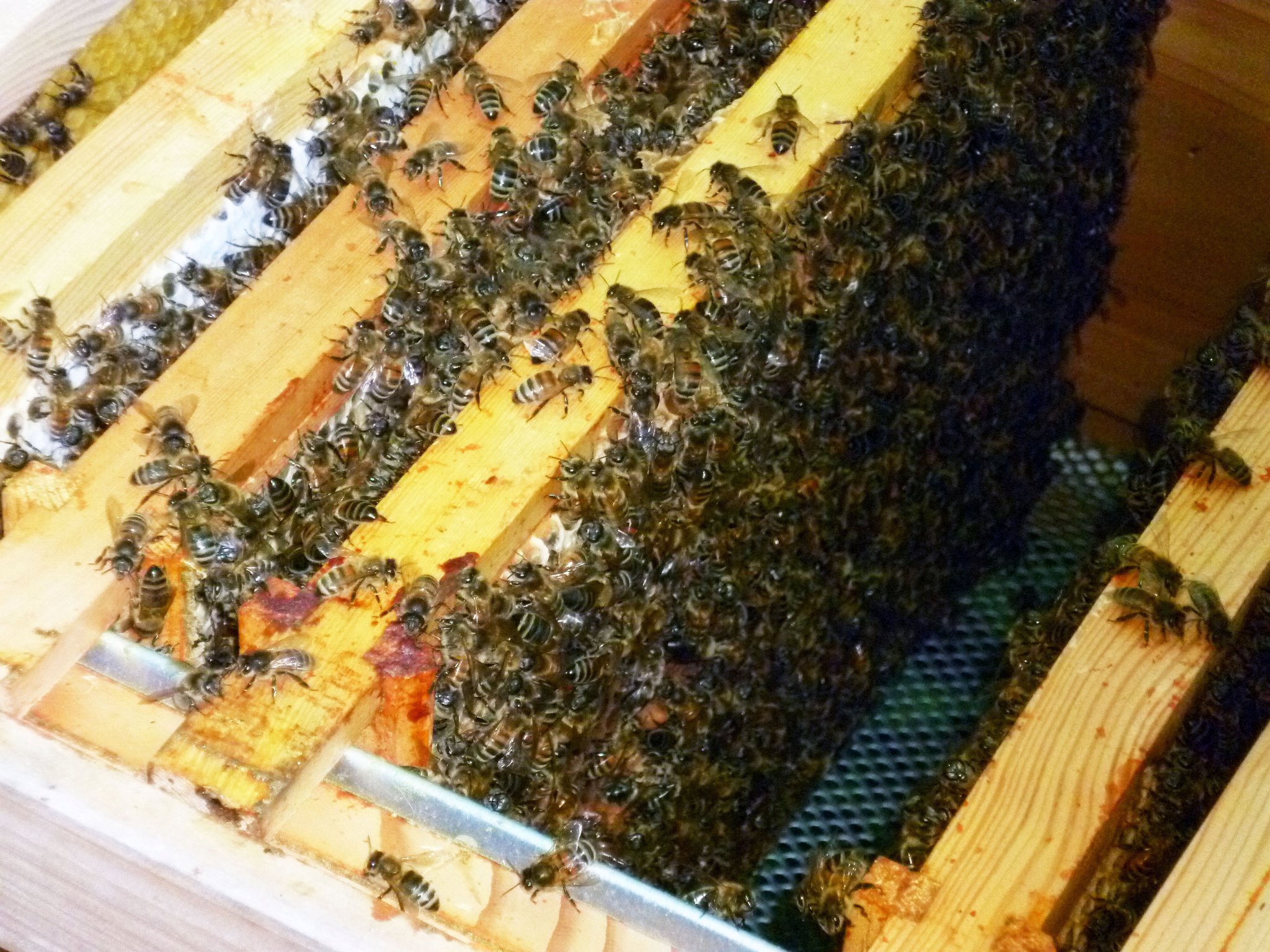
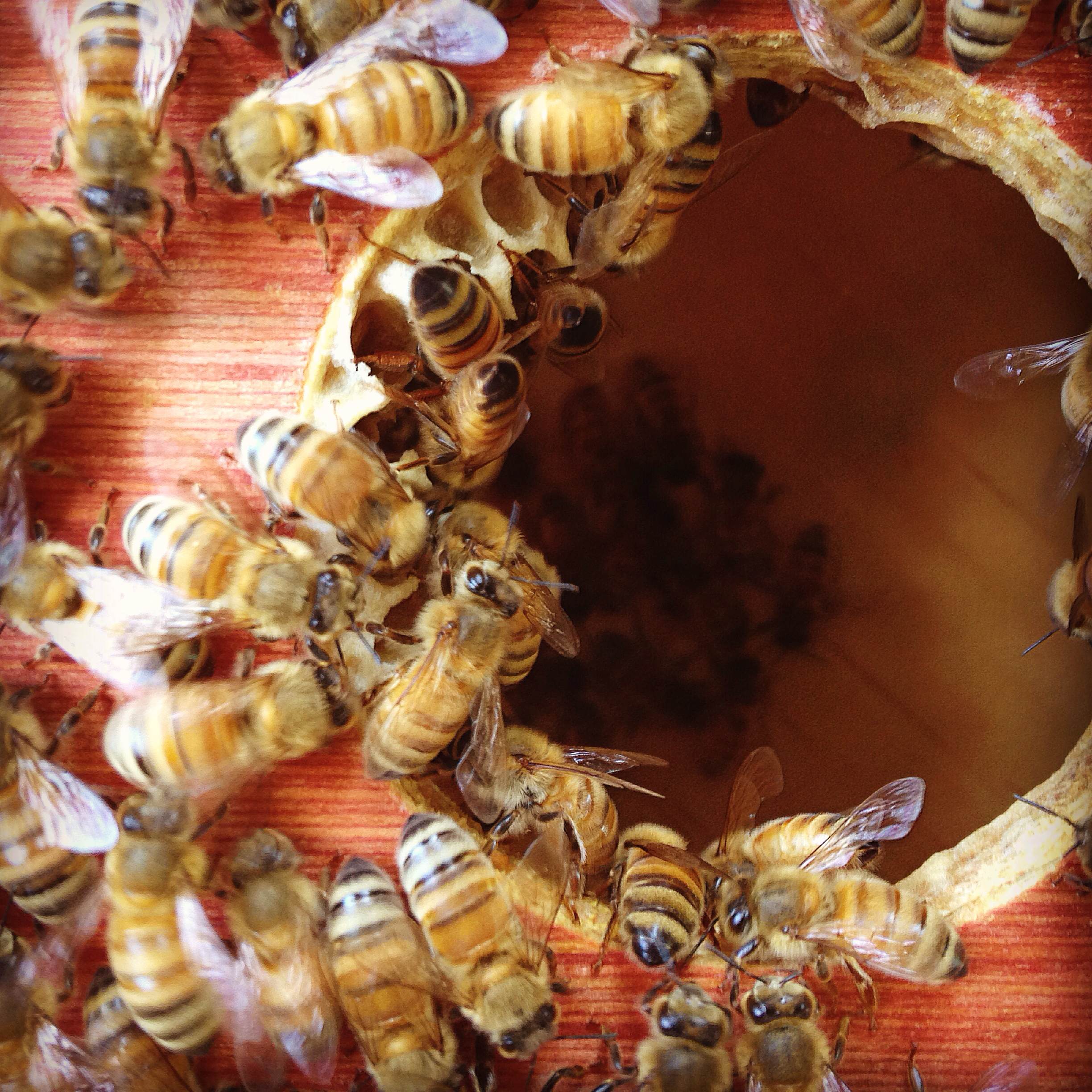
Bees filling a small space (less than 6 mm) above the top bars with stick propolis.
But whether it’s 6, 7, 8 or 9 mm, leaving a gap that the bees feel inclined to fill isn’t sensible. So, of course, that’s what Emily and I did. To be fair, this was during the four-week course of Apiguard treatments for varroa, where an eke (sort of an extension wooden frame) creates a space beneath the hive boxes where the Apiguard tray rests on the top bars.
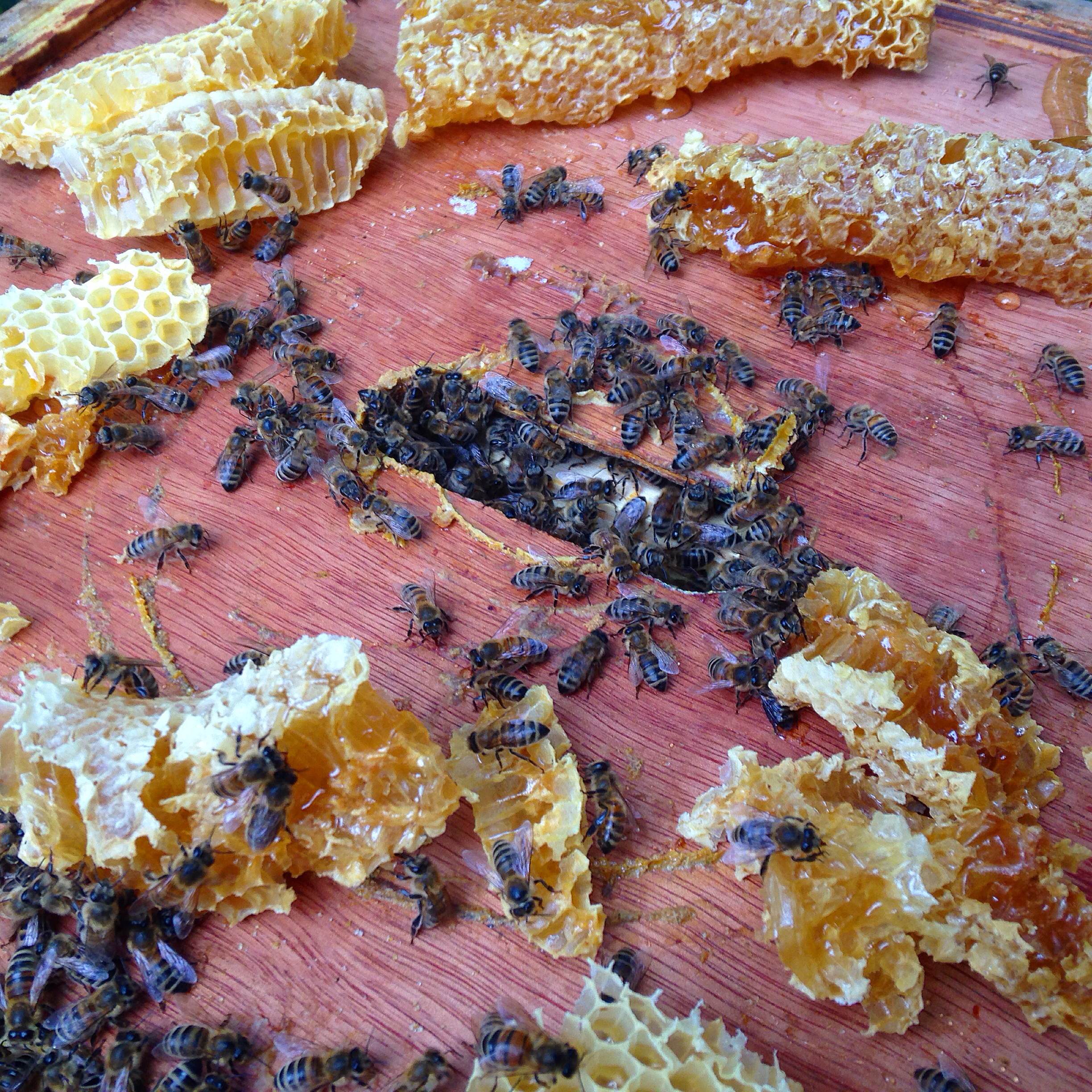
In Melissa’s hive our bees had dutifully built brace comb to fill the gap bigger than 9 mm. And it wasn’t easy to scrape it off the bottom of the super without the help of a hive partner. The bees showed their appreciation of our efforts by munching the oozing honey.
Some beekeepers might consider leaving space for the bees to build brace comb a waste of valuable energy and resources when they could be getting on with other work: filling up super frames with honey or getting ready for winter. There might be some truth in this, but I always enjoy seeing my bees build brace comb. The beautiful curved shapes of freely expressed honeycomb gives an insight into the secret life of wild honeybees.
How do honeybees in the wild know about bee space? Well, I haven’t read much on this, but it seems they weren’t taught it by the beekeepers. Bee space, like the building of vertical combs, is all about gravity:
“Guided by their sense of gravity, though, bees can maintain a comb construction that is vertical, and oriented downward from the roof to the floor. The distance between the comb results from the space a bee occupies when standing on the comb. When moving over the surface of neighbouring combs, bees must be able to pass one another, back to back, without difficulty … and this minimal distance is strictly maintained.” (The Buzz about Bees, Jurgen Tautz, Springer, London, 2008.) Tautz says that gravity receptor organs are found on the bees’ leg joints and between their head, thorax and abdomen, which allows them to build combs vertically down in the dark. Amazing creatures.
Last week we left Melissa’s amazing bees munching on the brace comb honey under the roof, which we hoped they would take down into the nest. Probably an unwise idea as our bees were likely to build more brace comb, but it seemed unfair to take away their secret stash of honey. This week, we would find out what the bees did.
The rainy morning had persisted into the afternoon and though the rain was drying up, the air was too damp and cold for inspections. I arrived to find a small crowd of people at the apiary sheltering under the awnings of the apiary hut. The air was filled with bees, unusual as they don’t often fly over the green netting that separates off the hive area. Perhaps they had also come for tea. In any case, they were happy to fly calmly about listening to the conversation.
Emily came with nuts to feed the magpies and robins. Jonesey was showing off his new iPhone 6 and a new beginner, Emma, was getting to know everyone. The crowd soon dispersed and it was time to see what our bees had done.
In Melissa’s hive I’m pleased to say the workers had done exactly what they were supposed to do! They had taken down most of brace comb honey into the hive. Emily and I cleared up the empty wax and left the remnants around the crownboard holes for the bees to finish up. I saw a little wasp on the crownboard drinking a dreg of honey. Wasps are desperate at this time of year, starving and dying off. I couldn’t bring myself to kill her but couldn’t leave her inside the hive either. I picked up the piece of comb with the wasp and placed it on the roof of an empty hive.
We had fed Pepper’s and Chili’s hives with pollen and syrup though they didn’t seem to need feeding, it has been a very kind autumn for bees. Chamomile’s hive was left to check.
We opened the roof and lifted the crownboard – and the wasps flew in! They must have smelt the scored honey frames feeding the bees above the crownboard. Quickly putting back the roof on the hive, there were at least a couple of wasps inside and many more buzzing around the outside, and trying to disturb the other hives.
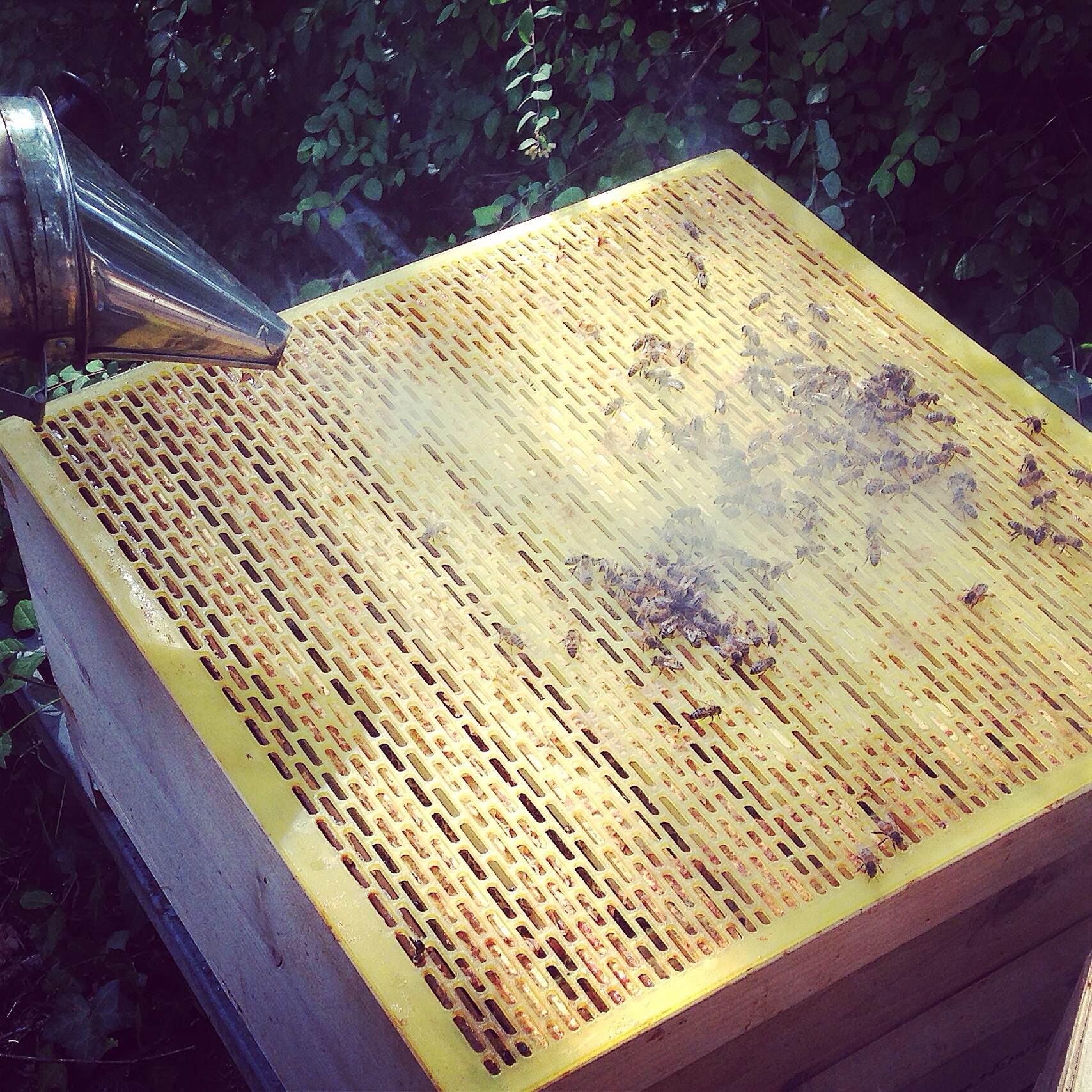
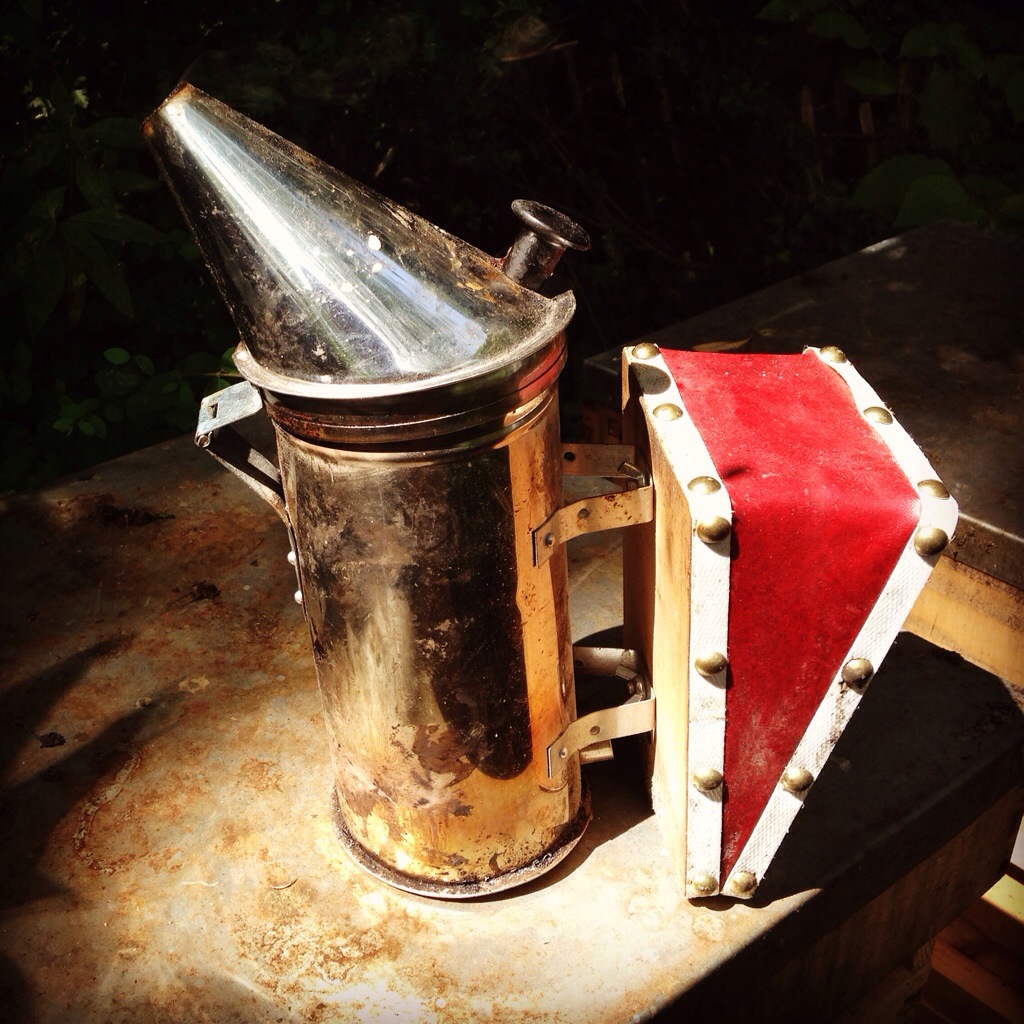
I lit the smoker to deter as many wasps as I could, while Emily used newspaper to make the hive entrances narrower. As the wasps cleared we lifted the roof from Chamomile’s hive again and the two trapped wasps flew out. There’s no space for wasps in our bee hives!
That done, we took a walk around the apiary. The rain had stopped, the sun had come out and wasps were still stalking most of the hives. It was time to leave.
Post notes If you’re interested, here’s some more information about bee space.
Top beeway or bottom beeway? In a natural colony of wild honeybees, bees only leave a distance between the vertical-hanging combs and around the walls of the nest. There is no need for horizontal spaces above and below the honeycomb. But in a bee hive, the beekeeper needs horizontal spaces to move the boxes during an inspection. Here, the concept of bee space is again used by leaving a gap between hive boxes around 6–9 mm. (Collins Beekeeper’s Bible, Ed: HarperCollins Publishers, London 2010.)
“The bee space can either be at the top of the box, over the frames (as in the Langstroth, Dadant and Smith hives), where the bottoms of the frames are in line with the bottom of the box (known as ‘top bee space’) or at the bottom (as in the National, WBC and Commercial hives), below the frames, so that the tops of the frames are level with the top of the box (‘bottom bee space’).” (Collins) Obviously, you can’t mix boxes with top- and bottom-bee space in the same hive or the concept of bee space won’t work.
Which is better? In Guide to Bees & Honey, Ted Hooper refers to this method of spacing as ‘top beeway’ and ‘bottom beeway’. He prefers the ‘top beeway’ design, which he says is most common in America, rather than the ‘bottom beeway’ design used in Britain (my fourth edition of the book was published in 1997, so I can’t say if this is still the trend on both sides of the pond, particularly as many beekeepers like to experiment).
“Top beeway is much more efficient in use and less of a strain on the beekeeper as supers can be lifted back and placed ‘cross-cornered’ on the hive and then slid around into place. With bottom beeway this cannot be done as the edge of the super box would run across level with the top of the frames and would decapitate any bee looking up between the frames and squash many of those walking about on top of the frames.” (Guide to Bees & Honey, Ted Hooper, 4th ed, Marston House, 1997.)
A short(ish) history of the movable-frame hive American-born Reverend Lorenzo L Langstroth (1810–25) is credited with the invention of the movable-frame hive. It was Langstroth who recognised the concept of ‘bee space’ in a ‘Eureka’ moment, which became a vital component in modern hive design and which now allows beekeepers all over the world to freely move and lift frames and boxes without breaking up the honeycomb. (Collins)
There had been similar bar hives previously, such as the leaf hive invented by Swiss natural historian Francois Huber (1750–1831), and the multi-layered skep hive invented by Englishman Thomas Wildman (1734–81), an experimenter, showman and beekeeper. It is thought that a movable-frame hive was also first designed by Englishman Major William Augustus Munn, author of A Description of the bar-and-frame hive (1844). (Collins)
The theories that lay behind these models may have helped to pave the way to Langstroth’s discovery.
When a space that is too big (more than 9 mm) is left in the hive, the bees will fill it with brace comb (bridges of honeycomb) as shown here above the top bars.
Langstroth was frustrated when his coverboards became stuck down with the sticky resinous substance propolis and like any good beekeeper he sought a practical solution. He cut a recess into the hive box that allowed him to drop the hive bars down to 9 mm below the coverboard, which seemed to solve the problem. Then he thought about similarly adjusting the spacing in the interior parts of the hive to make it easier to work with the bees:
“The critical aspect of his design was the space between the edges of the frames and the walls and floor of the box – an opening wide enough for a bee to pass through and hence termed the ‘bee space’.” (Collins) Langstroth initially used a space of 12.5 mm (1/2 in), before he further discovered that bees leave a 6–9 mm (1/4–3/8 in) space between their combs and the walls in their nests.
A Polish beekeeper Reverend Dr Jan Dzierzon (1811–1906) had put thought towards a system of movable frames by spacing the comb 38 mm (1 1/2 in) apart. But it seemed that 6–9 mm was found to be the most practical movable-frame system and Langstroth’s design is used by 75% of all modern hives sold throughout the world today. (Collins)
Often when people meet me and find out I am a beekeeper, they say: “Taking honey from bees is cruel, isn’t it?” I don’t really mind because ‘they’ are usually (self-confessed) vegans and all I have to say is: “Yes, but I don’t eat almonds” to confuse them and make my escape.
Of course, as a beekeeper I don’t think taking honey from the bees is cruel. To me, a single jar of honey at the end of the season is a sign of strong and healthy colony and a well-managed hive. The honey harvest is a culmination of a successful partnership between the bees and their beekeeper.
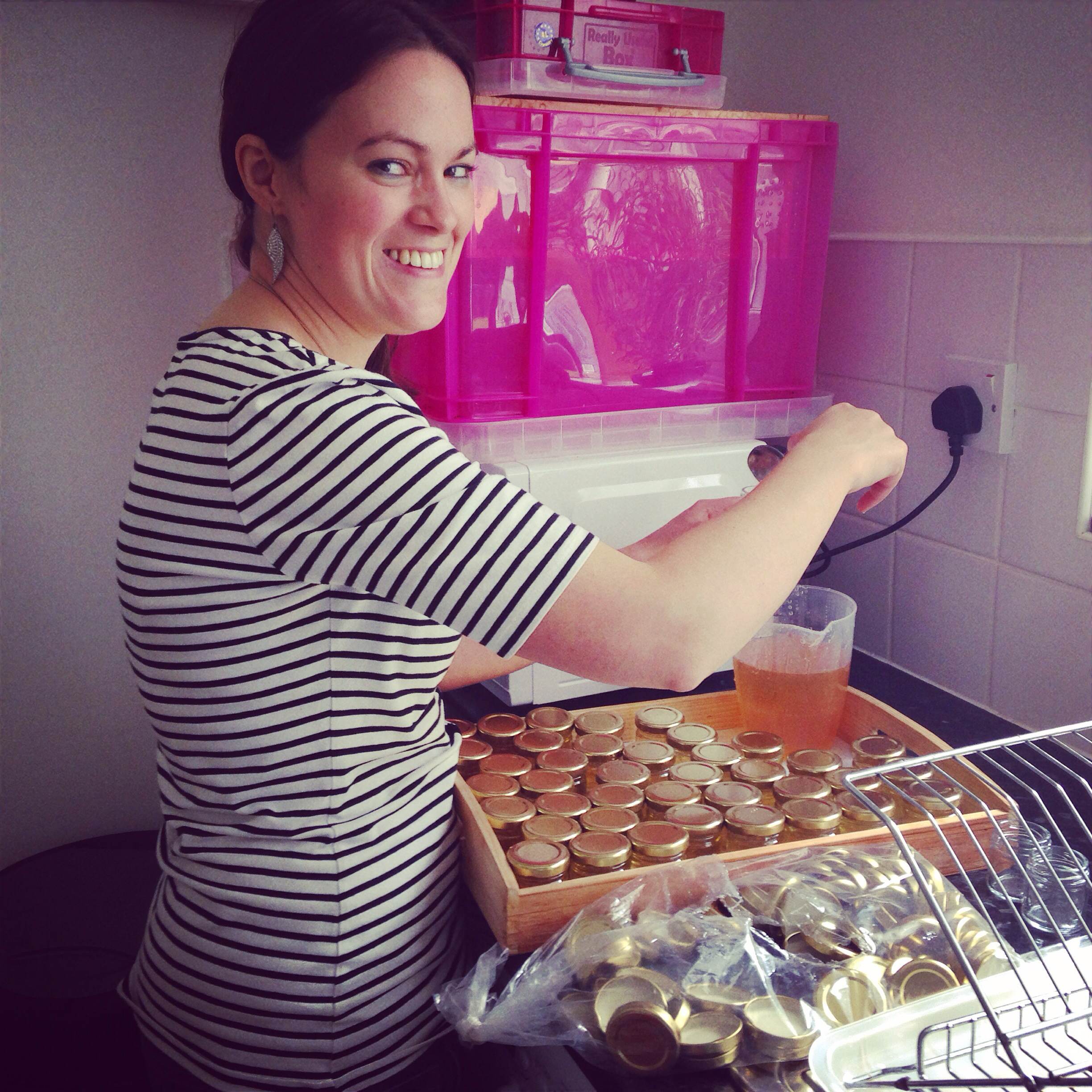
Today Emily (above) and I celebrated our harvest with a great honey bottling session. We poured and sieved our light golden and mildly sweet honey into containers and jars to be divided between us. I’m planning to label my jars ‘Myrtle’s honey’ after the queen who successfully led the colony for the past two years.
Ah, beautiful jars of honey – a taste for all our family and friends, thank you Myrtle.
If you’re not a regular reader of my blog, be assured that no bees were squashed or maimed in the making of our honey. Not a tiny wing or little leg was found as we decanted the precious golden liquid. Emily and I take care to clear bees from the supers by gently brushing and handpicking stragglers from every frame before they are taken home. Although, I should say that with only four hives we have the luxury of doing this.
Later in the afternoon we returned the last of the wet super frames to the apiary for the bees to clean up and add to their winter stores. The elder beekeepers were surprised that we had returned so much honey in the frames for the bees and thought they had better check to see it was ok. Thumbs were out and honeycomb was crushed, “Blackberry and lime,” was John’s verdict.
Though the days are growing shorter, the autumn has been mild and there was still time to look at our bees. Melissa (Myrtle’s daughter) has got her bees to work filling up another super, which along with the honey we have returned gives the colony more than enough stores for winter. Melissa’s workers had also left a mischievous honeycomb surprise in the hive after four weeks of varroa treatments. But more on that next week.
We took a look under the crownboards of our other colonies to see them calm and content, and building up good stores. Although someone needs to tell the bees that winter is coming as they are still very active: eggs, brood and even drone found in Pepper’s hive.
We have just finished the Apiguard treatments for varroa and the mite drop has shown that both the treatment has worked and that sadly varroa often flourishes when the colony does. Emily and I are both worried about Chamomile’s sickly hive, which we will try to treat further with a thymol mix for the syrup next week.
I’ve never met a beekeeper who isn’t obsessed about the wellbeing and survival of their bees. When many of the beekeepers at Ealing apiary went to a showing of More than honey, a Swiss documentary directed by Marcus Imhoof, they were shocked to watch the treatment of bees at an almond plantation in California. At a larger commercial scale for the pollination industry, the picture for honeybees is grim as colonies are mechanically processed by machines that crush and grind bees in their hundreds. I had mixed reactions to the film – awe at the spectacular scenes of life inside the hive and horror at the management of colonies as nests are torn apart into boxes of ‘brood’ and ‘honey’.
That’s why I don’t eat almonds, or buy almond oil. It probably doesn’t make a difference but I just can’t bring myself to make a purchase without thinking of that picture of suffering honeybees at the almond plantation. When I am asked what I think about taking honey, I suppose that I could explain how most beekeepers care greatly for their bees and how on the whole there are worse things that you could eat. What I really want to do on a Saturday afternoon though is enjoy beekeeping and having a nice cup of tea with the beekeepers, so I usually say nothing and hope the questioner goes away.
Last autumn I remember a visitor to the apiary who told me he was a vegan soon after we met, perhaps he could tell that I am a butcher’s daughter as well as a beekeeper. He showed his displeasure at treating the bees with Apiguard and the use of chemicals in the hive. I didn’t really mind this either, because I had been to an excellent Bee Health Day at London Beekeepers Association at which I had made up my mind that I disliked varroa and bee diseases much more than I disliked treating my bees. But as there was tea and cake waiting on the apiary table, I hoped to make a quick getaway rather than stand around and explain about naturally occurring chemicals thymol and oxalic acid. So I said: “I’m sorry, is there a chemical on the periodic table that you don’t take offense to?” Unfortunately, smoke and mirrors failed as he persisted to poke me like a small honey-stealing bear until I finally agreed “Yes, taking honey is very cruel” and “Yes, I shouldn’t treat my hives”. That done, I apologised for going because I wanted a cup of tea at the apiary, before enjoying a slice of black pudding for my supper at home.
I suppose that I am as naughty as Melissa’s bees.
Further reading – an interesting post by Bees with eeb on The Bee Man of Orn provides beekeeping from the perspective of a migratory beekeeper.
The moments of sunshine appear in and out of showers in these end of summer days, as I notice the bees nipping in and out of the fading flowers for every last dusting of pollen.
With the cooling of the summer’s warmth, is it my imagination that the bees’ furry coat becomes fuller?
We spent the last week of summer visiting John’s family in Hereford where the round bales of hay were being rolled in the fields and the trees were showing the first tinges of autumn.
I’ve always liked the autumn and winter months, perhaps because I was born in the winter. At the same time there is also a feeling of sadness as summer ends.
My grandad used to call it ‘the ebb time’. I feel the retreating evening warmth in the buzzing of the bees and watching them eagerly gathering every last flowerful of nectar from the Japanese anemones in the garden.
This year it’s different because I see the summer sunshine in my bees’ honey. I can appreciate the hard work of summer’s end and enjoy the beginning of autumn as we take the harvest and prepare the hives for the winter.
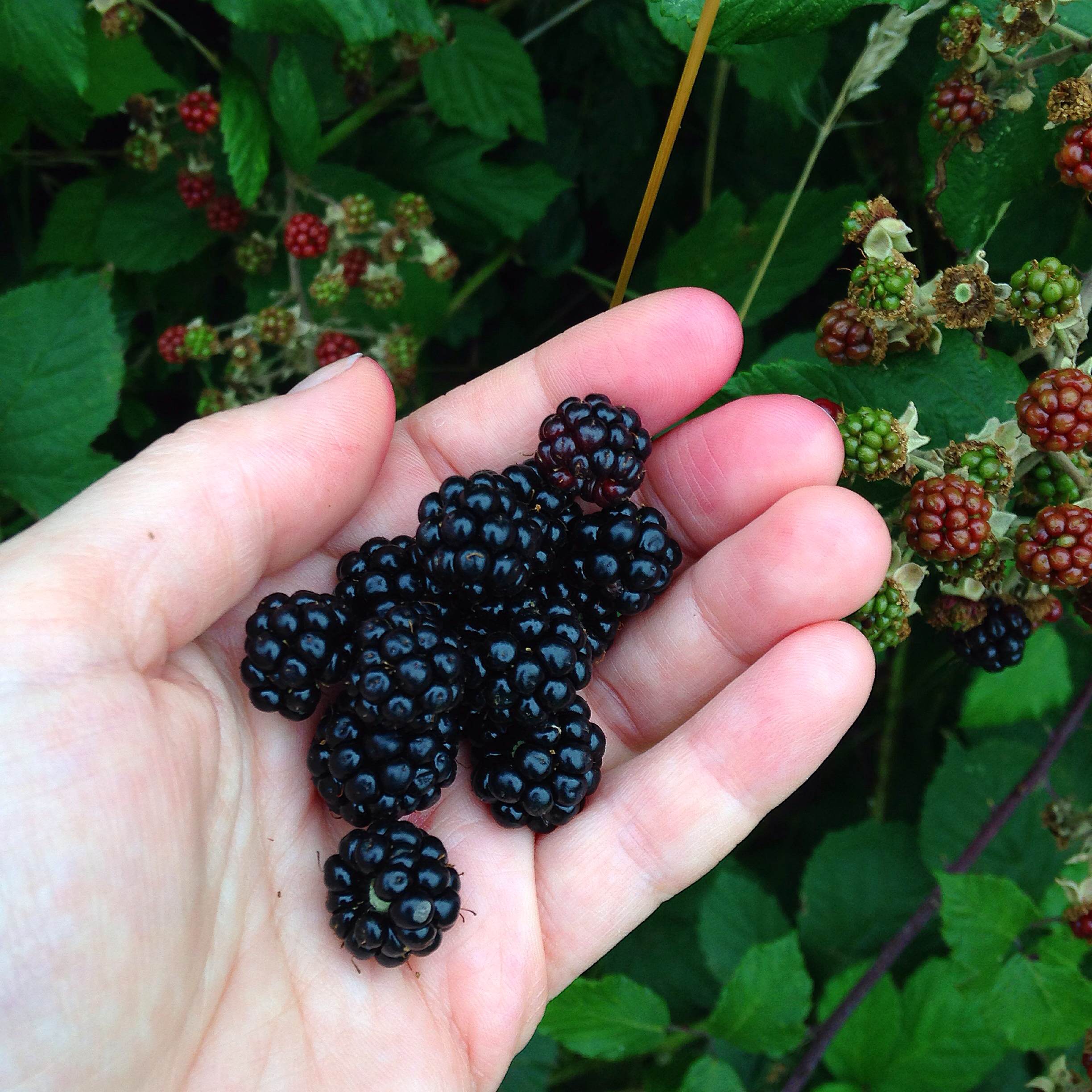
In Hereford I saw the richness of the harvest in the fruits of the fields as we picked blackberries, plums and apples for pie and crumble.
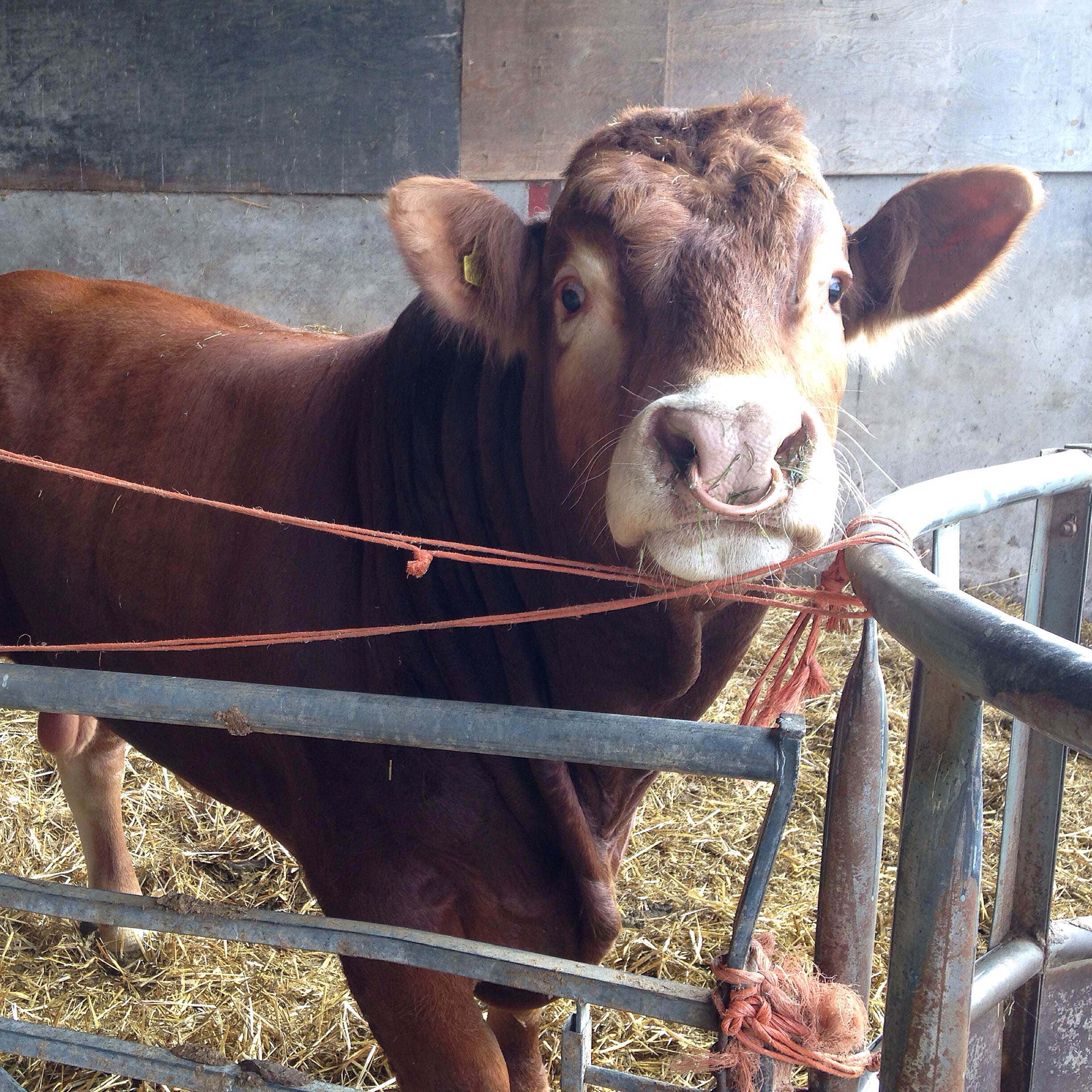
The cows were watching as we filled up tubs with fat juicy blackberries from the hedgerows. They (the cows) were inquisitive, said John’s mum. So was The Gruffalo, the magnificent new bull, but he got fresh hay, not blackberries, for supper and enjoyed his nose being scratched.
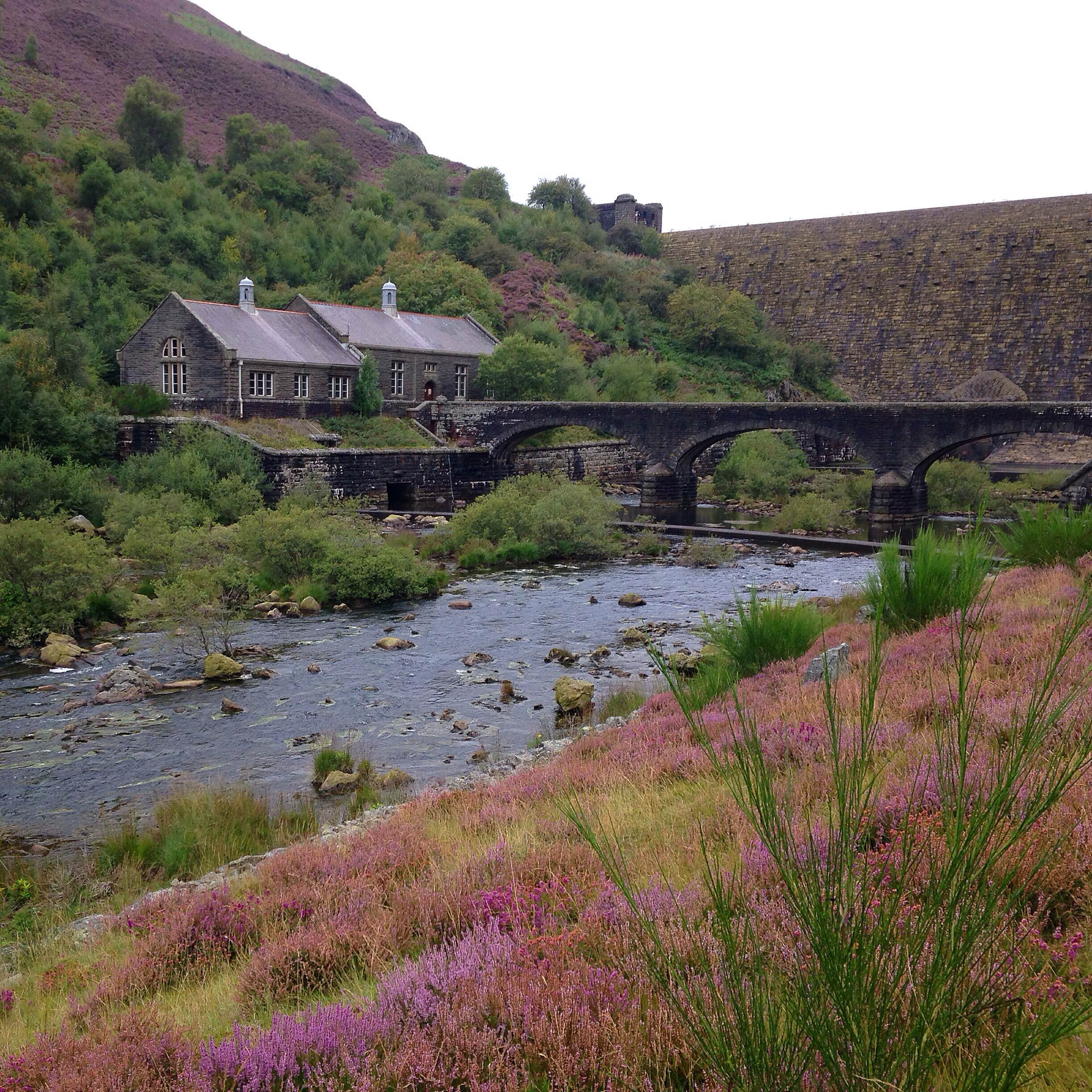
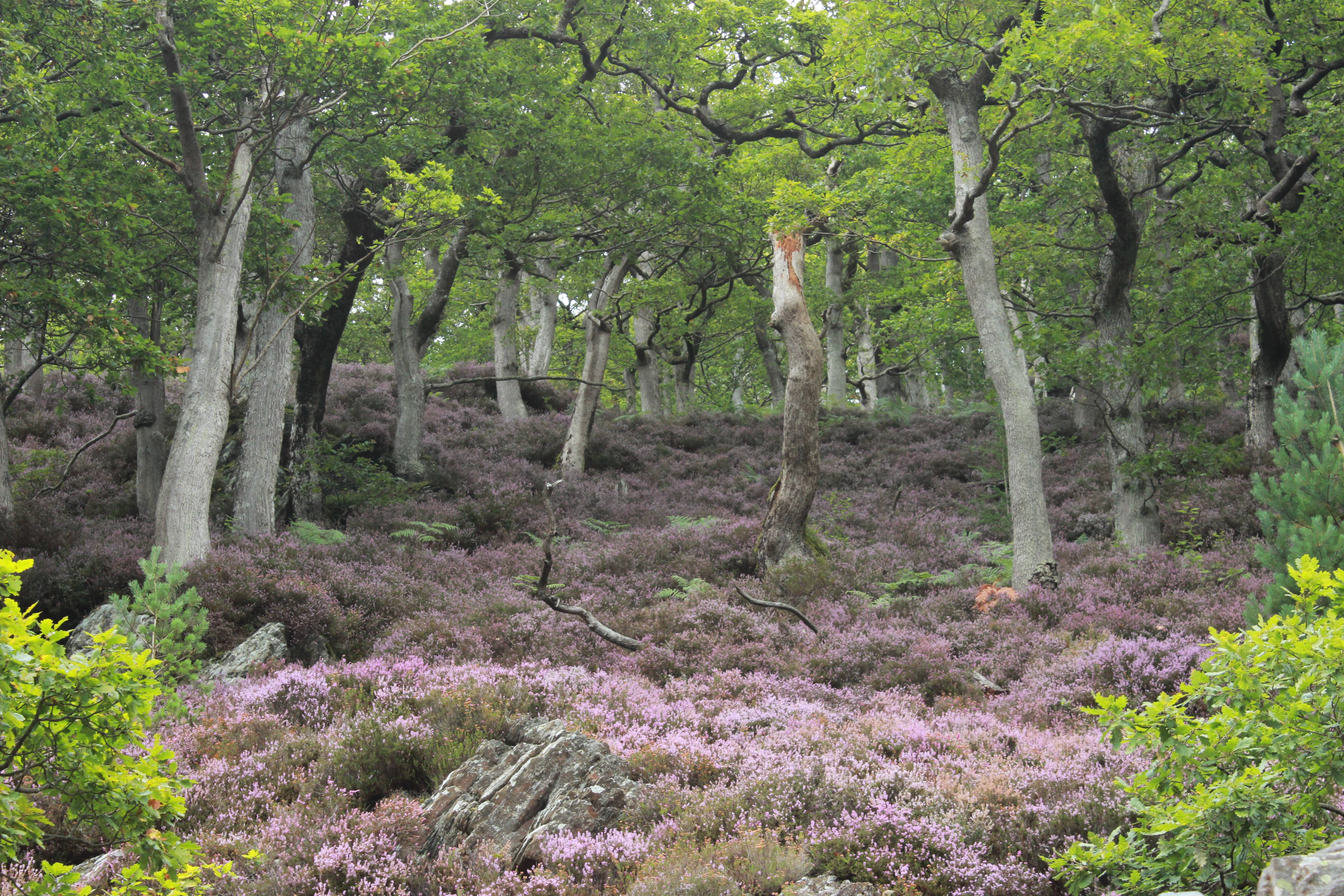
After the bank holiday’s rain had passed, we drove ‘abroad’ to Wales to view the impressive Victorian dams set in the beautiful Elan Valley in Rhayader. The country is always changing in Wales. It’s stunning.
A visit to the Elan Valley “never fails to delight and inspire” says the information at the visitor centre. I could imagine that living here would inspire creativity to flow from every pore.
There is a feeling of spending time in nature that I can only describe as contentment.
We met a friend of mine for lunch by Hereford cathedral and he put into words exactly what I felt. In London there is everything to do and no time to do it. Here, there is a lot to do and more time to do it. While being on holiday puts everything in a romantic light, I could easily imagine swapping city life for living in the country.
On the farm John’s dad brought home a bunch of hops and asked if I knew what they were. I didn’t.
He also found a dead grass snake in the corn field to bring back for show-and-tell. We laid him to rest behind a tree in the garden.
The last day of summer was the best day with deep blue skies and golden sunshine. I sat on the back of the bike as John cycled from the cottage to the farm house, listening to the birds and bees and watching the cats preen lazily in the yards.
We enjoyed a full roast dinner before saying our goodbyes and driving back to London. John took the very scenic route through Gloucester and Burford in the Cotswolds, and we eventually arrived home just before sunset. Our small London flat smelt of the honey that had been slowly dripping from frames hanging over a container for a week. Patience and perseverance has paid off, I may be able to return wet supers with drawn comb to the hive to give the bees a head start in spring.
Autumn is now here and as the sun rises lower in the skies so the afternoon shadows stretch longer and further, and the days grow shorter. My kitchen is overflowing with summer’s bounty of apples, plums and honey ready to make honeyed fruit crumbles and pies. Winter is coming so I’ll leave this memory of a playful calf frolicking at summer’s end.
Myrtle emerged inside the hive in July 2012 after a dramatic season of monsoons and regicide. It was during the London 2012 Olympics, her grandmother Lavender had swarmed and left behind her mother Neroli who failed shortly after. We were delighted by Myrtle’s gentle and playful nature, and she would become our most successful and long-lived queen.
Two year’s later, Myrtle disappeared in a suspected supersedure and we have anxiously waited a month for the new queen to show herself and start laying. The beautiful picture above was taken by John during our trip to Lancashire last month. I’ve posted it today in remembrance of our lovely Queen Myrtle.
And yesterday we spotted her beautiful daughter, here’s a blurry close-up.
We were fairly sure the new queen was Myrtle’s daughter, rather than from the frame of eggs put in by Emily from Chamomile’s hive, but I wanted to check our records at home first. The timing is right, the new queen is from Myrtle’s line. I’m so glad that we patiently waited for the queen and the bees, rather than combining the colony with another.
I have the perfect name for Myrtle’s daughter, although I won’t reveal until telling Emily. I’m just so happy and relieved that our long dynasty of gentle queens continues. Here are some of Myrtle’s old daughters looking content with their new matriarch.
Emily was just finishing an inspection on Chili’s hive when I arrived yesterday. Chamomile’s bees instantly stung a beginner beekeeper, British traffic policeman Rick, as he pulled the first frame. It was Rick’s first day as a beekeeper, I hope he didn’t feel like arresting our bees. You can see Chamomile at the bottom of this picture.
Fortunately it takes more than one sting to put off the British police. Rick inspected Pepper’s hive, who were cautiously well behaved. He spotted the queen on the fourth frame in and seeing that all was well we finished the day’s inspections. Emily smoked down Pepper’s bees to avoid squashing them when the super went back on.
Emily and I are extracting the honey at my dad’s house today. Four strong hives (though one not so healthy) and two supers of honey. I feel like it has taken a long winding road to get to where we are today, a bit like crossing a river of stepping stones. So here’s another lovely photo by John as this year’s beekeeping season comes to an end.
It seems neither the British weather forecast nor the British weather can be relied on after Saturday’s predictions of thunder, lightning and hail proved false. Saturday was a beautiful day for beekeeping, but Emily and I had already made other plans thinking there would be storms and rain. So we met on Sunday at the apiary beneath clear skies and decided to make short work of inspections. I checked Pepper’s hive while Emily checked Chili’s, then we both looked inside Myrtle’s and Chamomile’s hives.
Pepper is our newest queen and living up to her namesake of black pepper essential oil – a personality who finds it hard to show love! Her bees were feisty so Emily had to take over half way through the inspection as I had forgotten my thicker beekeeping gloves. We didn’t spot Pepper, she might have been sulking at the bottom of the hive.
Chili’s family looked well, said Emily. There was also a surprise when we spotted the queen – she was marked pink! Last Saturday at Andy’s party we had joked with Pat and John that we’d like our queens marked pink. The elder beekeepers do listen to us after all.
With two supers full of honey on Myrtle’s hive, you need a hive partner to help lift the heavy boxes in an effort to avoid squashing bees. Myrtle’s brood nest had a less welcome surprise inside. No sign of Myrtle for the second week running, in the middle of the third frame were six queen cells that looked strangely squashed, and the tenth frame had two surviving queen cells. What could have happened?
We knew the apiary hives may have been checked during the week before the beginner beekeepers’ assessments, and I wondered if the queen cells had been squashed to prevent a swarm or culled to select the best candidate for supersedure. Was the queen present and should we do an artificial swarm though? It was really hard to decide what to do without knowing what might have happened, so we decided to send an email and find out first before taking action. Depending on the outcome, Emily and I may be back at the apiary after work this week.
Chamomile’s moods can be as unpredictable as the British weather, so we’re never sure what to expect. We wanted to reduce her nest from a double-brood to a single-brood. I found Chamomile on the second frame and caged her to keep her safe during the procedure. We moved the frames of brood into one box and put the frames of honey into another box. Emily shook the bees into the bottom box as I held Chamomile safe and then released the queen back into her nest with the queen excluder placed on top. An empty brood box was placed between the brood nest and the brood box with honey frames to create a space that will encourage the bees to rob the honey from the top and take it down below. Emily scored the honey frames with her hive tool to make the task easier for the workers.
By then another beekeeper had arrived to check his hive and Albert turned up too. “Is it Saturday?” he asked.
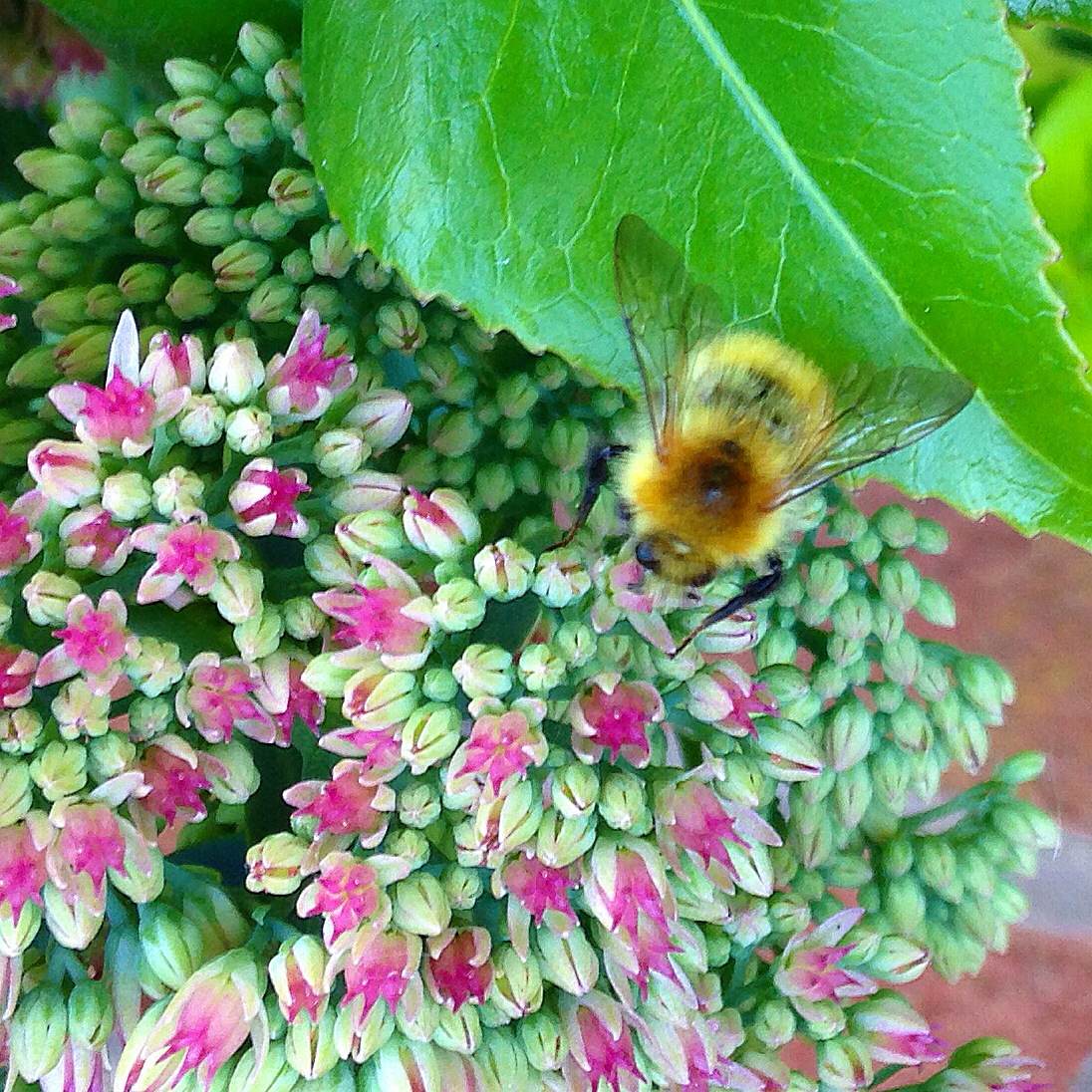
When John picked me up the weather was still clear, so we went for a walk around the 14th-century grounds of St Mary’s and stopped to sit on the green. I watched a common carder bee hovering over a clover before visiting its neighbour.
As a beekeeper and an aromatherapist I was doubly pleased to find out that bees and flowers do ‘talk’ to each other. In a wonderful new BBC bee drama Hive Alive, presented by Chris Packham and Martha Kearney, the secret language of flowers and bees was revealed. A flower has a negative charge that gives off an electrical signal to a bee. The bee has a positive charge that changes the electrical field of the flower when it lands to forage. This tells other bees that the flower has been visited and to come back later when it has replenished its supplies of nectar and pollen. Just amazing.
Hive Alive episode one aired on BBC2 this week and the second episode is due on Tuesday 22 July, 8pm, BBC2. I can’t wait!
Notes: In August the apiary hives are given Apiguard treatment for varroa that has a strong thymol smell which taints the honey stores. As Emily and I will miss each other at the apiary for the next two weeks, we’re harvesting our crop in early August. So there’ll be a short gap in bee posts until then.
A bee was born last Sunday afternoon along with a few hundred others in his small queenless hive. The drone chewed away the wax capping of his cell and emerged from a frame as Emily held it up to inspect for signs of a queen. He would have blinked at us, if he could.
The new queen had been missing since she was first spotted at the end of May. She had looked long and beautiful after her mating flight, full of promise for her colony. A couple of weeks later something had gone wrong. Emily found cells that had two eggs laid in them, usually a sign of a laying worker or sometimes a new queen getting used to her duties. We gave the queen the benefit of the doubt but the following weekend we found a queen cell with a small pearly larva coiled on a bed of royal jelly. The workers were trying to make a new mother and the unnamed beauty was nowhere to be seen. Two weeks later their attempts appeared to have failed and Emily and I decided to unite the hive with its original colony, Chamomile’s.
We met two weeks ago on Sunday at midday to go through the queenless hive using a method that John Chapple had taught us to make sure there is no queen or virgin hiding away. We took out each brood frame, inspecting in turn, and placed them in spaced-out pairs in an empty brood box to the side. If we did miss a queen on a frame then the bees would betray her by gathering around the frame she was on. We didn’t find her, but we saw emerging drones, drone brood and multiple eggs in cells. I saw a varroa on a worker, when looking through photos on my way home, this was not a healthy happy hive.
Emily had inspected Chamomile’s colony the day before and all seemed well. We removed the queen excluder from Chamomile’s hive (the queen-right hive) and placed sheets of newspaper on top of the brood box making small slits with our hive tools. We then placed the brood box of the queen-less hive above. The bees will chew away the newspaper as they become accustomed to each other’s smell and unite as one colony. That is, if Chamomile accepts the return of her prodigal daughters, and sons. We put on the roof and hoped for the best.
That was two weekends ago. This Saturday came with surprise sunshine instead of expected rain. The bees were on the wing and making honey. Emily and I arrived at the apiary for midday inspections ahead of Andy’s 60th birthday party that afternoon. It was hot work going through four hives in a mini heatwave, but wonderful to see our colonies bursting with bees and heavy frames of honey.
Chili’s colony had made a good start on a super that Emily had put on last Saturday. Chili is a slender bright orange-red queen like a tiny beautiful chili pepper. Her temperament pervades a hive of energetic and lively, but steady bees. We soon spotted her walking over the top and down a frame, and caged the queen to keep her safe during the inspection. We saw some queen cups and a cell that could have been a long drone or a queen, but these were too few to be attempts at swarming and were probably late summer plans of supersedure or workers playing as they do. I released Chili from her cage and she climbed onto my glove for a mini adventure before dropping into the hive.
The split hive from Chili’s colony is coming along nicely, although they haven’t made much work of their super. We saw the new queen, Chili’s daughter, who looks just like her mother. I had a name for her on the tip of my tongue, but couldn’t quite think of it.
Myrtle, our favourite queen and matriarch of our longest-standing hive, has given us two magnificent supers of honey this year and I’m really proud of the lovely queen and her bees. Myrtle’s gentle workers were noticeably more alert – not quite feisty but they have lots of honey to guard now.
We didn’t see Myrtle but there were eggs in cells so a queen is there. Earlier in June we found a couple of queen cells in Myrtle’s hive which led us to suspect the workers might try to supersede their two-and-a-half year old queen this summer. Perhaps mother and daughter are inside the hive now, tolerating each other until the workers decide the old queen’s time is done.
Last we opened Chamomile’s hive to see whether the bees had happily united. We went through the first brood box holding our breaths, it is always a test of nerves to find out if a hive combining has worked. There were eggs – single eggs – in cells of the former queen-less brood box which meant Chamomile had been upstairs and started to lay. The bees had chewed away most of the newspaper and were co-living contentedly. Chamomile was found in the bottom brood box along with a couple of queen cells that might again be signs of supersedure. Will we have all new queens to take our hives into winter?
That done, we changed out of hot beekeeper suits and went to Andy’s 60th birthday party where more bees awaited – chocolate raisin bees.
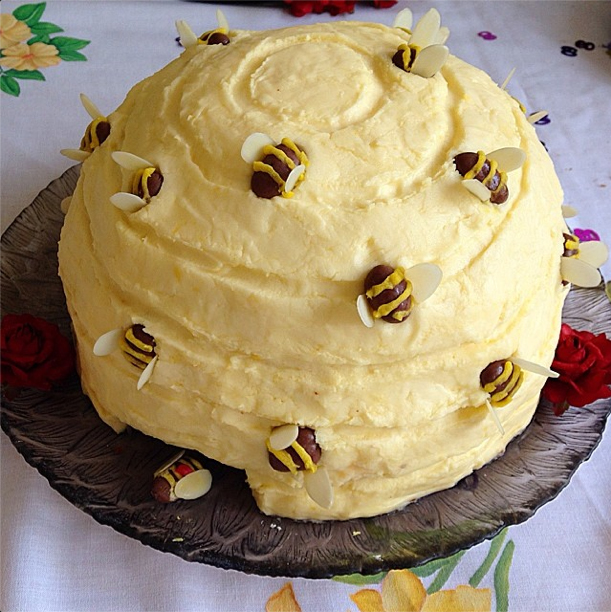
This delicious-looking honeybee birthday cake was baked by Andy’s clever wife Penny Pedley. The beekeepers at the party noticed that the queen sitting outside the hive entrance was marked with a red spot rather than a green spot for this year. “That makes the queen around 53, not quite 60,” said Andy wryly as he cut the cake. Penny had made the sponge using honey from Andy’s hive and so the cake was a birthday present from his bees too.
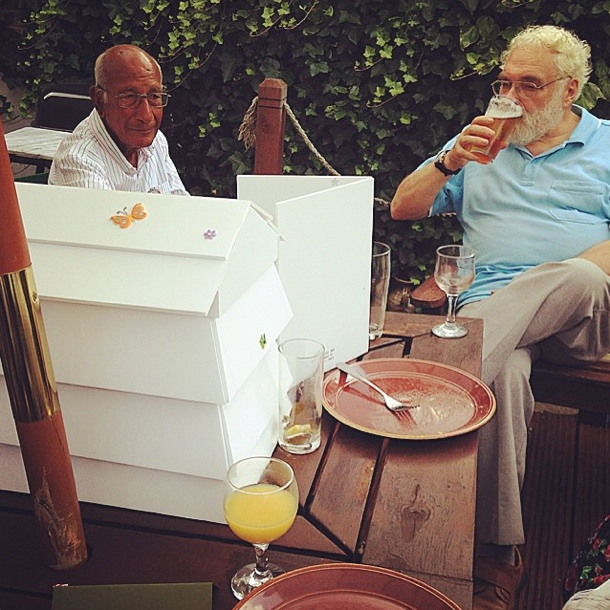
As this was a beekeeper’s birthday there was, of course, a beer hive…
… for beekeepers to enjoy a long cool dark beer after a hot day’s beekeeping.
Emily and I chatted to John Chapple about our bees while eating the buffet and cake. He asked about the ratio of brood, bees and honey in the hives, and we reported that all hives were producing less brood. “The bees are telling us that summer is coming to an end,” said John. But not quite yet.
The name for the new queen, Chili’s daughter, sprung into my mind as we sat in Andy’s pretty garden. Emily and I have a tradition of naming the queens of the hives we share after essential oils, so I asked Emily if she liked Pepper for black pepper essential oil. She did.
Black pepper (Piper nigrum) is a dark, intense and interesting aroma. In subtle aromatherapy the essence “will help us ‘get a move on’ at times when our lives feel ‘stuck'” (The Complete Guide to Aromatherapy, Salvatore Battaglia). Perfect for a late spring queen who needs her colony to get a move on before autumn.
So England has lost and is out of the World Cup. There is still a promising summer ahead and today was a beautiful day for beekeeping with blue skies and sunshine.
Festivals were taking place all over London from Hanwell to Greenwich, but I was more interested in celebrating bees and honey in Perivale. Last Saturday Emily and I had put a super on top of Myrtle’s hive and today we would see what the bees had done with it.
They did this…
Evidence.
Beautiful drawn honeycomb on every frame glistening with honey ready to be capped. We couldn’t help but spend a few minutes admiring it. Honey. That Myrtle’s colony has moved so quickly to fill up a super shows they had really needed the space. We lifted the super to one side and covered with the crownboard to keep the bees warm and protected from robbers.
Myrtle’s bees had been caught playing with the idea of building queen cells last week, although there were no larvae inside the cells. I read in Ted Hooper that removal of two-year-old queens should take place in late August to early September, because of the advantages of having a young queen for wintering. She is less likely to die or become a drone layer, and she keeps the brood nest active for longer in the season, which means younger workers do not have to live as long in winter conditions. (Guide to Bees and Honey, Ted Hooper.) Emily and I have never removed a queen unless it was necessary for the colony’s survival, such as a drone layer, and we’ve never bought a replacement queen, preferring the bees to make their own and decide when to do so. That’s worked out, so far. I have a feeling that the bees might supersede Myrtle in August without our interference. We’ll wait and see.
The queen in question was spotted during the hive inspection. “Look how calmly and slowly she walks,” said a beginner. Myrtle is our loveliest queen, regal and elegant with a skip of playfulness. I adore her. We saw more drone cells in the middle of the frame rather than the edges, which can be another sign of an ageing queen. Oh, Myrtle.
More evidence.
Jonesy lifted the super back on the hive and we put a second super on top. The lime is out and the bees will be flying. “You might need supers on all your hives,” said Jonesy. Hopeful. Though the two hives that were split into four on 11th May must build their brood to full strength. The colony of Chili’s daughter is on its way with plenty of brood and stores. However, the colony of Chamomile’s daughter shows signs of a failed queen. When Emily had spotted cells containing two eggs last week, we gave the new queen the benefit of the doubt and more time to get used to her egg-laying duties. Today we saw much more drone comb, fewer worker brood and young larvae, and no sign of the queen. I suggested a frame of eggs from another hive to test whether the she was still in there – if not, then the bees would build another queen cell – but as usual the workers were one step ahead of us. On the second-to-last frame we found a queen cell. Inside there was a pearly white larva coiled on a bed of royal jelly.
This was the first time in five years that I have seen a queen larva curled in her cell waiting to be sealed. I was tempted to take a picture, but conscious that the future of this colony is perilous and that queen larva in their cells are easily damaged. Returning the frame to the hive with care, we had two choices. The first to take down the queen cell and unite the, probably, queenless colony with its mother colony, Chamomile’s, to make one stronger hive with a laying queen. The second was to give the bees a chance to make their queen and become an established colony in their own right. We chose the latter, but their chances aren’t good. It is six weeks’ since the colonies were split and waiting for a new queen to emerge and mate will set back this colony another few weeks. As workers get older they become less able to nurse and raise brood. Nurse bees are usually between 5 to 10 days old and eat a lot of pollen for their glands to produce royal jelly and brood food. We don’t know how many workers in this hive are still nursers, but we may have to revisit our decision if the situation deteriorates and unite colonies for the wellbeing of the bees.
Chili’s colony is starting to fill the brood nest, although not with the same gusto that her bees had at the start of the season and before the split. Her bees were testy today. The same was true of Chamomile’s hive, except that our feistiest queen was in a fairer mood and her bees were behaving nicely. Having five hives to inspect is like going through every temperament of bee in an afternoon. You can see Chamomile in the picture above getting a licking from her workers as she walks across the frame. Her pheromones are being spread throughout the colony as her workers lick her and then each other, telling the entire court that the queen is present and well, and to do her bidding.
Today we left the apiary with our dreams of honey coming true, and thoughts of the first taste of Myrtle’s honey to come…
I taste its juice; sweet gods of the evergreen woods’ taste; crushed music, bars and epiphanies of dripping air; aggregated cells of each and every flower’s oddness there;
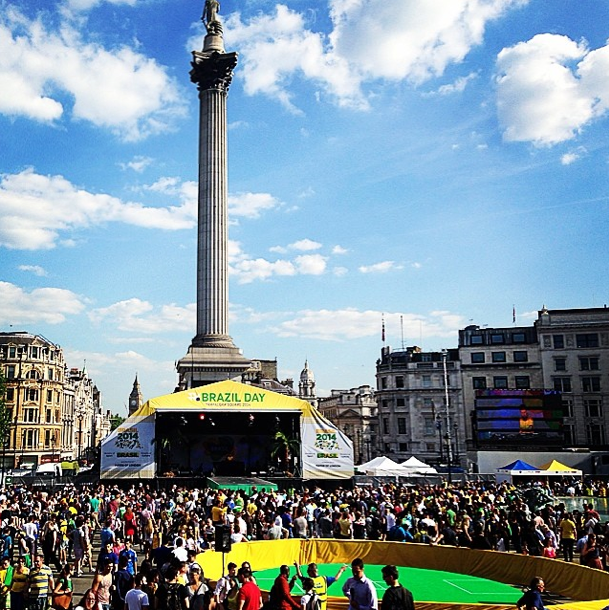
The World Cup opened in Brazil with a swirl of colours, dance and controversy. In London it was blue skies and sunshine as Brazil Day landed in Trafalgar Square giving citygoers a taste of Rio.
Today the sun slept-in after shining all week and a spectacular show of solar flares captured by NASA. The weather was hot, humid and overcast when Emily and I got to the apiary to light up a smoker and start Saturday beekeeping.
Last week we had left the unnamed queens of our split hives to settle-in and lay. There was concern that neither had started to produce eggs, and that one queen looked small and unmated.
The first hive we opened was artificially swarmed from Chili’s hive. Chili is a good queen and I was pleased when we did spot her daughter walking confidently across the frame. The new queen is now bigger (she has mated) and inherits her mother’s tiger stripes and colours. Emily spotted eggs and the colony seemed content. We closed up as there was no need to disturb the queen further and gave her small colony more syrup for the week.
The second artificial swarm was split from Chamomile’s hive and her daughter was spotted by Freddy, a keen beginner beekeeper, only two weeks ago. She was a big dark beauty, again like her mother. We didn’t see her today, but her bees looked more purposeful and eggs were seen, so the queen has started to lay. Emily spotted cells that had two eggs inside them, although the eggs were at the bottom of the cells, where only a queen could reach with her long abdomen. It might be that she is just getting used to her queenly duties, rather than a laying worker inside the hive.
I’m glad we gave the new queens more time to settle-in before deciding to combine the colonies. It can take a new queen longer to mate and begin to lay than the books say. Other factors can affect her egg-laying, such as poor weather, lack of forage and stores. In these circumstances, the workers might feed the queen less to slow down or stop her laying. This might be because they don’t want more hungry mouths to feed during times of scarcity.
Myrtle, our favourite queen, was next. Her hive is almost bursting with bees and I feel that the shook swarm at the beginning of the year worked to reinvigorate this slow-moving colony. The brood frames were lower on stores than I would like, although when the foragers returned home at the end of the day this hive would be quite crowded. The workers can’t fill all the cells with stores because the queen needs space to lay. So, for the first time in two years and with great excitement, we decided to put a super on this hive!
There was also another development. Emily had successfully caged Myrtle and was keeping a close watch on our escape artist queen. This was when we saw signs of queen cells being built in the middle of frames, although there were no larvae inside them. I suspect Myrtle’s bees might be planning to supersede her, because she is over two years old and her laying pattern is becoming patchy. It is something to keep an eye on.
Three hives down, we had a tea break and enjoyed a slice of marmalade cake made by Emily. Then it was back to work. I oversaw as Freddy inspected Chamomile’s hives and Emily helped Jonesy with his hive.
Freddy has the makings of a good beekeeper and he would like to keep fierce bees to learn how to handle them and to get lots of honey. We are thinking of selling him Chamomile’s hive. However, I would prefer that he does a few inspections on this colony first, and find out whether he can get along with this feisty queen.
He did very well and Chamomile’s colony was recovering from the artificial swarm and building up nicely. I pointed to a worker with blobs of shiny red propolis on her hind legs, which the bees will bite off and use to disinfect and insulate the hive. Freddy was surprised when I told him that London bees might collect propolis from tree resin or roof/road tar, whichever source is more convenient!
Chili’s hive was next and both queen and bees were happy to perform today. Her colony is also recovering fast and well from the artificial swarm. We will have to wait another two or three weeks, I think, before deciding which hives to combine or which queens and colonies to sell. But that’s a nice problem to have.
Our beekeeping done for the day, and some teaching fitted in, we visited the other hives. Sadly, we heard that David’s fierce ‘Welsh’ hive has gone as the bees were sick. It is a shame as the colony was well-established and fondly thought of, I shall miss them.
Thomas has been experimenting with natural comb in his supers, but his bees haven’t quite got the hang of it. While Jonesy was hovering about vying for queen cells to requeen a nasty-tempered hive. He was taken by the ‘cuddly’ Italian bees, although I have noticed that their gentle temperament can turn within a couple of generations, usually when the new queens mate with local drones, and become ill-tempered. Another reason I prefer our mongrel, dark, homegrown London bees.
The sun came out for the end of the afternoon and I was satisfied that the bees were much happier than last week – they even let us finish-up in time for the football. Tonight’s big match is England vs Italy, Emily is supporting Italy and I’m for England, the bees aren’t bothered. I wonder who will win?
After spring has flowered and before summer has quite arrived, there is a lull in foliage in the UK and Ireland which is called ‘the June gap’. As nature takes a breath before the summer rush, there are some perennial plants in gardens that help to bridge the gap but usually not enough to satisfy all pollinators.
The June gap is significant in beekeeping because by this time most colonies have built up their numbers and have many more bees to feed, or they have been split after swarming and may be small, weak and low on stores. It is another date in the beekeeping calendar when hives might, suddenly and unexpectedly, need feeding. This year I wondered if the June gap had come early after finding our colonies low on stores at the end of May.
Buckingham Palace is five minutes up the road from where I work. I enjoy eating my sandwiches at lunch in the rose gardens opposite the Queen’s place. I wonder how her hives are doing?
With this in mind, I left work on Wednesday night after the Queen’s parade and went to the apiary to feed the bees. All the hives have feeders under the roofs except for the hive split from Chamomile’s colony, which, not ideally for the time of year, has a bag of fondant above the crownboard. We ran out of feeders after the sudden increase in hives.
I lifted off each roof to find the feeders drained dry of syrup and bee proboscis eagerly poking under the rims to lick up the last drops. I refilled all the feeders and closed up, leaving behind happier bees.
Northolt Village every shade of green after another June storm on Wednesday night
So today when John drove me to the apiary, I was again heavily laden with litres of syrup and an umbrella. The forecast was dark and stormy, and though the storm had passed early this morning, the air was close and thundery. “Go and stroke all your bees,” John said, “Though it may take some time.”
A question asked by a beginner the weekend before had popped into my head as I walked towards the hives, “Isn’t it bad to feed the bees? I read that sugar is not very good for them.” Honey is better for honeybees, of course. But isn’t it also bad for the bees to starve? It’s an inconvenient truth at certain times of the year that hived bees might need feeding or they will starve and probably die.
If the bees don’t want the sugar, then they won’t take it. Experience with stronger hives, or when there is plenty of forage about, has taught me that bees wilfully ignore syrup in the roof when they don’t need it, and this often tells the beekeeper to stop feeding.
I always wonder when we are feeding our bees how other pollinators are surviving. The bees in London have beautiful gardens to visit and I have seen many big fat bumblebees foraging together.
A study recently published in Proceedings of the Royal Society Bhas shown that bumblebees prefer safety in numbers and feed on flowers where other bees are feeding safely. You can read about it in PhysOrg ‘Safe(bee) in numbers‘.
Emily and I currently have five hives at Perivale apiary and we hope soon to combine some colonies and perhaps sell one, which will leave us with fewer, bigger and stronger hives.
Today’s inclement weather made it unlikely that we would be deeply inspecting the hives. This didn’t matter, however, as Pat had advised to give the new queens two to three weeks to lay, then decide which queens were best before uniting colonies.
The sun came out long enough for us to inspect Myrtle’s hive, which is full of bees and has brood on eight to nine frames. The stores are still lower than we would like, so we decided to feed this colony another week before putting on a super.
We saw Myrtle and tried to cage her in case we needed her. However, she clearly didn’t feel like being caged and escaped twice. Myrtle’s brood pattern is patchy which might mean she is getting old. She is almost two and a half. The bees could supersede her in the autumn, which is how Myrtle herself took over the hive from her mother.
Bees flying in and out of an African-style top bar hive.
Next we checked Chili’s hive and didn’t spot the queen, but the bees were looking purposeful and Emily saw some eggs, so she is in there.
The bees were now getting fractious because of the heavy air and Alan had arrived at the apiary, so we took a break for a bee chat before inspecting the remaining three hives.
Chamomile’s bees were, as Alan said, not happy to perform. Emily spotted the queen, so we quickly closed up and fed them.
Finally, our two swarmed hives. Things were not looking good here and the bees were not happy. In one hive there was no sign of the queen spotted last week and no brood. In the other we spotted a small, probably virgin, queen but again no brood. We’ll give the two new queens a week’s grace to prove themselves worthy rulers.
Sorry for the lack of honeybee and beekeeping photos in this post – the June weather hasn’t been good for either. Yesterday, however, was the 70th anniversary of D-Day and like many people, my family remembered the bravery of those who fought for our country in the World Wars and any wars, for the freedoms that we enjoy today.
Here’s a picture that my stepdad Bryan Howard posted of his RAF days on his Facebook yesterday. He’s looking very handsome in 1960 at RAF Bridgenorth.
And here is my grandfather Kenneth Spooner, who passed away many years ago. My grandad told me tales of wild rivers, crocodiles and bush babies while on foreign duty during WWII. I hope there are no crocodiles here!





























 Mrs Apis Mellifera