A beekeeper’s notes for August

IMG_9073

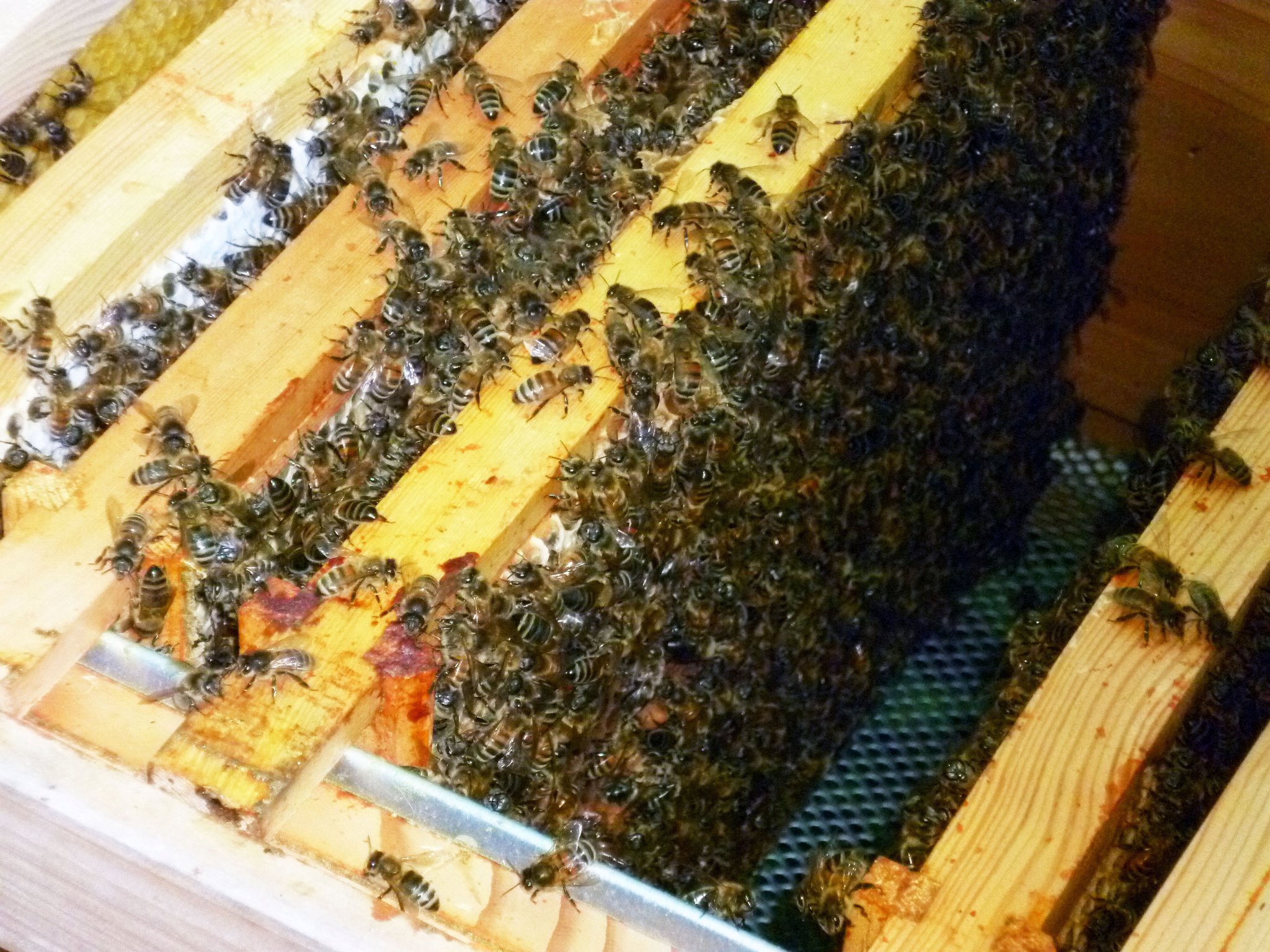
The beekeeping year has begun. Inside the hive the bees are preparing for winter. The queen lays fewer eggs, drones cower as their sisters evict them from the colony, and gaps in the nest are stuck fast by sticky red-brown propolis.

Foragers leave the hive early in the morning and return in the fading evening light. Their bodies are sprinkled with pollen and abdomens heavily laden with nectar. The queen and her workers are getting ready to begin all over again in spring, but first they must cosy themselves in a snug winter nest filled with the final drops of the season’s honey.

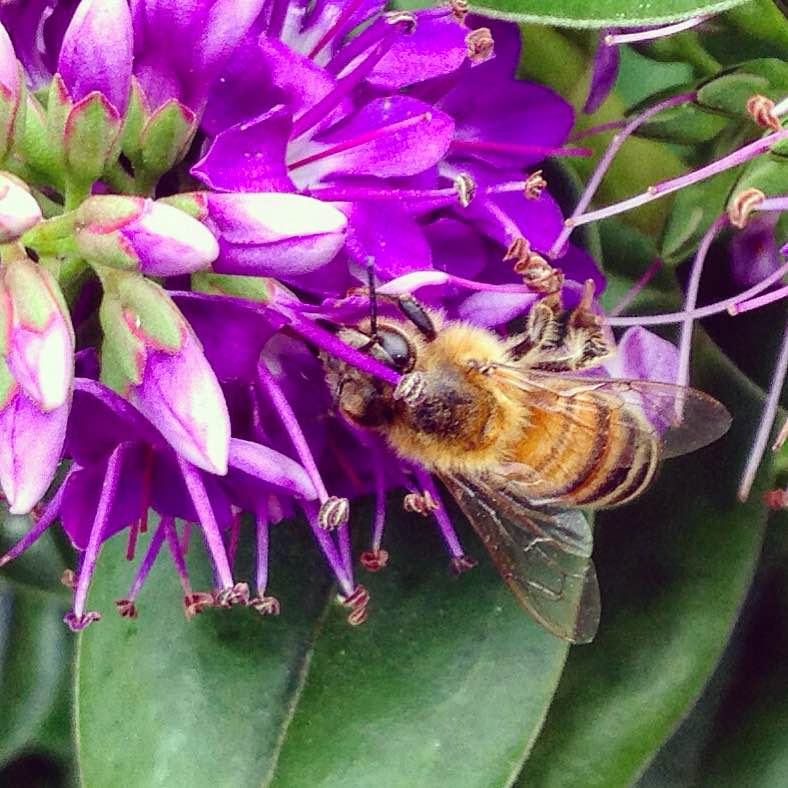
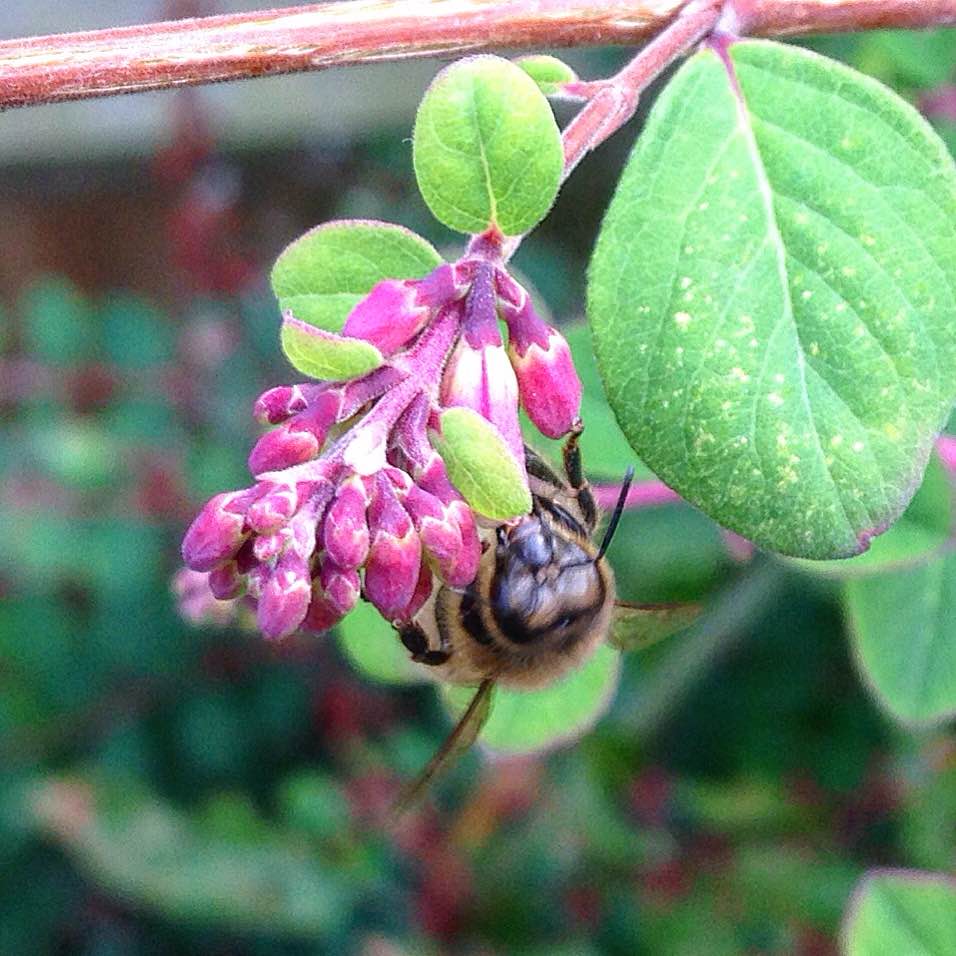
Of course, this seasonal activity varies with location, climate, available forage, and the situation within individual hives, but traditionally this is the picture of the start of the beekeeping calendar. On a recent holiday to the countryside, I saw plenty of bees (honeybees, bumbles and solitaries) out and about. On our return, the garden was buzzing with honeybees drinking from a bush with clustered dark-pink flowers like the last of the summer wine.
IMG_8991

In my kitchen, the honey crop has been settling since Emily and I did the hard work of extracting a few weeks ago. In past years, our bees have made honey that was difficult to spin out in the extractor, but which didn’t take much filtering. This year the honey spun out fine, but it has required more time to settle, strain and filter.

For a few days, our harvest sat in storage containers to let air bubbles and lighter particles float to the top, and larger debris sink to the bottom till the froth, or ‘marmalade’, could be scooped off. When it was ready, I cleared the kitchen table and got out the buckets, muslin cloth and string to start filtering.

IMG_9030

We had extracted the supers in three batches – the third batch being from Emily’s allotment hive – because it’s nice to bottle the honeys separately according to their unique taste and fragrance. Pepper’s crop smells of dark forests and Melissa’s harvest has an aroma of berries-and-lime.

The honey from Pepper’s and Melissa’s hives was first strained using fine muslin tied around two buckets with string. A wire mesh strainer also filtered out the honey that had pooled around the wax cappings.

IMG_9037

IMG_9039

With two buckets full, the air bubbles were still rising. I left the honey to settle for a second time, before scooping off the froth again, and filtering into jars to be bottled. I always use mini jars to make the honey harvest spread further, and keep it stored in a cool kitchen cupboard.

IMG_9046

IMG_9051

Most honeys crystallise over time as networks of crystals eventually form from the heavy concentrations of dissolved glucose suspended in the solution, though this process can vary from a few days to several years. I have one jar of Myrtle’s honey left from last year that still hasn’t crystallised.

Honey extraction, filtering and bottling is a lot of work for the hobbyist beekeeper, and even more work for the commercial beekeeper. For that reason, the leftover wax cappings and other gubbins have been set aside in mini buckets to clean up on a rainy day.

IMG_9042

My kitchen surfaces and equipment were scrupulously cleaned, and I was careful to not to contaminate the buckets, jugs and jars with any drops of water. As Andy Pedley told me once, “Water is the enemy of honey.” However, if I were to sell honey, then I’d need to be more fastidious about the whole operation from straining and filtering, to filling each bottle to the exact amount stated on the label. My family and friends might appreciate a jar of my honey, a true taste of home, but it wouldn’t win any prizes at the national honey shows!

IMG_9055

For the full legislation of the preparation and sale of honey, you can read the updated The Honey (England) Regulations 2015 on the government’s website.

The clean-up afterwards is almost as much work. Hot soapy water and towels to wash down and wipe clean sticky work surfaces, tables and equipment at least three times, but it was worth it!

At the apiary, the beekeeper is also preparing the hives for winter, and there are many things to think about. Is the queen laying well enough to take the colony through winter and to build up again in spring? Does a smaller, weaker hive need to be united with another colony to make a stronger hive for overwintering, with the provision there is no disease? Is the colony healthy and does treatment need to be given for varroa? Does the colony have sufficient stores or does it need feeding syrup before the end of autumn? Is the hive equipment in good order with gaps in the wood sealed and mended, entrances reduced against robbers and pests, and guard against woodpeckers and mice ready to put on? Are the supers staying on the hive or do they need to be cleared and removed for safe storage against wax moth?

Yes, quite a lot to consider, but most importantly is thinking about how to enjoy the last couple of months spent with the bees. Here’s Melissa’s hive with Emily removing the second tray of Apiguard after the workers tried to stick it to the top bars with propolis.

IMG_9076

After a long session of afternoon tea with the Ealing beekeepers, the smoker was lit, with some tips from Pat, and Emily and I were off to inspect our two remaining hives. The beginners had already checked Pepper’s hive, spotted the queen, and found a very high number of varroa mites (almost 600) on the board. This may be due to Apiguard treatment, but it is still disappointingly high. The only positive is that it is better to have varroa mites dropped onto the monitoring board, as a result of varroacide treatments, than in the hive.

Peppermint’s colony was calm and well behaved. These busy bees are rearing new brood like summer is here to stay, and the queen was spotted walking nicely across the comb. The hive is rather low on stores. We didn’t take any honey off of this hive, but it may benefit from autumn feeding after the Apiguard treatment. The mite drop so far is around 100, a lower number is to be expected from a newer artificially swarmed colony.
IMG_9074

Melissa’s colony is strong and well, and the queen was found with her head in the comb searching for suitable cells to lay her eggs. Signs of unsuccessful attempts to overthrow the queen by the workers remain. It looks like Melissa will lead this hive into next spring.

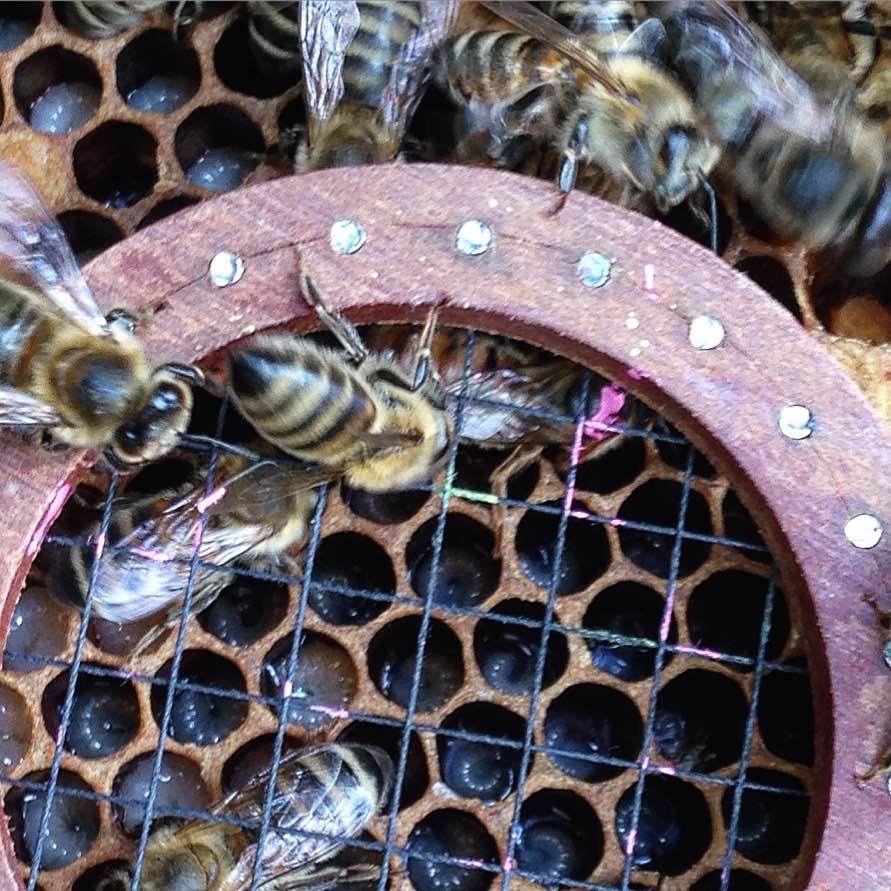
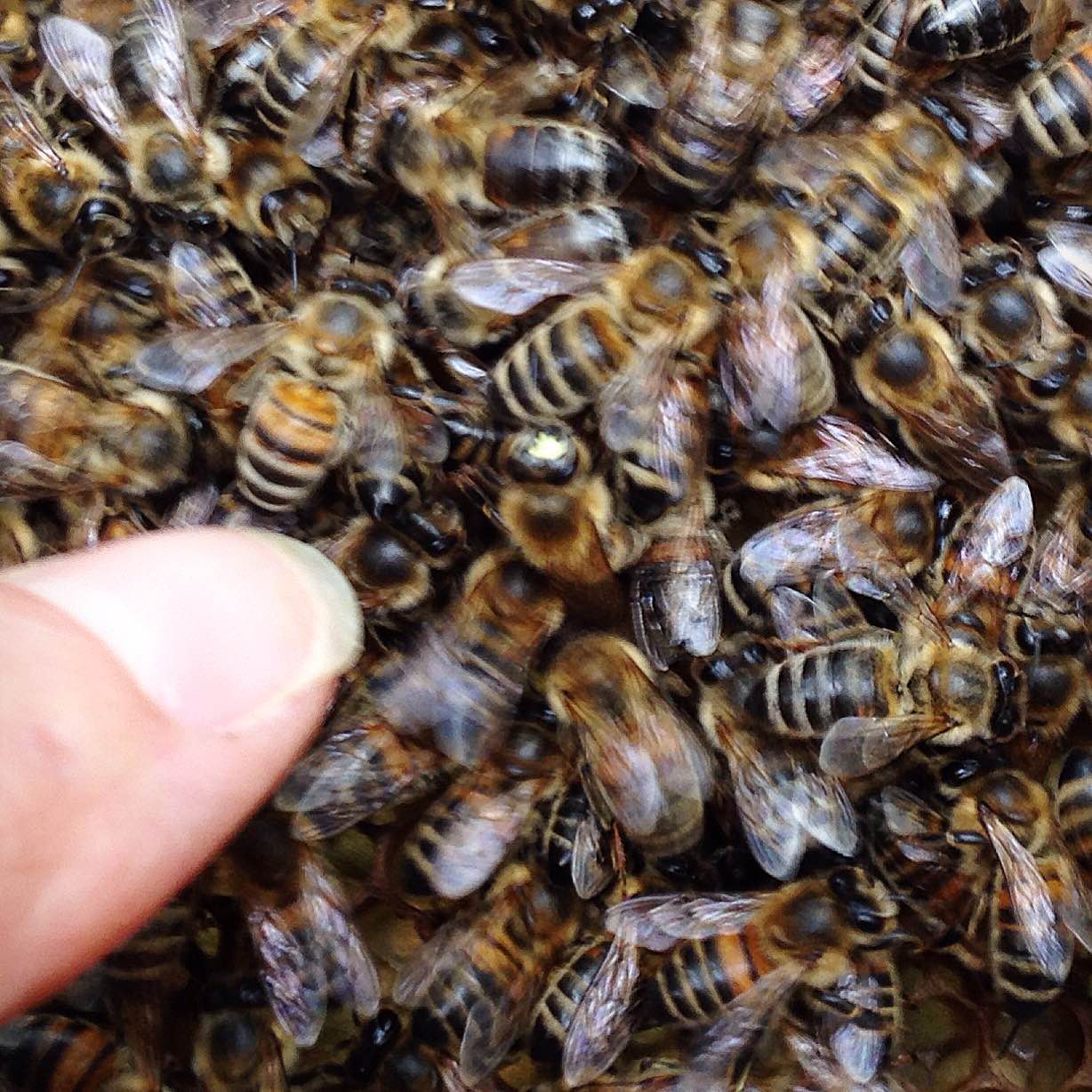
We spotted workers with yellow-splashed faces, perhaps from head-butting pollen into cells or from a flower they had visited (sorry for the blurry photo above, fortunately Emily’s finger is pointing to a worker with yellow warpaint). The white-striped Himalayan balsam foragers were also making their way through the colony.

We closed the hives with records written and plans discussed for the start of the season ahead.

Autumn mists have been falling on roofs and tree tops early in the morning this August. Yet, autumn is my favourite time of year, and in many traditions it is a time to clear out the old and to make space for new things. I can’t feel too sorry for the end of summer, only excitement for the inspiration that autumn will bring.

IMG_9020

A beekeeper’s notes for July

“It was clever of you to buy a house with a honey extraction room,” said Emily. The garage had been fixed up and painted white by Len, my dad, a few weeks ago. I’m not sure this was exactly what he had in mind – there was some talk between him and John about a dartboard – but the newly decorated tool shed worked perfectly well as a honey extraction room.

The supers were placed on the floor and the frames decapped on a work bench. In the corner of the room a new manual steel extractor, kindly gifted by the lovely people at DK Publishing (more on that in another post), spun out the honey beautifully.

Tom had generously helped Emily and I to take the supers off of the hives, and drove us from the apiary to my house. He had patiently waited as we single-handedly picked off each and every bee still straggling the frames.

The rhombus board had done a good job of clearing the supers, but there were around 50 bees in each super. “I love how you two do beekeeping,” Tom joked, because our method of taking away the supers was so painfully slow! I worried that my house was further than the three or four miles estimated for a forager bee to fly from the hive. It was sad to think of ‘lost bees’ trying to find their way home from my garden. A feather lent by Tom helped speed up the process.

After lunch at home we made short work of extracting three supers of honey in the factory set up in the garage, with John also taking a turn at spinning. First Emily’s super from Andromeda’s hive at the allotment was spun out to reveal dark, deeply floral-scented honey. Then we cleaned out the extractor to spin the next batch from Melissa’s hive – a beautiful rich gold, fruity honey with hints of blackberry and lime. Finally we spun out Pepper’s honey which was again darker and smelt of forests.

Three different types of honey from three differently tempered hives. It was a good job the garage doors were closed because a determined wasp headbutted the back window desperate to get inside. We had to see her off a couple of times.

That done, I poured us some old fashioned still lemonade and we had a walk around the garden. I was happy to show Emily the bees at the bottom of the garden and, of course, the fish. The masons and leafcutters are no longer flying about, but I did find a small sweat bee to show Emily on one of the creepers. The air may feel like autumn is coming, but the nectar flow is attracting bees of every size and shape to feed off the Passion flowers, jasmine and primroses.

Later that evening we drove Emily home and got treated to a curry by Drew for all our hard work.

The honey has sat in my kitchen for a week to allow air bubbles to settle to the surface. It is less clean than last year’s crop and will need filtering before jarring.

The cut comb was easy to put into trays – a happy accident thanks to a super frame not returned to Pepper’s hive one week.

Yesterday a month’s rain fell in one day and I got home to find the fish pond almost overflowing. The fish were inquisitively peering over the edges. I thought it best not to satisfy their curiosity and removed a bucket of water to lower the water level. It continued to rain all night.

This morning felt fresher but still unsettled. John drove me to the apiary to return the wet supers for Melissa’s and Pepper’s bees to clean up. The wasps were out and a few robber bees, so we had a quick look inside, put the supers on, and closed up.

Emily had seen Melissa (our best queen for hiding) last weekend, and all seemed fine with the other two colonies. At this time of year, when the wasps and robbers come, I find it’s better to keep the hives closed and less stressed by skirmishes. Emily put entrance reducers on to help the guard bees better defend the colonies, and I started the Apiguard treatment on Melissa’s hive.

Jonesy was inspecting his neighbouring hives. “Can you smell banana?” He asked.

“Isn’t that the smell of the alarm pheromone?” said Emily.

“Do you smell banana a lot?” I asked.

“All the time,” said Jonesy.

That done and we all finished up for tea and cake. Alan had started a bonfire to burn up some rubbish. Jochen arrived to tell us about a swarm he collected with Bill at Harrow Beekeepers.

The weather had made the bees irritable this weekend and even the gathering of beekeepers was modest. I left the apiary as Alan’s bonfire started to roar higher and the skies darkened with clouds.

When summers turn out to be this good for the bees, I wish that I could keep hives full time. The BBC recently had a great feature on learning to be a bee farmer: http://www.bbc.co.uk/news/uk-33663048

With plenty still to come in bee land, I left the apiary to return in August.

Sorry if the formatting of my post is off. I’ve been without a computer for over a month, getting online is a little challenging but another set of beekeeper’s notes are done.

A beekeeper’s notes for June: secrets inside the hive

IMG_8070

“Quick! Take the egg!” whispered the worker to her younger sister. “Hide the new princess in the upper chamber where the queen won’t find her!” The young worker gently picked up the precious egg in her mandibles and ran as fast as she could past the queen’s retinue, and up the stairs where her majesty couldn’t follow. Higher and higher she climbed till she stopped with exhaustion beneath a special cell. The smells of nectar in the loftiest chamber were overwhelming and the scent of the queen seemed far away. 

The young worker placed the egg carefully inside the secret cell already prepared to receive the new princess. The egg would be safe from the queen who would be unable to get through the nectary gates and tear down the hidden queen cell.

The longest day of the year had passed on the summer solstice last Sunday. At the apiary talk had turned to the honey crop and how much could be harvested this year. Emily and I had put two supers on Queen Melissa’s hive, which were filling up nicely. “Let’s check the super frames to see which can be taken,” I said going through the top super. Around the fifth frame in, I found her. A tiny, coiled, pearly larva in a silky white bed of royal jelly at the bottom of a damaged queen cell. Emily and I stared at her curiously wondering how the queen larva had got into the top super. The queen excluder was above the brood chamber and, we hoped, the queen had not gotten past to start laying in the supers.

IMG_8133

The queen cell looked partly torn away and whether that had happened when I pulled out the tightly fitted super frame or by a worker tearing down the cell, we could not tell. We marked the frame and carefully put it back for a further investigation of the hive.

I didn’t find any brood or further queen cells in the supers, but I did find several collections of pollen-packed cells, which is unusual. It seemed the workers were preparing to raise a special brood in the top super, and though the workers can move eggs, nectar and pollen around the hive this seemed a long way to carry an egg from the brood chamber. “Perhaps they heard us saying that we wanted to try queen rearing,” I joked to Emily.

A beginner beekeeper, Mark, was watching our discovery with interest and asked why the workers would hide the queen cell. “To keep it a secret from us,” I said, “Or more likely the queen who would tear it down.”

IMG_8124

Then it was time to go through the brood nest. Here there were only stores and brood, but no queen cells. Emily spotted the queen as I held up a frame, so I caged and marked her with a pink marking pen from Pat.

We closed up the hive. With only one queen cell hidden in the super, and now appearing partly damaged, this seemed a case of attempted supersedure rather than swarm. Emily and I have always let our bees get on with supersedure in the past, the workers know best when to replace a queen. Melissa and her hive were left to their royal secrets until next week.

In the artificially swarmed colony the still unnamed queen was also found and marked by Emily. Two queens now wear pretty pink crowns thanks to Pat’s pink queen-marking pen from Thornes. I wish they would make a glitter pen too.

Emily is mentoring new beekeepers for the London Beekeepers Association (LBKA) and had already checked Queen Pepper’s hive with Mark. This left us time for tea and cake (Polish cake from Clare and home-made ginger cake from Emily) and a casual visit to Den’s hive.

IMG_8125

Den was puzzled about why his bees were making waves of honeycomb above the frames. This was ‘bee space‘, we explained. There was a gap, more than 8mm, between the top bars and the top of the box. The bees would fill up any gap bigger than 8-9mm with honeycomb. The importance of bee space demonstrated and lessons were almost done for the day.

From the apiary to the garden there were fewer butterflies than bees, and I was hoping to attract more winged visitors to our flower beds. A butterfly supper of brown mashed banana on a plate and sugar syrup in a jar was prepared. These were simple to make and, I thought, an ideal activity if you’re entertaining young nieces…

How to make a butterfly supper

(null)_1

You will need: 

  • Plastic plate
  • String
  • Over-ripe brown banana
  • Decorative flowers

1. Pierce four holes in the plastic plate to pull through the string and tie handles on either side.

(null)_2

2. Stick on plastic flowers to make the plate look pretty for butterflies.

(null)_3

3. Mash a brown banana that butterflies love.

IMG_8129

How to make a butterfly sugar feeder

(null)_5

You will need: 

  • Jam jar
  • String
  • Sugar syrup

1. Mix one part sugar to four parts water to make sugar syrup.

(null)_6

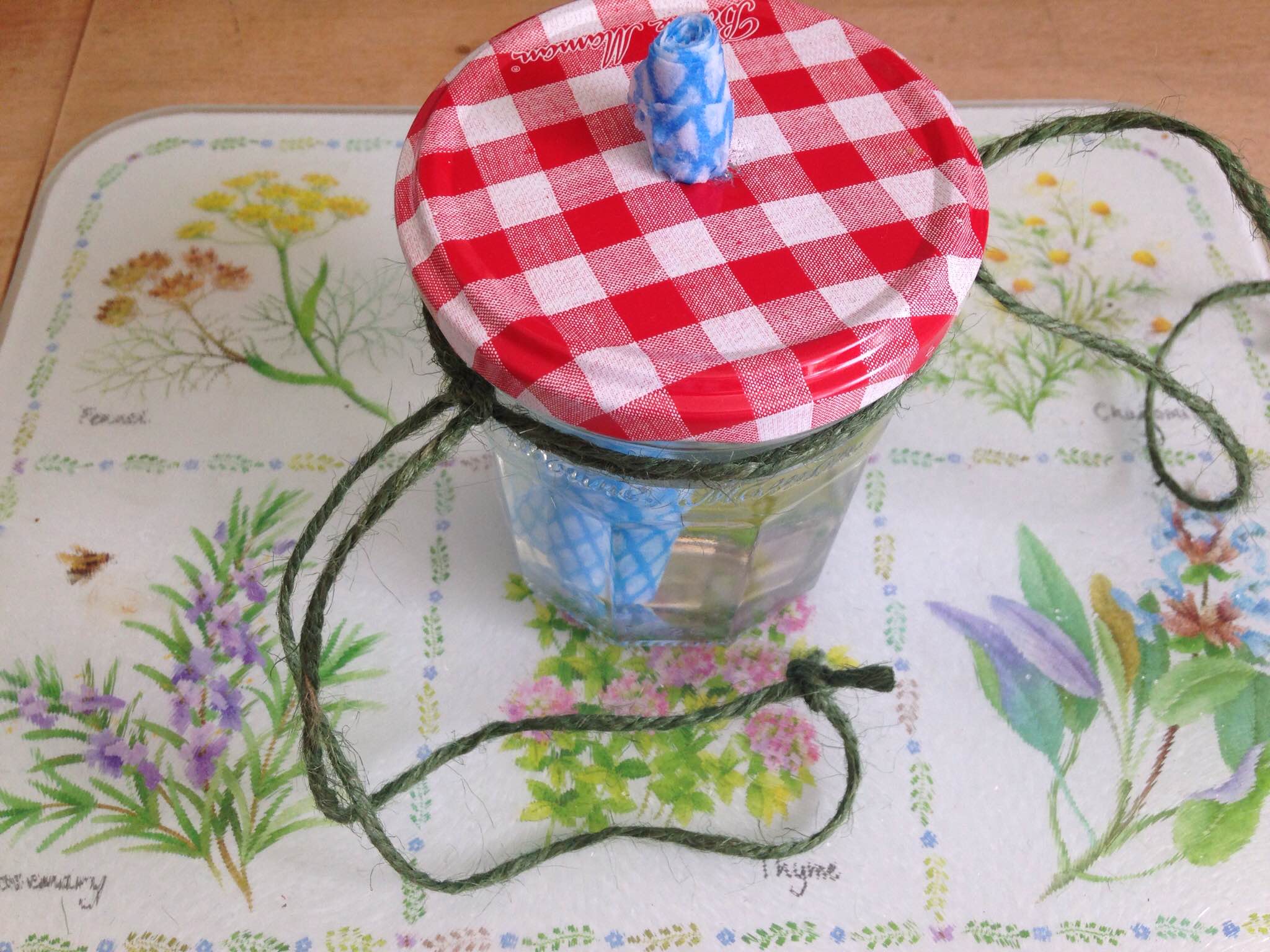
2. Pierce a hole in the jam jar lid and poke through a brightly coloured kitchen cloth.

3. Pour the sugar syrup in the jar and screw on the lid so the cloth can absorb the syrup.

IMG_8128

4. Secure with garden string and/or elastic bands to hang upside down.

The butterfly feeding stations were hung up high in the flowering bush that is busy with bees. We’ve had no customers yet, but I’m hopeful.

So the bees don’t feel neglected in the garden, my niece had a bright idea a couple of weekends ago. She asked me to pick one of each flower to put on a saucer. We then drizzled the flowers in honey. “This is a bee bed,” she said proudly putting her creation on the flower bed wall. “For tired bees.”

IMG_8139

edit: my story of the worker moving the egg is anecdotal (see comments below) and pure guesswork as I can’t know for certain how a suitable egg got into the super for the bees to try and make a queen. Moving eggs is one theory I’ve heard over the years, laying workers is a possibility though these eggs would become drone not queens, or a small queen able to slip through the excluder after all or even a second queen in the hive still unseen…

Lock the gate before the horses

IMG_7916

There was nothing to be done for the beginner’s hive. Overhead a dim sky cast a heavy gloom on the apiary and the air felt warm and close. The bees were bearded under the hive floor and Tom suspected a queen was in the cluster waiting to fly off with the swarm. “He had three queen cells in the hive last week, all sealed.” I recalled. “I suggested an artificial swarm but…” Tom, Emily and I stood in front of the hive that was once headed by Queen Chili. The colony was no longer ours, having been sold to the beginner a month ago, so we couldn’t open up and see what was happening inside. The cluster looked quite small – a cast off perhaps and the old queen flown off?

IMG_7917

Emily had already inspected Pepper’s hive and the artificial swarm, and she confirmed that both colonies were fine. Tom was about to open Ken’s hive to check the bees. The colony had improved in strength and temper. The brood box was almost full and the bees were placid despite the humid weather.

IMG_7918

“Have you seen Albert’s new bees?” asked Tom. Emily and I walked over to the polynuc and watched as the apiary’s most recent arrivals flew in and out of their new home. The colony was a swarm collection.

IMG_7920

The only sign of Queen Melissa in our longest-standing colony were eggs in cells that I could barely see in the clouded daylight, and bees that were behaving contentedly queen-right. The nest had an average count of brood and stores, but with two supers above maybe the bees were focusing on the nectar flow rather than brood rearing.

The varroa board count for June was around 25 mites for Pepper’s and Melissa’s colonies (above 30 mites may be cause for concern) and, as I would expect, a lower mite drop for the artificially swarmed colony which has yet to build up as much brood. “You’re very good monitoring the mite drop each month,” said Tom. It certainly helps get a better picture of the natural peaks in the varroa cycle throughout the year.

IMG_7919

The afternoon was still and quiet. The Ealing Beekeepers were away at the association’s summer barbeque. Tom was heading off to inspect his hives at the bee hut in Perivale Wood and invited us along. It’s been a year since I was last at Perivale Wood and Andy Pedley greeted us at the gates. The bale hut was coming along nicely and people were picnicking in the field.

“Watch out for the horses!” The woodland’s community, the Selborne Society, had recently bought four new horses as part of its century-long management plan to keep the surrounding fields grazed. “They’re a bit skittish,” explained Andy, “Make sure you give them a wide berth and close the gates behind you.”

IMG_7921

We arrived at the bee hut without disturbing any grazing horses and put on our bee suits. The bee hut is a large shed with four hives inside and entrances on the outside for the bees to come and go.

IMG_7922

IMG_7923

From swarming bees to swarming ants, Tom revealed a nest of ants as he lifted the first hive roof. Flying ants taking off and worker ants carrying cocooned eggs showed the full life cycle of this other order of Hymenoptera. I would have liked to remove the ant colony from the roof of my hive, but like a true naturalist Tom had observed the ants’ behaviour in previous years and was not concerned that anything needed to be done. “Last year they flew off once the flying ants had all come out.” The ants were just passing through then, like an airport terminal, and there was no need to interfere, just yet, with an event that had probably occurred in these woodland hives for years.

IMG_7924

It was a very calm inspection with no bees flying around our veils in the bee hut. The apiary environment is different even for mine and Emily’s gentle bees. Tom explained that the bees flying in and out of the hive entrance were probably less aware of us, because we were inside the hut doing the inspection while their outside environment appeared unchanged with no beekeepers standing about.

IMG_7925

IMG_7926

The three of us took the scenic route back to Perivale Wood’s decorative iron-wrought gates. Andy was talking to Elsa when we rejoined him. “There was a fly survey of the woods and they identified over 100 different species of flies,” said Andy, pleased to report the findings of the woodland’s diverse ecosystem. “That explains all the flies in my kitchen!” said Elsa, who lives closeby.

At home there are fewer flies in our kitchen since the fish pond was cleaned by aquatic expert Luke during the week. The fish had enjoyed their holiday home while the pool was cleared of an accumulation of sludge and the fountain fixed. They are now happier than ever swimming around the new lilies and playing beneath the water spray.

IMG_7853

IMG_7873

IMG_7857

A walk around our garden completed a day spent outdoors and my sense of wellbeing was remarkably restored after a busy chaotic week in the city. Birds sang, mason bees hung out of nesting tubes, and bumblebees dangled their legs in front of beguiling foxgloves. The clammy, drizzly start to the day had turned out, in fact, to be a perfect Saturday for a beekeeper.

IMG_7794

A stocking filler from the bees

candle 1

Today is the winter solstice, the shortest day and the longest night of the year in the UK. For a moment the Earth tilts furthest away from the sun in the northern hemisphere, before it turns back towards the light.

My pagan friends celebrate the winter solstice, Yule, by lighting candles to mark the sun’s rebirth. While it is a long time till spring from this point on we can all welcome back the lengthening of days.

candle 2

I’m not pagan, well maybe a tiny bit…

In beekeeping traditions the darkest day of winter is a point of stillness inside the hive. The queen has stopped laying and the workers cluster around her in a broodless nest. A perfect time to give the bees a solstice stocking filler of warmed oxalic acid in syrup.

Yesterday was bright, cold and dry at the apiary. The beekeepers were feeling festive as they ate mince pies and drank home-brewed beer. Everyone was soon very merry!

Andy Pedley was amused that I had decorated our hives a few weeks ago with pine cones and berries to look Christmassy, he tweeted:

andys tweet

There also had been exciting news from Andy during the week, he wrote: “This might justify a special email?” He and John Chapple had been interviewed for Alan Titchmarsh’s The Queen’s Garden, which airs on Christmas Day at 3.10pm on ITV. Wow, beekeeping royalty to follow the Queen’s speech. I can’t wait till Christmas! (You can see John Chapple looking like Father Christmas in his red coat and white beard above.)

Elsa helped us to warm the oxalic acid that we were giving to the bees by standing the bottles in an upturned lid of a teapot. As we marvelled at her practicality, she said in her gentle Australian accent, “I wasn’t a Girl Scout, but I was raised in the bush”.

The sun was dropping fast through the trees and the mince pies had all been eaten. It was time to give the bees their stocking filler.

christmassy2

I’ve blogged about giving the bees oxalic acid before, this year two beginners gave it to the hives. They will make excellent beekeepers. The oxalic acid is meant to burn the mouths and feet of varroa mites feeding on adult bees, so they drop off. It is given in midwinter when the colony is thought to be almost broodless and the varroa mites have fewer places to hide.

christmassy3

Some beekeepers now check their hives for brood a few days before giving the oxalic acid following last year’s findings by Laboratory of Apiculture and Social Insects (LASI), which caused something of a stir among beekeepers. The research suggests any time between 10th December and Christmas is a good time for oxalic acid treatment and that you check for sealed brood, and destroy it, around two days before. I hadn’t forgotten the advice but we didn’t do this. I could tell by looking at the way the bees were moving around and over the frames that there is likely to be sealed brood inside the hives. Perhaps it is a knock-on effect of a longer brooding season due to a milder autumn and winter? What effect that will have on the oxalic acid treatment, I don’t know.

Even so, all’s looking well inside the four hives. Chili’s bees were playful, Melissa’s bees were peaceful, Chamomile’s were curious (a good sign) and Pepper’s were spirited!

christmassy1

Merry Christmas lovely bees!

This is my last post of the year as I take a break for Christmas. So, as an aromatherapy beekeeper, I’ll leave you with a picture of the apiary on the darkest day in winter and a stocking filler from the bees – a home-made honey-and-lavender lip balm that you can make quite easily. The recipe is in the Postnotes below, along with more details about The Queen’s Garden.

All that remains to be said is a Very Happy Christmas bees, humans and everyone!

goodnight apiary

See you all in the New Year xx

Postnotes

Home-made honey-and-lavender lip balm

Ingredients:

  • 40 ml olive oil
  • 10 g beeswax
  • 1 tsp honey
  • 10 drops lavender essential oil

Method:

  1. Heat the oil gently in a saucepan over a low heat.
  2. Add the beeswax, stirring till completely melted.
  3. Mix in the honey then pour into a warmed bowl.
  4. Add the lavender essential oil and stir quickly before the balm starts to set.
  5. Pour the warm balm into small pots and leave to set, then lid and label your honey-and-lavender lip balm.

Of course, the lip balm is meant as a gift – you can’t sell home-made cosmetics without special safety requirements. As an added precaution too, skip the lavender oil if you are pregnant. Aromatherapy texts differ on which essential oils to use in pregnancy and at which stage of pregnancy, and the proper advice is actually a lot more involved than this. I’m not going into that now, so skip the lavender to be on the safe side – the balm really is as nice just as honey and beeswax.

The recipe is also posted on the Ealing and District Beekeepers’ website which I run, as a news item along with a link to the recent Bee Craft live episode on using hive products.

The Queen’s Garden
Don’t forget to watch The Queen’s Garden on Christmas Day! Elsa is sure from a preview that you’ll at least see John Chapple, the Queen’s Beekeeper, pull a frame from a hive!

The Queen’s Garden
Thursday 25th December at 3:10pm on ITV
Queen’s Garden, Episode 1: The first of two programmes in which Alan Titchmarsh gets exclusive access to the royal gardens at Buckingham Palace for a whole year. He watches the garden change over the four seasons and reveals its hidden treasures that have evolved over five centuries. In the first part, he arrives along with 8,000 others to attend the Queen’s summer garden party, but unlike the other guests, he has a different itinerary. He begins by venturing into the garden’s wilder spaces where nature has been left to rule. He meets the Queen’s bee keeper John Chapple, delves into the history of the garden and finds its oldest tree. Late summer is the ideal time to visit the rose garden with its 18th-century summer house. Later, as Christmas arrives, Alan helps royal florist Sharon Gaddes-Croasdale bring in plants to decorate the palace.

Download a free ebook stocking filler here, a Christmas gift from me and the bees.

cover

A Christmas gift from the bees

It has been a fantastic year of beekeeping. To celebrate I’ve made a book to say thank you to everyone for reading my blog. I’ve enjoyed sharing the ups and downs, queens and swarms, honey and drones, with you all. This is a gift from the bees.

cover

The industrious honeybee has inspired people for centuries, while the treasures of the hive bring sweetness in honey and light in candles. What is life like through the compound eyes of the bee? This little book of bee magic journeys through the honeybee year, from season to season.

You can download the ebook for free on Blurb books here to read on iBooks for iPhone and iPads. Or send an email using the form below and I will send you a copy of the ebook. I’ll wait a week to receive everyone’s requests before sending copies.

Go back

Your message has been sent

Warning
Warning
Warning

Warning.

This is my first ebook, I hope you have as much fun flipping through the pages as I did making them. Let me know what you think, because I’m planning more ebooks with all funds raised donated to a charity Bees for Development.

A winter’s tale

001

There is a bee legend handed down from bee generation to bee generation about the great sparkle.

“Ooh the great sparkle,” say the bees as they see the twinkling stars and the early evening frost. “Get inside quickly before the instant freezing grips you in its icy hold.” Then they all settle down in their nice warm hives to listen to the tales about Jack Frost.

It is a fable, of course. Frost fell on the farm in Hereford last weekend. I imagined the bees peering out at the frozen earth.

003

Yesterday was another beautiful winter’s day when Emily and I met for lunch in Ealing, back home in London. A mushroom risotto warmed us before getting the bus to Perivale. The clear blue sky was tinged orange in the late afternoon sun.

Emily’s marmalade cake caused a stir among the beekeepers who had gathered for tea. “Your bees have been flying like hell,” said Stan, as I cut a slice of cake.

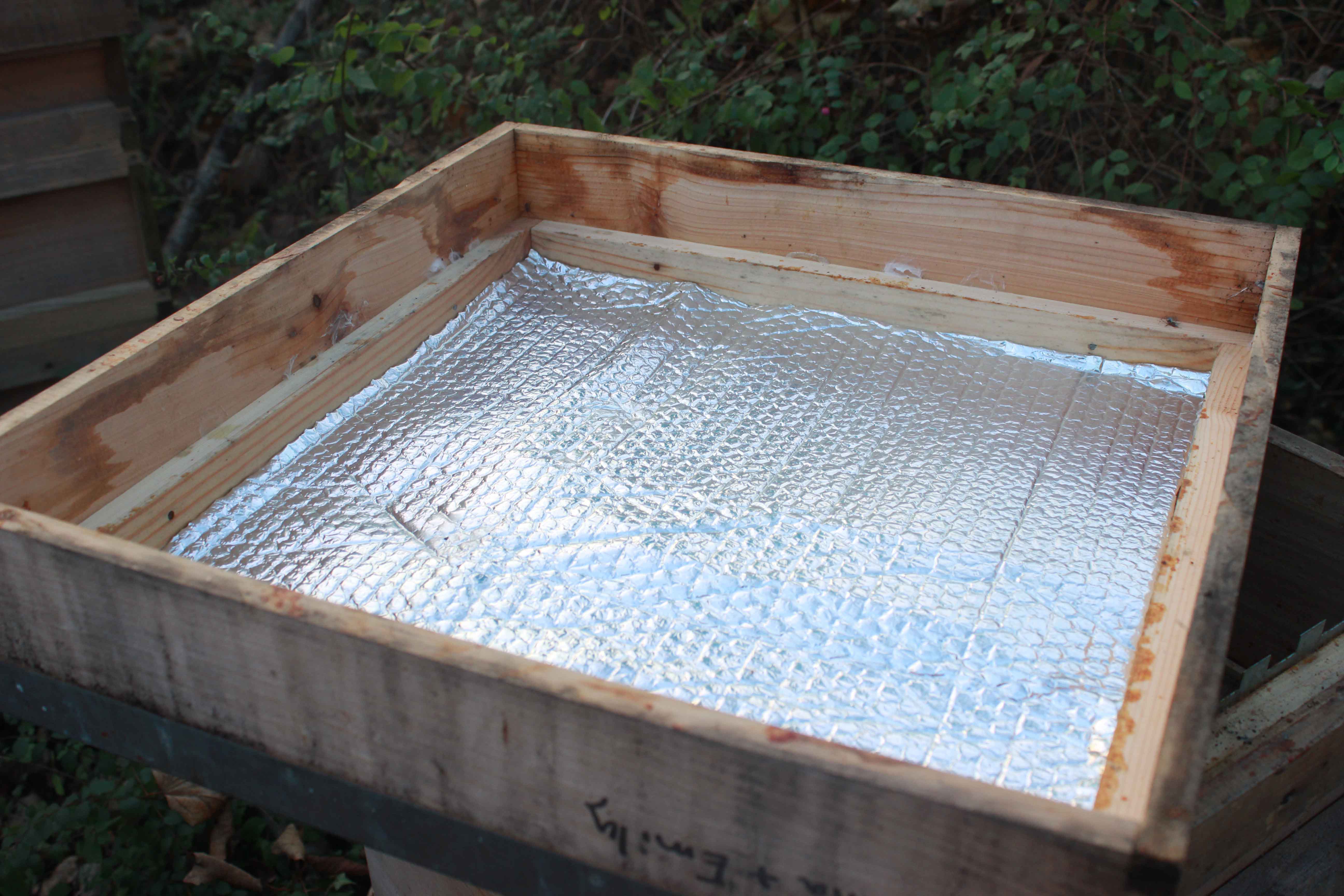
Another bee legend at Ealing apiary, Alan, gave Emily and I tips on insulating the hives with the foil bubble wrap. Here he is showing Emily how to cut squares around a queen excluder to fit into the roof.

003

Alan then helped us to fit the foil bubble wrap inside the roof of each hive. The colony will do a good job of keeping themselves warm in winter, but the foil will help to reflect the heat back into the hive. Hopefully, the bees will feel even more cosy.

004

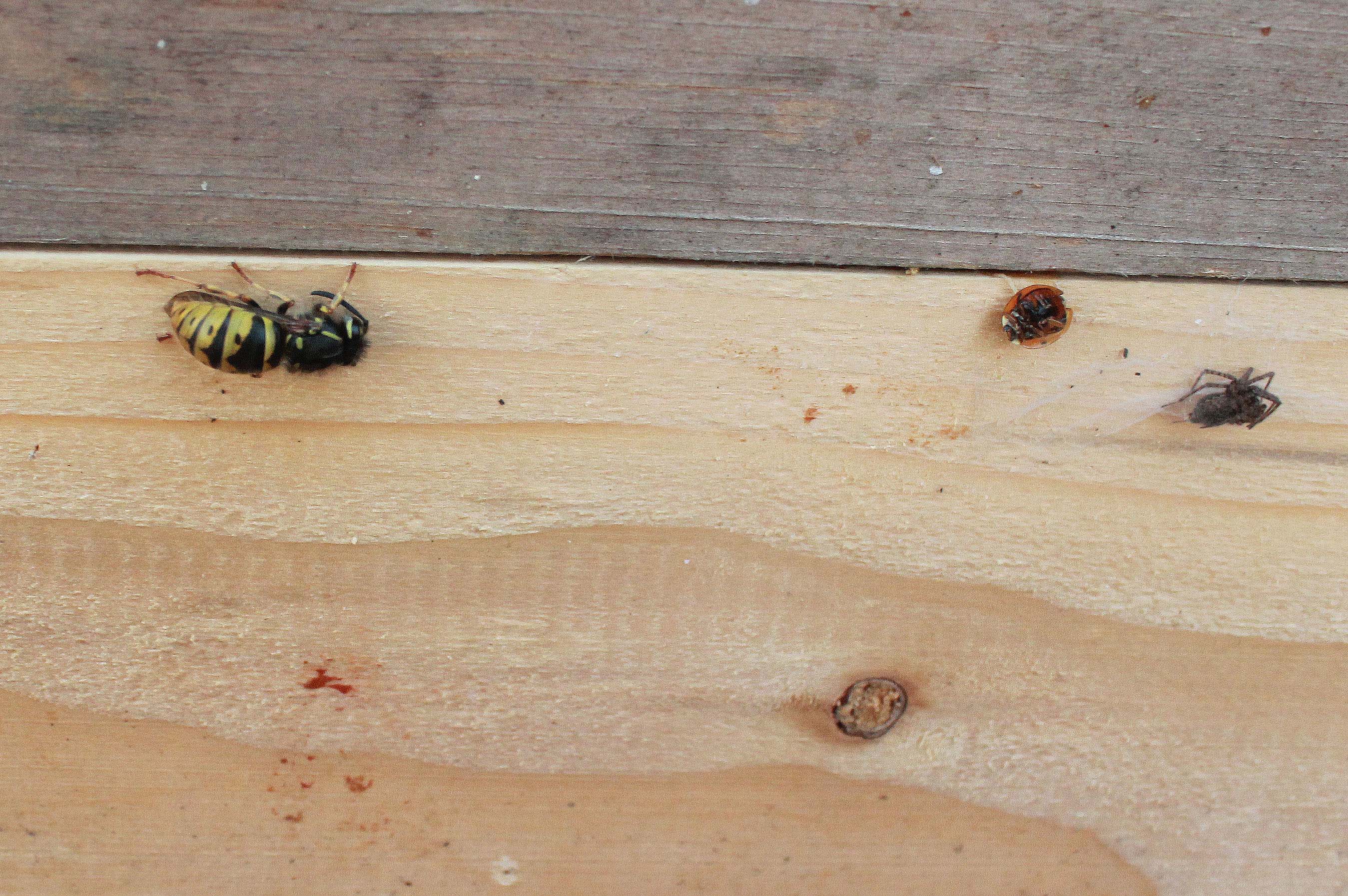
Bees tucked in for winter, I got a surprise when lifting the roof off an empty hive to put away some equipment. A sleeping wasp with her wings folded neatly by her legs. A bit further along the wood was a desiccated spider and a ladybird who may have died in suspicious circumstances… What dark fairy tale had unfolded?

005

I gently placed the roof back on the hive trying not disturb the sleeping beauty. She looks small for a wasp queen, perhaps a worker who had abandoned her dying nest? In any case, few hibernating wasp queens survive the winter, either succumbing to the cold or spiders, she’ll have as good a chance as anyone else.

The hives had become still as Emily and I got out the chicken wire to make a start on wrapping the bees for Christmas. The dusk was chasing away the day.

006

… As usual, and as happened every year, there were those bees who didn’t heed their sisters’ warnings. They were caught by Jack Frost’s creeping, sometimes sudden, appearance. The late returning foragers caught frostbite on their wings, or even worse turned into instant bee statues on a flower. Those who returned home too late could only be saved if they happened to land on the hive roof, so that their beekeepers could breathe on them warm air and thaw their frosted wings. These lucky bees were the ones who told the tales that were handed down.

007

It is a story, of course, as we left the quiet hives behind us to keep their winter secrets.

Winter breaks for bees

It’s getting chillier. How are the bees enjoying their winter break?

They’re building igloo hotels from honeycomb.

009

Climbing the sugar slopes to ski downhill.

004

Relaxing on heated sunbeds to get a winter tan.

011

Bringing home gold-wrapped gifts from shopping malls for Christmas.

012

This autumn’s warm weather and unusual bee behaviour has puzzled beekeepers. Facebook beekeeper groups are abuzz with posts about bee activity; workers still foraging, queens still laying, drones still sighted. The hot topic: “Should I inspect my hive or not?” is dividing opinion between “This winter breaks all the rules” to “leave the bees alone”. Personally I would leave the bees to get on.

If I open a hive to find a queen cell or a virgin – how is she going to mate with fewer drones about? Hive combine, perhaps? But is the old queen still inside? These things are never straightforward in summer and in winter it’s often too late to fiddle with the bees.

The bees don’t worry. Does this bee look worried?

002

I think she may be a young worker from her fluffy coat, enjoying a brief rest from an orientation flight.

Beekeepers worry in winter because they have to leave the bees alone. The sight of bees flying out and about is a concern, because it means they are using up their winter stores to generate energy for all that increased activity. They are finding plenty of pollen to bring home, but are they finding enough nectar to replace the stores they are using? An Ealing beekeeper who keeps his hives at Royal Botanic Gardens Kew says the flowers there are continuing to bloom, so I’m hopeful that our bees will find forage too – closer to home.

This winter I am going to enjoy watching my bees, something I never have enough time to do in summer. Like surprising this bee by catching her in the less graceful yoga pose of ‘face-in-sugar with bum-in-air’.

005

006

What could be more fun for a bee than a winter coasteering adventure? Experiencing breathtaking honeycomb coastlines with towering cliffs, caves and jumps.

010

007

While beekeepers scratch their heads at the sight of bees enjoying an unseasonal winter break, the bees know winter is coming and they are making the most of the sun.

EDIT: What do beekeepers do on their winter break? Well, I’ve refreshed the website of my beekeeping association, Ealing and District Beekeepers, to tell people who we are, what we do and where to find us. If you’re in London next summer, check out how to visit. I’m never far from a bee book most of the year and spend much of winter buried in them. My winter study posts about bees will start again soon.

I’ve also refreshed my blog pages with a new blog index to find more easily posts about beekeeping, bumble bees and solitary bees, nature and wildlife, aromatherapy, travelling, photography and more. There’s an updated About me page and I’ll be bringing out new pages about beekeeping and aromatherapy with useful downloads, and an updated blog roll directory over the winter months.

The wasp palace

IMG_5547

The afternoon had turned out perfectly nice for beekeeping. A low sun brought its warmth closer to the bees who were flying out and about like on a spring day. Mushrooms with long shadows had popped up all over the place to remind me it was autumn.

It was the second Saturday of the month which meant that Ealing beekeepers were at the scout hut for a workshop. But I was not the only visitor to the apiary, there were also the wasps. Last Sunday I had laid a couple of traps to deter wandering wasps from bothering our hives. Yesterday I found out it might not be so easy.

IMG_5576

This is as close as l’m going to get to a (suspected) wasps’ nest, even in a bee suit. A small burrow in the ground with fast-flying insects coming and going in a blur. Too small for bumbles and too many for solitaries. Had I stumbled on a wasp palace?

Wherever the wasps were hiding, the Wasp Queen had given orders to attack Queen Chamomile’s bees. As Emily arrived and stepped through the mushroom path, I had found a dent in the woodwork of Chamomile’s hive that hadn’t been there before. It seemed too early for woodpeckers who would still have lots of other tasty things to eat. “They don’t usually become a problem until the ground gets hard,” said Emily.

IMG_5549

EDIT: wood damage from rot, woodpeckers or very determined wasps! Some helpful suggestions in the comments below.

Irritated by the wasps circling the hive boxes like sharks in the water, I looked at the front and saw a row of wasps scraping and gnawing at the wood, determined to get inside.

Luckily, Emily and I had some spare duct tape and together we taped around the vulnerable seams of wood between the hive boxes and the crownboard. The wasps weren’t happy and retreated back to their queen for new orders.

IMG_5580

There is nothing more tempting to a beekeeper on a sunny day than a wooden box full of insects. But we resisted the temptation to open the hives. The opportunity for wasps to fly in and stress the bees would be too great. Instead we cleaned and topped up feeders with syrup.

We also left small bags of dry sugar under the roofs of Melissa’s and Chamomile’s hives as an experiment. Emily had read that some beekeepers feed hives dry sugar in autumn and spring, leaving the bees to add the water themselves. Though all our colonies are heavy with winter stores, Melissa’s inquisitive workers immediately checked out the spilled sugar. We’ll see next week if they liked it or not, as it’s a useful tip to know if we’re ever caught short of syrup or fondant.

IMG_5584

We then walked around the apiary to visit the other beekeepers’ hives. The new bees living in David’s old green hive seemed much better tempered and were content for us to watch them come and go. Although I spotted a hitchhiker on a returning forager (image above, bottom left).

Emily found a worker crawling beneath the apiary’s top bar hive with shrivelled wings, likely caused by deformed wing virus (DWV). Another clue that varroa was always lurking and that we must be ever vigilant against bee diseases even after a good season.

IMG_5583

The wasps would probably finish off the hapless bee. They are, after all, useful scavengers. Incidentally, we should also thank wasps for beer and bread.

A new beekeeper had arrived not realising that everyone else was at the scout hut. He had recently got a colony of bees from John Chapple and was giddy with excitement. “I can’t stop watching them.”

John Chapple would tell us to leave the bees alone as, despite appearances being contrary with bees flying in and out with brightly coloured pollen, they were making preparations for winter. Preparations that would be undone by nosy beekeepers pulling at frames to say hello.

IMG_5581

With that we closed the gate and left the bees, and the wasps and the mushrooms, to enjoy the rest of the afternoon in peace.

Postscript notes
Aside from the wasps, this has been a great year beekeeping. Check out my new blog index for posts on this year’s and past year’s beekeeping adventures, along with posts about lots of other things!

Eight is the magic number, sort of

331357_10150371518613383_927758323_o

When you first start learning to be a beekeeper, you may be taught that 8 mm is the magic number of the ‘bee space’. Perhaps this is easier to learn when starting to build your own hives. In truth, it’s closer to 6–9 mm.

What is bee space? Imagine an alley between the neighbouring combs within a bee hive, or indeed a natural bee nest. The ‘bee space’ leaves a gap so that bees can work on the opposite sides of the combs and have enough space to move past each other back to back.

This gap or ‘bee space’ is widely considered to be around 6–9 mm (1/4–3/8 in) and is a key principle in the design of most modern bee hives allowing the bees free passage between the frames and the hive wall and above or below the frames.

57110_10151308979163383_2135209757_o

Bee space is the gap between the frames in the hive, and around the walls and above and below the frames. This gap gives the bees enough space to work on opposite sides of the comb and pass each other back to back.

I’ve read that the variation in spacing might be due to the varying sizes of the different species of honeybee, although 6–9 mm seems a pretty uniform measurement to me.

Why is it important to remember bee space? Because any gap that is too small (less than 6 mm) the bees will fill with propolis, a sticky resinous substance, and any gap that is too big (more than 9 mm) the bees will fill with brace comb (bridges of honeycomb). This, of course, makes it harder to move the frames and boxes of the hive during an inspection.

Beekeeper David A Cushman describes bee space as “A gap in a natural nest bees don’t fill up”. He provides an interesting list of the different types of bee space. He also suggests sometimes the bees will fill small gaps with pollen, perhaps to allow some light to filter around the hive.

293634_10150371515963383_1772260056_n

Bees filling a small space (less than 6 mm) above the top bars with stick propolis.

But whether it’s 6, 7, 8 or 9 mm, leaving a gap that the bees feel inclined to fill isn’t sensible. So, of course, that’s what Emily and I did. To be fair, this was during the four-week course of Apiguard treatments for varroa, where an eke (sort of an extension wooden frame) creates a space beneath the hive boxes where the Apiguard tray rests on the top bars.

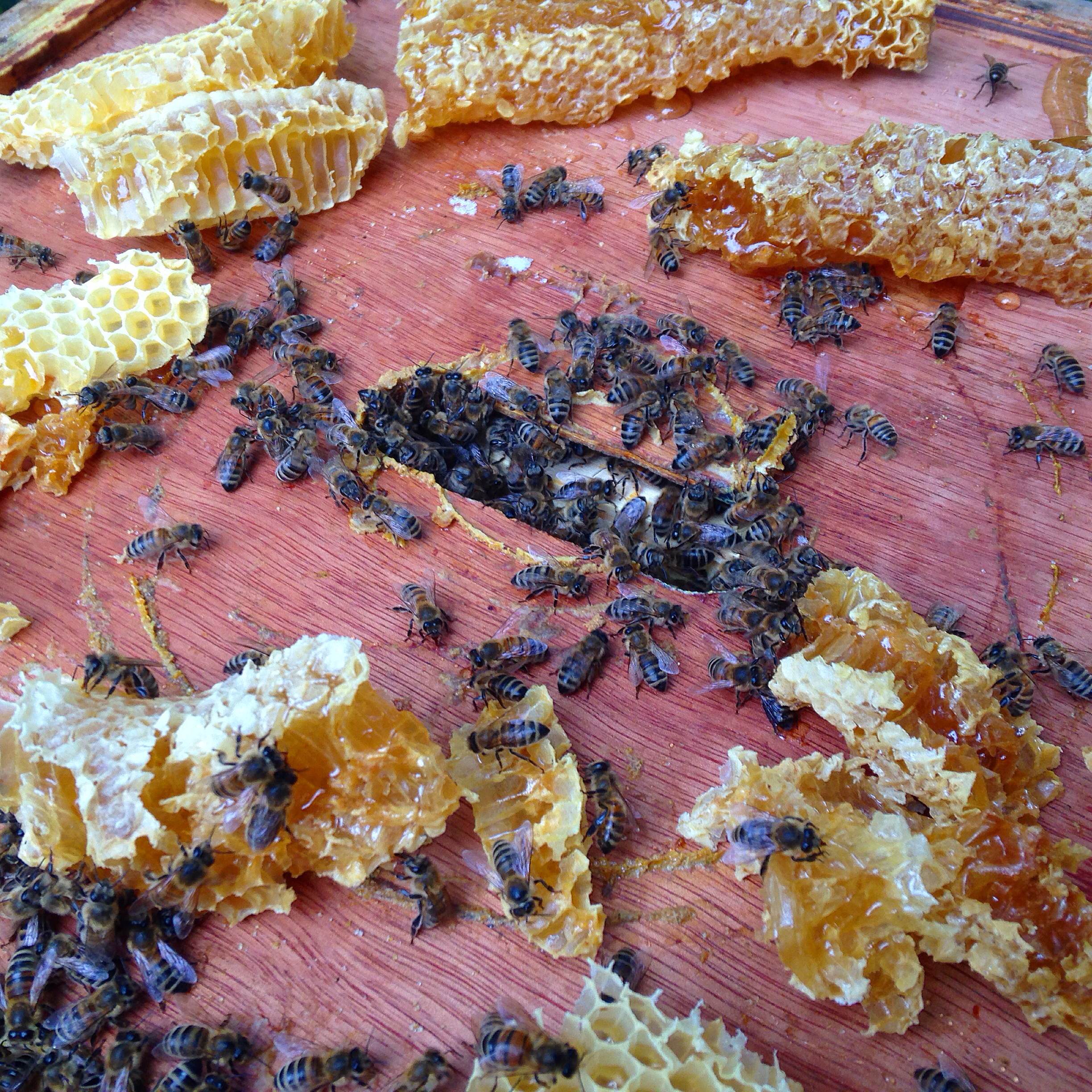
In Melissa’s hive our bees had dutifully built brace comb to fill the gap bigger than 9 mm. And it wasn’t easy to scrape it off the bottom of the super without the help of a hive partner. The bees showed their appreciation of our efforts by munching the oozing honey.

Some beekeepers might consider leaving space for the bees to build brace comb a waste of valuable energy and resources when they could be getting on with other work: filling up super frames with honey or getting ready for winter. There might be some truth in this, but I always enjoy seeing my bees build brace comb. The beautiful curved shapes of freely expressed honeycomb gives an insight into the secret life of wild honeybees.

How do honeybees in the wild know about bee space? Well, I haven’t read much on this, but it seems they weren’t taught it by the beekeepers. Bee space, like the building of vertical combs, is all about gravity:

“Guided by their sense of gravity, though, bees can maintain a comb construction that is vertical, and oriented downward from the roof to the floor. The distance between the comb results from the space a bee occupies when standing on the comb. When moving over the surface of neighbouring combs, bees must be able to pass one another, back to back, without difficulty … and this minimal distance is strictly maintained.” (The Buzz about Bees, Jurgen Tautz, Springer, London, 2008.) Tautz says that gravity receptor organs are found on the bees’ leg joints and between their head, thorax and abdomen, which allows them to build combs vertically down in the dark. Amazing creatures.

IMG_5409

Last week we left Melissa’s amazing bees munching on the brace comb honey under the roof, which we hoped they would take down into the nest. Probably an unwise idea as our bees were likely to build more brace comb, but it seemed unfair to take away their secret stash of honey. This week, we would find out what the bees did.

The rainy morning had persisted into the afternoon and though the rain was drying up, the air was too damp and cold for inspections. I arrived to find a small crowd of people at the apiary sheltering under the awnings of the apiary hut. The air was filled with bees, unusual as they don’t often fly over the green netting that separates off the hive area. Perhaps they had also come for tea. In any case, they were happy to fly calmly about listening to the conversation.

Emily came with nuts to feed the magpies and robins. Jonesey was showing off his new iPhone 6 and a new beginner, Emma, was getting to know everyone. The crowd soon dispersed and it was time to see what our bees had done.

IMG_3942

In Melissa’s hive I’m pleased to say the workers had done exactly what they were supposed to do! They had taken down most of brace comb honey into the hive. Emily and I cleared up the empty wax and left the remnants around the crownboard holes for the bees to finish up. I saw a little wasp on the crownboard drinking a dreg of honey. Wasps are desperate at this time of year, starving and dying off. I couldn’t bring myself to kill her but couldn’t leave her inside the hive either. I picked up the piece of comb with the wasp and placed it on the roof of an empty hive.

IMG_3947

We had fed Pepper’s and Chili’s hives with pollen and syrup though they didn’t seem to need feeding, it has been a very kind autumn for bees. Chamomile’s hive was left to check.

We opened the roof and lifted the crownboard – and the wasps flew in! They must have smelt the scored honey frames feeding the bees above the crownboard. Quickly putting back the roof on the hive, there were at least a couple of wasps inside and many more buzzing around the outside, and trying to disturb the other hives.

IMG_3938

I lit the smoker to deter as many wasps as I could, while Emily used newspaper to make the hive entrances narrower. As the wasps cleared we lifted the roof from Chamomile’s hive again and the two trapped wasps flew out. There’s no space for wasps in our bee hives!

That done, we took a walk around the apiary. The rain had stopped, the sun had come out and wasps were still stalking most of the hives. It was time to leave.

Post notes If you’re interested, here’s some more information about bee space.

Top beeway or bottom beeway?
In a natural colony of wild honeybees, bees only leave a distance between the vertical-hanging combs and around the walls of the nest. There is no need for horizontal spaces above and below the honeycomb. But in a bee hive, the beekeeper needs horizontal spaces to move the boxes during an inspection. Here, the concept of bee space is again used by leaving a gap between hive boxes around 6–9 mm. (Collins Beekeeper’s Bible, Ed: HarperCollins Publishers, London 2010.)

“The bee space can either be at the top of the box, over the frames (as in the Langstroth, Dadant and Smith hives), where the bottoms of the frames are in line with the bottom of the box (known as ‘top bee space’) or at the bottom (as in the National, WBC and Commercial hives), below the frames, so that the tops of the frames are level with the top of the box (‘bottom bee space’).” (Collins) Obviously, you can’t mix boxes with top- and bottom-bee space in the same hive or the concept of bee space won’t work.

242905_10150261343648383_1399111_o

Which is better? In Guide to Bees & Honey, Ted Hooper refers to this method of spacing as ‘top beeway’ and ‘bottom beeway’. He prefers the ‘top beeway’ design, which he says is most common in America, rather than the ‘bottom beeway’ design used in Britain (my fourth edition of the book was published in 1997, so I can’t say if this is still the trend on both sides of the pond, particularly as many beekeepers like to experiment).

“Top beeway is much more efficient in use and less of a strain on the beekeeper as supers can be lifted back and placed ‘cross-cornered’ on the hive and then slid around into place. With bottom beeway this cannot be done as the edge of the super box would run across level with the top of the frames and would decapitate any bee looking up between the frames and squash many of those walking about on top of the frames.” (Guide to Bees & Honey, Ted Hooper, 4th ed, Marston House, 1997.)

A short(ish) history of the movable-frame hive
American-born Reverend Lorenzo L Langstroth (1810–25) is credited with the invention of the movable-frame hive. It was Langstroth who recognised the concept of ‘bee space’ in a ‘Eureka’ moment, which became a vital component in modern hive design and which now allows beekeepers all over the world to freely move and lift frames and boxes without breaking up the honeycomb. (Collins)

There had been similar bar hives previously, such as the leaf hive invented by Swiss natural historian Francois Huber (1750–1831), and the multi-layered skep hive invented by Englishman Thomas Wildman (1734–81), an experimenter, showman and beekeeper. It is thought that a movable-frame hive was also first designed by Englishman Major William Augustus Munn, author of A Description of the bar-and-frame hive (1844). (Collins)

The theories that lay behind these models may have helped to pave the way to Langstroth’s discovery.

rogue

When a space that is too big (more than 9 mm) is left in the hive, the bees will fill it with brace comb (bridges of honeycomb) as shown here above the top bars.

Langstroth was frustrated when his coverboards became stuck down with the sticky resinous substance propolis and like any good beekeeper he sought a practical solution. He cut a recess into the hive box that allowed him to drop the hive bars down to 9 mm below the coverboard, which seemed to solve the problem. Then he thought about similarly adjusting the spacing in the interior parts of the hive to make it easier to work with the bees:

“The critical aspect of his design was the space between the edges of the frames and the walls and floor of the box – an opening wide enough for a bee to pass through and hence termed the ‘bee space’.” (Collins) Langstroth initially used a space of 12.5 mm (1/2 in), before he further discovered that bees leave a 6–9 mm (1/4–3/8 in) space between their combs and the walls in their nests.

A Polish beekeeper Reverend Dr Jan Dzierzon (1811–1906) had put thought towards a system of movable frames by spacing the comb 38 mm (1 1/2 in) apart. But it seemed that 6–9 mm was found to be the most practical movable-frame system and Langstroth’s design is used by 75% of all modern hives sold throughout the world today. (Collins)