A beekeeper’s notes for October: Autumn is icumin in

lead2

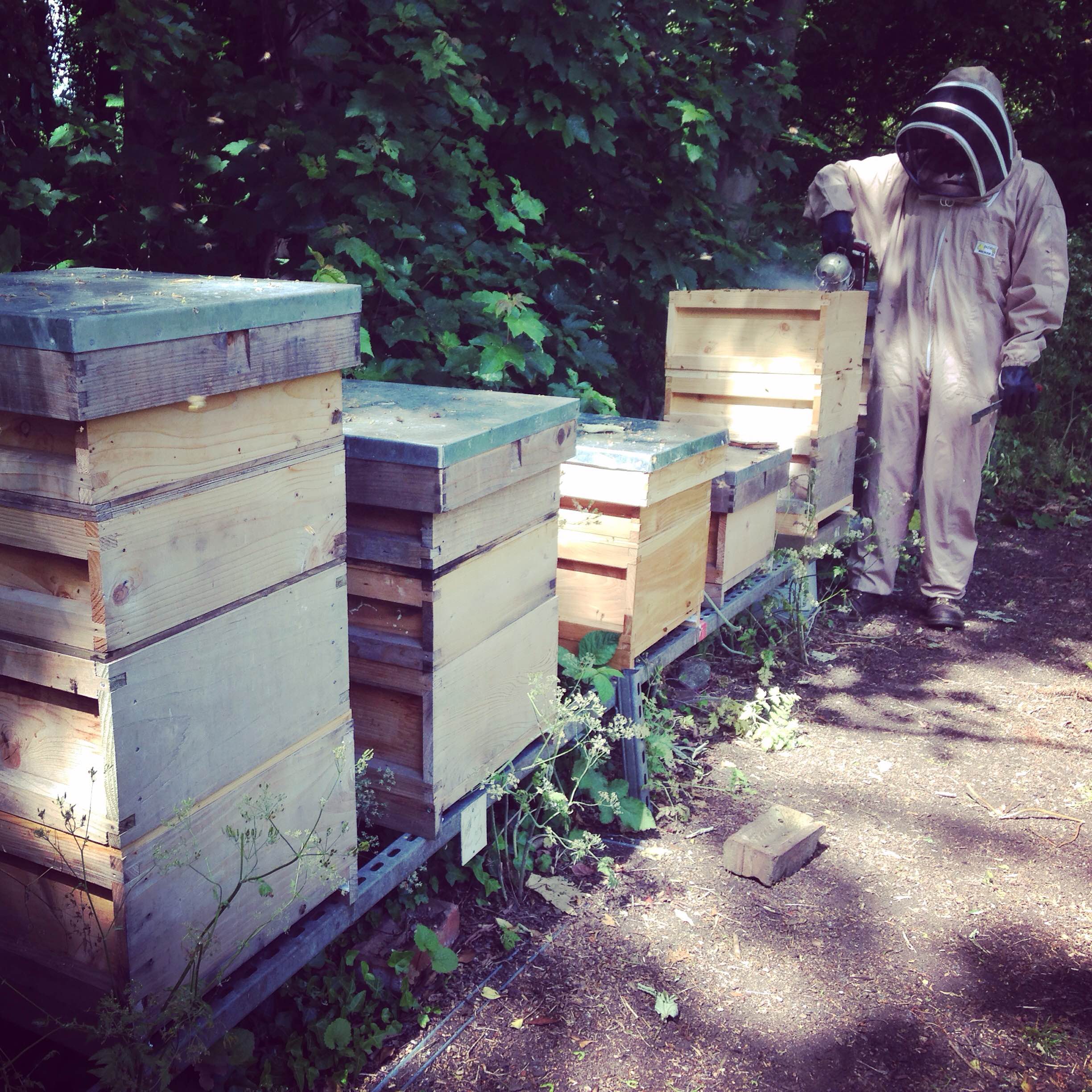
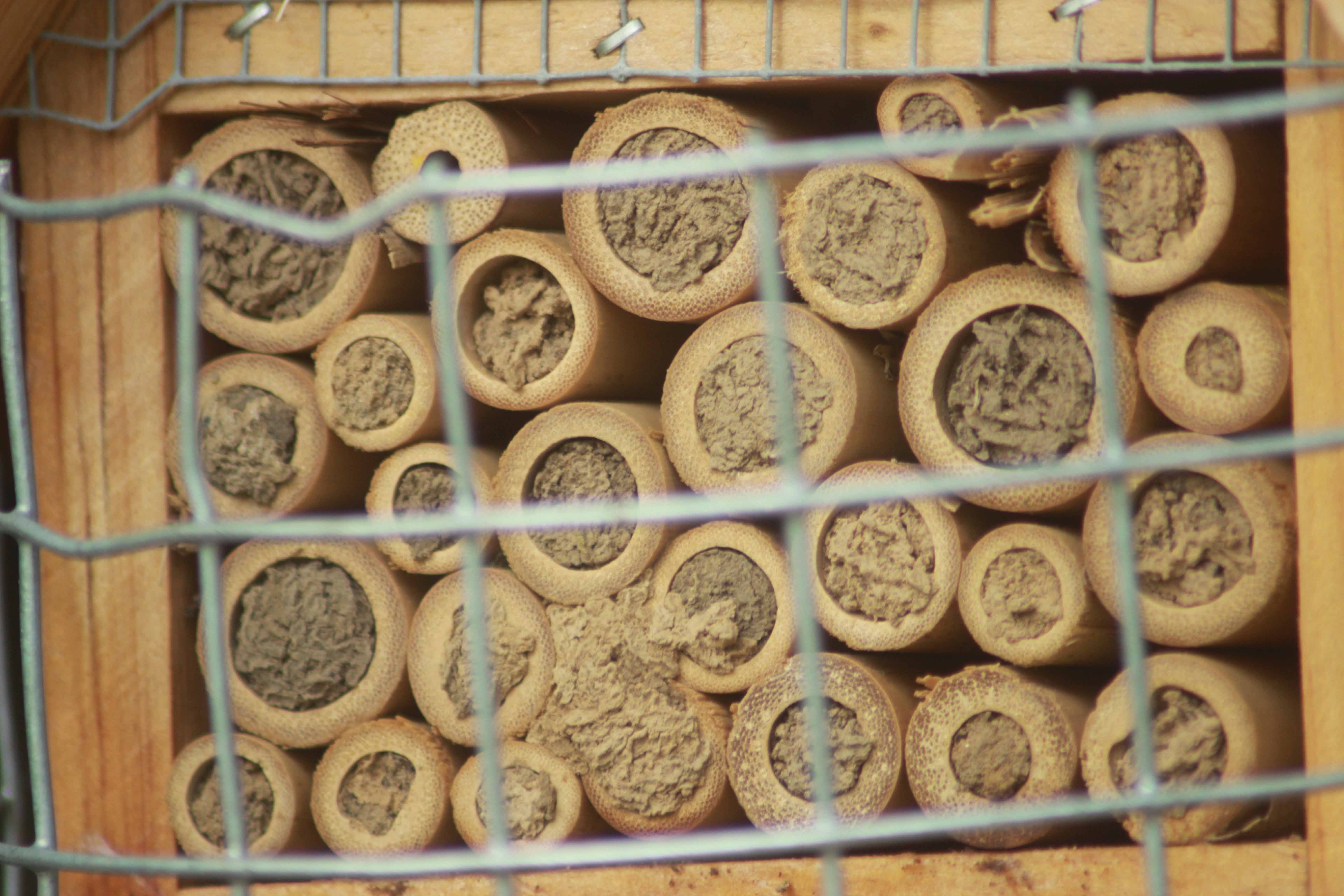
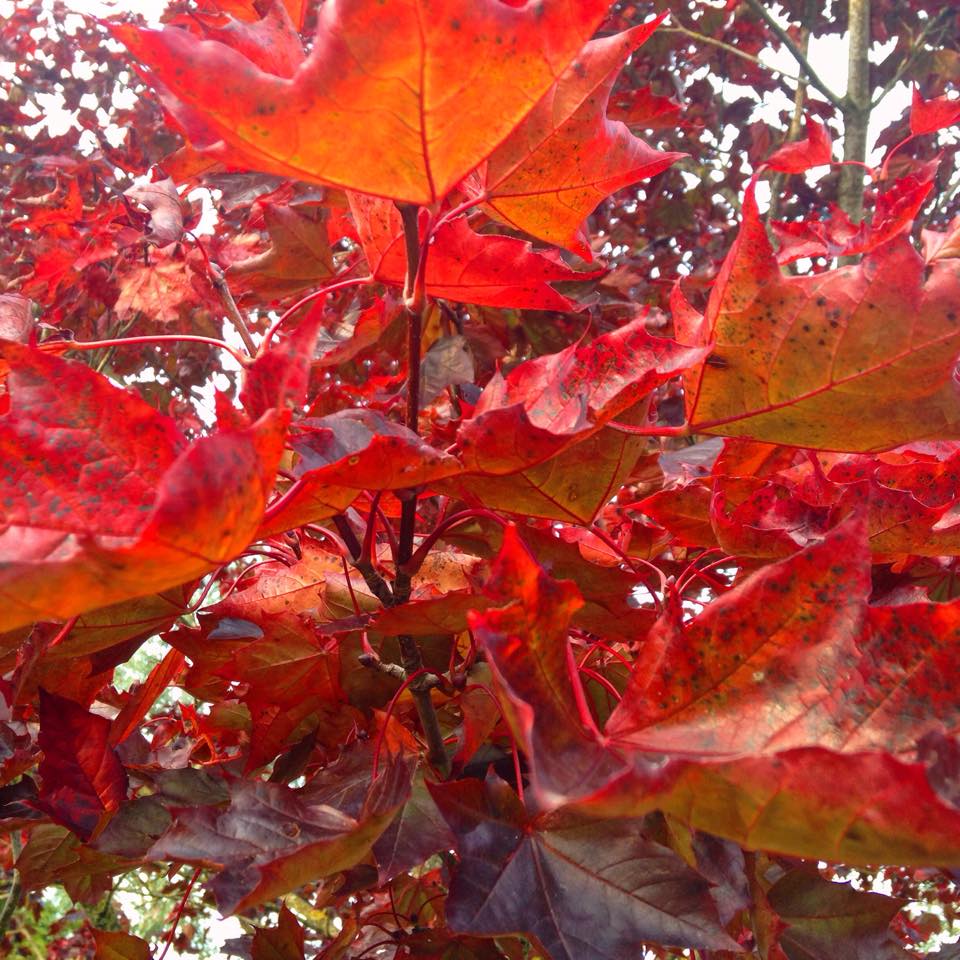
Autumn had arrived almost unnoticed at the bottom of the garden. The crimson vine creeping over the sheds was set ablaze in oranges and reds in the morning sun. The mason bees and leafcutters were still asleep behind closed doors of mud and leaves. I cleared away the overgrown foliage to warm the bee houses in the sunshine and to remove easy routes for spiders and their webs.

lead1

Unlike our solitary bees fast asleep in their comfy homes, the honeybees were bringing back pollen to the hives faster than the foraging squirrels scampering between trees in London parks. Thomas Bickerdike had organised an apiary tidy-up the weekend before and some beekeeping treasures had been unearthed.

IMG_0115

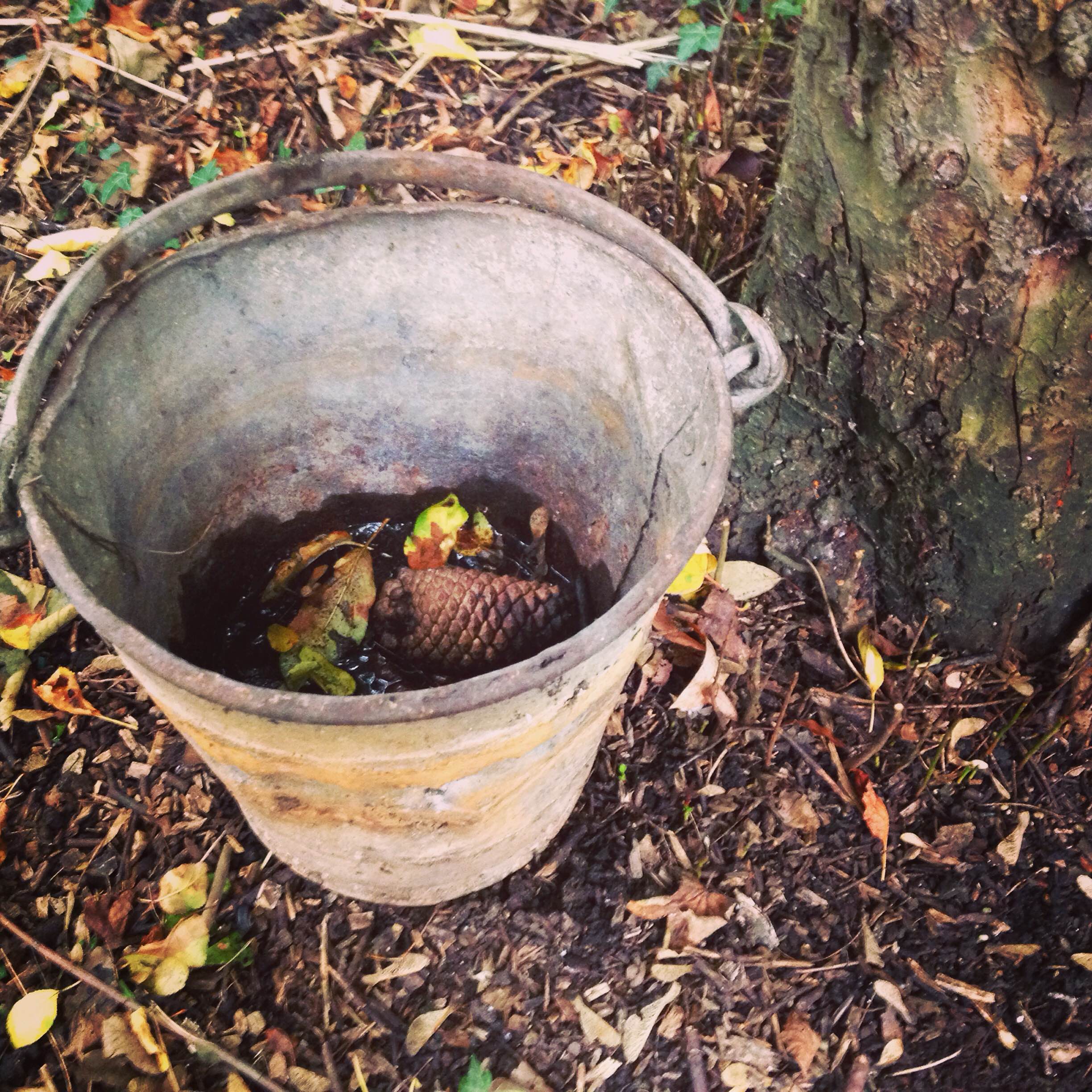
A well-loved smoker and kit box were not the most unusual finds, it seemed. John Chapple’s concerns about witchcraft at Ealing apiary may be warranted, but I promise this cauldron doesn’t belong to Emily or myself.

IMG_0116

It was the second Saturday of the month, which meant Ealing beekeepers were at the scout hut for a workshop and the apiary was free for witches to get up to mischief. As I had forgotten my wand – I mean my hive tool – I had no choice but to wait for my coven partner – I mean my hive partner Emily – to arrive.
IMG_0117

Two weeks previously it looked like Melissa’s hive was getting top heavy. The first super above the brood box was full and the bees were meandering about the second super thinking about filling the comb, but the brood box was lighter in stores around the nest than I would have liked. There may not be a particular reason why the bees have filled up the supers rather than packing honey around the brood – in fact, it’s a characteristic of this colony – but I wanted to close up the nest with dummy boards. This would help to keep the colony warmer as the nights were getting chillier, and, as I had found in the past, might even encourage our wayward bees to build outwards rather than upwards.

The bees were one step ahead of me. Emily and I opened up Melissa’s hive, along with new beekeeper Bertrand, to find that not only had the workers almost filled the second super but the empty brood frames had stores too. Well done girls!

This particular hive loves to build brace comb at every opportunity, regardless of what space is available elsewhere, and had packed a few rolling hills of oozing honey between the top and bottom super frames. Emily scraped off the delicious honeycomb with her hive tool for Bertrand to taste honey fresh from the hive. A taste of autumn.
abc6

The brace comb was not the only mischief that Melissa’s bees had been up to – I also spotted a play cup at the bottom of a brood frame. We couldn’t see an egg or larvae inside and from the shape it looked unlikely to be drawn out into a queen cell. But I have a feeling that Melissa may lose her crown next year.

Peppermint’s hive is much stronger after August rains had left this small colony quite weak. Pepper’s colony had fastidiously packed down propolis and pollen for winter. Bertrand spotted our queen walking calmly across the comb. The super above Pepper’s hive remains empty though the brood box is well stacked with stores. However, some workers were nursing the comb, so Emily and I decided to give them till the end of the month to fill the super before taking away empty frames for safe storage against wax moth.

That done, it was time to go home and decide what to do with all the apples picked with John’s mum on the farm in Hereford last weekend…

abc11

IMG_0101

IMG_0102

More autumn activities soaking the cooking apples in water with a pinch of salt to get rid of lingering bugs (sorry bugs) and wrapping the apples in newspaper to store in the garage before I have time to freeze them or bake pie and crumble.

Summer may have passed the baton to autumn, but we were lucky to have pale blue skies on the drive from London to Hereford and to wake up to beautiful morning mists.

abc13

abc9

And even a drizzly day couldn’t dampen the beauty of turning leaves and pretty villages like Ludlow. Here’s what we got up to in Hereford even before breakfast!

abc2

A visit to the picturesque town of Ludlow to look around the impressive church. You should be warned that behind small church doors are usually a lot of steep steps going up.

abc12

abc5

Two hundred steps up. I’m taking a break by the bells. But it was worth the view at the top of the church tower.

abc8

Here’s my handsome boyfriend John and his lovely parents Roger and Marilyn enjoying a windy day overlooking Ludlow.

abc1

abc3

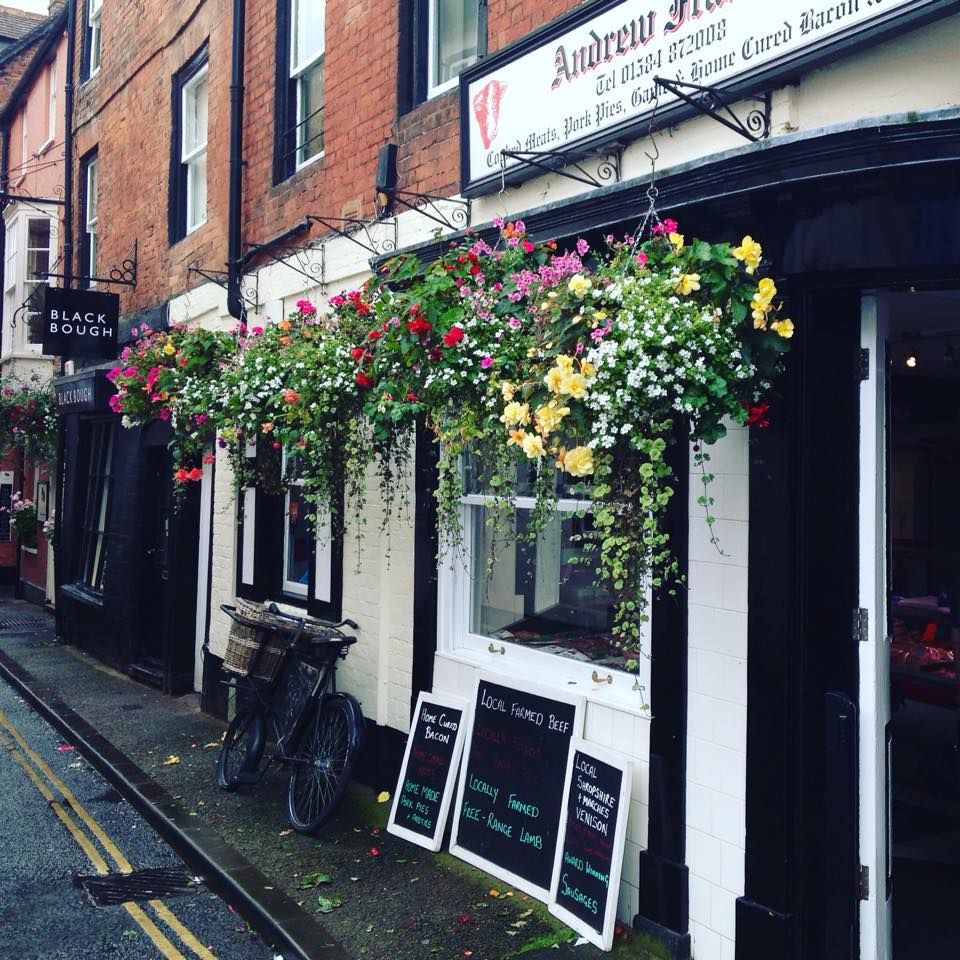
We enjoyed a walk around the parish gardens and market place shops before heading back to the farm for brunch.

abc10

abc14

Autumn may be icumin in, but there’s still lots to see and do! My next post will be at the end of the month bringing beekeepers’ notes for October. Till then, enjoy the changing of the season.

IMG_0123

The day Lolly met the bees

IMG_9727

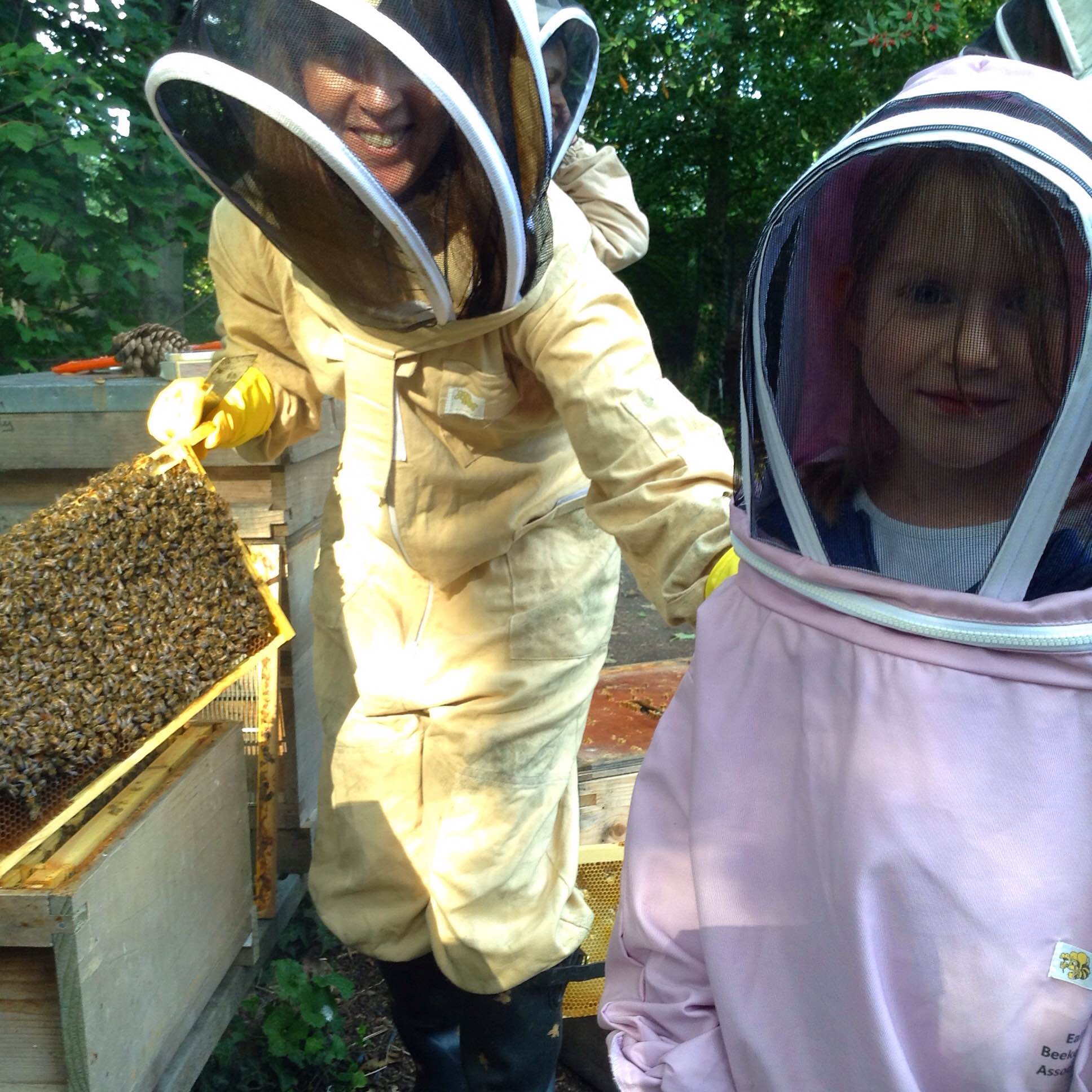
The sun was bright at the apiary when they arrived. Most of the beekeepers had floated home as sleepily as drones. I ran to meet them as small feet in sparkly pink boots pattered down the overgrown path.

The visitors were my sister Amie and her five-year-old daughter Lauren (Lolly). They had come to meet the bees. “Come and meet my hive partner, Emily,” I said, as Lolly looked around curiously. She is very shy in new company so introductions were brief.

IMG_9710

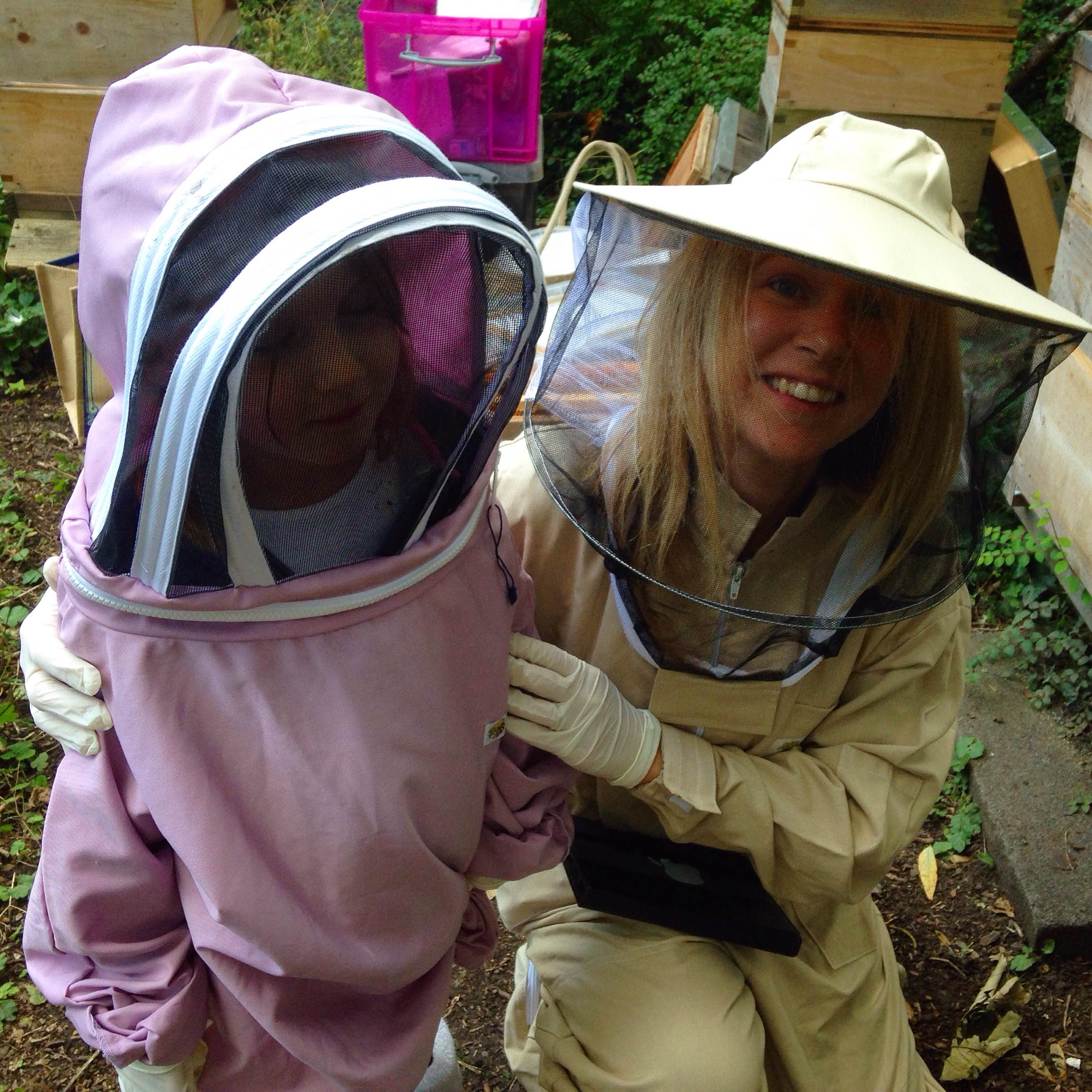
Lolly wore fur-trimmed, pink-glitter Frozen boots for her ‘bee wellies’ and was pleased that I had picked out a matching pink bee suit. These are probably the sparkliest bee-boots that I’ve ever seen.

Emily, Tom and Jochen went on ahead to check Ken’s hive, while my sister and niece put on their bee suits and gloves. That done, we were ready to venture into bee land.

IMG_9711

My sister Amie is suspicious of stripy, stingy flying things, so it was brave of her to visit. She admitted “I was thinking in the car on the way: ‘Oh dear, oh dear – bees!'”

Lolly stood in the apiary clearing quietly taking in all the hives. “This is where the bees live,” I said. “Let’s go see my bees.” We walked to Queen Melissa’s hive and stood watching lots of honeybees flying to-and-fro.

“What’s that?!” asked Amie, as something buzzed past her veil.
“A bee,” I said.
Lolly stared at the hive.

I lit the smoker and put it on the roof. “The smoke makes the bees calm in case they’re naughty,” I explained to reassure them both. “But these bees are very good.”

Their eyes widened as I pulled out a frame of bees from the super box. The bees were busy working on the honeycomb. I pointed out the cells of glistening nectar collected from flowers and the white-capped patches of honey.

IMG_9723

IMG_9713

Thanks Emily, for this surprise picture of us all on my phone!

I showed Amie and Lolly the crownboard to introduce the workers crawling across. “These are girl bees, because they have smaller bottoms than the boys,” I said, “The boy bees are mostly thrown outdoors by their sisters at this time of year.” Lolly nodded at the joke, because sometimes she has to throw her little brother Zac out of her bedroom.

IMG_9712

Next we looked inside the nest. I lifted the super to one side and prised apart the queen excluder using my hive tool. “The bees make everything really sticky with propolis, which is a tree sap,” I told Lolly, “The propolis helps to keep the hive clean and warm.”

The queen excluder now removed, I explained that we were looking at the bees’ nest inside the brood box. “This is where Queen Melissa lives with her bees.”

IMG_9725

Lolly stepped a little closer as Amie brushed a bee off her back. I pulled out a brood frame of glittering nectar. “What are these bees?” I asked. “Girl bees,” answered Lolly. The bees were as good as gold. Their gentle humming meant they were happy.

Emily gave the brood nest a quick puff of smoke as I pulled out a frame from the middle of the hive. Things got more interesting.

IMG_9715

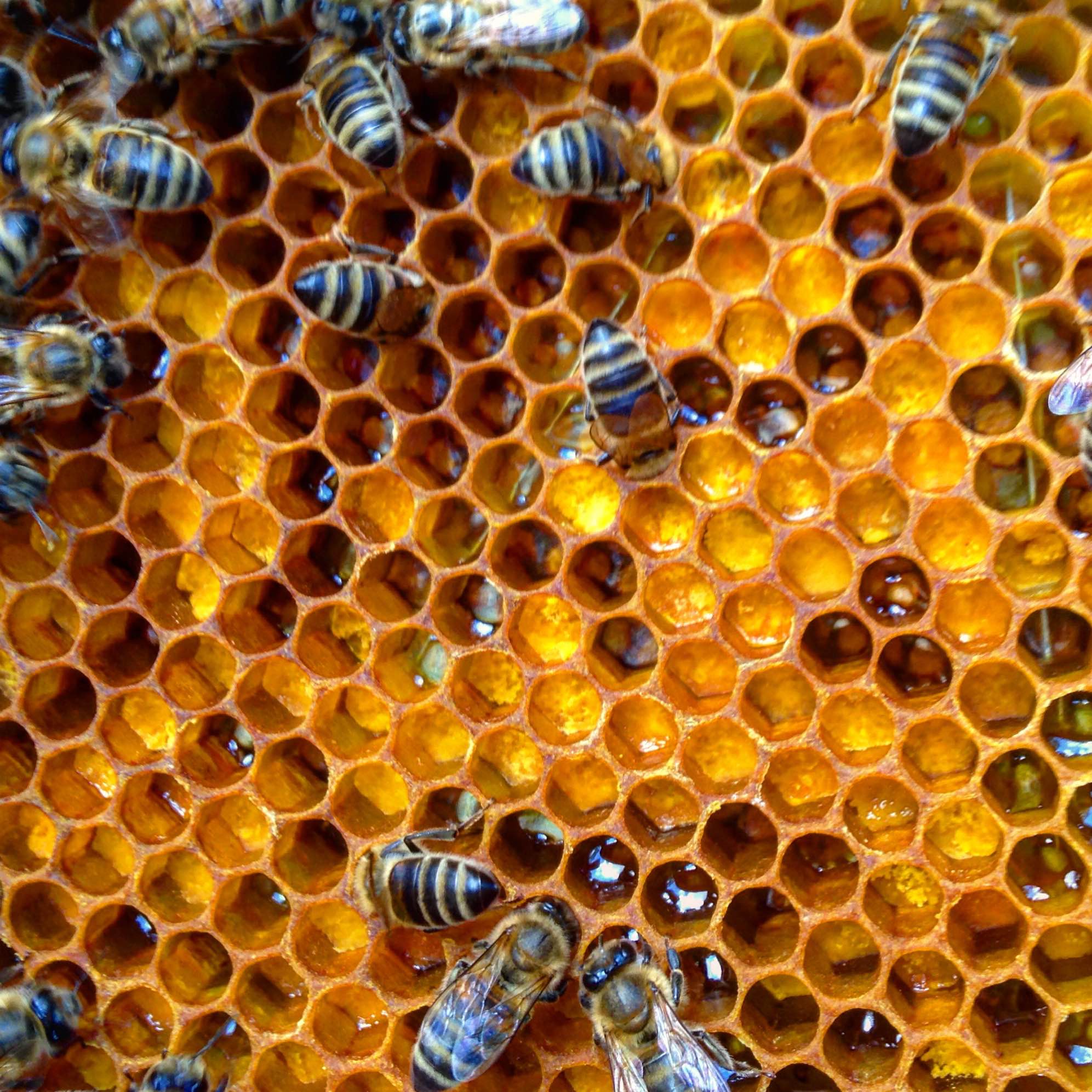
Lolly stepped closer as I told her what was happening on the honeycomb. “Here the worker bees are keeping the baby bees warm in their cells until they are ready to hatch. It’s probably warmer inside the hive than your home.” I brushed a few workers aside to reveal the biscuit-coloured brood cells. Then a few bees walked past with bright-coloured blobs on their legs. “The bees are carrying pollen home from flowers like you see in your garden.” I pointed at the cells with gold-and-orange pollen inside. “The bees will head butt the pollen into the cells and use it to make bee bread to eat.”

I put the frame back inside the hive and asked Lolly what she thought of the bees. “Good!” she said with a big smile. She was even happy to hold a frame of bees by herself.

IMG_9724

The humming was getting slightly louder as I told Amie and Lolly to listen to the difference. “The bees are ready for their bedtime.” Emily and I closed the hive. “Do you want to give the bees their dinner?” Lolly nodded. She helped me pour the autumn syrup into the feeder. I gave her a ball of beeswax scraped off the crownboard to take to school for show-and-tell.

IMG_9726

Emily and I had checked the hives of queens Pepper and Peppermint earlier in the afternoon. Here’s pink-spotted Pepper walking across the frame. There seems to be a lot more pink at the apiary since Emily and I started keeping bees.

IMG_9716

The bees seemed content with their visitors, my sister Amie was glad of her veil, and Lolly was amused by the whole adventure. The neighbouring bagpipe player had also come out to play for the bees, which she thought was funny. It was time to go home for dinner and tell baby brother Zac all about the bees and the bagpipes.

IMG_9714

If you enjoyed reading about Lolly’s visit, you might like The day my mum met the bees.

A beekeeper’s notes for September

spider dangling

The spiders spin their crafty webs between the autumn sedum in September. Thousands of tiny pink star-like flowers open to welcome honeybees in their dozens to drink from a forest of nectar.

The bees trip over themselves to visit every single flower. They fly carelessly close to silken strands where garden spiders dangle beneath the leaves waiting to pounce. The bees’ tantalising electrical charge in the air attracts the webbing even closer to their wings.

IMG_9528

I think the variety of sedum in our garden is autumn joy? The large clump of ungainly leaves growing out from the bottom of the decking had looked suspiciously like a weed to untrained gardeners’ eyes. “I’ll dig it out for you,” my dad said, eager to clear away overgrown foliage from our garden. “No” I replied, “We’re waiting to see what everything turns into this year.”

The green clusters have slowly exploded into bright pink blooms over the past couple of weeks. “Is there a nest of bees in the garden?” John and dad both had asked me. “No, just the autumn sedum,” I replied.

IMG_9530

I was tempted to brush away the spiders’ webs to protect the foraging bees. But who am I to interfere and deprive a spider of her dinner? The sedum looks well established and it’s likely this dance between spiders and bees has been going on for decades in our garden. So far I’ve counted only one mummified bee in a web, the spiders are hardly winning.

The nectar flow is usually considered to be over by many beekeepers come late summer to early autumn. However, as I watch the bees in the garden few appear to be pollen collectors. Their baskets are empty as they search for every place on the flower beds to drink. This gives me hope that autumn forage will bring both more nectar and pollen to the hives, if the bees can withstand the chilly drop in temperatures.

IMG_8914

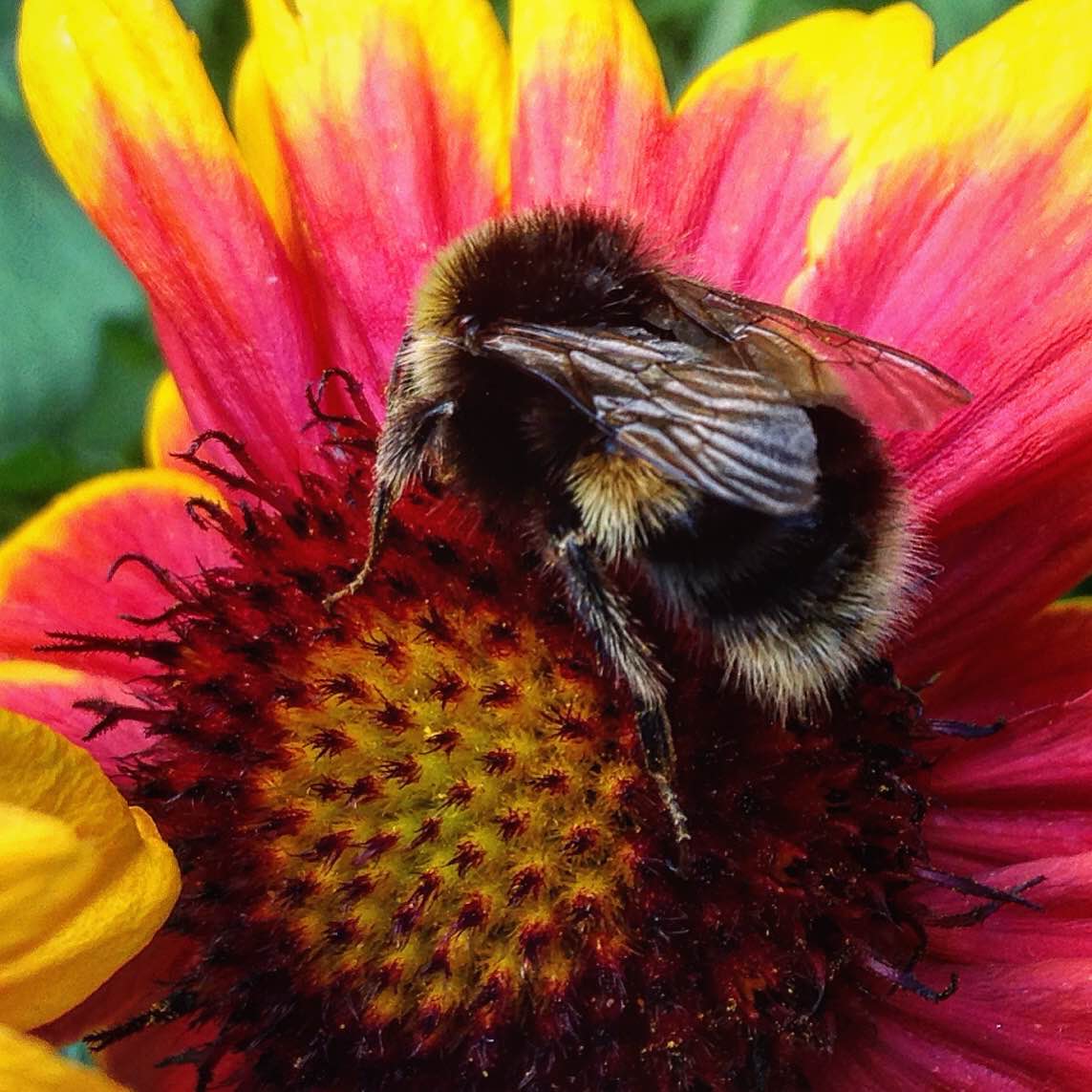
This hardy warm-blooded bumblebee in a garden centre seemed less bothered by the cool day than the cold-blooded honeybees.

At the apiary table beekeepers were taking a pause for tea, and honey fudge bought by Emily from her holiday. “This looks far too posh to eat,” complained John Chapple. “I think you should wrap it in Christmas paper,” agreed Stan. Emily cut the fudge into cubes for the beekeepers to (reluctantly) eat.

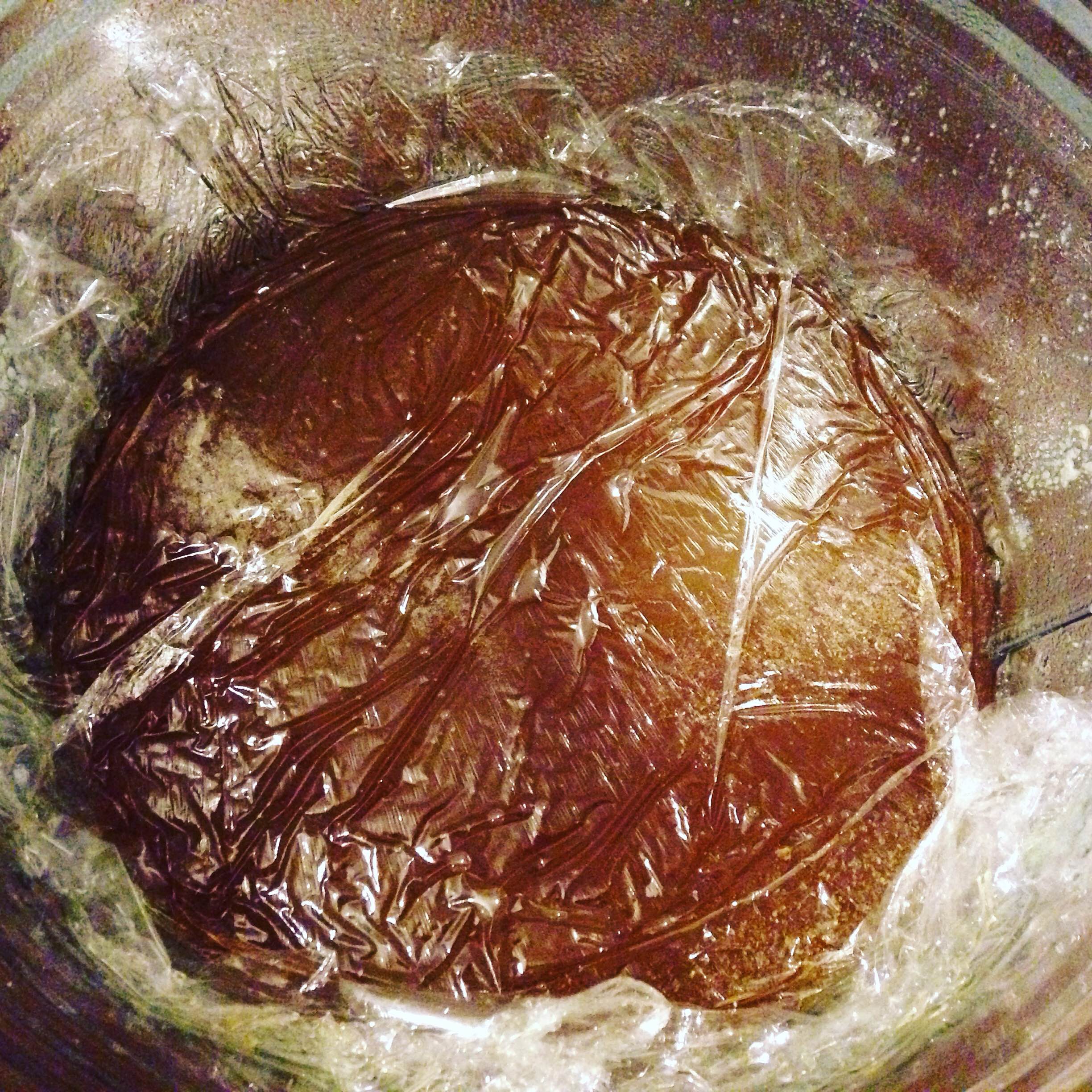
Talk was on about this year’s National Honey Show with Jonesy being persuaded to take part. I shared a tip passed-on by Dev from last year’s honey judges. To get out more air bubbles, spread cling film on the surface of the honey and leave (perhaps 20 minutes) then peel off…

IMG_9586

… air bubbles cling to the film and lift off. I’m not sure of the physics behind it, but it works. Clearer honey!

IMG_9587

Our three hives have ended the summer queen right. With the honey crop off and the Apiguard treatment finished, we’re checking the bees are bedding down properly for winter. To prove the point, Melissa’s colony had stuck down the hive roof hard with lots of propolis.

Peppermint’s hive was low on nectar stores (we hadn’t harvested from this artificially swarmed colony) although packed-full of bright orange pollen. There were also piles of beautiful orange pollen dropped at the bottom of the hive. Be more careful with your shopping, ladies! Going through the frames it was clear this hive would need autumn feeding to meet their quota of 20–30 lb of honey to survive winter. The bees were well behaved despite the low amounts of stores and brood in the nest, which would usually make a colony quite grumpy.

IMG_9584

In Melissa’s and Pepper’s hives the August wash-out had made the bees tuck into their put-away stores and left the returned wet supers unfilled. A reminder of how quickly things can change in bee land. Emily and I may decide this month whether or not these supers now need to be taken off for safer storage against wax moth. There’s no hurry, we’ll wait and see if the forecast Indian summer makes any difference.

We didn’t spot the queens this weekend, but the bees were behaving as good as gold so their majesties must be at home. I wondered if it might also be the effect of Jochen standing nearby. This German beekeeper seems to have a calming influence on our bees.

IMG_9585

Emily holds up a brood frame from Melissa’s colony. The hive had completed a Bailey comb change in the spring, yet how quickly the golden honeycomb turns brown after one summer of brood. It makes me think of how many bees have emerged from each cell leaving behind a cocoon.

The summer holidays felt like a distant memory as we talked about getting ready for winter. Autumn is always a reminder of how fast time flies.

IMG_9366

Two bees chat about their summer holidays while sticking propolis to the hive roof.

A beekeeper’s notes for August

IMG_9073

The beekeeping year has begun. Inside the hive the bees are preparing for winter. The queen lays fewer eggs, drones cower as their sisters evict them from the colony, and gaps in the nest are stuck fast by sticky red-brown propolis.

Foragers leave the hive early in the morning and return in the fading evening light. Their bodies are sprinkled with pollen and abdomens heavily laden with nectar. The queen and her workers are getting ready to begin all over again in spring, but first they must cosy themselves in a snug winter nest filled with the final drops of the season’s honey.

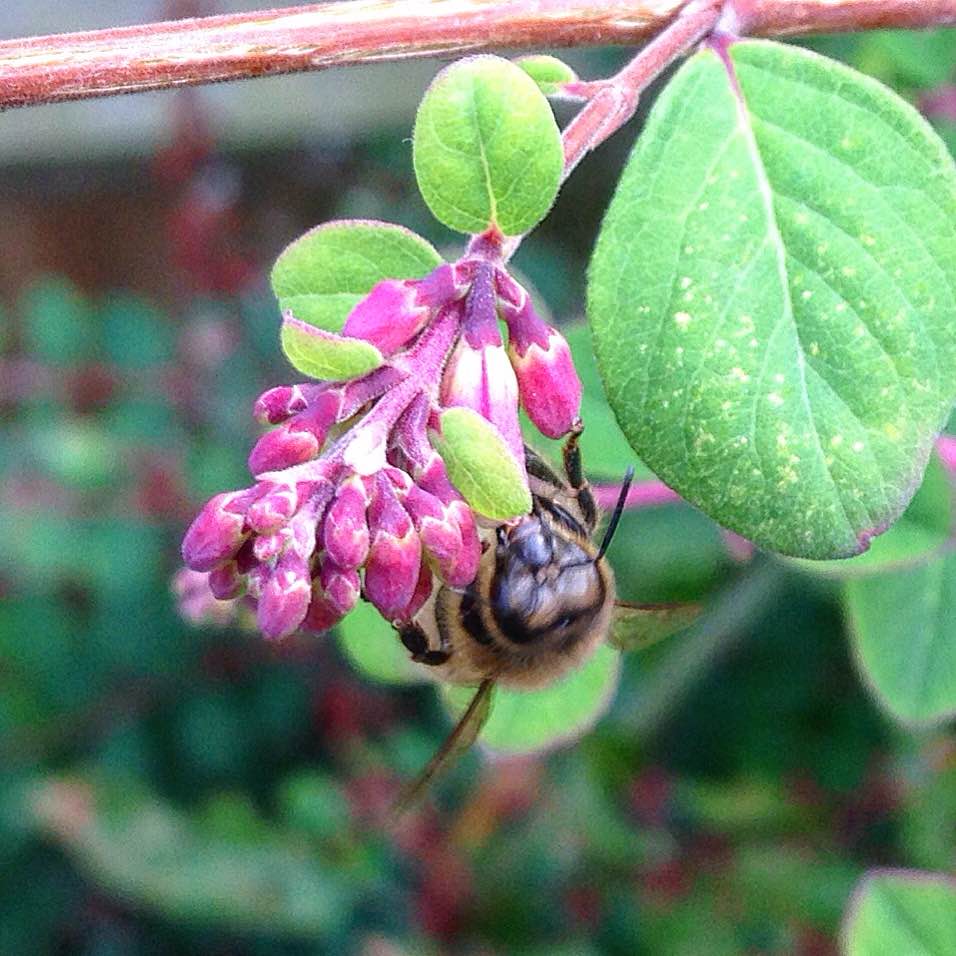
Of course, this seasonal activity varies with location, climate, available forage, and the situation within individual hives, but traditionally this is the picture of the start of the beekeeping calendar. On a recent holiday to the countryside, I saw plenty of bees (honeybees, bumbles and solitaries) out and about. On our return, the garden was buzzing with honeybees drinking from a bush with clustered dark-pink flowers like the last of the summer wine.

IMG_8991

In my kitchen, the honey crop has been settling since Emily and I did the hard work of extracting a few weeks ago. In past years, our bees have made honey that was difficult to spin out in the extractor, but which didn’t take much filtering. This year the honey spun out fine, but it has required more time to settle, strain and filter.

For a few days, our harvest sat in storage containers to let air bubbles and lighter particles float to the top, and larger debris sink to the bottom till the froth, or ‘marmalade’, could be scooped off. When it was ready, I cleared the kitchen table and got out the buckets, muslin cloth and string to start filtering.

IMG_9030

We had extracted the supers in three batches – the third batch being from Emily’s allotment hive – because it’s nice to bottle the honeys separately according to their unique taste and fragrance. Pepper’s crop smells of dark forests and Melissa’s harvest has an aroma of berries-and-lime.

The honey from Pepper’s and Melissa’s hives was first strained using fine muslin tied around two buckets with string. A wire mesh strainer also filtered out the honey that had pooled around the wax cappings.

IMG_9037

IMG_9039

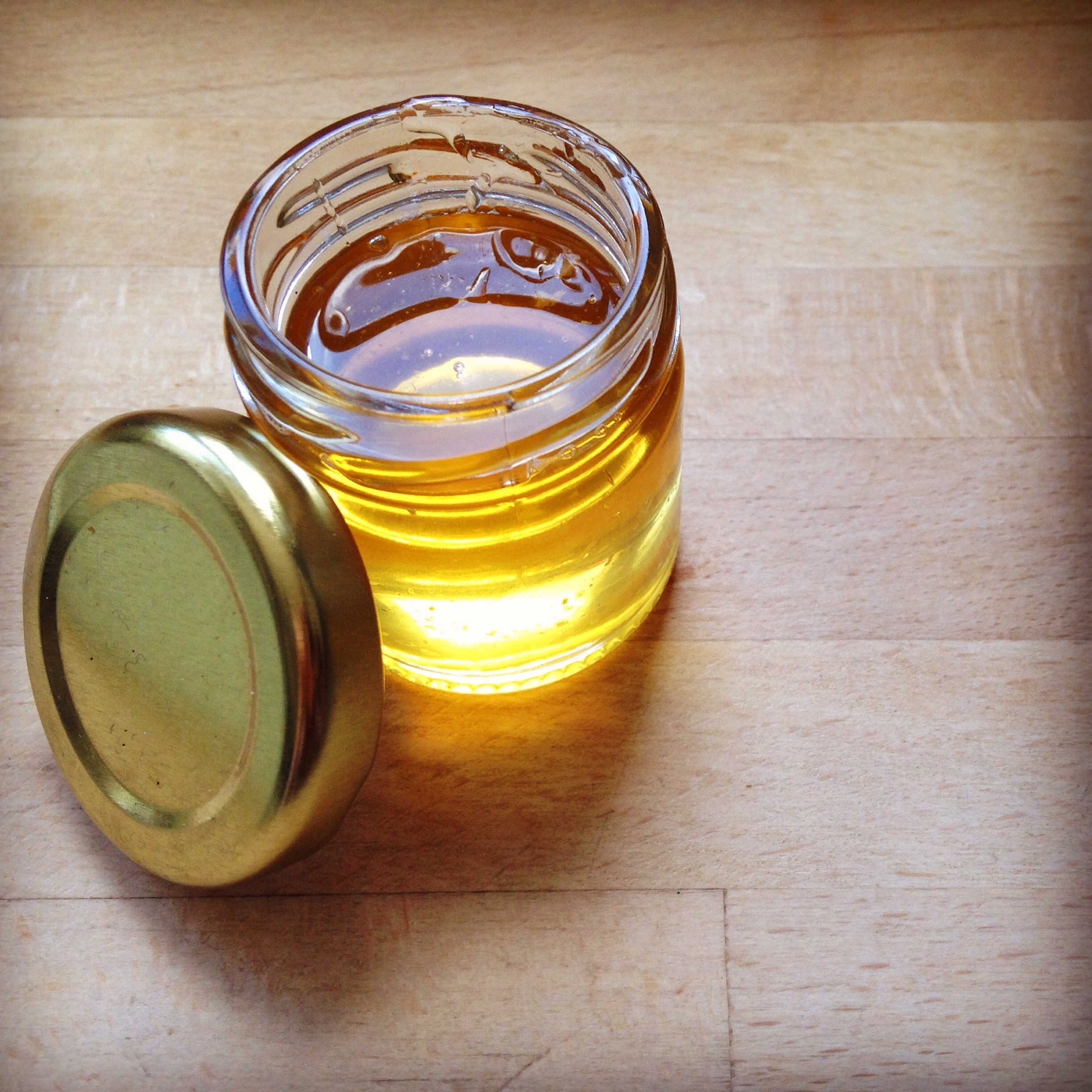
With two buckets full, the air bubbles were still rising. I left the honey to settle for a second time, before scooping off the froth again, and filtering into jars to be bottled. I always use mini jars to make the honey harvest spread further, and keep it stored in a cool kitchen cupboard.

IMG_9046

IMG_9051

Most honeys crystallise over time as networks of crystals eventually form from the heavy concentrations of dissolved glucose suspended in the solution, though this process can vary from a few days to several years. I have one jar of Myrtle’s honey left from last year that still hasn’t crystallised.

Honey extraction, filtering and bottling is a lot of work for the hobbyist beekeeper, and even more work for the commercial beekeeper. For that reason, the leftover wax cappings and other gubbins have been set aside in mini buckets to clean up on a rainy day.

IMG_9042

My kitchen surfaces and equipment were scrupulously cleaned, and I was careful to not to contaminate the buckets, jugs and jars with any drops of water. As Andy Pedley told me once, “Water is the enemy of honey.” However, if I were to sell honey, then I’d need to be more fastidious about the whole operation from straining and filtering, to filling each bottle to the exact amount stated on the label. My family and friends might appreciate a jar of my honey, a true taste of home, but it wouldn’t win any prizes at the national honey shows!

IMG_9055

For the full legislation of the preparation and sale of honey, you can read the updated The Honey (England) Regulations 2015 on the government’s website.

The clean-up afterwards is almost as much work. Hot soapy water and towels to wash down and wipe clean sticky work surfaces, tables and equipment at least three times, but it was worth it!

At the apiary, the beekeeper is also preparing the hives for winter, and there are many things to think about. Is the queen laying well enough to take the colony through winter and to build up again in spring? Does a smaller, weaker hive need to be united with another colony to make a stronger hive for overwintering, with the provision there is no disease? Is the colony healthy and does treatment need to be given for varroa? Does the colony have sufficient stores or does it need feeding syrup before the end of autumn? Is the hive equipment in good order with gaps in the wood sealed and mended, entrances reduced against robbers and pests, and guard against woodpeckers and mice ready to put on? Are the supers staying on the hive or do they need to be cleared and removed for safe storage against wax moth?

Yes, quite a lot to consider, but most importantly is thinking about how to enjoy the last couple of months spent with the bees. Here’s Melissa’s hive with Emily removing the second tray of Apiguard after the workers tried to stick it to the top bars with propolis.

IMG_9076

After a long session of afternoon tea with the Ealing beekeepers, the smoker was lit, with some tips from Pat, and Emily and I were off to inspect our two remaining hives. The beginners had already checked Pepper’s hive, spotted the queen, and found a very high number of varroa mites (almost 600) on the board. This may be due to Apiguard treatment, but it is still disappointingly high. The only positive is that it is better to have varroa mites dropped onto the monitoring board, as a result of varroacide treatments, than in the hive.

Peppermint’s colony was calm and well behaved. These busy bees are rearing new brood like summer is here to stay, and the queen was spotted walking nicely across the comb. The hive is rather low on stores. We didn’t take any honey off of this hive, but it may benefit from autumn feeding after the Apiguard treatment. The mite drop so far is around 100, a lower number is to be expected from a newer artificially swarmed colony.

IMG_9074

Melissa’s colony is strong and well, and the queen was found with her head in the comb searching for suitable cells to lay her eggs. Signs of unsuccessful attempts to overthrow the queen by the workers remain. It looks like Melissa will lead this hive into next spring.

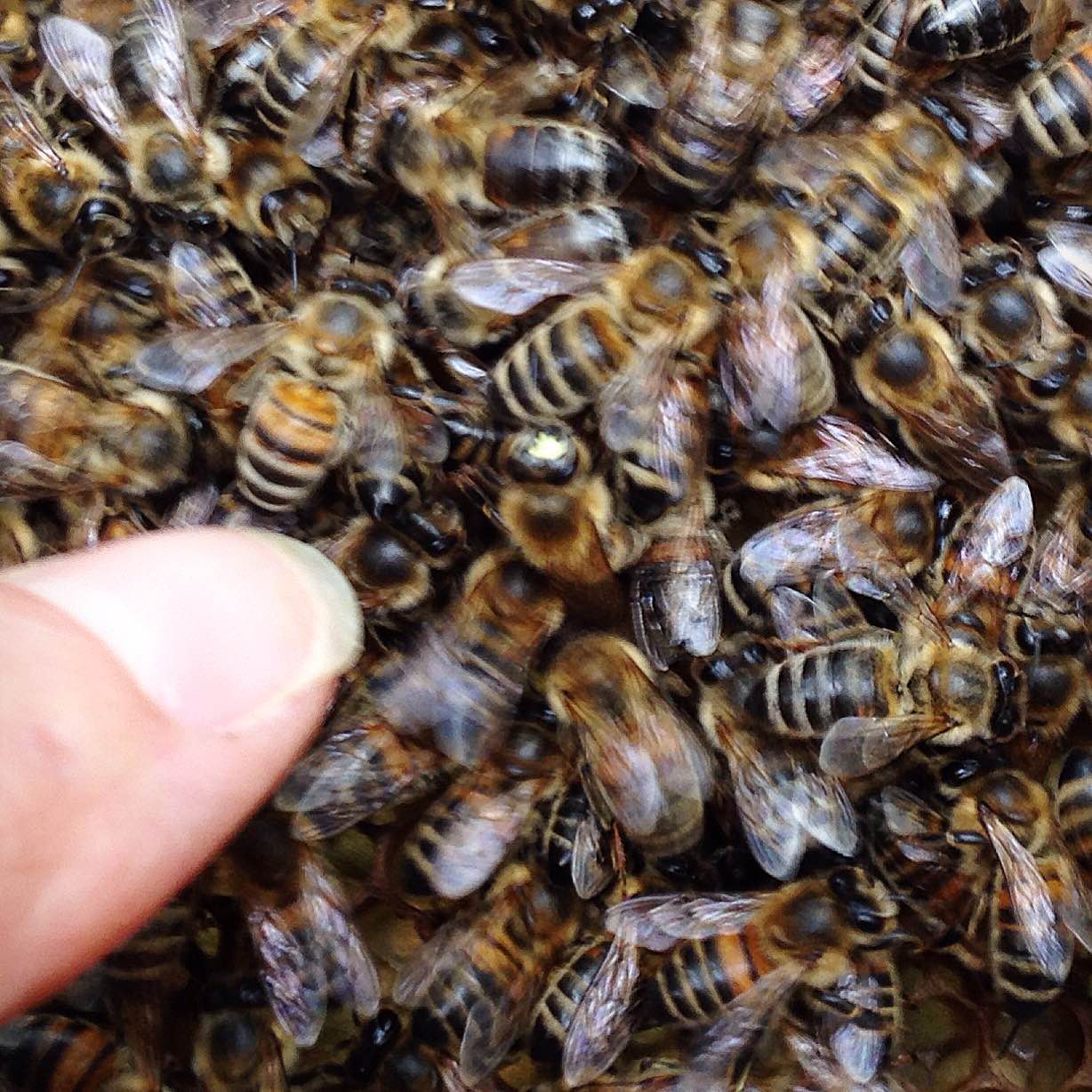
We spotted workers with yellow-splashed faces, perhaps from head-butting pollen into cells or from a flower they had visited (sorry for the blurry photo above, fortunately Emily’s finger is pointing to a worker with yellow warpaint). The white-striped Himalayan balsam foragers were also making their way through the colony.

We closed the hives with records written and plans discussed for the start of the season ahead.

Autumn mists have been falling on roofs and tree tops early in the morning this August. Yet, autumn is my favourite time of year, and in many traditions it is a time to clear out the old and to make space for new things. I can’t feel too sorry for the end of summer, only excitement for the inspiration that autumn will bring.

IMG_9020

A beekeeper’s notes for July

“It was clever of you to buy a house with a honey extraction room,” said Emily. The garage had been fixed up and painted white by Len, my dad, a few weeks ago. I’m not sure this was exactly what he had in mind – there was some talk between him and John about a dartboard – but the newly decorated tool shed worked perfectly well as a honey extraction room.

The supers were placed on the floor and the frames decapped on a work bench. In the corner of the room a new manual steel extractor, kindly gifted by the lovely people at DK Publishing (more on that in another post), spun out the honey beautifully.

Tom had generously helped Emily and I to take the supers off of the hives, and drove us from the apiary to my house. He had patiently waited as we single-handedly picked off each and every bee still straggling the frames.

The rhombus board had done a good job of clearing the supers, but there were around 50 bees in each super. “I love how you two do beekeeping,” Tom joked, because our method of taking away the supers was so painfully slow! I worried that my house was further than the three or four miles estimated for a forager bee to fly from the hive. It was sad to think of ‘lost bees’ trying to find their way home from my garden. A feather lent by Tom helped speed up the process.

After lunch at home we made short work of extracting three supers of honey in the factory set up in the garage, with John also taking a turn at spinning. First Emily’s super from Andromeda’s hive at the allotment was spun out to reveal dark, deeply floral-scented honey. Then we cleaned out the extractor to spin the next batch from Melissa’s hive – a beautiful rich gold, fruity honey with hints of blackberry and lime. Finally we spun out Pepper’s honey which was again darker and smelt of forests.

Three different types of honey from three differently tempered hives. It was a good job the garage doors were closed because a determined wasp headbutted the back window desperate to get inside. We had to see her off a couple of times.

That done, I poured us some old fashioned still lemonade and we had a walk around the garden. I was happy to show Emily the bees at the bottom of the garden and, of course, the fish. The masons and leafcutters are no longer flying about, but I did find a small sweat bee to show Emily on one of the creepers. The air may feel like autumn is coming, but the nectar flow is attracting bees of every size and shape to feed off the Passion flowers, jasmine and primroses.

Later that evening we drove Emily home and got treated to a curry by Drew for all our hard work.

The honey has sat in my kitchen for a week to allow air bubbles to settle to the surface. It is less clean than last year’s crop and will need filtering before jarring.

The cut comb was easy to put into trays – a happy accident thanks to a super frame not returned to Pepper’s hive one week.

Yesterday a month’s rain fell in one day and I got home to find the fish pond almost overflowing. The fish were inquisitively peering over the edges. I thought it best not to satisfy their curiosity and removed a bucket of water to lower the water level. It continued to rain all night.

This morning felt fresher but still unsettled. John drove me to the apiary to return the wet supers for Melissa’s and Pepper’s bees to clean up. The wasps were out and a few robber bees, so we had a quick look inside, put the supers on, and closed up.

Emily had seen Melissa (our best queen for hiding) last weekend, and all seemed fine with the other two colonies. At this time of year, when the wasps and robbers come, I find it’s better to keep the hives closed and less stressed by skirmishes. Emily put entrance reducers on to help the guard bees better defend the colonies, and I started the Apiguard treatment on Melissa’s hive.

Jonesy was inspecting his neighbouring hives. “Can you smell banana?” He asked.

“Isn’t that the smell of the alarm pheromone?” said Emily.

“Do you smell banana a lot?” I asked.

“All the time,” said Jonesy.

That done and we all finished up for tea and cake. Alan had started a bonfire to burn up some rubbish. Jochen arrived to tell us about a swarm he collected with Bill at Harrow Beekeepers.

The weather had made the bees irritable this weekend and even the gathering of beekeepers was modest. I left the apiary as Alan’s bonfire started to roar higher and the skies darkened with clouds.

When summers turn out to be this good for the bees, I wish that I could keep hives full time. The BBC recently had a great feature on learning to be a bee farmer: http://www.bbc.co.uk/news/uk-33663048

With plenty still to come in bee land, I left the apiary to return in August.

Sorry if the formatting of my post is off. I’ve been without a computer for over a month, getting online is a little challenging but another set of beekeeper’s notes are done.

Summer surprise 


Our first summer in the Crooked House is passing quickly. The blue tit family has flown away and the mason bees are sealed behind mud doors.

This year’s crop tastes of blackberries and lime. My kitchen was filled with the smell of freshly spun comb after I took three frames of honey from Queen Melissa’s hive. The comb dripped generously as the wax caps were taken off.


The honey was not as clear as last summer’s pale straw-like harvest, but it was surprisingly easy to spin out in a new extractor. I poured some of the golden liquid into a mini pot for Emily, leaving the rest to settle in a bucket before it is filtered and jarred.


The smoker was billowing in the hazy sunshine when I arrived at the apiary. There were more surprises waiting inside the hive.

Queen Melissa’s workers had built a wave of natural comb in the space left by one of the super frames. We carefully upturned the crownboard and removed it intact to take home.


A quick inspection of the supers showed that the queen cells had now disappeared. Had the workers succeeded in their attempts to supersede the queen, or given up?

I returned the wet frames to the supers for the bees to clean up, before opening the brood nest. There was no sign of Melissa for a second week. The numbers of bees climbing over the frames made the inspection difficult and I couldn’t clearly see eggs. The brood nest looked small, had a young rival overthrown Melissa after all? We decided to wait till next week before putting in a test frame of eggs to find out.


The swarmed colony from Pepper’s hive is building up strongly. The new queen has been named Peppermint for her mother, and for the lively spirit of the bees that she makes. I didn’t see the queen, but the brood nest gives confidence that she is inside and laying well. I’ve noticed that queens are good at hiding later in the season.

Pepper’s workers were busy licking up a pool of honey from more natural-built comb inside the hive. We’re going to tackle that next weekend.


Tom’s experiments in natural comb-building have been a success at the apiary. He pulled frame upon frame of curved comb built without foundation or wire by the bees. “I’ve noticed that the bees use every bit when they make the comb themselves,” said Tom. “Whereas on the foundation they sometimes leave cells untouched.”

At the entrance of the hive, Tom pointed out the drones being kicked out in droves by the workers. It seems early in the season for a drone exodus, but perhaps another sign of how quickly this summer is passing by.

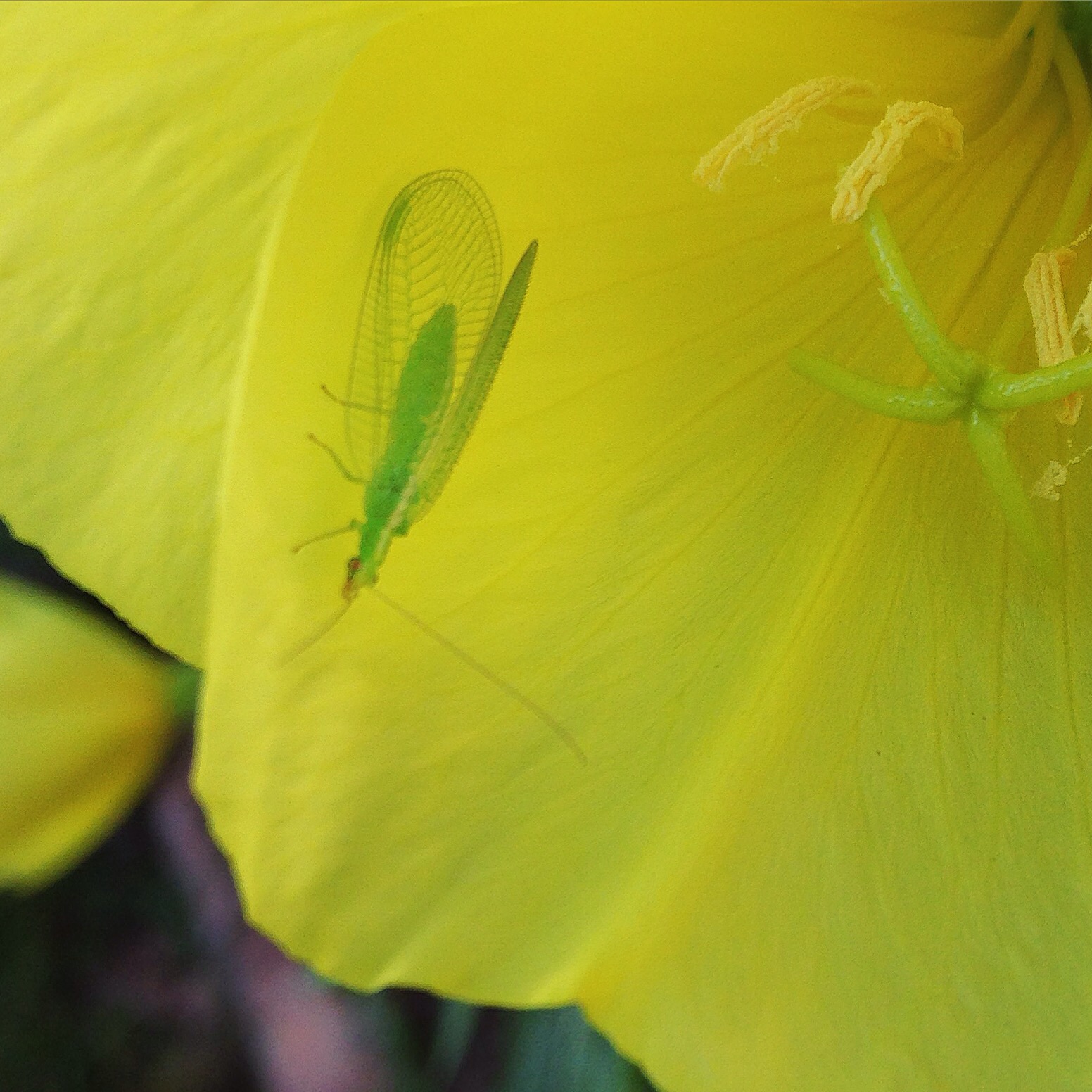
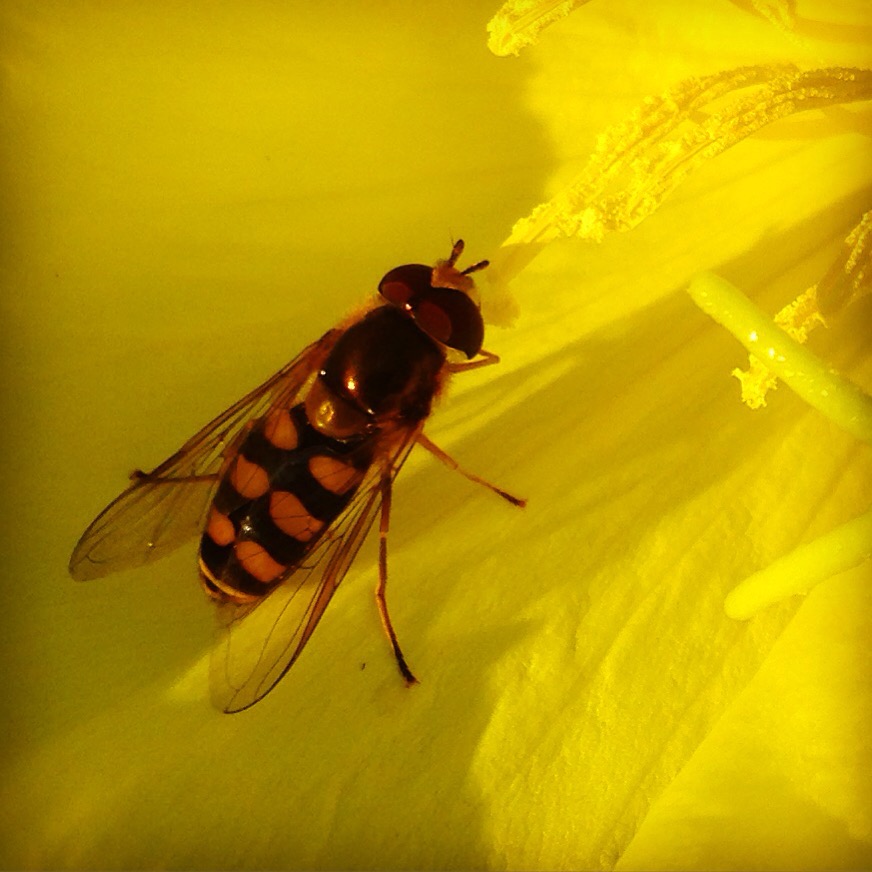
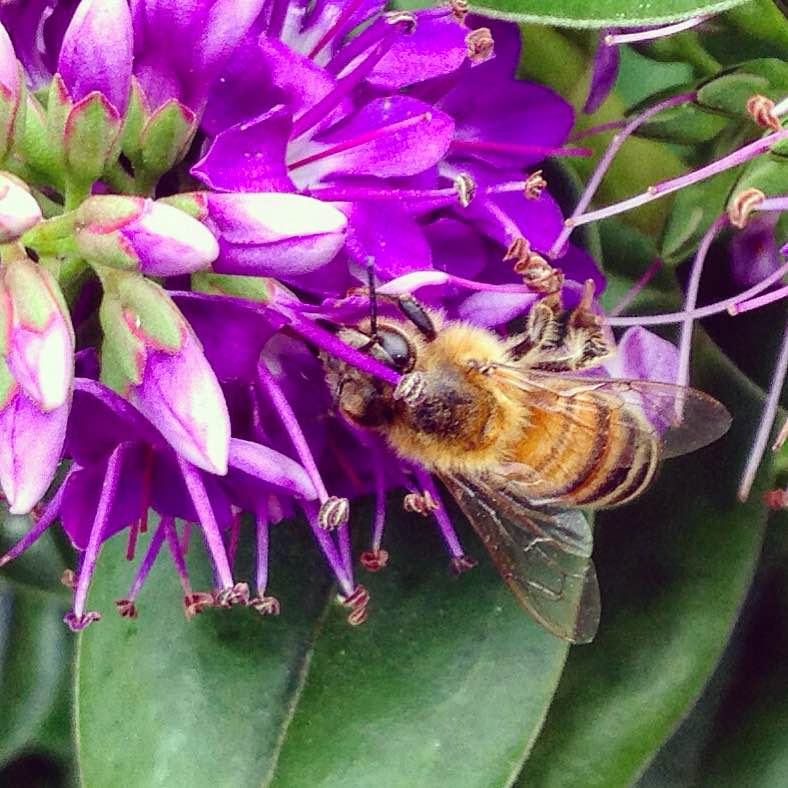
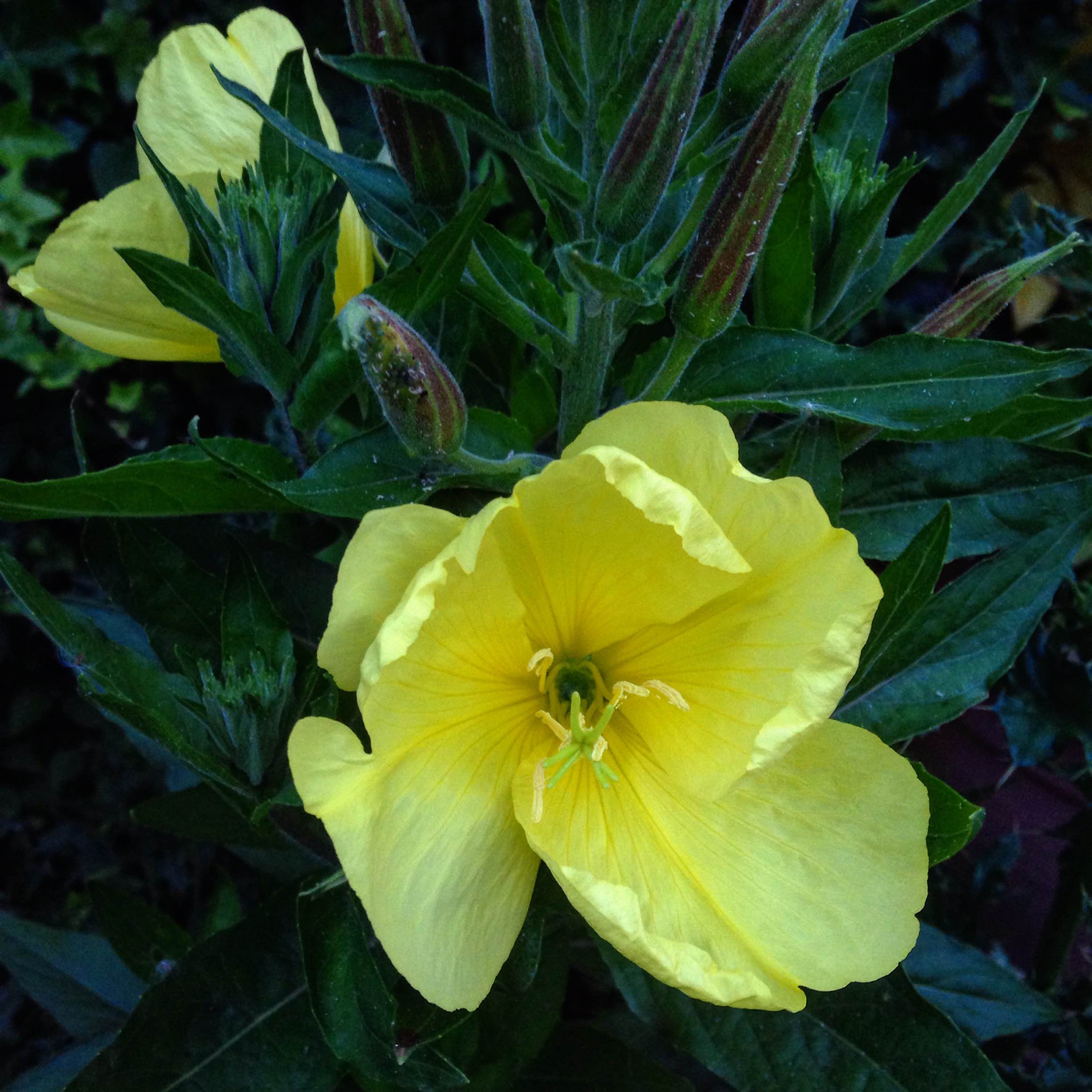
The flower beds in my garden have been full of their own surprises this summer. A Sunday afternoon of weeding revealed a beautiful yellow Missouri primrose hidden behind a wall of thistles. She blooms at dusk and has had a lot of visitors in the morning. A lacewing, a hoverfly and a sweat bee (Lasioglossum sp.) have basked in the sunshine of her petals.


The rampaging weeds at the back of the garden in the vegetable patch remain untouched. I’ll dig over the earth in autumn to sow runner beans and potatoes, but for now the foliage is providing a habitat for creatures like hornet mimic hoverflies and the new leafcutter bees in the bug hotel.


I’ve called the big leafcutter who comes and goes most, Albie. They are more shy than the masons.

A new family of baby sparrows have been landing on the garden decking to play in the makeshift bird bath (a large salad bowl filled with water and stones). They give hope that despite the march of the drones, there is still new life to come from this summer.

A beekeeper’s notes for June: secrets inside the hive

IMG_8070

“Quick! Take the egg!” whispered the worker to her younger sister. “Hide the new princess in the upper chamber where the queen won’t find her!” The young worker gently picked up the precious egg in her mandibles and ran as fast as she could past the queen’s retinue, and up the stairs where her majesty couldn’t follow. Higher and higher she climbed till she stopped with exhaustion beneath a special cell. The smells of nectar in the loftiest chamber were overwhelming and the scent of the queen seemed far away. 

The young worker placed the egg carefully inside the secret cell already prepared to receive the new princess. The egg would be safe from the queen who would be unable to get through the nectary gates and tear down the hidden queen cell.

The longest day of the year had passed on the summer solstice last Sunday. At the apiary talk had turned to the honey crop and how much could be harvested this year. Emily and I had put two supers on Queen Melissa’s hive, which were filling up nicely. “Let’s check the super frames to see which can be taken,” I said going through the top super. Around the fifth frame in, I found her. A tiny, coiled, pearly larva in a silky white bed of royal jelly at the bottom of a damaged queen cell. Emily and I stared at her curiously wondering how the queen larva had got into the top super. The queen excluder was above the brood chamber and, we hoped, the queen had not gotten past to start laying in the supers.

IMG_8133

The queen cell looked partly torn away and whether that had happened when I pulled out the tightly fitted super frame or by a worker tearing down the cell, we could not tell. We marked the frame and carefully put it back for a further investigation of the hive.

I didn’t find any brood or further queen cells in the supers, but I did find several collections of pollen-packed cells, which is unusual. It seemed the workers were preparing to raise a special brood in the top super, and though the workers can move eggs, nectar and pollen around the hive this seemed a long way to carry an egg from the brood chamber. “Perhaps they heard us saying that we wanted to try queen rearing,” I joked to Emily.

A beginner beekeeper, Mark, was watching our discovery with interest and asked why the workers would hide the queen cell. “To keep it a secret from us,” I said, “Or more likely the queen who would tear it down.”

IMG_8124

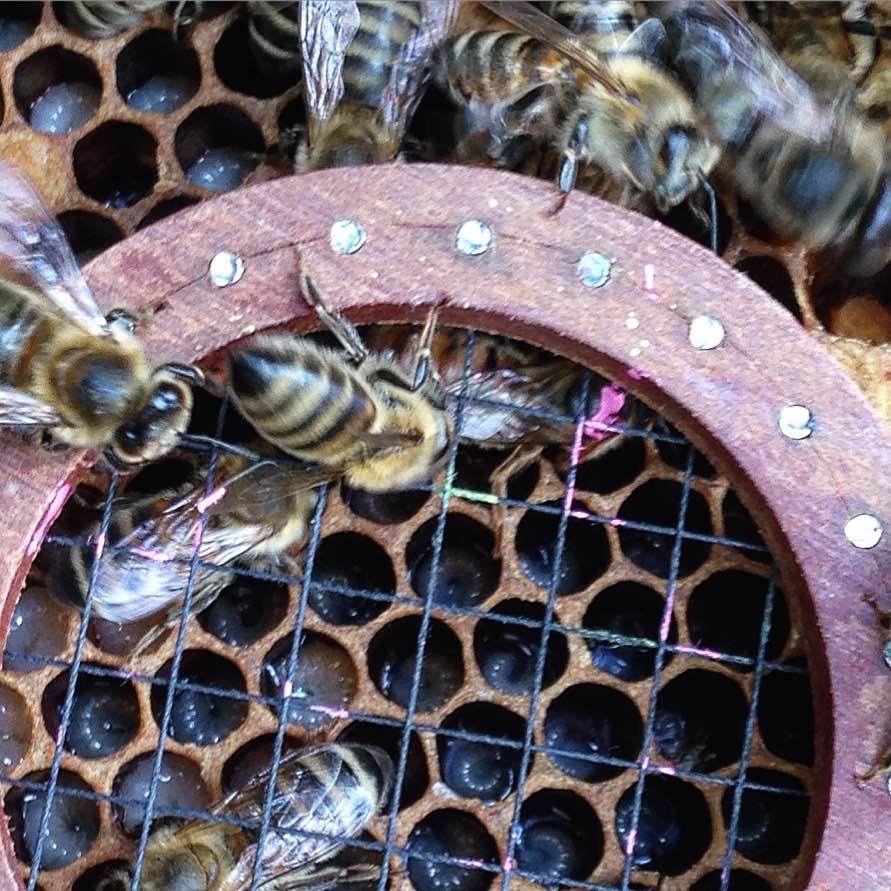
Then it was time to go through the brood nest. Here there were only stores and brood, but no queen cells. Emily spotted the queen as I held up a frame, so I caged and marked her with a pink marking pen from Pat.

We closed up the hive. With only one queen cell hidden in the super, and now appearing partly damaged, this seemed a case of attempted supersedure rather than swarm. Emily and I have always let our bees get on with supersedure in the past, the workers know best when to replace a queen. Melissa and her hive were left to their royal secrets until next week.

In the artificially swarmed colony the still unnamed queen was also found and marked by Emily. Two queens now wear pretty pink crowns thanks to Pat’s pink queen-marking pen from Thornes. I wish they would make a glitter pen too.

Emily is mentoring new beekeepers for the London Beekeepers Association (LBKA) and had already checked Queen Pepper’s hive with Mark. This left us time for tea and cake (Polish cake from Clare and home-made ginger cake from Emily) and a casual visit to Den’s hive.

IMG_8125

Den was puzzled about why his bees were making waves of honeycomb above the frames. This was ‘bee space‘, we explained. There was a gap, more than 8mm, between the top bars and the top of the box. The bees would fill up any gap bigger than 8-9mm with honeycomb. The importance of bee space demonstrated and lessons were almost done for the day.

From the apiary to the garden there were fewer butterflies than bees, and I was hoping to attract more winged visitors to our flower beds. A butterfly supper of brown mashed banana on a plate and sugar syrup in a jar was prepared. These were simple to make and, I thought, an ideal activity if you’re entertaining young nieces…

How to make a butterfly supper

(null)_1

You will need: 

  • Plastic plate
  • String
  • Over-ripe brown banana
  • Decorative flowers

1. Pierce four holes in the plastic plate to pull through the string and tie handles on either side.

(null)_2

2. Stick on plastic flowers to make the plate look pretty for butterflies.

(null)_3

3. Mash a brown banana that butterflies love.

IMG_8129

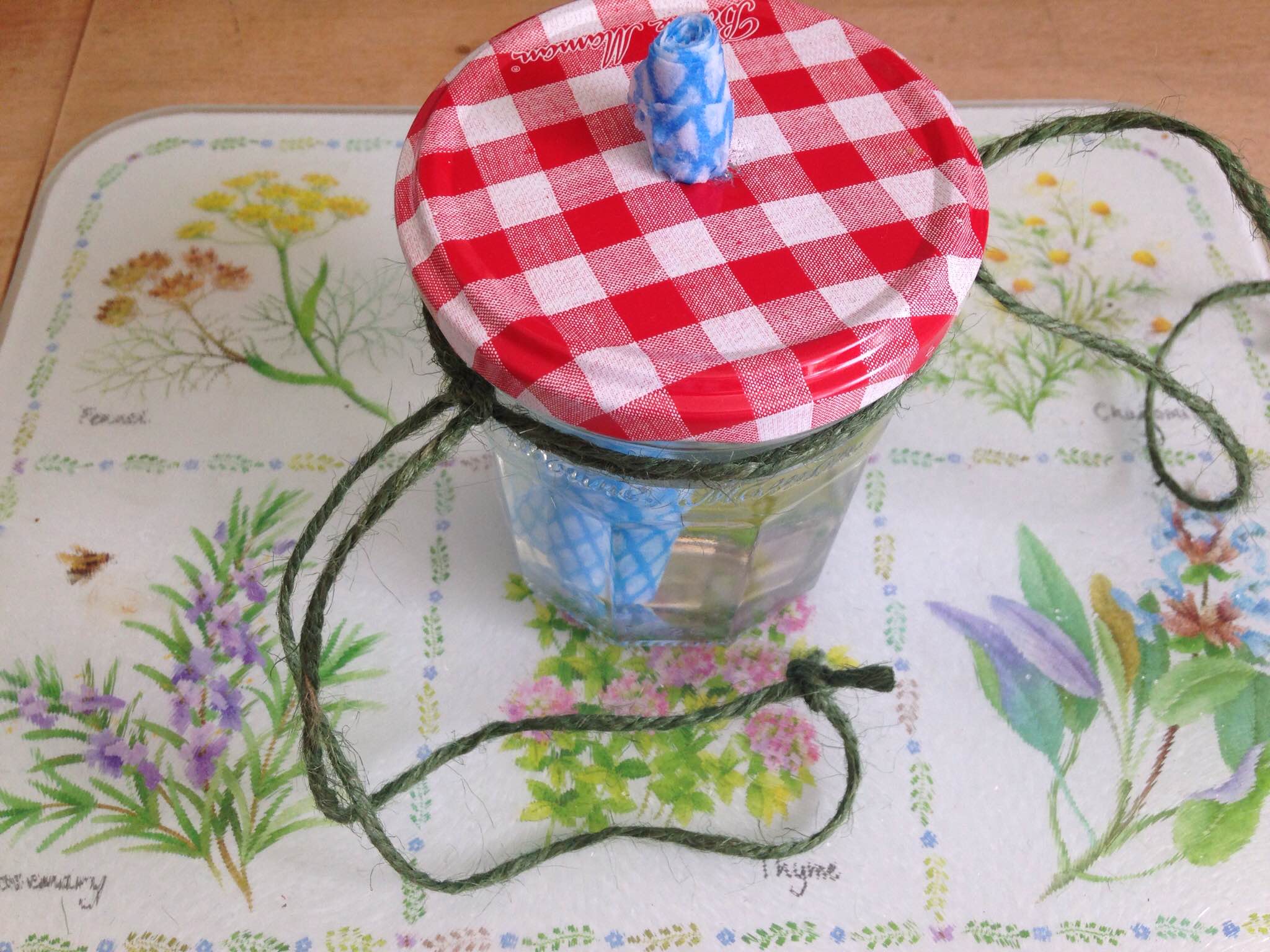
How to make a butterfly sugar feeder

(null)_5

You will need: 

  • Jam jar
  • String
  • Sugar syrup

1. Mix one part sugar to four parts water to make sugar syrup.

(null)_6

2. Pierce a hole in the jam jar lid and poke through a brightly coloured kitchen cloth.

3. Pour the sugar syrup in the jar and screw on the lid so the cloth can absorb the syrup.

IMG_8128

4. Secure with garden string and/or elastic bands to hang upside down.

The butterfly feeding stations were hung up high in the flowering bush that is busy with bees. We’ve had no customers yet, but I’m hopeful.

So the bees don’t feel neglected in the garden, my niece had a bright idea a couple of weekends ago. She asked me to pick one of each flower to put on a saucer. We then drizzled the flowers in honey. “This is a bee bed,” she said proudly putting her creation on the flower bed wall. “For tired bees.”

IMG_8139

edit: my story of the worker moving the egg is anecdotal (see comments below) and pure guesswork as I can’t know for certain how a suitable egg got into the super for the bees to try and make a queen. Moving eggs is one theory I’ve heard over the years, laying workers is a possibility though these eggs would become drone not queens, or a small queen able to slip through the excluder after all or even a second queen in the hive still unseen…

Lock the gate before the horses

IMG_7916

There was nothing to be done for the beginner’s hive. Overhead a dim sky cast a heavy gloom on the apiary and the air felt warm and close. The bees were bearded under the hive floor and Tom suspected a queen was in the cluster waiting to fly off with the swarm. “He had three queen cells in the hive last week, all sealed.” I recalled. “I suggested an artificial swarm but…” Tom, Emily and I stood in front of the hive that was once headed by Queen Chili. The colony was no longer ours, having been sold to the beginner a month ago, so we couldn’t open up and see what was happening inside. The cluster looked quite small – a cast off perhaps and the old queen flown off?

IMG_7917

Emily had already inspected Pepper’s hive and the artificial swarm, and she confirmed that both colonies were fine. Tom was about to open Ken’s hive to check the bees. The colony had improved in strength and temper. The brood box was almost full and the bees were placid despite the humid weather.

IMG_7918

“Have you seen Albert’s new bees?” asked Tom. Emily and I walked over to the polynuc and watched as the apiary’s most recent arrivals flew in and out of their new home. The colony was a swarm collection.

IMG_7920

The only sign of Queen Melissa in our longest-standing colony were eggs in cells that I could barely see in the clouded daylight, and bees that were behaving contentedly queen-right. The nest had an average count of brood and stores, but with two supers above maybe the bees were focusing on the nectar flow rather than brood rearing.

The varroa board count for June was around 25 mites for Pepper’s and Melissa’s colonies (above 30 mites may be cause for concern) and, as I would expect, a lower mite drop for the artificially swarmed colony which has yet to build up as much brood. “You’re very good monitoring the mite drop each month,” said Tom. It certainly helps get a better picture of the natural peaks in the varroa cycle throughout the year.

IMG_7919

The afternoon was still and quiet. The Ealing Beekeepers were away at the association’s summer barbeque. Tom was heading off to inspect his hives at the bee hut in Perivale Wood and invited us along. It’s been a year since I was last at Perivale Wood and Andy Pedley greeted us at the gates. The bale hut was coming along nicely and people were picnicking in the field.

“Watch out for the horses!” The woodland’s community, the Selborne Society, had recently bought four new horses as part of its century-long management plan to keep the surrounding fields grazed. “They’re a bit skittish,” explained Andy, “Make sure you give them a wide berth and close the gates behind you.”

IMG_7921

We arrived at the bee hut without disturbing any grazing horses and put on our bee suits. The bee hut is a large shed with four hives inside and entrances on the outside for the bees to come and go.

IMG_7922

IMG_7923

From swarming bees to swarming ants, Tom revealed a nest of ants as he lifted the first hive roof. Flying ants taking off and worker ants carrying cocooned eggs showed the full life cycle of this other order of Hymenoptera. I would have liked to remove the ant colony from the roof of my hive, but like a true naturalist Tom had observed the ants’ behaviour in previous years and was not concerned that anything needed to be done. “Last year they flew off once the flying ants had all come out.” The ants were just passing through then, like an airport terminal, and there was no need to interfere, just yet, with an event that had probably occurred in these woodland hives for years.

IMG_7924

It was a very calm inspection with no bees flying around our veils in the bee hut. The apiary environment is different even for mine and Emily’s gentle bees. Tom explained that the bees flying in and out of the hive entrance were probably less aware of us, because we were inside the hut doing the inspection while their outside environment appeared unchanged with no beekeepers standing about.

IMG_7925

IMG_7926

The three of us took the scenic route back to Perivale Wood’s decorative iron-wrought gates. Andy was talking to Elsa when we rejoined him. “There was a fly survey of the woods and they identified over 100 different species of flies,” said Andy, pleased to report the findings of the woodland’s diverse ecosystem. “That explains all the flies in my kitchen!” said Elsa, who lives closeby.

At home there are fewer flies in our kitchen since the fish pond was cleaned by aquatic expert Luke during the week. The fish had enjoyed their holiday home while the pool was cleared of an accumulation of sludge and the fountain fixed. They are now happier than ever swimming around the new lilies and playing beneath the water spray.

IMG_7853

IMG_7873

IMG_7857

A walk around our garden completed a day spent outdoors and my sense of wellbeing was remarkably restored after a busy chaotic week in the city. Birds sang, mason bees hung out of nesting tubes, and bumblebees dangled their legs in front of beguiling foxgloves. The clammy, drizzly start to the day had turned out, in fact, to be a perfect Saturday for a beekeeper.

IMG_7794

A beekeeper’s notes for May

bumble foraging

Today was sunny and warm for foraging. The garden was buzzing with honeybees, bumbles, solitary bees, and other pollinators. “Do damselflies buzz?” I wondered as a bright blue streak flew past.

Fairer weather had attracted cake-foraging beekeepers to the apiary with a small crowd sitting down for cream sponge and chocolate chip. I tried a slice of each and Jonesy told me his latest queen dramas. “I bought a new queen from Greece,” he said. “I’ve called her Olivia.”

IMG_7731

Pulling on our suits, Emily and I followed Jonesy past the overgrown apiary path to visit Olivia. She was still in a cage with the worker bees desperately crowded around her. We all hoped that they would greet the new queen kindly. We’ll have to wait and see.

IMG_7732

A bumble bee was slowly walking towards the hive reigned by Queen Pepper. Emily tried to discourage her from going inside, because Pepper’s lively ladies would probably nip off her hairs.

The Bailey comb change was interrupted on Pepper’s hive, because the colony was split in an artificial swarm about three weeks ago. This I feel is a possible disadvantage to doing a Bailey comb change later in the season, by becoming interrupted by the swarming instinct, but the wet weather at the start of spring made us wait.

Pepper wasn’t spotted in her hive, but Emily found eggs so the queen was there at least three days ago. The bees were content and doing well for stores and brood, and even have a super on top.

IMG_7730

The split colony was behaving well, but there was no sign of a new queen, eggs or much in the way of brood or stores. We’ll check again next week, as new queens can take their time to settle in, before deciding whether to re-combine the colonies.

Melissa’s hive had completed the Bailey comb change. I found eggs in the top brood box along with nicely even biscuit-coloured worker brood and plenty of stores. The honeycomb in the bottom brood box was almost emptied, but it was still full of bees. How to get them out? Shake the bees?

IMG_7734

We chose a gentler option that had worked in previous years. With the top brood box placed on the hive floor, we created a space above the colony using an empty brood box and put the bottom brood box above this. The cavity should encourage the bees to rob out any remaining stores and move downstairs, but it will be quite crowded. This is a strong colony. Another super will be needed to give the bees more space.

IMG_7733

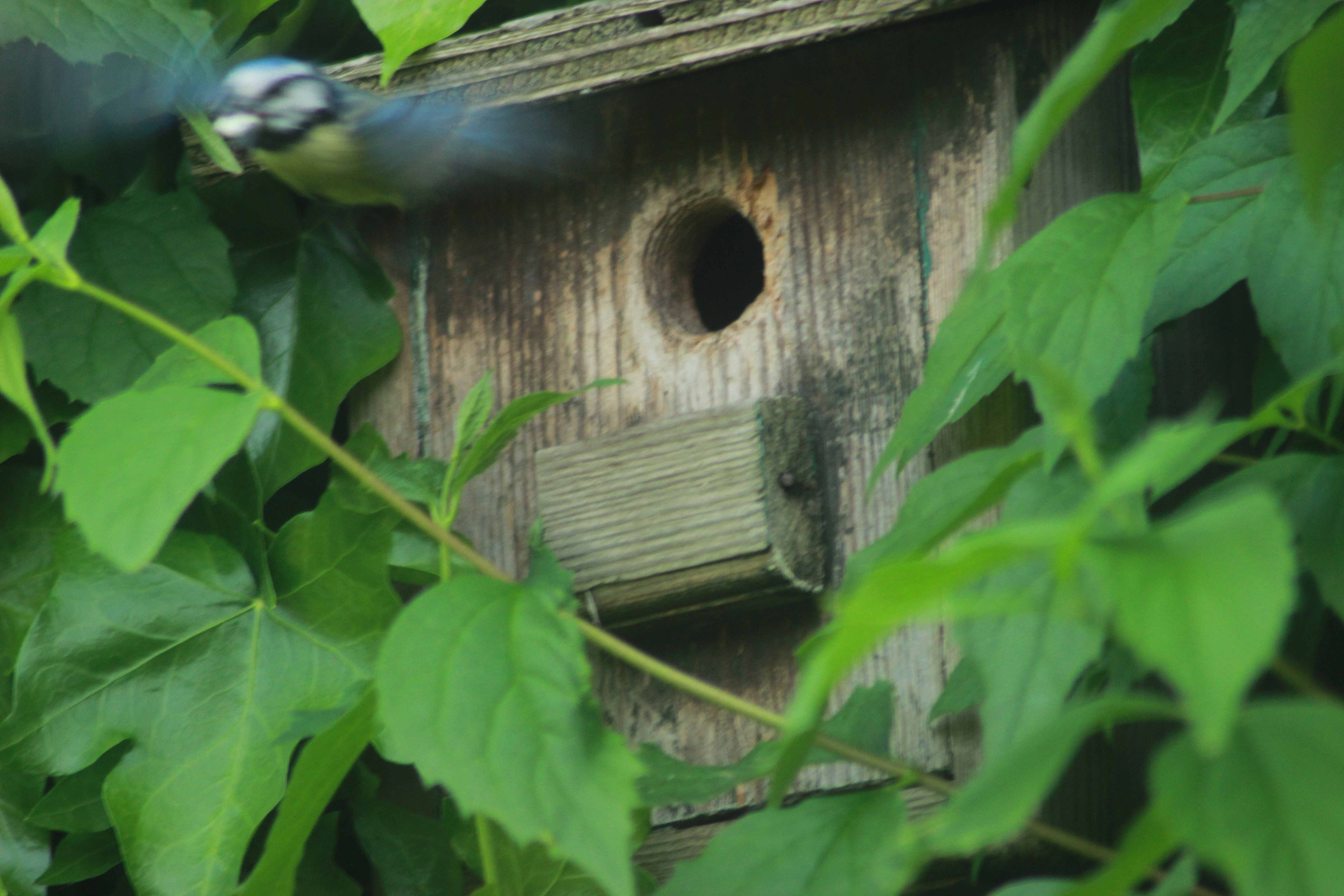
At home it was peaceful to sit in the garden and let nature take care of itself. I got out my camera for the first time since the start of the year and captured the blue tits coming and going from their nesting box.

blue tit feeding blue tit flying

The mason bees are behind bars after I found strange sticks poking out of the bug hotel. It was suggested on the UK Bees, Wasps and Ants Facebook Group that larger birds like magpies and crows might use sticks to poke out the bees. The cage seems to have deterred the birds, I’ve found no more strange sticks and the bees don’t mind it.

bees behind bars

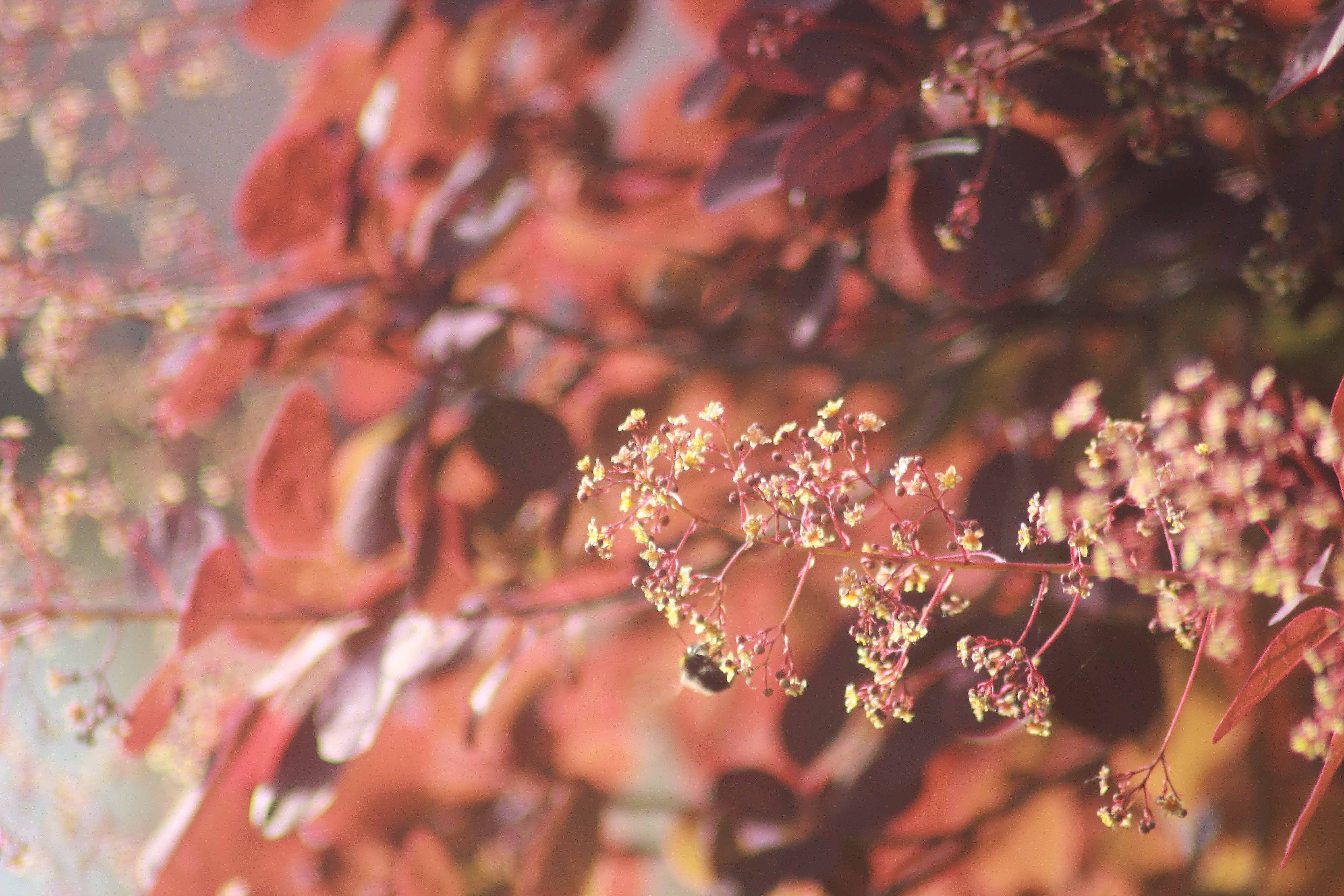
The red leafy tree is yielding delicate tiny flowers beloved by honeybees and bumble bees. I could just about see a fat fuzzy bumble hanging off foliage in the branches above.

bumble in sun

All is well in the hives and garden for May – long may it last. Tomorrow rain is forecast, let’s hope it passes soon.

My next post will be in two weeks’ time, while I catch up with all of yours!

Bees at the bottom of the garden

IMG_7214

The bees were in high spirits when I arrived. A group of beginner beekeepers had finished looking at David Pugh’s hive, and were floating about the apiary like drones.

I took my time in lighting the smoker and opening up the hive belonging to our queen Melissa. After a few weeks spent away for illness, and with Emily at her allotment bees this weekend, it felt like my first proper inspection for a while. I was surprised to find that I needed to steady my nerves before getting on.

A heavy super lifted out of the way and I was inside the nest. The workers were busy, the drones were buzzing loudly, and the queen was spotted on the third frame that I pulled out. I was glad to see that I hadn’t lost my queen-spotting skills, but as the buzzing got louder I imagined the queen hadn’t recognised me. “Who is she?” The bees were saying, “What is she doing looking here?”

IMG_7197

The beginners who had bought Chili’s and Chamomile’s colonies from Emily while I was away were asking questions. I really wasn’t much help, I’m afraid, as I was trying to focus my breath and my thoughts on what I was doing. They had found two queen cells with the old queen in the small colony, and were wondering what to do. I suggested that they could do an artificial swarm with the old queen if they were worried about the bees swarming (although the colony was small for a split), or wait till next week as more than likely the workers were trying to supersede the two-year-old queen, and as there were only two queen cells (unless they had missed more). The beginners had already decided to wait and see.

As the new beekeepers left, I finished inspecting the top brood box and then looked inside the bottom brood box for the two queen cells listed as found in our hive records two weekends ago. The cells were gone as I imagined they would be.

IMG_6830

The two queen cells were found on my first Saturday back inspecting the hives with Emily, and when the Bailey comb change was underway. I suspect that either a small swarm was missed in late April to early May, or that the bees were starting to make preparations to swarm that were thwarted by the late Bailey comb change. Perhaps with the queen being in the top brood box and a queen excluder beneath, the bees were unable to swarm away unless they starved her smaller. I doubt the bees were trying to supersede young Melissa who is laying nicely, but it’s just guesswork as I haven’t been able to do much with the bees this spring and I’m still catching up.

I closed up the hive as best as I could, but the weight of the heavy super felt the crunch of some bees beneath.

IMG_7361

Pepper’s hive was split during a beginners’ session last weekend. Interestingly that colony also was in the middle of a Bailey comb change with the queen found in the bottom box and the queen cells found in the top box. The top box was removed to make a new hive leaving the colony ‘artificially swarmed’ in a less than usual way.

Pepper’s bees can be feisty and, as they had already been split, and as I’m supposed to be taking things slowly for another few weeks, I stopped at one inspection hoping that the original colony wasn’t busy casting off.

IMG_7212

At the apiary table Andy Pedley, John Chapple and Alan Gibbs were talking about the record number of swarms reported in London this year. What could be causing this? The rise in ‘middle-class’ beekeepers as one newspaper reported, the surge in inexperienced beginners, or ailing beekeepers like myself failing to check for cast offs? Perhaps it was due to the changeable spring weather with spurts of warm sunshine taking bees and beekeepers by surprise? Or had there been a sudden surge in nectar, because the apiary bees were bringing home a wealth of stores? It could be all of the above, although the newspapers often don’t reflect the world of possibilities in beekeeping.

I left the apiary as Tom was leading Jochen to see the hives. I had more bees waiting for me at home, as well as fish and birds.

IMG_7278

We have bees at the bottom of the garden, which is something that I’ve dreamed about since I first started beekeeping. Our bees aren’t honeybees, they are red mason bees, I think!

The bug house that I planted beside the plot of earth, which will be next year’s vegetable patch, has taken up residents. The mason bees moved in a few weeks ago and have been so busy occupying each tube that they are now looking for more holes in the two sheds for homes. I’ll have to buy another bug house!

IMG_7279

It’s good to see Myrtle’s Palace so well used and I’m learning lots about my new bees, the solitaries, along the way. My early morning walks around the garden have revealed that red mason bees like to have a lie-in…

IMG_7321

And apparently the bees lose their red colour as they get older, becoming more yellow…

IMG_7394

I also learned one evening, after finding a few ants casually walking in and out, that bug hotels need some keeping too. A night spent reading how to care for a solitary bee home, including how to protect it from predators like ants, spiders and birds, had me awake early the next day to rebuild the stand higher up with a water tray ‘moat’ and Vaseline-smeared bricks. This seems to have done the job of deterring the ants for now.

IMG_7393

The fish at the top of the garden are doing well. They had a visit from two local garden and pond fish experts, Sylvia and Paul, who said the pond was doing just fine. Sylvia kindly brought some cuttings of a yellow flower from her pond to put into ours, because “it grows beautifully and the fish love it”.

IMG_7392

I was relieved to hear that I’d been feeding the fish and topping up the water levels correctly. The garden has buckets to collect rainwater to help top up the pond and I use Fresh Start when topping up with tap water, though Sylvia also reassured me that leaving a bucket of tap water to stand outside for a few days would make “the chlorine fly away”.

IMG_7277

The collected rainwater is also useful for feeding the Venus flytraps in our kitchen, one of which is now flowering.

IMG_7276

I discovered that we have a hidden well, which Sylvia and Paul thought had once been a frog pond. “Look out for frogs in the fish pond” they said when I told them about the frog spawn, “the frogs can strangle the fish if they start competing for space or want something to mate with!”

IMG_7330

A stroll around the middle of the garden and past the blue tits’ nesting box (I’ve not been fast enough to get a picture of the birds coming in and out) allowed Sylvia and Paul to helpfully point out weeds…

IMG_7391

…and give me some useful gardening advice, in particular how to control our rampaging bamboo and how to repair the Yorkshire stone paving. “Don’t throw it away or give it to me!” said Sylvia.

There is a world of discovery waiting for us in the garden, I wish that I had more time to spend there. I’m so grateful for Sylvia’s and Paul’s visit and for their generous advice. I’ve given them details of visiting our apiary in return.

IMG_7323

My next post will be in two weeks’ time bringing more stories from the hive and unlocking more secrets from the garden. Thank you for reading and have a wonderful week ahead.